Almanzor: The Man Who Dismantled the Caliphate From Inside
Almanzor ran Córdoba for 25 years without claiming the caliphate. Fifty-seven undefeated campaigns, the bells of Santiago, a purged library — and civil war.
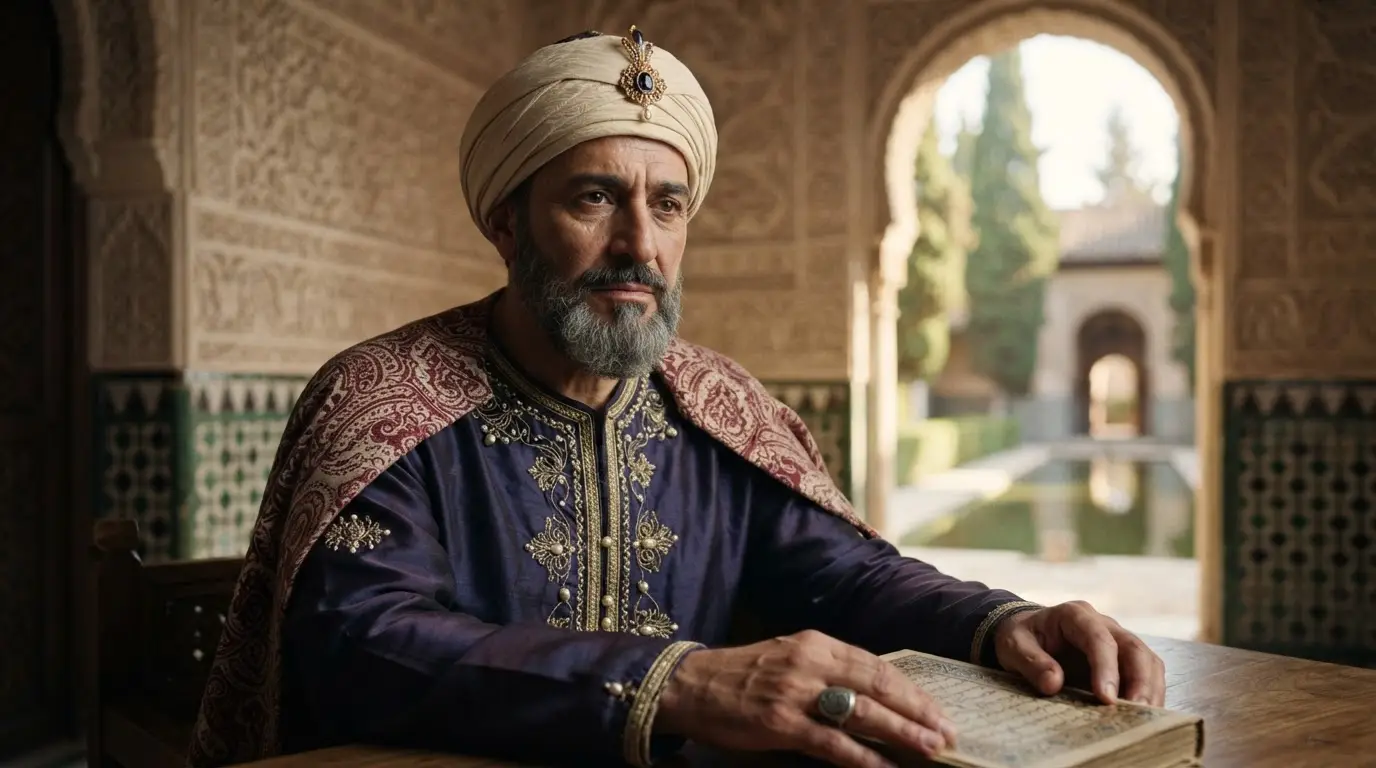
For a quarter century, the most powerful man in Córdoba was not the caliph. Almanzor — born Muhammad ibn Abi Amir around 938 near what is now Torrox, Málaga[1] — rose from penniless notary to effective ruler of al-Andalus without ever claiming the title he had made meaningless: he won 57 campaigns and lost none[1], burned the philosophy books to buy clerical support, and carried Santiago's church bells back on Christian prisoners' shoulders. The power structure he built on personal loyalty and paid mercenaries was so perfectly calibrated to one man that it collapsed within a decade of his death.
In this article
Jump to a section
⌄
The scrivener who became the state
Almanzor arrived in Córdoba in the 950s as a student from a minor Arab family. He had no money, no court connections, and no military rank. What he had was quick Arabic script and the patience to find work wherever it was offered.
His first recorded position was as a notary in the chancery of the Córdoba qadi: a legal clerk, drafting documents. From there he talked his way into the retinue of the royal household, and then into something that would change everything: access to Subh[2], the Basque slave-concubine who had become the mother of the heir apparent, the future Hisham II.
Subh (her name means dawn in Arabic) was among the most politically significant women in the caliphate. After the death of Caliph al-Hakam II in 976, her son inherited the throne at the age of roughly ten. Subh needed administrators she could trust. She trusted Ibn Abi Amir. He administered her personal finances, then her son's finances, then the state's finances[1]. That same year, the chief minister al-Mushafi ordered him to eliminate a rival claimant to the throne, the prince al-Mughira, the same man for whom Madinat al-Zahra's workshop had carved the Pyxis of al-Mughira eight years earlier. Almanzor carried out the killing — the first proof, to the regency he would later outmanoeuvre, of exactly how useful he could be.
By 978 CE he held the position of Hajib, the chamberlain: the highest administrative office in the caliphate, nominally the caliph's personal secretary but in practice the man who controlled access to the ruler and therefore controlled the ruler. At that point Hisham II was barely a teenager, kept largely in the palace at Medina Azahara with minimal contact with the outside world. The Hajib ran everything else.
The title Ibn Abi Amir gave himself later, al-Mansur billah (the Victorious by the grace of God), came after his victory at the Battle of Torrevicente in July 981[1], where he defeated Ghalib, his own father-in-law and a general who had briefly contested his rise. Ghalib died not long after, apparently of natural causes at around 80 rather than from any wound[1] — but the defeat itself was enough to end Ghalib's challenge and let Ibn Abi Amir claim the title outright. He named himself after a title only God could confer. The caliph remained on the throne, unseen and ceremonially intact. Everyone understood who governed Córdoba's Islamic history.
The puppet and the power
Hisham II never ruled in any meaningful sense. His reign (officially 976 to 1009, with one interruption) was a long institutional fiction maintained for the legitimacy it provided to others[1].
The Umayyad caliphs of Córdoba drew their authority from two sources: descent from the Prophet's tribe and the ceremonial apparatus of the caliphal court. Almanzor had neither. He could not claim the caliphate without destroying the very source of legitimacy that gave his authority its cover. So he kept Hisham on the throne, rarely seen and never heard, while systematically stripping the caliphal office of every real function.
57
Campaigns conducted by Almanzor between 977 and 1002, all won[1]. No Muslim commander in al-Andalus before or after him matched that record. The 48th, against Santiago de Compostela in 997, became the most famous and the most deliberately symbolic.
The treasury, the mint, and the army came under Almanzor's direct control[1]. He reorganised the tax system, redirected military appointments through his own household, and built a new administrative city east of Córdoba: Medina Alzahira, his personal seat of government, a deliberate counterpoint to the Umayyad caliphal palace-city 8 kilometres west of the city that had been the caliphal capital under Abd al-Rahman III and al-Hakam II[1].
The court moved to Almanzor's city. Petitioners came to Almanzor's city. Foreign embassies presented their credentials at Almanzor's city. Medina Azahara became, in effect, a gilded confinement for the nominal ruler of the state.
Subh, whose patronage had enabled all of this, eventually understood what she had helped create. the sultana who had first elevated him, then spent the 990s trying to bring him down — met her final defeat here. Around 996 she attempted to withdraw substantial funds from the treasury, an assertion of independent financial authority that implied she intended to act as a counterweight[2]. Almanzor moved quickly: she was confined and her political influence ended. She died around 999, isolated[2].
The Umayyad caliphate was intact in name. In practice, it had become a theatre set.
Fifty-seven campaigns, zero defeats
Between 977 and 1002, Almanzor conducted 57 military campaigns[1] into Christian territory. None ended in defeat. This was not luck or the weakness of opponents. It was the result of a military reorganisation that broke with the traditional structure of the Umayyad armed forces.
The old Andalusi army relied on tribal Arab and Berber contingents whose loyalty attached to clan leaders and ultimately to the Umayyad lineage. Almanzor replaced this with a professional paid army, recruited across ethnic lines: Berbers from North Africa, Galicians and Leonese taken as slaves and trained as soldiers, sub-Saharan African troops, and Slavic palace guards[1]. Pay, not tribe, was the bond. He could move them, dismiss them, and replace them without negotiating through clan hierarchies.
His campaigning tempo was relentless. He left Córdoba each spring and returned in autumn. The targets ranged from Barcelona (sacked in 985)[1] to León (sacked in 988)[1], the capital of the most powerful northern kingdom. León's royal archive was destroyed; its royal palace was razed. The city was empty when his army left. This was deliberate: Almanzor's campaigns were rarely about territory. They were about exhaustion, tribute, and the demonstration that no Christian city on the peninsula was beyond reach.
The Christian kingdoms, individually, could not match this. Navarre, León, and Castile fought separately, negotiated separately, and lost separately. Several northern rulers paid tribute. Some sent daughters to Almanzor's harem as diplomatic gestures. The campaigns kept the caliphal treasury full and kept Almanzor's Berber mercenaries employed and loyal, two problems solved simultaneously.
Recommended tours
Tours are selected for quality, not commission. We earn a small fee if you book — at no extra cost to you.
He also understood the propaganda value of the raids. Each return to Córdoba was a public event. Prisoners, livestock, and treasure arrived in columns through the city. Abd al-Rahman I had built the caliphate's legitimacy through dynasty and architecture. Almanzor built his through public military spectacle, the only kind available to a man who could not claim a throne.
The bells of Santiago
In the summer of 997, Almanzor launched his 48th campaign. He left Córdoba on 3 July[3] with a large army, moving northwest along routes his engineers had surveyed in advance.
The target was Santiago de Compostela: the shrine of St James, the most sacred site in Christian Iberia, a pilgrimage destination drawing worshippers from across Europe. Reaching it was a ten-week march each way through hostile territory the length of the peninsula.
His army reached Santiago on approximately 10 August[3]. The bishop and most of the population had fled. Almanzor gave explicit orders that the Apostle's tomb was not to be touched[4], either from a calculated desire to avoid martyrdom-generating destruction, or from something like genuine respect for a holy site. Everything else was burned: the city, the markets, the cathedral complex[3].
The bells of the cathedral (heavy bronze objects, symbols of Christian worship and the call to prayer that Islam explicitly did not use) were taken down and loaded for the march back south[4]. Almanzor ordered them carried on the shoulders of Christian prisoners, walking the length of the peninsula as living trophies. What happened to the bells once they reached Córdoba is where documented history gives way to legend: the enduring story has them melted down and recast as oil lamps for the Mezquita, but no Muslim source from the period confirms this, and historians treat it as a later Christian tradition rather than an established fact[4]. What is documented is the bells' removal and the prisoners' march south; the lamps are the part of the story nobody at the time wrote down.
The reversal, as the legend has it, came 239 years later. When Fernando III of Castilecaptured Córdoba in 1236, later tradition holds he found lamps said to be made from Santiago's bells still hanging in the mosque, had them dismounted, and carried back to Santiago de Compostela on the shoulders of Muslim prisoners[4] — the precise inversion of Almanzor's procession, deliberately choreographed, if the underlying bells-into-lamps story is taken at face value.
One act is documented, the other is legend, and both were theatre either way. What made the Santiago campaign extraordinary was not just the reach of it (no Muslim army had been to Galicia in generations) but the completeness of the symbolic package: the march, the tomb spared, the bells taken, the lamps the story says were made, retold for centuries on both sides.
What he built — and what he burned
Almanzor's relationship to Córdoba's physical fabric was complicated.
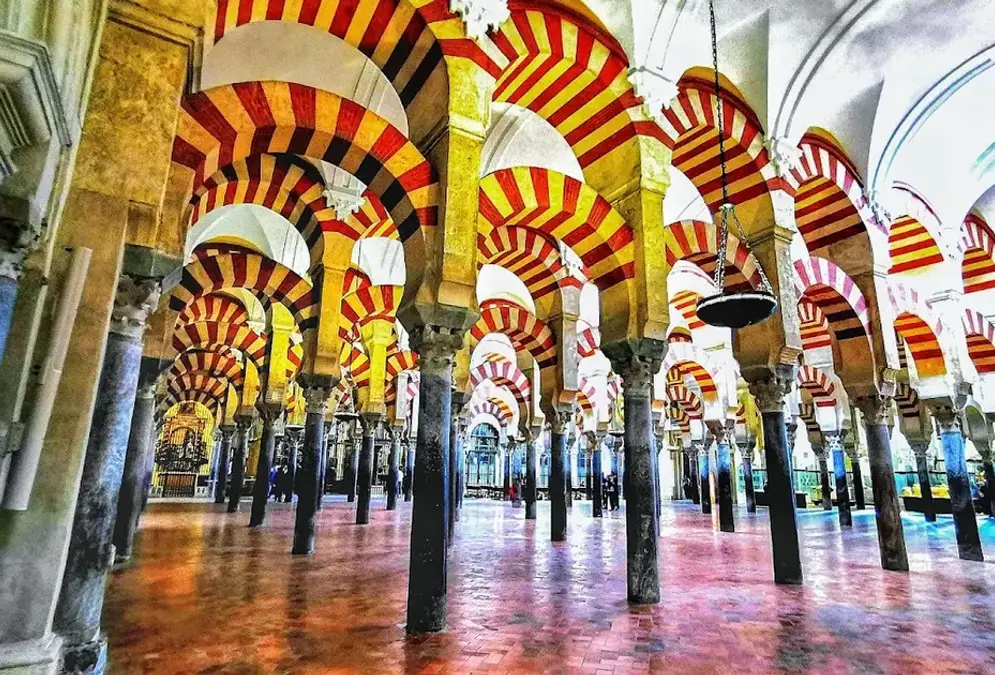
On one side: the Mezquita expansion of 987[5], the largest single addition to the mosque in its history. Eight new naves added to the eastern side essentially doubled the prayer hall's capacity. The expansion meant demolishing part of the perimeter wall and building outward, which disrupted the mosque's original orientation toward Mecca but delivered an interior of 856 columns[5]. The columns Almanzor added are still there. They are the section you enter through on the eastern face, the columns with the slightly more mechanical spacing that tells you they were built under a different kind of patron: not a scholar-caliph commissioning art, but an administrator commissioning capacity. You can see the join, if you know where to look.
On the other side: Medina Alzahira, his palace-city east of Córdoba[1]. Where Medina Azahara was Abd al-Rahman III's statement of caliphal legitimacy, built to awe foreign ambassadors with marble and water, Medina Alzahira was Almanzor's statement of personal power. The city was reportedly built in record time, with materials stripped from other projects. Nothing of it survives above ground. It was demolished during the Fitna (civil war) around 1013[1], its dressed stone reused or burned for lime. Archaeological surveys have located its probable footprint east of the modern city, but the site is not open to visitors.
Then the library. In 978, early in his Hajib years, Almanzor ordered a purge of the library assembled by al-Hakam II[6]. Al-Hakam had spent his reign acquiring books on philosophy, logic, astronomy, and Greek science: a collection of 400,000 volumes[6] described by contemporaries as the largest in the western world. Almanzor had the philosophy and logic sections burned to satisfy conservative clerics who considered them a threat to religious orthodoxy[6].
The contrast is blunt. Al-Hakam II had extended caliphal authority through knowledge; Almanzor burned part of that knowledge to buy political support from the ulema. It was a successful transaction in the short term. The clerics gave him their legitimacy. The books did not come back.
What remained of the collection was eventually scattered during the Fitna. Some manuscripts survived in private libraries across al-Andalus. Some found their way to Toledo, where they became part of the 12th-century translation movement that returned Aristotle and Galen to European thought in Latin. The loss was real; the transmission was partial.
The seeds of collapse
Almanzor's power had one structural flaw: it was entirely personal.
The Umayyad caliphs ruled through dynastic legitimacy, religious authority, and a court culture that had accumulated for generations. Their power was institutional. Almanzor's power was personal loyalty, paid mercenaries, and the continued willingness of a captive caliph to sign documents. None of these could be inherited in the way a dynasty can be inherited.
He tried anyway. His son Abd al-Malik al-Muzaffar succeeded him as Hajib in 1002 and governed competently for six years, holding the structure together through force of personality and the remaining loyalty of his father's army. His younger son, Abd al-Rahman Sanchuelo (whose mother was a Navarrese princess, which tells you something about the ethnic mixing in Almanzor's household), was less able. Sanchuelo made the error of formally demanding the right of succession to the caliphate itself in 1009[1], dropping the fiction that had kept the arrangement coherent. The Umayyad family revolted. Hisham II was deposed. The Fitna (the civil war) began and ran for nearly twenty years, ending with the caliphate dissolved and al-Andalus fragmented into the taifa kingdoms[1].
Almanzor himself died on 8 August 1002 at Medinaceli[1], returning from his 57th campaign. He had been ill for some time; the march had worsened it. He was approximately 63 years old.
Timeline
c. 938
Born in Turrush (modern Torrox, near Málaga province)[1] into a minor Arab family claiming descent from a Companion of the Prophet.
c. 967
Enters the service of Subh, the Basque concubine and mother of the future Hisham II, as financial administrator[2].
976
Al-Hakam II dies. Hisham II accedes as a child. Ibn Abi Amir takes effective control of the administration[1].
978
Appointed Hajib (chamberlain). Orders the burning of philosophy and logic books from al-Hakam II's library[6].
981
Defeats his father-in-law Ghalib at the Battle of Torrevicente; Ghalib dies soon after, reportedly of natural causes. Adopts the title al-Mansur billah[1].
Completes the eastern expansion of the Mezquita: eight new naves, the largest single addition in the mosque's history[5].
988
Sacks León, destroying the royal palace and archive[1].
997
48th campaign: sacks Santiago de Compostela (3 July–October)[3]. Cathedral bells carried back to Córdoba on prisoners' shoulders; tradition (unconfirmed by Muslim sources) says they were recast as Mezquita lamps[4].
1002
Dies 8 August at Medinaceli[1] returning from his 57th campaign. His son Abd al-Malik inherits the Hajib position.
c. 1013
Medina Alzahira demolished during the Fitna[1]. The caliphate dissolves into taifa kingdoms.
The Battle of Calatañazor is a story found in Christian chronicles, claiming a great defeat near Soria shortly before his death, from which he retreated mortally wounded. It is not attested in any Muslim source[7]. The Christians needed their own explanation for his death; a battle where God finally struck down the destroyer of Santiago made narrative sense. It almost certainly did not happen. Almanzor died of illness, not of wounds, on a routine return march from a routine victory.
His body was buried at Medinaceli. A well-known tradition holds that the earth from his campaigns, shaken from his clothes after each battle and carefully preserved, was buried with him at his instruction — a legend rather than a documented contemporary record, but one that fits how completely his identity had fused with the campaigns themselves.
Almanzor left less physical trace in Córdoba than his importance suggests. The city he built, Medina Alzahira, was erased. His administrative records were dispersed. What remains is structural rather than monumental.
The eastern section of the Mezquita is his most tangible legacy in the city[5]. The eight naves he added in 987 are visually distinguishable from the earlier additions by al-Hakam II and Abd al-Rahman I: the proportions are slightly different, the columns less varied in their marble sources, the carved capitals less individual. It is the work of a builder prioritising scale over beauty, which is about right for the man.
Almanzor's reputation in later centuries split cleanly along religious lines. Christian chronicles remembered him as a scourge, a destroyer of cities, a near-supernatural threat to the faith. Muslim Andalusi historians remembered him with a complicated mixture of admiration for the military record and discomfort at the illegitimacy of his position. Neither reading is wrong, exactly. He was a military administrator of extraordinary effectiveness who kept a dying political structure running through personal force long past its natural end. When the force ended, so did the structure.
Frequently asked questions
Who was Almanzor and why is he important to Córdoba?
Almanzor (full name Muhammad ibn Abi Amir, titled al-Mansur billah) was the Hajib — chamberlain — of the Córdoba Caliphate from 978 to 1002. He never took the caliphal title but effectively governed al-Andalus throughout that period, keeping the child caliph Hisham II as a ceremonial figurehead. He conducted 57 military campaigns against Christian kingdoms and won all of them, sacking Barcelona, León, and Santiago de Compostela. His 987 expansion of the Mezquita remains the largest single addition in the mosque's history. After his death, the political structure he had built on personal loyalty collapsed within a decade, triggering the civil war that ended the Córdoba Caliphate.
Did Almanzor really sack Santiago de Compostela?
Yes. Almanzor's 48th campaign in 997 reached Santiago de Compostela. He left Córdoba on 3 July, arrived in Santiago around 10 August, and burned the city for several days. He gave explicit orders sparing the tomb of the Apostle James. The cathedral bells were removed and carried back to Córdoba on the shoulders of Christian prisoners. Tradition holds they were melted down and recast as oil lamps for the Mezquita, though no Muslim source from the period confirms this and historians treat it as a later Christian legend rather than documented fact. According to that same tradition, Fernando III reversed it in 1236 when he captured Córdoba, having the lamps carried back to Santiago on Muslim prisoners' shoulders.
What is the Battle of Calatañazor and did it actually happen?
The Battle of Calatañazor is a story in Christian chronicles claiming Almanzor suffered a decisive defeat near Soria shortly before his death in 1002, from which he retreated fatally wounded. No Muslim source mentions such a battle. Historical consensus treats it as a Christian legend constructed to explain Almanzor's death in terms that gave the Christian kingdoms credit for ending the threat. Almanzor died of illness at Medinaceli on 8 August 1002, returning from his 57th campaign.
Can you see Almanzor's additions to the Mezquita in Córdoba?
Yes. The eastern section of the Mezquita, comprising eight naves added in 987, is Almanzor's work and the largest single expansion in the mosque's history. It is physically integrated into the overall building and accessible as part of a normal visit. Visitors who know where to look can spot the join between al-Hakam II's earlier additions and Almanzor's section by differences in column spacing and capital carving. There is no separate ticket or dedicated tour for this section; it is part of the standard Mezquita visit.
Where is Medina Alzahira and can you visit it?
Medina Alzahira was Almanzor's personal palace-city, built east of Córdoba as a rival administrative centre to the Umayyad palace of Medina Azahara. It was demolished during the Fitna civil war around 1013, and nothing survives above ground. Archaeological surveys have identified its probable location in the eastern suburbs of modern Córdoba, but the site has no public access or visitor infrastructure. It is not the same as Medina Azahara, which is open to visitors 8 kilometres west of the city centre.