
A prince's gift carved from a single elephant tusk
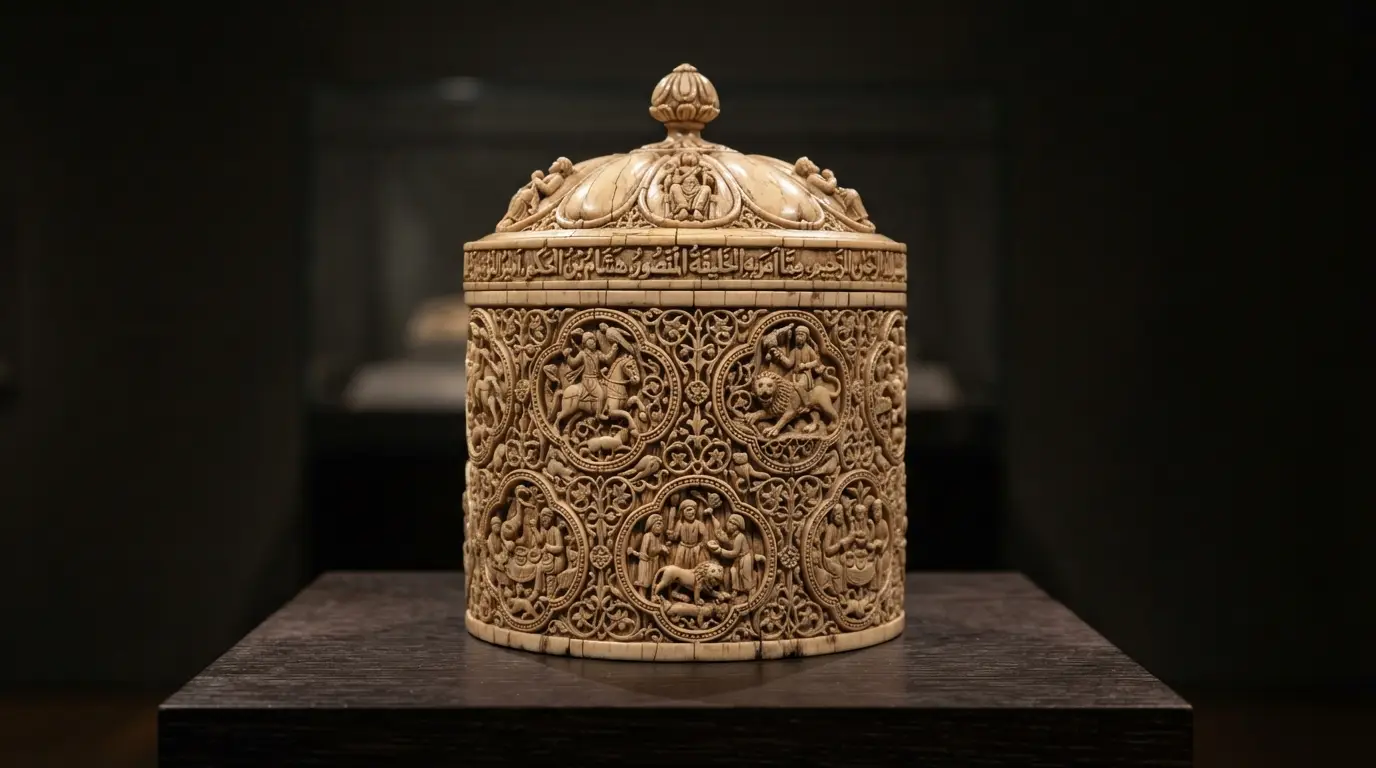
In 968 CE, artisans in the royal workshops of Madinat al-Zahra, the fortified palace-city Abd al-Rahman III built a few kilometres outside Córdoba, carved a lidded box from a single piece of elephant ivory, imported by the caliph's court from North Africa[1]. The date is carved into the object itself, in Kufic script naming the Hijri year 357, and the Louvre's own catalogue confirms both the date and the Madinat al-Zahra workshop[2].
The pyxis (from the Greek word for a small box) stands 18 centimetres tall, with an outer diameter of 11.8 centimetres and walls carved down to just 0.4 centimetres thick[3]. In places the ivory is worked to a thickness of only three millimetres, thin enough that light passes straight through it, so the carved medallions glow when held to a lamp or a window[4]. That is not incidental decoration. Whoever carved this piece wanted the surface to do something no flat painted panel could: change with the light.
3 mm
The lid carries a dedication in Kufic script, wrapped around its base: "Blessing from God, goodwill, happiness and prosperity to al-Mughira, son of the Commander of the Faithful, may God's mercy be upon him, made in the year 357."[5] The recipient was Abu al-Mutarrif al-Mughira, the youngest son of caliph Abd al-Rahman III, born to a concubine named Mushtaq[6]. Most scholars read the object as a coming-of-age gift, commissioned for al-Mughira around the time he reached adulthood[7] — though, as a later section covers, not every historian agrees.
The workshop itself was not a craft studio in the modern sense. Madinat al-Zahra, the palace-city Abd al-Rahman III began building in 936 to house the machinery of the Umayyad Caliphate he had just declared, kept a dedicated ivory-carving atelier, sometimes called the dar al-sina'a (the house of craft), producing luxury objects exclusively for the ruling family. A pyxis like this one did not circulate in a market: it moved from one hand to another inside the family that ran the caliphate. The guide to caliphal crafts of Córdoba traces how this same court economy of leather, silver and ivory work took shape.
Reading the box right to left: four medallions of power
The pyxis's decoration runs around its body in four eight-lobed medallions, separated by spandrels of interlacing vegetal ornament. Read in isolation, each is an appealing genre scene: musicians, riders, falconers, animals. Read in sequence, right to left, they form a chronological argument art historians have spent decades decoding[8].
Medallion One shows a court scene: two seated figures flank a smaller central figure, read as a servant on account of his diminished scale. One of the seated pair holds a braided sceptre and flask, the ceremonial regalia of the Umayyads; the other holds a fan[9]. It is a throne-room scene, not a hunting scene; the object announces its political register from the first panel.
Explore nearby · Monument
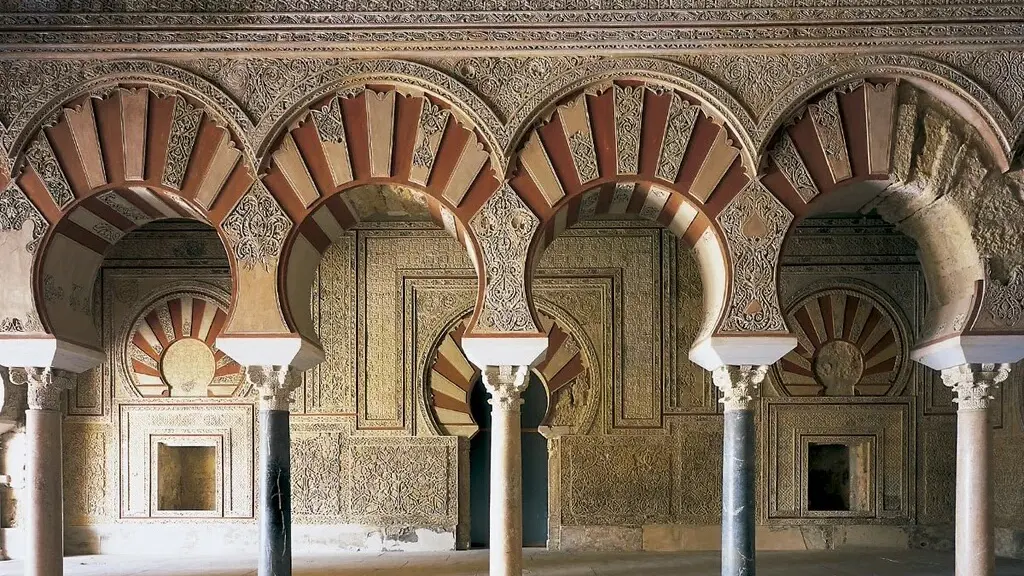
Medina Azahara
Medina Azahara is Córdoba's UNESCO listed Caliphate City: a 10th century palace 8 km from town, with the Salón Rico and award-winning museum. Plan your visit.
Medallion Two shows two horsemen picking dates from a palm tree. Date palms belong to the Middle East and North Africa, not to al-Andalus, and several readings connect the scene to the Umayyads' lost eastern homeland, the territory the family had ruled from Damascus before the Abbasid revolution of 750 drove the last Umayyad prince into exile in Spain[10]. A fruit-harvesting scene, on this reading, is a memory of dispossession.
Medallion Three shows two men robbing eggs from falcon nests, a scene widely read as a coded reference to Umayyad legitimacy itself. The Abbasid caliph who deposed the family in the east is said to have nicknamed the dynasty's founder in al-Andalus, Abd al-Rahman I, "the falcon of the Quraysh"[11]. A century and a half later, a box carved for a caliph's son still carries that epithet as its central image.
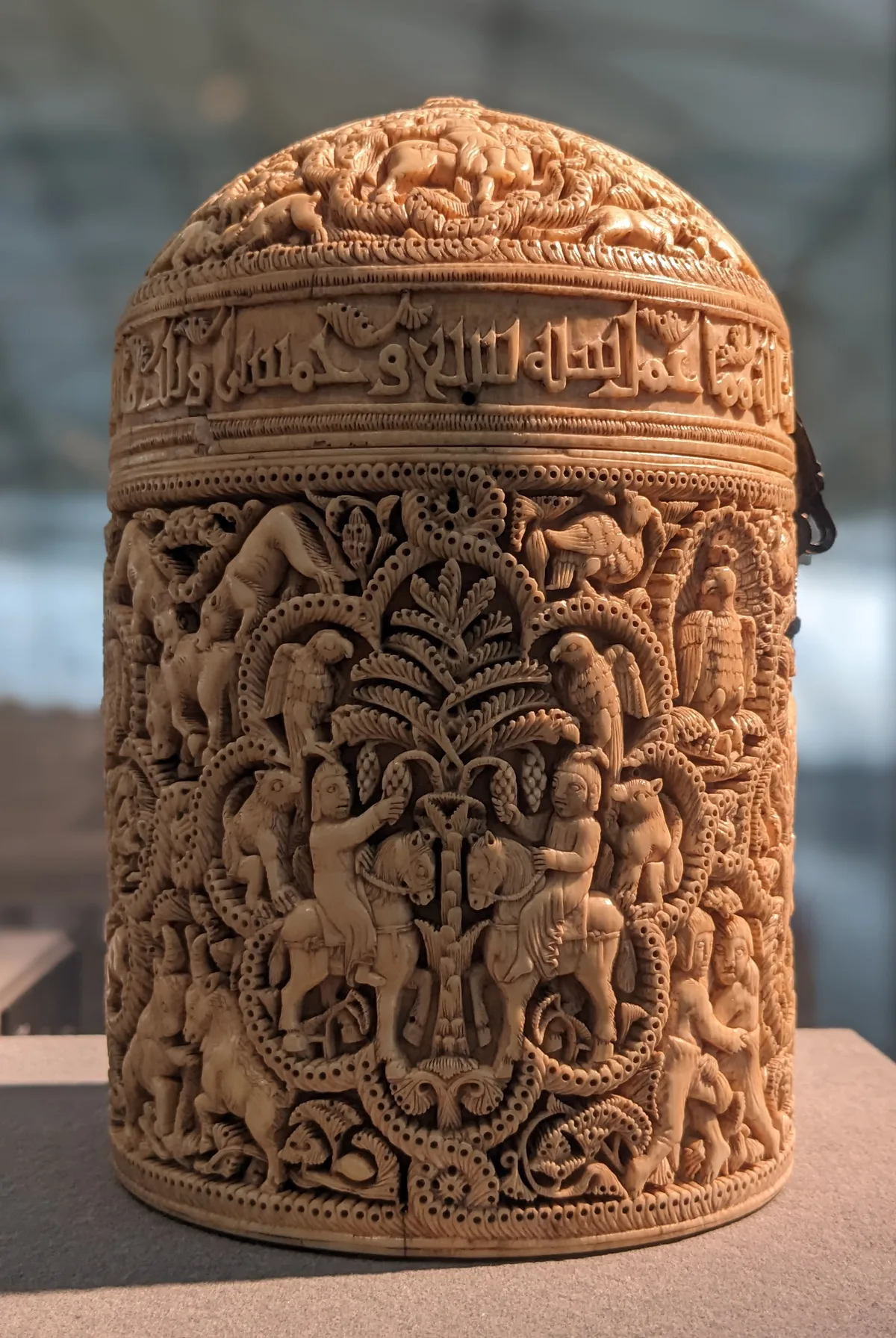
The four eight-lobed medallions and the domed lid of the Pyxis of al-Mughira, with the Kufic dedication band carved around the base. Photo: Shonagon via Wikimedia Commons (CC0). Musée du Louvre, OA 4068.
Medallion Four, the last panel read right to left, shows a lion mauling a bull. Louvre curators and the art historian Eva Baer have both read it as the most direct image on the box: a statement of Umayyad authority set against the rival Abbasid caliphs ruling from Baghdad[12]. It was carved to make an argument about who held legitimate power, one that, within a generation, would be tested by exactly the succession dispute the box's imagery seems to anticipate.
The succession crisis the ivory anticipated
Abd al-Rahman III died in 961 and was succeeded by his son al-Hakam II, whose sixteen-year reign built Córdoba's reputation as a centre of Mediterranean scholarship. He died in 976 without a settled succession beyond his ten-year-old son[13].
That son, Hisham II, became caliph at ten years old, a minor, by every account, unfit to rule in his own right[13]. A faction inside the Umayyad court tried to bypass him entirely. Their candidate was al-Mughira: the same prince, now grown, the pyxis had been carved for eight years earlier.
The plot to bypass the boy caliph
The court's chief minister, al-Mushafi, the hajib, or chief chamberlain, blocked the plan, backed by the regent Subh and by Berber troops loyal to the young caliph. Rather than risk al-Mughira becoming a rallying point for a rival succession, al-Mushafi ordered a rising military commander to eliminate him. That commander was Almanzor — reluctant or not, he carried out the order. Al-Mughira was killed in 976, the same year Hisham II took the throne[14].
It is worth being precise about what can and cannot be said here. The sources agree on the political mechanics: a faction tried to install al-Mughira, the regency crushed the attempt, and Almanzor killed him on al-Mushafi's order[14]. Colourful details about the manner of his death circulate in popular retellings but do not trace back to a citable primary account, so they are left out here.
Almanzor's rise and the fitna that followed
The killing did not stabilise anything for long. Having removed his rival, Almanzor moved to sideline the men who had ordered him to do it, and by 981 he had made himself the caliphate's de facto ruler, controlling the hijaba, the regency office, until his own death in 1002[15]. Hisham II reigned as a figurehead for three more decades.
Then, in February 1009, a rival branch of the Umayyad family under Muhammad II al-Mahdi seized Córdoba and took Hisham II hostage, opening the fitna — the civil war that fragmented the caliphate into dozens of competing taifa kingdoms within twenty years[16]. Read against that timeline, the pyxis of al-Mughira looks less like a lucky survival than a fossil of the exact fault line that broke the caliphate: a box carved to argue for Umayyad legitimacy against an external rival ended up belonging to the one Umayyad prince his own family had killed over an internal succession dispute.
Whose gift was it, and what was it for
No one has found a stain, a residue, or a trace of anything inside the pyxis. Whatever it once held, jewellery, perfume, cosmetics, the small precious things pyxides typically stored, left no physical evidence, so its practical use is, strictly speaking, unknown[17].
That gap has produced real scholarly disagreement, not a settled answer papered over for tidiness. The art historian Sophie Makariou reads it as a coming-of-age gift, commissioned through the court for a prince entering adulthood. Glaire D. Anderson has argued against that reading on a technical point: al-Mughira was around eighteen when the pyxis was made, several years past the customary coming-of-age window of thirteen or fourteen, which would make it a gift from his mother Mushtaq rather than a formal court presentation. Renata Holod has floated a third, more unsettling possibility: that the gift carried an ironic edge, a message to a prince everyone already understood would never rule.
None of these readings is provable from the object alone, and each says something different about what the caliphal court thought of the boy this box was made for. A coming-of-age present assumes affection and expectation. A mother's private gift assumes tenderness outside the machinery of politics. An ironic gift assumes the court already knew, in 968, what would happen to al-Mughira in 976.
Recommended tours
Tours are selected for quality, not commission. We earn a small fee if you book — at no extra cost to you.

From Madinat al-Zahra to the Louvre, and how to see the world it came from
The pyxis left Córdoba long before its current owners. By the time French collectors were acquiring Andalusian ivories in the nineteenth century, it belonged to Juan Facundo Riaño, a Spanish art historian; the Louvre purchased it from the dealer Stanislas Baron in 1898[18]. It has been part of the Louvre's Islamic art department ever since.
It is not always in Paris. Since October 2024 the pyxis has been on an exceptional loan to Louvre Abu Dhabi, where it holds its own dedicated gallery, lit by a near-180-degree projection screen and an oud soundscape, a display treatment normally reserved for the museum's most photographed objects. The loan is scheduled to run until July 2027[19].
None of that helps a visitor standing in Córdoba today, where the pyxis has never been displayed. What the city does have is the place that made it. Madinat al-Zahra, the ruined palace-city where the ivory workshop once operated, sits eight kilometres west of Córdoba's centre and is now a UNESCO World Heritage Site with its own on-site museum. Nothing on display there is the pyxis itself, but the excavated reception halls, the fragments of decorative stonework, and the sheer scale of the palace complex Abd al-Rahman III built to project Umayyad power are the physical context the object came out of. Anyone deciding whether to make the trip can weigh it against the practical Medina Azahara visitor's guide.
Deep dive · Article
An Andalusian Treasure Has Sat in the British Museum Since 1932
A silver hoard dug up in Córdoba in 1915 left Spain against the law and has been in the British Museum since 1932. Here is how, and what a 2026 study found.
A half-day guided excursion to Madinat al-Zahra is the closest a visitor gets to standing where the pyxis was carved. For the fuller story of the palace-city itself, including why it was built, why it was abandoned within a century, and what survives today, see Medina Azahara: the lost palace city.