
A hole dug for an oil jar
Three hundred coins, a torc and a bowl
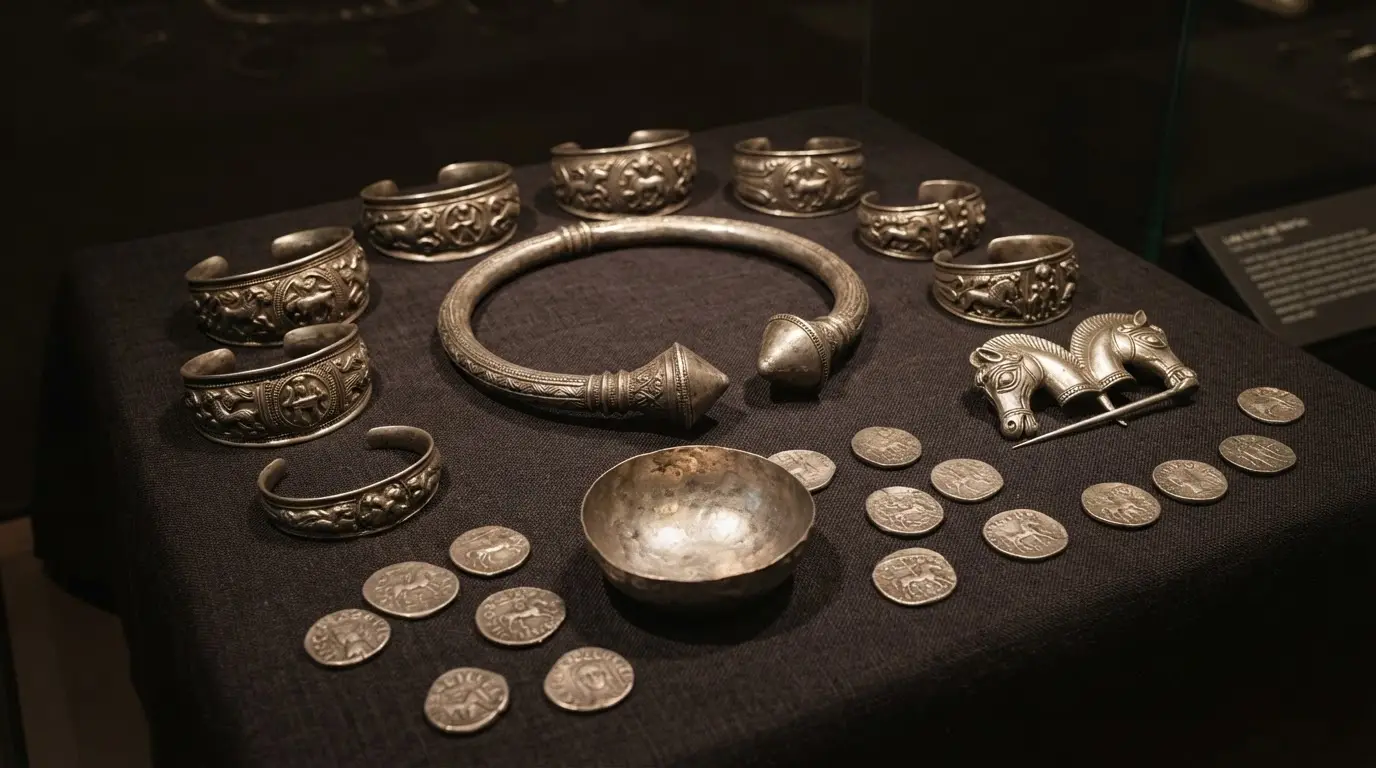
The jewellery is the showpiece: a large torc, eight armlets and a brooch in the shape of two horses' heads.[8] Coins make up most of the count: over three hundred, of which 82 were locally made and 222 minted in a Roman city.[9]
The coins date it, and the hoard was probably buried about 100 BC.[10] Roman coins outnumber local ones by nearly three to one, though other studies do not count them the same way.
The jewellery points somewhere else. Rome had only just taken this corner of Spain, yet the pieces are still made in a Celtic manner.[11]
What the hoard was for is unsettled. Hildburgh, who published it in 1922, took it for silver gathered by a jeweller with melting in mind;[12] similar finds elsewhere have been read as votive deposits in cult places.[13]
Explore nearby · Museum
Museo Arqueológico de Córdoba
33,500 pieces in a Renaissance palace built over a Roman theatre: mosaics, Iberian sculpture, Caliphal ceramics. Free for EU citizens. Closed Mondays.
The valley's earlier military history is its own story, told in our piece on a possible Punic War elephant bone.
How it left Spain
The Córdoba Treasure is one of the few Iron Age hoards from the Iberian Peninsula held by a museum outside Spain or Portugal.[14] How it got there is the uncomfortable part. Bugella Altamirano's 2016 study concludes that its "exportation and subsequent sale was made breaching the legislation" of the first decades of the twentieth century.[4]
Spain was not indifferent at the time. The treasure became a matter for Córdoba's Provincial Monuments Commission from 1929,[15] three years before the museum bought it.[3]
The seller, Walter L. Hildburgh, sold or gave the museum more than a thousand pieces.[16] The museum's own biographical note adds that he became an international-level figure-skater and swimmer and judged at the 1931 World Figure Skating Championship.[17]
The sources used here do not say what happened between the hole in the ground and Hildburgh's hands, or what the museum paid. Nor do they discuss any return to Spain. The finding concerns the law of the early twentieth century, not a ruling on who should hold the silver today.
The signs on the bowl
The newest chapter is a small one. A 2026 paper in the journal Veleia reported Iberian signs on the treasure's silver bowl. No earlier literature on the bowl or the hoard had mentioned them.[18]
One mark sits on the base of the vessel, and Eugenio Luján recognised it as the Iberian sign ko.[19] The paper reads several of the signs as Iberian graphemes.[20] The bowl is 139.7 mm across, 87.1 mm high and weighs 231 g,[21] a small object to have carried unnoticed writing through a century of study since the 1922 publication.
What the marks mean is not answered in the sources, and a sign on a base is not a sentence. But it moves a hoard long filed under Celtic-style jewellery and Roman coins toward a third voice, a local script. It was buried about 100 BC; the siege of Corduba under Caesar, the city's best-documented crisis, was still decades off.
Seeing it, and what to do in Córdoba
The treasure is in London, not Córdoba.
In Córdoba the hoard itself is not the draw, because the museum bought it in 1932 and has kept it since.[3] The nearest thing to its world is the Archaeological Museum of Córdoba, the city's own home for archaeological finds, where the pre-Roman and Roman layers of the place can be read in local material.
Deep dive · Article
Ibn Hazm's Ring of the Dove: Córdoba's Love Treatise
Ibn Hazm's Ring of the Dove (1022 CE) is the medieval Arab world's most searching analysis of love and one of the most readable books to survive Al-Andalus.
Recommended tours
Tours are selected for quality, not commission. We earn a small fee if you book — at no extra cost to you.
The hole for the oil jar is now a library, the silver is in London, and the bowl's marks went unrecorded for a century. The open question is the one the bowl poses: what else in a century-old catalogue is waiting for someone to look at the base?