The Siege of Corduba: How Caesar Punished the City
After Munda in 45 BC, Julius Caesar besieged Roman Corduba, executed the garrison of armed slaves, and forced Pompey's capital to pay a heavy indemnity.
Art history background with eight years writing interpretive content on Córdoba's Caliphal heritage.
Published
history-buffsarchitecturephotographers
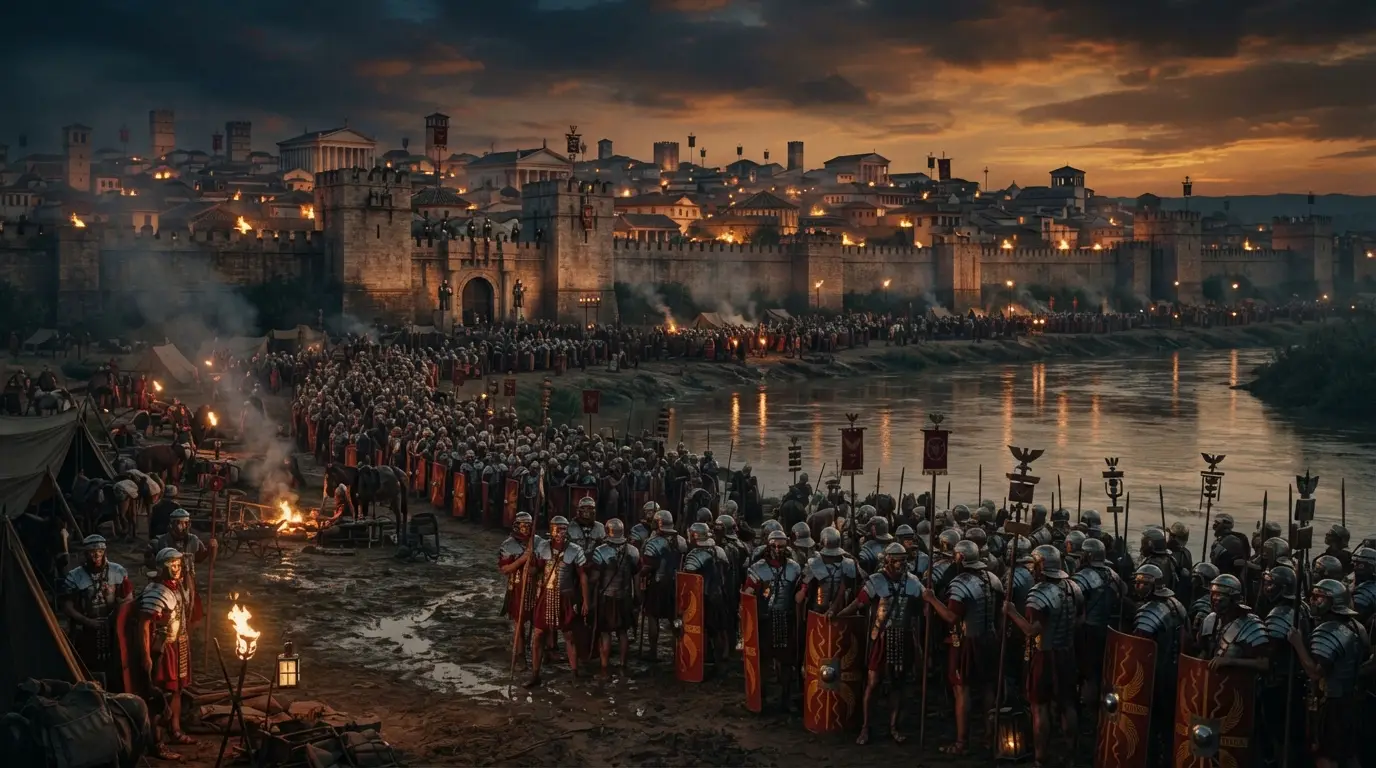
Three days after his narrow victory at Munda in March 45 BC, Julius Caesar arrived outside the walls of Corduba, capital of the Roman province of Hispania Ulterior, a city that had just spent months as the operational headquarters of the losing side. What followed was one of the few episodes in which Caesar's army slipped beyond his control: a short siege, a surrender, and a punishment so severe that Cassius Dio records it in language normally reserved for foreign conquests. The indemnity Caesar extracted would reshape the city's Roman identity for the next four centuries.
Siege of Corduba
45 BC
Caesar arrived on 19 or 20 March, three days after the Battle of Munda[1]
Reported dead
22,000
The contested storming tradition claims casualties on this scale[2]
Indemnity imposed
Heavy
Armed slaves executed, the rest sold; tribute so rigorous it touched temple treasure[3]
In this article
Jump to a section
⌄
Why Corduba mattered in 45 BC
Corduba was not one city among many. It was the capital of Hispania Ulterior, a province that supplied Rome with grain, olive oil, and silver[4]. By the late Republic, the city had a Roman forum, a bridge across the Guadalquivir, then called the Betis, and a population large enough to make holding it a political statement. When Gnaeus Pompeius and his younger brother Sextus chose Corduba as their base in the winter of 46–45 BC, they were not picking a remote fortress. They were occupying the administrative heart of Roman Spain.
The civil war between Julius Caesar and the Optimates (the senatorial faction loyal to the memory of Pompey the Great) had been running for four years. Pharsalus in 48 BC had killed Pompey himself. Thapsus in 46 BC had finished off most of the senatorial opposition in North Africa. By early 45 BC, the only armed conservative force left in the Roman world was the army Gnaeus and Sextus Pompeius had assembled in southern Spain. At its core were thirteen legions, the remnants of every Optimate army that had survived the previous battles[5].
Corduba was the headquarters. The Pompeian brothers had spent the winter reinforcing the city, provisioning it, and using it as the anchor for a defensive strategy built on a line of fortified towns: Ategua, Ucubi (modern Espejo, south-east of Córdoba), and Munda itself[5]. When Caesar marched into Hispania Ulterior in late 46 BC, he understood that taking Munda was the military objective, but capturing Corduba was the political one.
This is also the moment to draw a sharp line between two events that share a city but nothing else. The siege of Córdoba in 1236, Ferdinand III's Reconquista conquest of the Moorish city, occurred more than twelve centuries later in a different city, a different war, and a different world. That siege turned on Almogávar infiltrators, truce-breaking, and the collapse of the Almohad Caliphate. This one turned on legionaries, civil war, and a dictator's need to make an example of a province that had chosen the wrong side.
The defenders: Sextus Pompeius and the garrison
Gnaeus Pompeius had placed his younger brother Sextus in charge of Corduba before the campaign season opened. It was a command heavier than his age (Sextus was barely twenty), but the logic was sound. Corduba held the Pompeian treasury, the supply lines north toward the Sierra Morena, and a garrison that would prevent Caesar's legates from severing communications between Munda and the interior. Caesar himself noted that Corduba was "defended by Sextus Pompeius and a strong garrison[6]."
The garrison was substantial. Ancient sources do not give a precise order of battle for the city alone, but when the Pompeian field army marched out to meet Caesar at Munda, the force remaining in Corduba numbered around 20,000 men[7]. Many of these were not regular legionaries. In the desperate final months of the war, Gnaeus Pompeius had extended freedom to slaves and enrolled them as combatants, a measure that gave him numbers but created a force with no veteran core, limited training, and no stake in the senatorial cause beyond the freedom they had just received.
The figure of 20,000 includes both the regular garrison and these newly freed slaves.[7]
Cassius Dio's account makes clear who fought and who did not when the crisis came: the regular troops and the native Cordubans would choose one path, the armed slaves another.
Corduba's position on the northern bank of the Betis gave its defenders one concrete advantage. The Roman bridge of Córdoba was the only crossing for miles in either direction. Controlling the bridge meant controlling access to the city from the south, where Caesar's legates were encamped at Obulco (Porcuna), roughly 35 Roman miles (about 56 kilometres) east of Corduba[4]. A garrison that held the bridge and the city walls could make the crossing expensive.
The three-day siege
Caesar arrived outside Corduba on 19 or 20 March 45 BC. The ancient sources disagree on the exact day, but both place it immediately after the smoke had cleared at Munda[1]. He had just fought the bloodiest battle of his career. The Pompeian field army had been destroyed: Gnaeus Pompeius was fleeing toward the coast, and some 30,000 Optimates lay dead on the field[5]. But Corduba still stood, and a garrison of thousands was inside it.
The sequence of what happened next comes to us primarily from two sources: the anonymous De Bello Hispaniensi (the Spanish War), a campaign memoir written by one of Caesar's officers, and Cassius Dio'sRoman History, composed more than two centuries later but drawing on sources now lost.
Sextus Pompeius did not wait to be trapped. When Caesar's approach became clear, Sextus gathered roughly 100 cavalry and fled westward toward Lusitania (roughly modern Portugal). Before leaving, he placed a subordinate named Annio Scapula in command of what remained[8]. The handover was an admission that the city could not be held against Caesar's full army. It was also a death sentence for the man left in charge.
Scapula knew it. Rather than face Caesar's judgment (Caesar was not known for clemency toward Pompeian officers who had fought to the end), Scapula hosted a banquet for his family and friends. He dressed in his finest clothes, distributed his jewellery and possessions to the guests, and then ordered a slave standing behind him to run him through with a sword[9]. The commander of Corduba's garrison died at his own dinner table.
Timeline
17 March 45 BC
Battle of Munda
Caesar's final victory over the Pompeian field army. Gnaeus Pompeius flees toward Carteia on the coast. The path to Corduba opens.
19 or 20 March 45 BC
Caesar arrives at Corduba
Sextus Pompeius flees with 100 cavalry to Lusitania, leaving Annio Scapula in command. The siege begins.
20 or 21 March 45 BC
Scapula's banquet suicide
The garrison commander hosts a final banquet, distributes his possessions, and orders a slave to run him through with a sword.
March 45 BC
Surrender and punishment
The native population comes over to Caesar. Armed slaves are executed, the rest sold. A heavy indemnity is imposed.
15 March 44 BC
Caesar assassinated
Less than one year after Corduba, Caesar is murdered in the Senate by Brutus, Cassius, and other conspirators.
The fall: surrender, execution, and indemnity
What happened after Scapula's death is where the sources diverge, and the divergence matters because it determines whether you read Corduba's fate as a surrender or a massacre.
Cassius Dio and the Battle of Munda aftermath describe a surrender. Once Scapula was dead and Sextus had fled, the native population of Corduba came over to Caesar's side. Dio writes that the natives "came over to his side, although their slaves, since they had been made free, resisted them[10]." The dynamic Dio describes is specific: the armed slaves whom Gnaeus had freed to fight had no reason to trust Caesar's mercy and every reason to resist, while the civilian population and the regular garrison had every incentive to negotiate.
The punishment that followed was precise rather than indiscriminate. Caesar slew the slaves under arms (those who chose to fight rather than surrender) and sold the rest[11]. The regular garrison and the civilian population appear to have been spared the mass killing. But the city itself did not escape: Corduba was forced to pay a heavy indemnity, and Caesar "levied tribute so rigorously that he did not even spare the offerings consecrated to Hercules in Gades" (modern Cádiz)[12].
“
“He slew the slaves under arms and sold the rest.”
Cassius Dio, Roman History, Book 43.39
This is the better-sourced account. It comes from Cassius Dio 43.39, the closest thing to a primary source we have for the Corduba episode, and it is corroborated by the summary of the aftermath: "Corduba surrendered: men in arms present in the town (mostly armed slaves) were executed, and the city was forced to pay a heavy indemnity[3]."
A contested alternative: the storming tradition
A second tradition exists, but it rests on weaker foundations. Some 19th-century Spanish chroniclers describe something far bloodier: a full storming of the city in which 22,000 people died, a circumvallation was built partly from corpses, and Caesar lost control of his army entirely[2]. These accounts appear to draw on the De Bello Hispaniensi interpreted through a particular local historiographical tradition, and they are not corroborated by Dio's more measured version. The archaeological record gives us no way to settle the debate; no mass grave from 45 BC has been found in Córdoba.
What both traditions agree on is the essential fact: Caesar punished Corduba. Whether he did it through a targeted execution of the armed slaves or a general massacre, the city paid in blood and silver for its choice of allies.
The missing number
One detail does not appear in any ancient source: a specific sum for the indemnity. What the sources do give us is qualitative: a "heavy" indemnity, a tribute "so rigorous" it touched temple treasures at the far end of the province. The absence of a number in the ancient record is itself a fact worth stating.
From Corduba to Colonia Patricia
Caesar did not destroy Corduba. He punished it and then rebuilt it.
The evidence for what happened in the months and years after the siege is indirect but consistent. Sometime between 46 and 45 BC (the exact date is not recorded), Corduba was refounded as Colonia Patricia, a settlement for Roman military veterans and their families[4]. The name Patricia suggests a connection to the patrician class, perhaps a gesture toward the city's senatorial loyalists who had sided with Caesar after Munda, or a reward for the veterans who had fought for him in Spain.
Recommended tours
Tours are selected for quality, not commission. We earn a small fee if you book — at no extra cost to you.
The refoundation transformed Corduba from a provincial administrative centre into a proper Roman city. The forum was expanded, new temples were built, and the infrastructure of Roman civic life (aqueducts, an amphitheatre, a circus for chariot races) followed over the next century. The Roman houses of Colonia Patricia, with their mosaic floors and central courtyards, date from this post-Caesarian period, when a new elite class was building the domestic architecture appropriate to a Roman colony.
Caesar's triumph and assassination
What Caesar himself did after Corduba is well documented. He returned to Rome and celebrated a triumph for the Spanish war, a celebration that Plutarch says displeased the Roman public, because "he had not defeated foreign generals, or barbarian kings, but had destroyed the children and family of one of the greatest men of Rome[13]." He was made dictator for life, consolidated his power through a series of reforms, and was assassinated on 15 March 44 BC by Brutus, Cassius, and a circle of senators who believed they were restoring the Republic[14].
The Pompeii and a note on Munda
Gnaeus Pompeius, the elder son, did not outlive Caesar by much. After escaping Munda, he was cornered during the Battle of Lauro somewhere on the southern coast of Spain and killed, ending the direct Pompeian line[15]. Sextus Pompeius survived longer: he evaded Caesar's pursuit in Lusitania, rebuilt a naval force, and for a time controlled Sicily, before being executed on Mark Antony's orders in 35 BC.
One clarification about Munda that bears repeating: the battlefield where Caesar nearly lost everything was almost certainly not in Córdoba province. The exact location of Munda "has long been a matter of debate," and the leading hypothesis places it near La Lantejuela, between Osuna and Écija in the province of Seville[16]. Other experts specifically place it "just outside Osuna, in the province of Seville[17]." Montilla, in Córdoba province, claims the battle on civic-pride grounds, but the strongest archaeological evidence points to Seville province. The siege of Corduba and the Battle of Munda are two distinct events, fought in two distinct places, three days apart.
Walking Roman Córdoba today
Nothing directly visible in Córdoba today is a remnant of Caesar's siege. No siege wall, no burnt stratum, no monument to the 22,000[2], or to the executed slaves. What survives is the city that the siege made possible.
The Roman bridge across the Guadalquivir is the most direct physical link to the Corduba of 45 BC. The bridge that Caesar's legates crossed, and that the Pompeian garrison defended, was built in the 1st century BC under the Roman Republic; the seventeen arches you walk across today rest on foundations from that period. The river it spans was the city's primary defensive asset and its economic artery. Standing on the bridge at dusk, watching the current run south toward Seville, you are looking at the same water Caesar's scouts watched for signs of movement from the Pompeian camp.
The Roman temple on Calle Claudio Marcelo (eleven Corinthian columns rising against the modern skyline) belongs to the imperial period, a generation or two after the siege. It is the civic face of the Colonia Patricia that emerged from Caesar's punishment: a city rebuilt on Roman terms, with a forum large enough to announce that Corduba was no longer a provincial backwater but a piece of Rome transplanted to the banks of the Betis.
Beneath the modern historic centre, Roman Corduba is everywhere. The street grid of the Judería follows the layout of the colony's residential quarters. The Archaeological Museum holds the mosaic floors, household objects, and inscriptions that document daily life in the Roman city, the city the siege of 45 BC punished but did not erase.
To walk from the Roman bridge, up through the Puerta del Puente, and toward the Roman temple is to trace the route that connected the military Corduba Caesar besieged to the civilian Colonia Patricia he founded. The stones are not the ones his soldiers touched. But the geography is the same: the river, the slope of the bank, the light on the water. And the geography is what the siege turned on.
Frequently asked questions
Was Córdoba sacked by Julius Caesar?
Not exactly. After the Battle of Munda (45 BC), Sextus Pompeius abandoned the city and Corduba came over to Caesar. Cassius Dio writes that 'the natives came over to his side, although their slaves, since they had been made free, resisted them.' The punishment was severe but targeted: the men in arms, mostly armed slaves, were executed, and the city was forced to pay a heavy indemnity. Some later accounts describe a full storming with 22,000 dead, but the better-sourced narrative is surrender followed by punishment.
What happened to the Roman garrison at Córdoba?
It was executed. Cassius Dio (Roman History 43.39) records that Caesar 'slew the slaves under arms and sold the rest.' The Wikipedia summary states that 'men in arms present in the town (mostly armed slaves) were executed.' Only those who resisted under arms were killed; the rest were sold.
How much did Córdoba have to pay Caesar as an indemnity?
The ancient sources record no specific sum for Corduba. They say the city was forced to pay a 'heavy indemnity' and that Caesar 'levied tribute so rigorously' across Spain that he did not spare the offerings consecrated to Hercules in Gades (Cádiz). The figure of 10 million sesterces cannot be verified in any ancient source and should be treated as unconfirmed.
Was the Battle of Munda fought in Córdoba?
Almost certainly not. The exact location of Munda 'has long been a matter of debate.' The leading hypothesis places the battlefield near La Lantejuela, between Osuna and Écija in Seville province, well outside the Córdoba area. Montilla, in Córdoba province, claims the battle on civic-pride grounds, but the strongest archaeological evidence points to Seville province.
Who commanded Corduba after the Battle of Munda?
Sextus Pompeius, son of Pompey the Great, commanded the city. When Caesar marched on it, Sextus fled to Lusitania with 100 cavalry, leaving Annio Scapula in charge. Scapula, knowing Caesar would show him no mercy, killed himself at a banquet rather than face capture.
What happened to the sons of Pompey after the siege?
Gnaeus Pompeius, the elder son, was hunted down and killed shortly after Munda at the Battle of Lauro on Spain's southern coast. Sextus Pompeius escaped to Lusitania, rebuilt a naval force, and controlled Sicily for a time before being executed on Mark Antony's orders in 35 BC. He was the last Optimates commander standing.
What happened to Caesar after the Spanish campaign?
He returned to Rome and celebrated a triumph that Plutarch says displeased the Romans: he had not defeated foreign kings but 'had destroyed the children and family of one of the greatest men of Rome.' He was made dictator for life and assassinated on 15 March 44 BC by Brutus, Cassius, and other senators.
Where can I see Roman Córdoba today?
The Roman bridge across the Guadalquivir (the Betis of the ancient sources) still carries pedestrians into the historic centre. The Roman temple on Calle Claudio Marcelo survives from the city's imperial heyday, and the Archaeological Museum holds finds from the Roman city. Beneath the modern streets, Roman Corduba's grid follows the same plan as the Colonia Patricia that Caesar founded after the siege.
“He gathered family and friends in a great banquet, dressed in his best clothes, gave desserts and jewelry to the guests and when the time came, he ordered a slave behind him to run him through with a sword.”
“He levied tribute so rigorously that he did not even spare the offerings consecrated to Hercules in Gades; and he also took land from some cities and laid an added tribute upon others.”
“Caesar was made dictator for life, though his success was short-lived; Caesar was murdered on March 15 of the following year (44 BC) by the next generation of statesmen, led by Brutus and Cassius.”