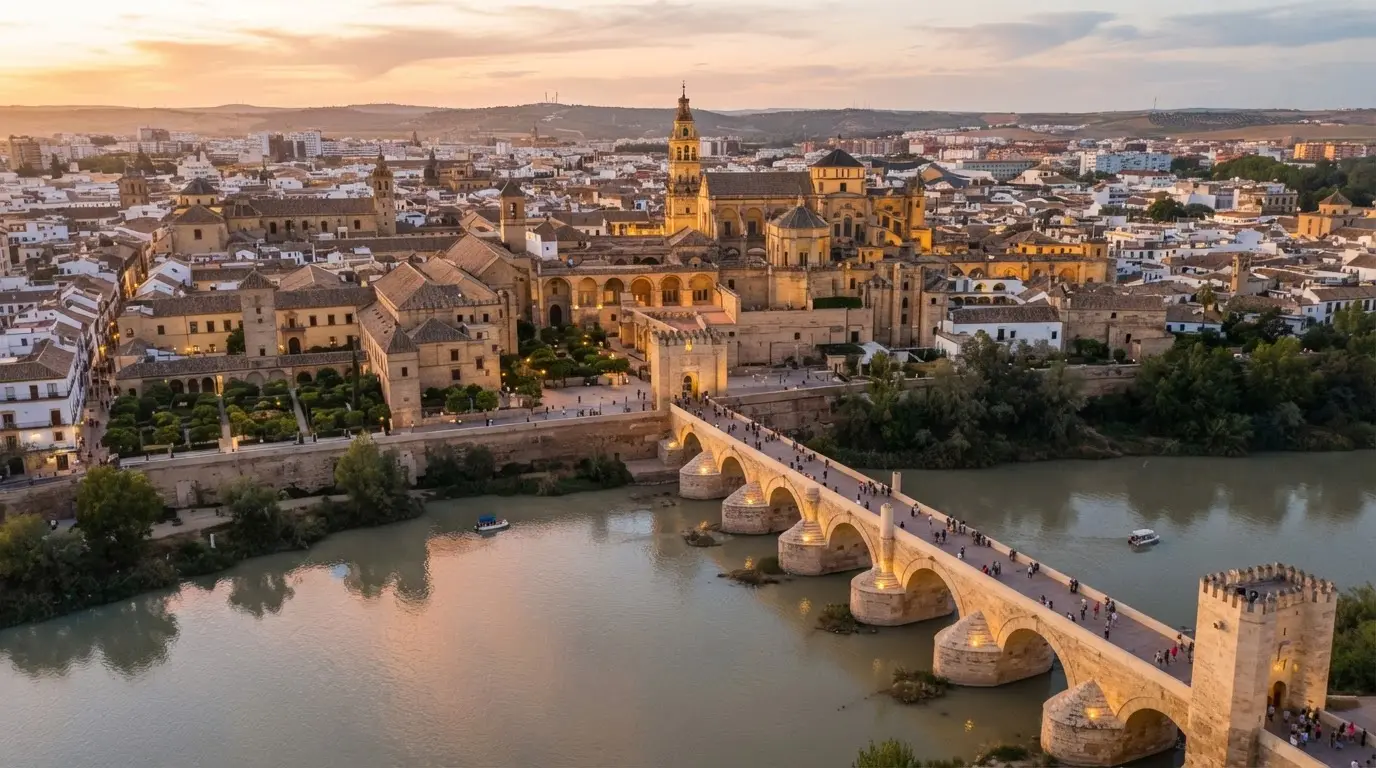

The Iberian root: Corduba before the Romans
Before Rome, before the Mezquita, before any of the names we now associate with the city, there was a settlement on the right bank of the Guadalquivir that called itself something close to Corduba. The name is Old Iberian, a pre-Roman language spoken across much of the Iberian Peninsula before Latin arrived with the legions[1].
In 1799, the Spanish orientalist José Antonio Conde proposed that the name came from Punic, the language of Carthage: qart ṭūbah, meaning 'good town.' Carthage had traded along the Guadalquivir, and a Semitic etymology would link Córdoba to the wider Phoenician colonial world[2]. But modern linguists rejected it. C. F. Seybold and M. Ocaña Jiménez wrote definitively: 'The name is certainly not Semitic but Old Iberian.' The phonetics do not support the Punic theory[3].
What Old Iberian Corduba meant is unclear. Some scholars link it to a root meaning 'ford' or 'crossing point,' plausible given the city's position on the Guadalquivir, where the river could be crossed before the Roman bridge was built. Others connect it to a word for 'olive grove,' reflecting the agricultural landscape of the Guadalquivir valley. We do not know for certain. What we do know is that the name existed before the Romans arrived, and it was old enough that they never quite managed to erase it.
Roman Corduba: the colony that named itself twice
The Romans conquered the settlement in 206 BC during the Second Punic War[4]. They kept the name, Corduba, but Latinised it, fitting the Iberian sounds into Roman phonetic patterns. The double 'u' became a single 'u,' and the ending shifted to match Latin declension norms.
In 169 BC, the Roman consul Marcus Claudius Marcellus, the grandson of a general who had governed both Hispania Ulterior and Hispania Citerior, founded a newer settlement alongside the existing Iberian town[5]. The exact location is debated, but it was close enough that the two settlements eventually merged. Between 143 and 141 BC, the Lusitanian guerrilla leader Viriatus besieged the town, and by 113 BC a Roman forum existed in the city[6].
2,600+
The decisive moment came around 46-45 BC, when Corduba was granted the status of a colonia, a settlement of Roman citizens, and received the full official name Colonia Patricia[7]. The 'Patricia' likely honoured the city's elite status or its connection to a patron, though the reason is unknown. The name Corduba continued in parallel usage; Roman writers used both forms depending on context.
The colony became the capital of Hispania Baetica, the Roman province that covered most of modern Andalusia. It was the main centre of Roman intellectual life in Hispania, home to Seneca the Younger, his father Seneca the Elder, and the poet Lucan[8]. The Roman temple on Calle Capitulares and the foundations of the crossing over the Guadalquivir still stand, physical remnants of the Corduba these writers knew. For the fuller sweep of this period, see our guide to Roman Córdoba.
The Visigoths kept the name
When the Visigoths conquered Corduba in the late 6th century, they kept the existing name. The Visigothic Kingdom ruled Hispania from the 5th to the 8th century, and throughout that period the city appears in documents as some variation of Corduba or Cordova[9].
This is the quietest chapter in the name's history. The Visigoths did not transform the city's identity the way the Romans or the Arabs would. They were Christian, Germanic-speaking, and relatively thin on the ground, a ruling elite layered over a largely Hispano-Roman population. The name persisted because the population that used it persisted.
Recommended tours
Tours are selected for quality, not commission. We earn a small fee if you book — at no extra cost to you.
The most notable figure from this period is Hosius of Corduba, also known as Bishop Ossius, an important and prominent advocate within the Latin Church during the early 4th century, before the Visigoths arrived, but during the transitional period when Roman authority was fragmenting. Hosius attended the Council of Nicaea in 325 AD, where he probably presided, and was among the most influential churchmen of his era[13]. His career shows that Corduba's name already carried weight in the wider Mediterranean world long before the Arab conquest.
Arabic Qurṭuba: the name reaches its peak
The Muslim conquest of Córdoba in 711 or 712 introduced the Arabic form of the name: Qurṭuba (قرطبة)[10]. Unlike many Iberian place names, which the Arabs replaced entirely, Qurṭuba was a phonetic adaptation of the existing Corduba, the Arabic consonant system absorbing the Latin sounds and bending them into Arabic phonology.
The 'q' (ق) reflects the deep guttural 'qaf' of Classical Arabic, replacing the Latin 'c.' The 'ṭ' (ط), an emphatic 't,' substituted for the plain Latin 'd.' The final '-a' became '-ah' (ة), the Arabic feminine marker. The result was recognisably related to Corduba but unmistakably Arabic, a word that announced who ruled the city.
Under the Umayyad emirate and then caliphate, Qurṭuba became one of the most frequently cited city names in the medieval world. The city was the capital of al-Andalus, home to over 80 libraries, and by the 10th century the second-largest city in Europe[11]. Arabic geographers and poets used the name constantly, it appears in the works of Ibn Hawqal, al-Muqaddasi, and Ibn Bashkuwal, among others. For three centuries, the name Qurṭuba was synonymous with the foremost centre of Islamic civilisation in the West.
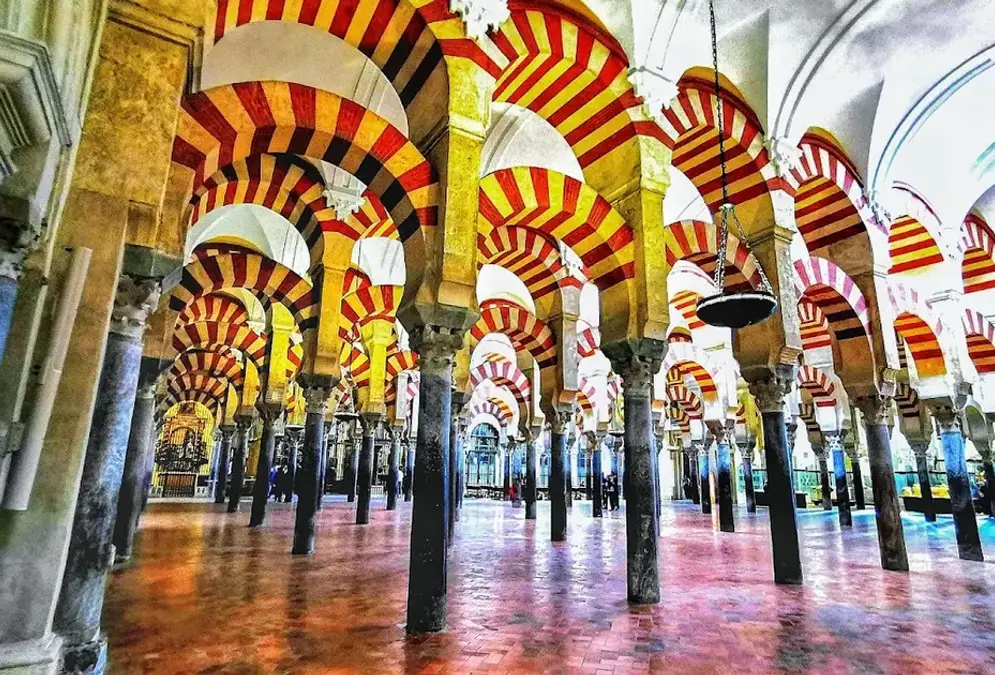
The Great Mosque of Córdoba, the Masjid Qurṭuba, was begun in 785 by Abd al-Rahman I and expanded repeatedly through the 10th century. It was the architectural embodiment of the name, a structure so monumental that it made Qurṭuba impossible to forget.
The Christian reconquest and the birth of Córdoba
When Ferdinand III of Castile conquered Córdoba in 1236, the city's name underwent its final transformation. The Castilian administration rendered Qurṭuba as Córdoba, dropping the Arabic emphatic consonants, adding the Spanish acute accent to mark the stressed 'o,' and adjusting the ending to fit Castilian phonology[12].
The process was gradual. For decades after the conquest, documents used both 'Qurṭuba' and 'Córdoba' interchangeably. The Christian administration was more concerned with repopulating the city and reorganising its districts, the colaciones, than with standardising its name. But by the 14th century, Córdoba had won.
The name's journey from Qurṭuba to Córdoba involved a subtle but important shift: the loss of the Arabic 'q,' a sound that does not exist in Spanish, and its replacement with the softer 'c,' pronounced like 'th' in Castilian Spanish, or 'k' in Latin American Spanish. The emphatic 'ṭ' became a simple 'd.' The Arabic feminine '-ah' ending was replaced by the Spanish '-a.' Each change made the word more Spanish and less Arabic, but the core structure, three syllables, stress on the first, remained intact.
5
English-speaking travellers and writers introduced a further variation: Cordova, with a 'v' instead of a 'b.' This form appears in 19th-century travel guides and persists in some older English texts. Modern English usage has largely settled on 'Córdoba,' matching the Spanish pronunciation, though 'Cordova' still appears occasionally in historical contexts.
The argument that never ends
The etymology of Córdoba is not a settled question. The Old Iberian root is accepted by modern linguists, but its meaning remains disputed. The Punic theory, though rejected, resurfaces periodically in popular histories. And the phonetic journey from Corduba to Córdoba, through Latin, Arabic, and Castilian, is a case study in how place names survive conquest.
What makes the name unusual is its persistence. Many Iberian cities were renamed entirely by successive conquerors. Seville was Hispalis to the Romans, Isbiliya to the Arabs, Sevilla to the Castilians, three recognisably different names. Córdoba, by contrast, has always been recognisably the same word. The root survived because each civilisation found it easier to adapt the existing name than to impose a new one.
The name is certainly not Semitic but Old Iberian.
For visitors, the name is a compressed history lesson. Say 'Córdoba' and you are saying a word that Roman senators, Arab caliphs, and Castilian kings all used. The city's identity is embedded in its very syllables, and our guide to Córdoba's history traces how that identity took shape.