
A 450-metre racetrack under the city
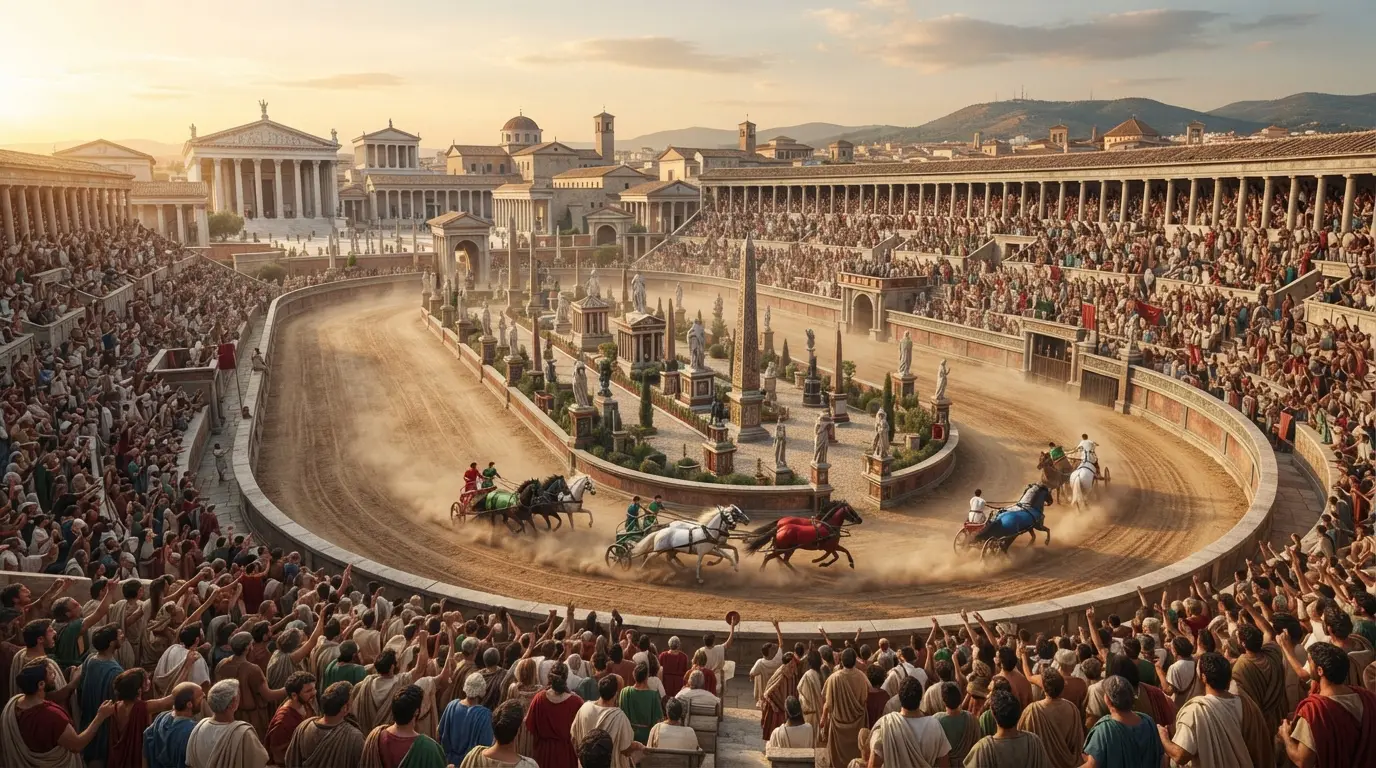
The Roman circus of Colonia Patricia ran east-west across the southern half of the Roman city, parallel to the Provincial Forum to its north[5]. At roughly 450 metres long and 75 metres wide, it matched the scale of circuses at Mérida (Emerita Augusta) and Arles, substantial infrastructure for a provincial capital[1]. Colonia Patricia had been refounded as a Roman colonia between 46 and 45 BC and became the capital of Hispania Baetica, the wealthiest and most Romanised province in the western empire[9]. A circus of this size was not decorative. It was the physical expression of a city that governed territory stretching from the Sierra Morena to the Strait of Gibraltar.
From the air, the circus would have read as a long U open at the western end, where the carceres, the starting gates, released chariots onto the track[3]. The arena was split along its length by the spina, a raised central barrier that charioteers circled anticlockwise, seven laps to a race. Around the spina stood the metae, the three-coned turning posts at each end, the most dangerous points on any Roman racetrack, where drivers cut the turn as close as they dared and the crowd held its breath.
What happened to all of it is the story. The circus was in continuous use from the 1st through the 4th century CE[2]. When the western empire contracted, maintenance stopped. The track filled with rubble. The stone seating was stripped for other buildings. By the time a Castilian arcaded square went up over the site in 1683, the circus was invisible, a buried footprint under a plaza that nobody in Córdoba connected to chariot racing.
Three clues survive today. The first is the square itself: Plaza de la Corredera, whose name, corredera, means "running track" or "race course"[3]. The etymology is not conclusively Roman; medieval horse races and bullfights on the same ground before the plaza was built may have supplied the name. But the alignment is exact. The second clue is the San Pablo church garden, where excavation in the 1990s exposed circus masonry[4]. The third is a few foundation fragments near Calle Caballerizas Reales, visible to anyone who knows where to look[6].
How chariot racing worked in Roman Córdoba
The mechanics of a Roman circus race were the same in Córdoba as they were in Rome: chariots lined up at the carceres, a set of starting gates at the western end, rigged to open simultaneously[3]. Drivers raced quadrigae (four-horse chariots) or bigae (two-horse chariots) down the right side of the spina, turning anticlockwise around the metae, completing seven laps covering something like five kilometres total distance.
The Córdoba circus, at 450 metres per lap[1], would have given each race a duration of roughly ten to twelve minutes. Compare the Circus Maximus in Rome: 621 metres per lap, capacity of up to 150,000 spectators, the imperial standard against which every provincial circus was measured[8]. Córdoba's version was about 72% the length and aimed at a city of perhaps 100,000 people[4]. It was not trying to rival Rome. It was scaled to its city.
What made the circus work as a spectacle was the spina, the central barrier that gave chariot racing its specific geometry. On the spina stood lap counters: eggs or dolphins, tipped over one by one as each lap completed, plus statues, altars, and sometimes an obelisk. Roman sources describe the chaos of the turn at the metae: drivers jostling for the inside line, wheel hubs scraping the stone posts, a single miscalculation throwing a chariot into the barrier and the horses into the path of the field behind them. The danger was not incidental to the appeal. It was the point.
Explore nearby · Monument
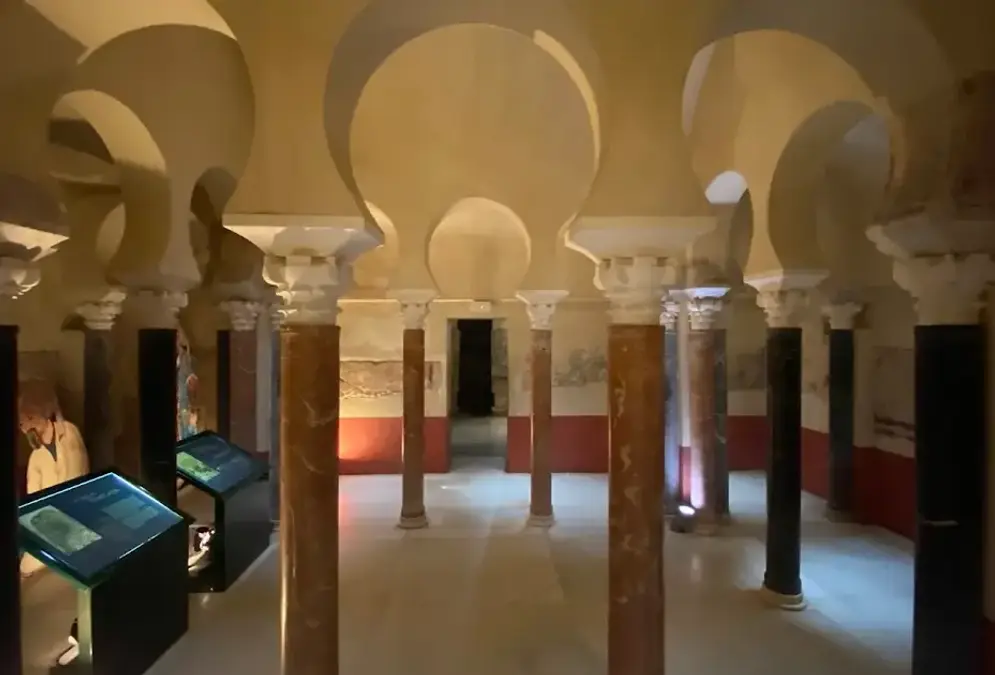
Caliphal Baths (Baños del Alcázar Califal)
Underground 10th-century Islamic hammam beneath Córdoba's Campo Santo square, with star skylights, marble pillars and intact cold, warm and hot rooms.
The ludi circenses, the circus games, were among the most popular forms of public entertainment in the Roman world. More people could fit into a circus than into an amphitheatre or a theatre, and the events were free, funded by wealthy citizens or the provincial government as acts of public largesse. In a provincial capital like Colonia Patricia, the circus calendar set the rhythm of civic time: holidays, imperial anniversaries, and the gods' festival days were all marked by races in the arena.
Charioteers were professionals, organised into factiones, racing stables identified by colour: the Blues, Greens, Reds, and Whites. They were recruited young, often from enslaved or low-status backgrounds, and the best among them earned fortunes and celebrity across the empire. A charioteer who survived long enough to retire could die rich. Most did not survive long enough.
The Archaeological Museum of Córdoba holds inscribed stones and fragmentary evidence from the city's circus, including architectural elements that help archaeologists reconstruct the structure's original layout. The closest most visitors get to the circus today is standing in Plaza de la Corredera with a map, tracing the vanished track under their feet.
Circus and amphitheatre: twin spectacles of Colonia Patricia
Córdoba under the Romans built entertainment infrastructure at a scale that seems improbable for a provincial city, until you remember which province it governed. The venues speak for themselves.
The theatre was the largest in Hispania. The amphitheatre, discovered only in 2002 beneath the university rectorate, is ranked by archaeologists as the third-largest in the Roman Empire.
| Venue | Function | Size / Capacity | Visible today |
|---|---|---|---|
| Circus | Chariot racing | 450m × 75m, ~30,000 | Plaza de la Corredera outline, San Pablo garden fragments, Calle Caballerizas Reales |
| Amphitheatre | Gladiatorial combat, animal hunts | 178m × 140m, 30,000–40,000 | Partial excavation under Rectorado (by appointment) |
| Theatre | Dramatic performances | 124m diameter, ~15,000 | Basement visible at Archaeological Museum |
These three structures were not built in isolation. They were part of a coherent programme of Romanisation: imported forms of architecture and entertainment that signalled a provincial capital's membership in the empire. The same families who funded the circus also funded the theatre and the amphitheatre. The same crowds moved between all three on festival days.
Recommended tours
Tours are selected for quality, not commission. We earn a small fee if you book — at no extra cost to you.
The 2002 amphitheatre discovery is instructive for the circus story because of what happened during the excavation. Workers breaking through to Roman masonry beneath the university's Rectorado building initially identified what they saw as a circus. The fragments were ambiguous: large curved substructures, buried at scale. It took archaeologist Jose Carrillo of the University of Córdoba Archaeology Laboratory to re-identify the structure correctly as an amphitheatre. A circus, Carrillo argued, would look different in section, more elongated, with a different proportion of arena to seating. The initial confusion tells you how faint the circus's archaeological footprint was: even trained observers struggled to distinguish one from the other from partial remains.
The Roman amphitheatre sits beneath an active university administration building and requires an appointment to visit. The circus is even less visible. The amphitheatre at least has excavated sections, gladiatorial tomb stele, and a published archaeological record. The circus has the outline of Plaza de la Corredera, a few foundation stones, and the garden behind San Pablo.
Who paid for the races: inscriptions, elites, and euergetism
An inscription held by the Archaeological Museum of Córdoba records a provincial flamen, a priest of the imperial cult, who funded chariot races in Colonia Patricia as part of his official duties[7]. The practice had a name: euergetism, from the Greek for "doing good works." In Roman terms, it meant wealthy citizens spending private money on public amenities — buildings, games, banquets — in exchange for social prestige and political advancement.
The inscription from Córdoba uses a formula familiar from other Baetican cities: the flamen's name, his title, the act of patronage. What is unusual is not the text but the city it describes. Colonia Patricia was a place where the imperial cult had serious institutional weight. The provincial forum, with its temple to the deified emperors, sat directly north of the circus, linked physically and ritually to the chariot-racing venue below. A provincial flamen funding the ludi circenses was connecting two expressions of Roman power: religious devotion to the emperor and the mass spectacle of the arena.
This was not charity in the modern sense. Euergetism was a system of obligation. The Roman elite of Baetica, landowners enriched by olive oil, wine, and garum exports, were expected to spend conspicuously on their cities. A provincial flamen held office for a year and was expected to leave a mark: a new portico, a restored bath complex, a season of games. The inscription that survives tells you the result of one such year in Córdoba: chariot races, paid for by a man whose name is now partially lost but whose office and gesture remain legible in stone.
The relationship between circus and forum was not accidental. Roman urban planning in provincial capitals placed entertainment venues near civic and religious centres. In Córdoba, the circus ran parallel to the Provincial Forum for over 400 metres[5]. A person walking from the forum's ceremonial precinct to the circus's entrance walked a few hundred paces. The architecture encoded a message: what happened in the forum (law, religion, governance) and what happened in the circus (chariot racing, mass entertainment) were part of the same civic order. The flamen who funded the races was performing the same role as the magistrate who dedicated a temple — both were spending private wealth to reinforce public loyalty to Rome.
From hippodrome to plaza: two thousand years of burial
The circus did not vanish overnight. Its disappearance was a slow architectural digestion, each century laying something new on top of the Roman surface. After the circus fell out of use in the 4th century CE[2], its fabric became a quarry. Stone seating blocks were taken for Visigothic churches and Umayyad houses. The spina's statues and altars were smashed or repurposed. The track itself, a thick bed of compacted earth and gravel, became the foundation layer for whatever was built next.
During the Umayyad period (8th–11th centuries), when Córdoba was the capital of al-Andalus, the southern quarter of the city filled with workshops, houses, and small mosques. None of the builders dug deep enough to expose the full circus, but they used its remains as stable ground. The Roman substructure, designed to support tens of thousands of spectators, made an excellent base for lighter medieval buildings.
By the time Plaza de la Corredera was constructed in 1683, the circus was entirely forgotten. The square's architect, Antonio Ramós Valdés, chose the site for its central position, not for its Roman archaeology. The arcaded galleries, uniform facades, and open central space were a deliberate Castilian intervention in an Andalusian city, a piece of Valladolid or Madrid dropped into the streets of Córdoba. The irony is that the square's shape, a long rectangle with curved short ends, faintly mirrors the circus beneath it. Nobody at the time noticed.
The first modern confirmation of the circus's location came not from excavation but from cartography. Archaeologists working with the Roman street grid of Colonia Patricia traced the outline of a massive U-shaped structure in the southern sector of the city, aligned with the forum, extending east-west for several blocks. Ground-penetrating radar later confirmed what the maps suggested: a buried structure of circus proportions beneath the Corredera and its surrounding streets.
The San Pablo church garden discovery in the 1990s[4] gave the first physical proof accessible to non-archaeologists. The church, one of the thirteen Fernandine churches built after the Christian reconquest of Córdoba in 1236, sits near the eastern end of what was once the circus track. The garden excavation exposed circus masonry, stonework whose scale and curvature could not be anything else. The fragments are not presented as a formal archaeological site. They sit in a church garden[4]. But they exist.
How to find the circus today: a walk through Córdoba's invisible monument
You cannot buy a ticket to the Roman circus of Córdoba. There is no entrance, no audio guide, no interpretive centre. What you can do is walk its length, tracing a 450-metre route that runs from the Bar Santos corner of Plaza de la Corredera eastward toward the San Pablo church, and in doing so, walk through two thousand years of buried city.
Start at Plaza de la Corredera. Stand with your back to Bar Santos, the famous bar on the square's western side whose counter serves the city's best-known tortilla. You are now roughly where the carceres, the starting gates, stood[3]. The carceres were a curved line of stalls, twelve of them, each closed by a rope or wooden gate that dropped at the signal to start. From here, the chariots would have burst onto the track ahead of you, heading east.
Walk east across the square. The plaza is roughly 100 metres long, a fraction of the circus's total length. As you cross it, you are walking the first segment of the spina, the central barrier that divided the track. The arcades on your left and right stand where the lowest tiers of seating would have been: the ima cavea, reserved for magistrates, priests, and the wealthiest citizens.
Exit the square onto Calle Lucano and continue east. The circus track extended well beyond the plaza's eastern edge, passing under the narrow streets of the old Jewish quarter. Calle Lucano, Calle Caballerizas Reales, and the blocks around them all sit on top of the circus substructure. If you look carefully at the street level, the slight rise, the way the ground holds a long, flat profile before dipping south toward the Guadalquivir, you get a sense of the Roman earthworks that still shape the city's topography.
At Calle Caballerizas Reales, look for circus foundation fragments[6]. They are not signposted. You are looking for large, squared stone blocks at the base of a modern wall, rougher and darker than the construction above them. These are likely sections of the circus's outer retaining wall, the structure that held the seating bank against the slope of the ground.
Deep dive · Article
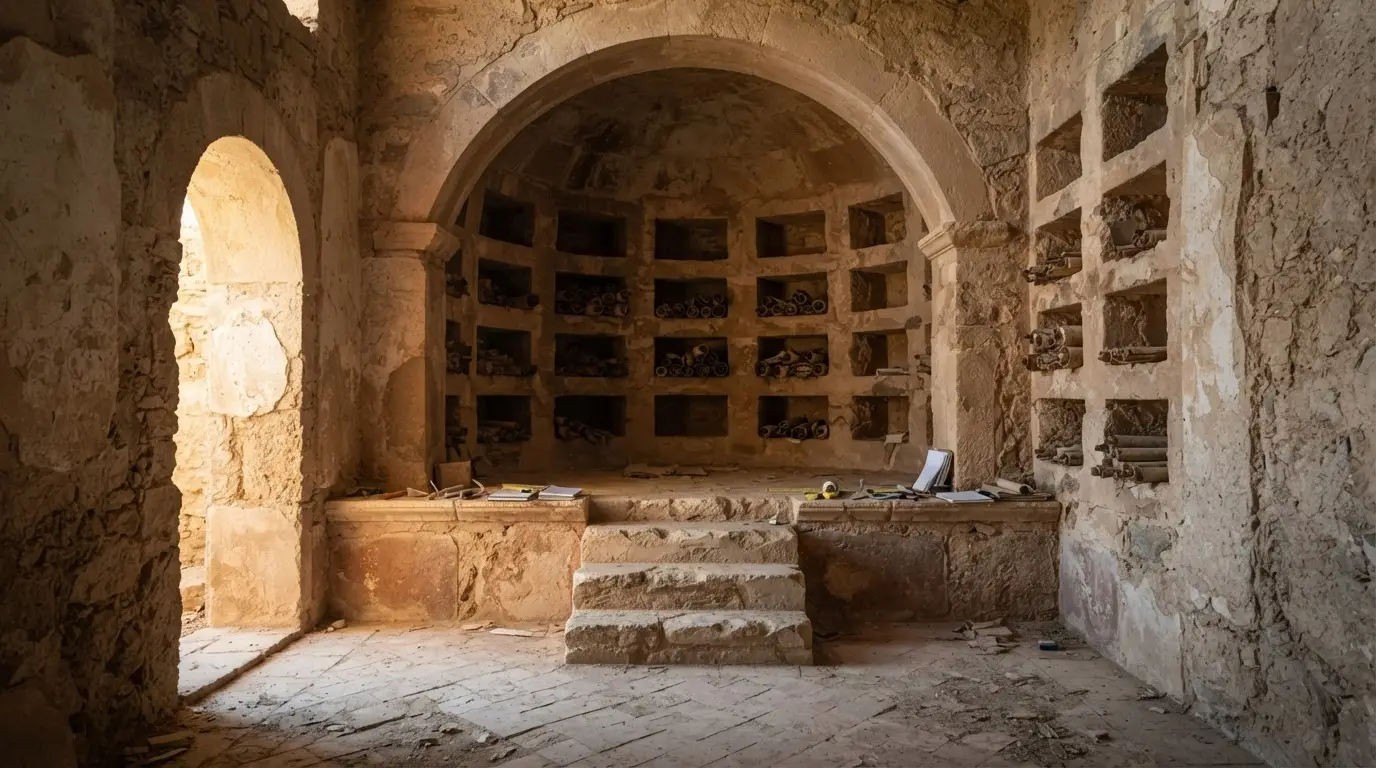
Roman Library in Córdoba: The Villa Room Once Called a Shrine
A 2026 study reidentifies a Córdoba-province villa room, catalogued for decades as a Mithras shrine, as Iberia's oldest documented Roman private library.
End at the San Pablo church (Iglesia de San Pablo) on Calle Capitulares. The garden behind the church contains the circus fragments discovered in the 1990s[4]. Access to the garden is not guaranteed; it depends on the church's schedule, but if the gate is open, you can see Roman masonry embedded in the earth, the only circus remains in Córdoba that are not buried under a building.
The entire walk takes twenty to thirty minutes at a normal pace. It costs nothing. There is no sign, no plaque, and no tourism office leaflet that marks the route. You do it with a map and a sense of what you are walking on.
For the full archaeological context: the inscriptions, the architectural fragments, the flamen's chariot-race dedication; the Archaeological Museum of Córdoba is a fifteen-minute walk from Plaza de la Corredera. Its Roman collection holds the material evidence that the buried circus left behind. Between the museum and the walk, you can assemble a reasonably complete picture of the city's chariot-racing past without ever seeing a standing ruin.
For more on the Roman city, the Roman Córdoba walking guide connects the circus, the amphitheatre, the temple, and the bridge into a half-day route through Colonia Patricia.