
The Almodóvar Gate: a 14th-century rebuild on older ground
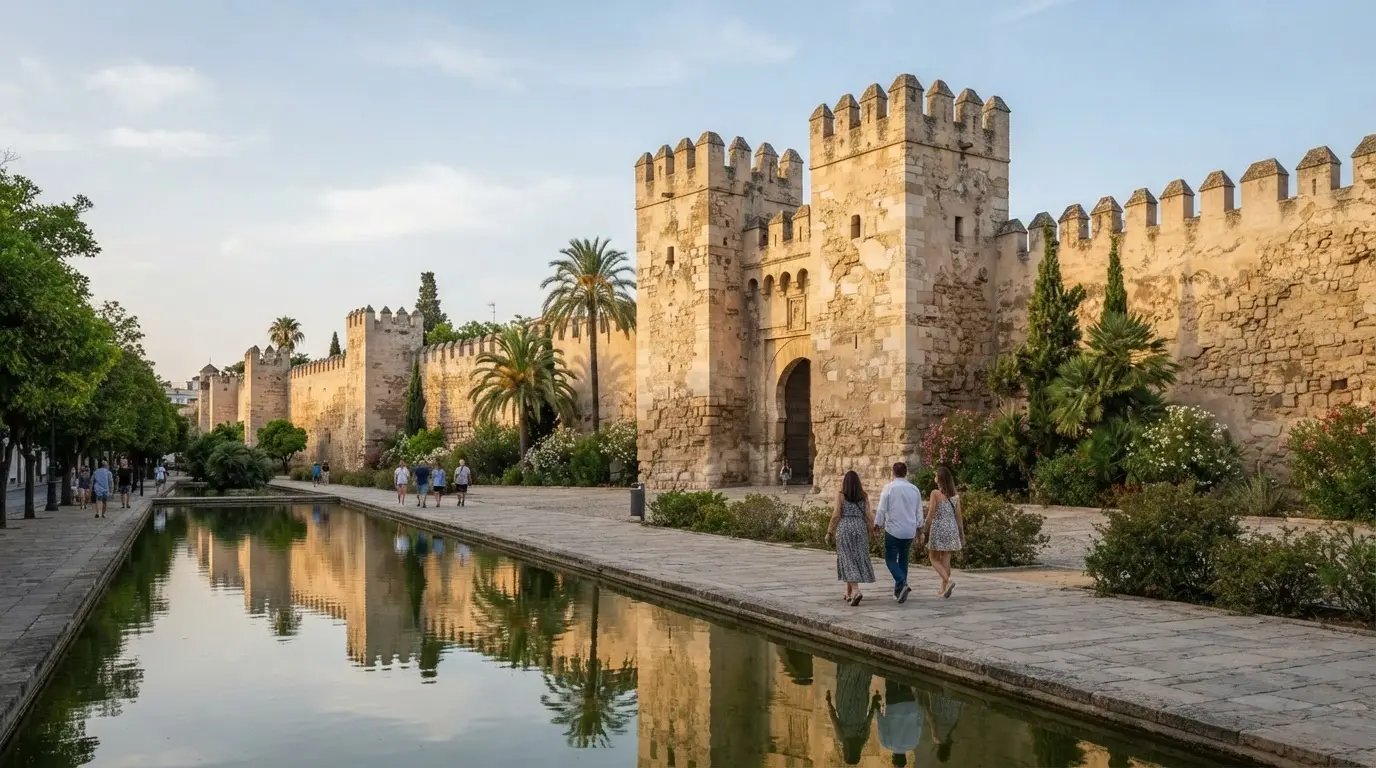
Start where the wall is most convincing. The Puerta de Almodóvar is two blunt towers and a battlemented walkway, and the city tourist board describes it as mainly Christian construction dating from the 14th century.[4] Claims that it is a surviving Caliphal gate circulate widely. They sit badly with that date, so treat them as unsettled.
Spain's national tourism portal lists it under a second name, the Puerta del Nogal (the walnut-tree gate), alongside the Puente gate by the Mezquita, rebuilt in the 16th century.[5] Different names for the same opening are a reminder that the wall has been renamed as often as it has been repaired.
In front of the arch stands Seneca. Córdoba's gallery of great thinkers opens with the Stoic, and his statue is said to watch life go by from this spot.[6] The usual account adds a local twist: the bronze was paid for by the bullfighter Manuel Benítez, El Cordobés, as compensation for the urban-development trouble caused by the Los Gallos hotel.[7] The philosopher himself has his own page: Seneca of Córdoba.
Stand under the arch for a minute. Traffic, scooters and tour groups all squeeze through a gap designed for neither.
Behind the arch begins the quarter this gate once served. The city tourism board gives the Judería two bookends, this gate and the Mezquita-Catedral, with the episcopal palace closing the south.[8] Those bookends are your route. The gate is the western doorway, the cathedral-mosque the eastern anchor, and everything between them is lanes that reward patience more than planning.
Calle Cairuán: a Tunisian name from 1968
The name comes from a twinning. Córdoba is twinned with the Tunisian city of Kairouan, whose main mosque has features similar to the Mezquita.[9] The street was renamed Cairuán on 27 May 1968; before that the area was the Huerta del Rey, named for its closeness to the Alcázar.[2]
That resemblance is the whole link: a municipal gesture of the 1960s, not evidence of an older tie. Official signage prints Cairuán with the accent, maps and search boxes flatten it to Cairuan, and the twin city itself turns up as Kairouan or Quairuan. All of them lead to the same street.
Explore nearby · Monument
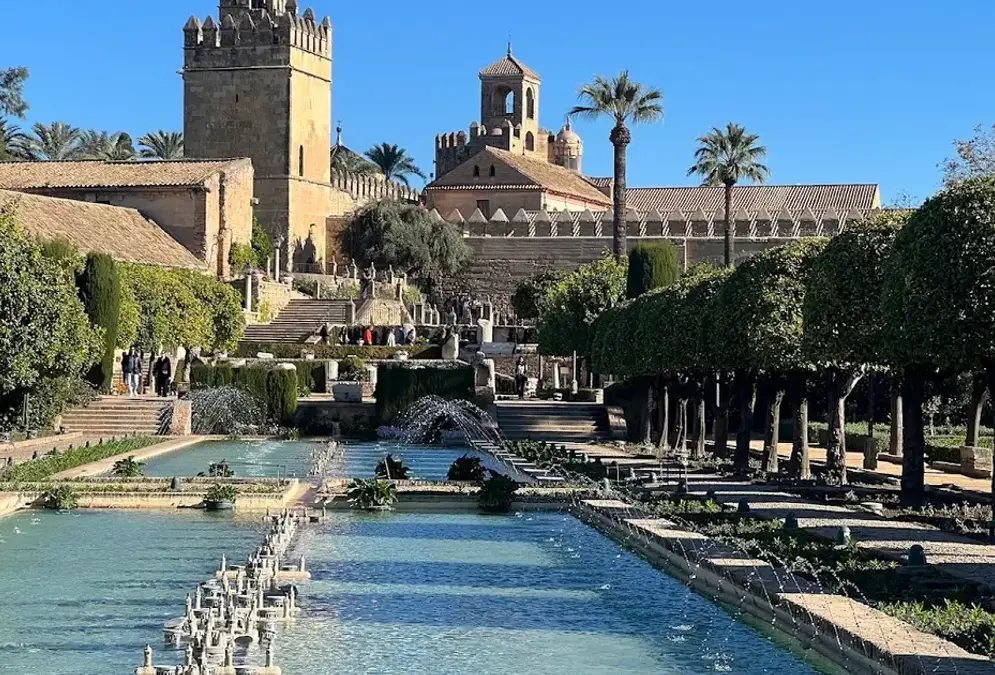
Alcázar de los Reyes Cristianos
Alcázar de los Reyes Cristianos, Córdoba: free entry on Tuesdays. A 14th-century fortress-palace with terraced Moorish-inspired gardens and Roman mosaics.
Walk the street from the gate towards the Alcázar de los Reyes Cristianos and the pedestrian side feels like a long garden bench. A cascade of ponds and water channels runs along the outer face of the wall, and in the evening the sound of running water covers the traffic. It is the quietest stretch of the western circuit.
The statue at the far end, Averroes seated with his book, belongs to a different story, told elsewhere on this site. Here it is enough to say that the promenade was laid out as a gallery of Córdoban worthies, with Seneca at one end.
Carry the 1968 date with you for the rest of the walk. It tells you the street is a modern frame set around a much older wall, and once you know that you stop expecting the name to explain the stone. The name speaks for municipal diplomacy; the wall speaks for itself, and the next section is about reading it.
Roman footing, medieval fabric, 20th-century polish
The wall along Calle Cairuán stands on top of earlier Roman walls, and what we see today owes much to restoration carried out in the 20th century.[10] That one sentence from the tourist board is more useful than any single date. Dating the visible stonework to one century is a mistake.
Less survives of the Arab circuit than guides imply: only stretches of curtain wall and some of the gates remain.[11] The gate itself was restored in 1802, a campaign that kept the battlements and walkway in their original form.[1] So the crenellations you photograph have been through at least two rounds of repair.
There is a tempting shortcut here, and it is wrong. Study of Córdoba's eastern Axerquía walls shows that the upstanding remains are Christian-era reforms from the first half of the 14th century, not the original Almoravid wall.[12] Nothing I found ties that reform to the western gate, so the 14th-century date belongs to the tourist board, not to a proven phase.
In practice, read the wall as a sequence of repairs. Where the courses change colour or bonding, you are looking at a patch; the open question is which century made it. For the city's earlier defences, see the article on Córdoba's pre-Roman walls.
The gate's material tells the same story in a different register. Brick appears alongside the cut sandstone,[13] and two materials in one structure are what a building that has been mended tends to show. The bricks alone cannot say which campaign they belong to, so resist the urge to assign them to a century. Stand close, compare the sandstone courses with the brickwork, and let the contrast do the explaining.
A useful habit on any stretch of this wall is to ask what the surface is hiding rather than what it shows. A crisp, even course may be recent work laid over something far older, and a worn, uneven one may be the survivor. Neither is proof of anything without excavation records, and the sources behind this article give none for this sector.
Through the gate: the Judería as a souk-style maze
Step inside the arch and the street plan changes. The Judería keeps the layout of a medieval Islamic city, with two main streets crossing amid a labyrinth of smaller streets that often end in dead ends or narrow alleys.[14] That is what "souk-style" means here: a plan, not a market. Distances shrink, lanes close overhead, and the Judería rewards slow walking more than any fixed itinerary.
The ground just outside the gate, beyond the edge of the quarter, once held an ancient Jewish cemetery.[15] Gate and wall therefore mark a real edge: living quarter inside, burial ground outside. The tourist board describes the stretch along Calle Cairuán as part of the circuit that once surrounded the Medina,[16] which makes the arch less a decoration than the hinge between two ways of using the ground.
Treat any craft courtyard you find as a bonus rather than a destination. I could not confirm its history or opening hours from an official source, so ask at the tourist office before you plan a stop around it.
Go early. By late morning, groups arriving from the Mezquita fill the lanes and the labyrinth stops feeling like one.
Deep dive · Article
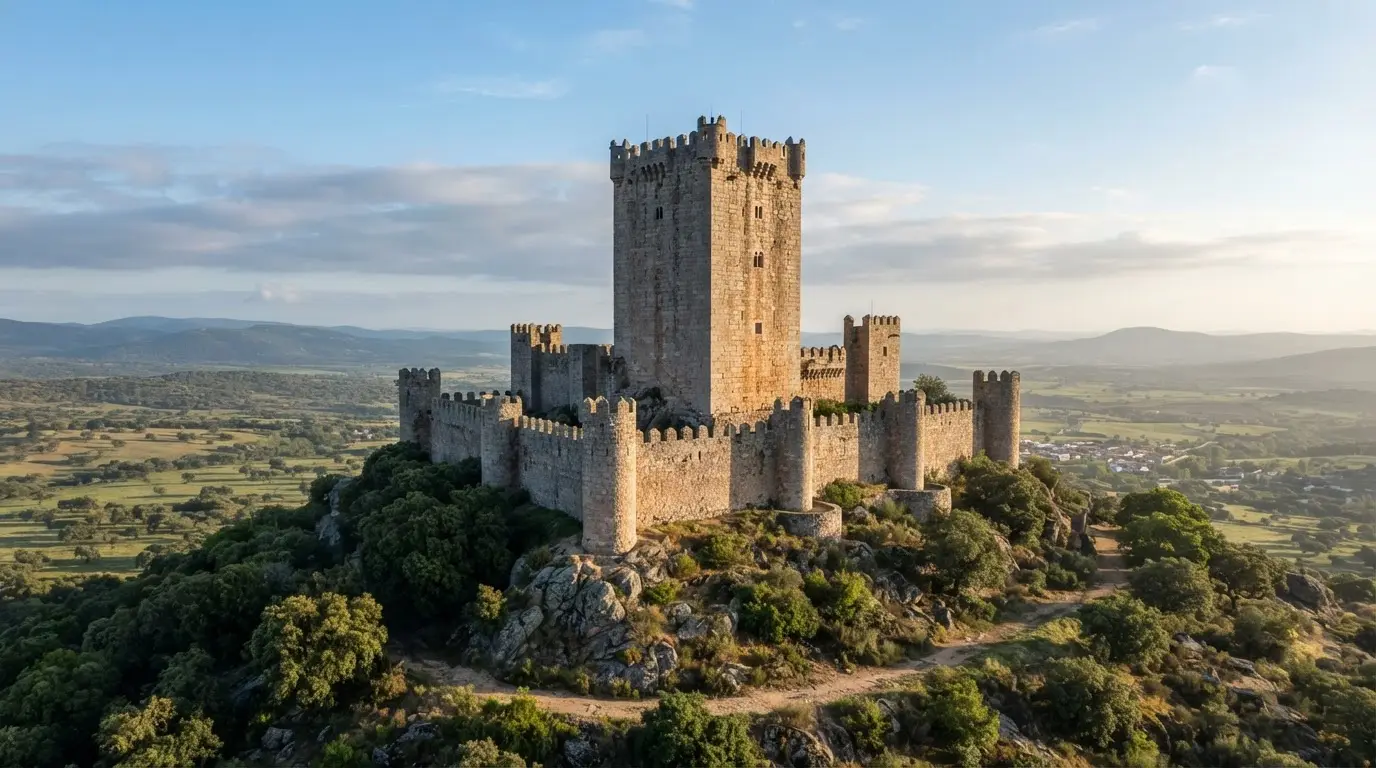
47 Metres Tall and Almost Unknown: Spain's Tallest Keep
Belalcázar Castle's 47 m keep is listed by the Junta de Andalucía as Spain's tallest. How it grew, what to see inside and how to book the free guided visit.
Keep the two central streets in your head and let the rest happen. Because the plan is a pair of main axes with smaller lanes hanging off them, you are never truly lost, only a few turns from something recognisable. A dead end is not a failed route. Turn round, take the next opening, and treat each cul-de-sac as a small courtyard you were allowed to glimpse.
Look up as well as ahead. The narrowness that makes the quarter cool in summer also frames the sky in strips, and the bell-tower and rooflines you catch between walls are the quickest way to check your bearings without a map.
A short walk, in order
The route runs from the Puerta de Almodóvar along Calle Cairuán, through the gate into the Judería, past the church of San Miguel and on to the Mezquita-Catedral. No timings are sourced for it, so treat the order as a sequence rather than a schedule, and linger where the water is.
The route at a glance
- Start at the Puerta de Almodóvar and face the Seneca statue
- Walk Calle Cairuán beside the wall and the water channels
- Look for repairs in the wall: Roman base, later patches
- Step through the gate into the Judería lanes
- Find San Miguel and its Hebrew inscription
- Finish at the Mezquita-Catedral
Inside the Judería, one stop is worth a detour. A common slip is to call the Almodóvar arch the Gate of the Jews. The city tourism board attaches that medieval name to the Osario gate instead, and the church of San Miguel beside it holds a Hebrew inscription worth hunting for.[17] It is a small, concrete reminder that the quarter's layers are written on its walls, and a useful correction to any guide that blurs the two gates.
From there, continue towards the Mezquita-Catedral, the natural end of the walk. If the lanes have hooked you, the Jewish Quarter walk strings the quarter's stops together in a longer loop.
Recommended tours
Tours are selected for quality, not commission. We earn a small fee if you book — at no extra cost to you.

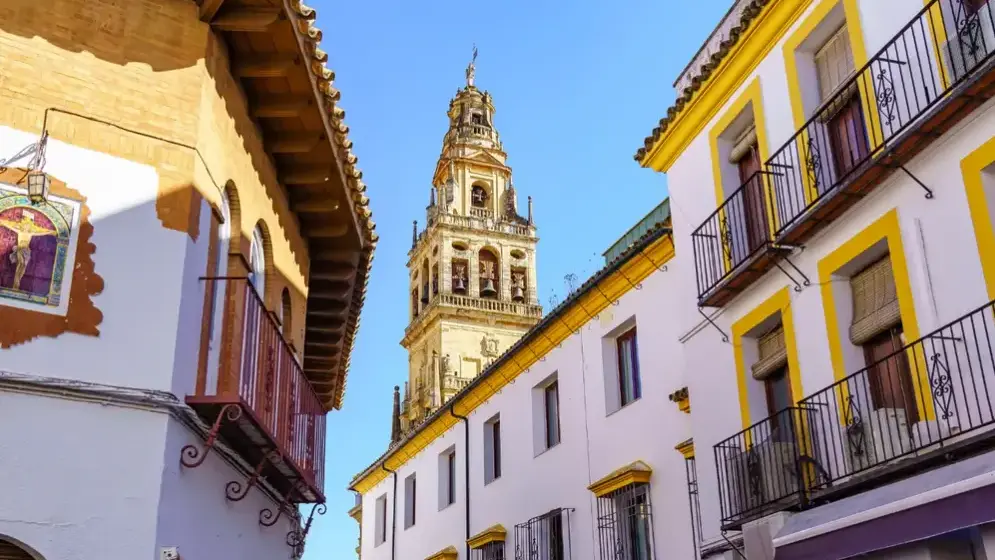
Count the survivors before you leave and the arch you began under looks less ordinary. Of the medieval gates, the Almodóvar shares its survival with just two others, the Puerta del Puente and the Seville Gate.[18] A rare piece of the circuit, then, even if the stonework is patched and the street name is a 20th-century gift from Tunisia.
Wear flat shoes. The pavement on both sides of the gate is old stone and the wall-side promenade is open to sun.