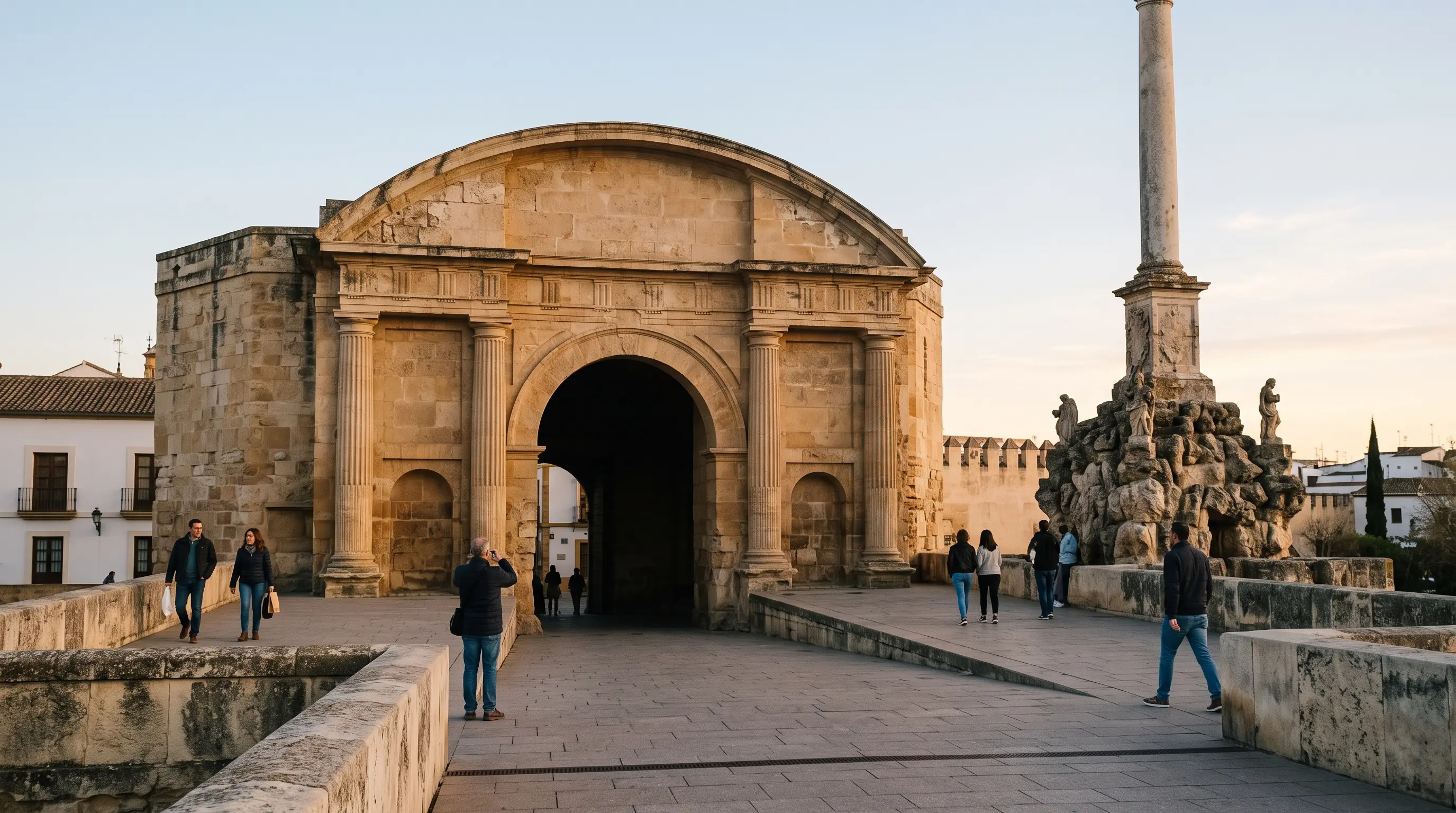

A squat arch below street level
Walk towards the river and the arch seems to sit lower than it should. An older city-hall description puts the squat look down to levels: the gate is set lower than the streets around it.[4] Beyond it lie the Roman Bridge and, across the water, the Calahorra Tower.
Squat is not the same as modest. Three sections, fluted columns at the ends, and a lintel and curved pediment over the central opening:[5] the vocabulary of a Roman triumphal arch, translated into 16th-century Córdoba.
The ground has moved before. In the late 1950s the land bordering the gate was lowered, and neighbouring buildings with it, until the original ground level came back.[6] Yet the arch still reads low in older descriptions. The sources I found do not say how far the street now sits above the original sill.
So treat any count of steps you read as someone's estimate. What you can trust is the effect: the gate does not tower over you, it receives you.
What stood here before the Renaissance gate
The honest answer is a gate, perhaps more than one, and no description of the fabric. Three accounts give three emphases.
- Wikipedia places the Renaissance gate on the site of earlier Roman gates linking the city with the bridge and the Via Augusta.[7]
- The tourism board's leaflet describes a structure that began as part of the city walls and, after the Christian conquest, became the Algeciras Gate, where the southern road out of Córdoba started.[8]
- The infocordoba page records an Arab gate standing here until 1571.[9]
The dates are tangled too. Wikipedia records the order to build as issued on 18 February 1572 by the mayor, Alonso González de Arteaga.[10] The infocordoba page puts the order in 1571, the year the Arab gate went.[9] A one-year gap is small, but it means no tidy built-in date survives contact with the sources.
Explore nearby · Monument
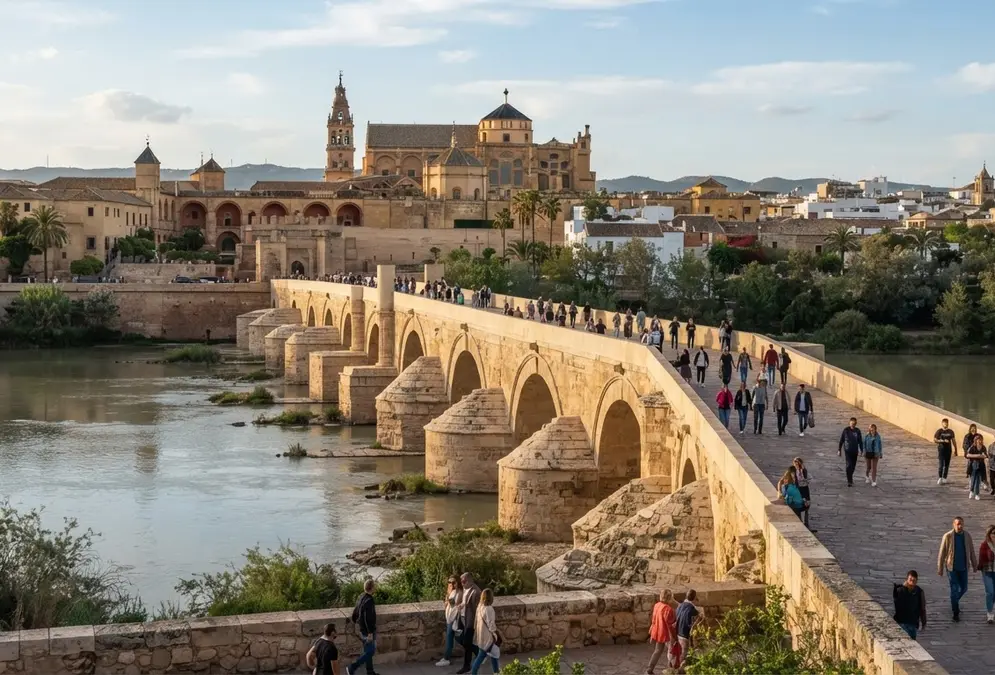
Puente Romano de Córdoba
Puente Romano de Córdoba: 16 arches over the Guadalquivir since the 1st century BC. Best viewpoint for the Mezquita at sunset. Game of Thrones location. Free.
The city's officials wanted more than a repair. They meant to enlarge the opening and improve its artistic merit as part of an urban renewal.[11]
What the previous gate looked like, whether Roman fabric survives inside the later one, how the Roman, Algeciras and Arab names map onto one another: none of it is documented in the sources I could verify. Distrust any guide that supplies those details without citing an excavation. For the bridge itself, the Roman Bridge's own history covers the ground this piece leaves alone.
Montalbán, Ruiz and a budget that tripled
Francisco de Montalbán started the building. Hernán Ruiz III took over, and design complications pushed the budget from 1,400 ducats to 3,100.[1] The source calls that a tripling; the figures give a little over double. Either way, a council that had asked for a bigger, better gate was paying for a ceremonial one.
Then the work stalled. The stoppage lasted about four years, and Ruiz returned in 1576.[12] The gate stayed unfinished, with council debt and a shortage of funds the suggested reasons rather than a documented one.
The tourism board's leaflet credits Hernán Ruiz III with the redesign to mark Philip II's visit, and with the grand style that survives.[13] Read that as an attribution, not a signature. A façade begun by one man, taken over by another and resumed after a gap is easier to call Ruiz's gate than to document line by line.
The commemorative brief explains the form. A gate meant to honour a king's visit has no reason to look like a fortress, and this one does not.
From wall to memorial gate: 1912 and 1928
The face you photograph owes a good deal to the 20th century. In 1912, under Alfonso XIII, the area was stripped of its walls; it was rebuilt in 1928 as a memorial gate, with the forms of the outer side repeated on the inner side.[14]
The tourism board's leaflet words it differently. At the turn of the 20th century, it says, the surrounding buildings were cleared and the ground lowered to restore the original height.[15] The two accounts overlap on what happened and part on when. I would not reconcile them without the municipal records.
The result is a gate with two lives. Europa Nostra's award text calls it a Renaissance gate that had been transformed a century earlier into a triumphal arch, a phrase that sits comfortably with the 1928 rebuild without naming it.[16] So the arch's triumphal profile owes something to that later work, and the sources do not say how much of the visible stone is 16th-century.
The same question, how much of what you see is original, hangs over the Almodóvar Gate. The article on Calle Cairuán and the Almodóvar Gate works through it.
The Triunfo de San Rafael next to the gate
The earliest San Rafael at this threshold dates from 1651. Bernabé Gómez del Río's statue went into a parapet of the Roman Bridge to bless travellers entering by the gate.[2]
The big monument beside the gate is the Triunfo de San Rafael by Michel de Verdiguier. Andalucía.org dates it to 1781 and says it thanks the archangel for saving the city from an earthquake.[17] Spain.info gives another reason, a plague epidemic.[18] Sources differ, so I would present both rather than pick one.
In July 2026 the Cabildo Catedral began a restoration of the Triunfo costing €96,618.50, with scaffolding due to go up on Monday 27 July.[19] If you are visiting soon after, check whether the column is still under cover. The gate itself is a separate monument.
Seeing the gate now
Check the interior first. The Consorcio de Turismo's official page lists visits to the gate as temporarily closed, with no reopening date.[20] Normally the visit covers a permanent exhibition room on the gate's history and a top-floor balcony with views of the monuments around it.[21] That room is the product of the last phase of a ten-year conservation project on the bridge, gate and tower.[22]
The visitor reception centre at the gate is the place to ask. The Consorcio's May 2025 leaflet gives Monday to Saturday 09:00–18:50,[23] and Sundays and holidays 09:00–14:20,[24] but those are last-published hours, so check them before you go.
Recommended tours
Tours are selected for quality, not commission. We earn a small fee if you book — at no extra cost to you.

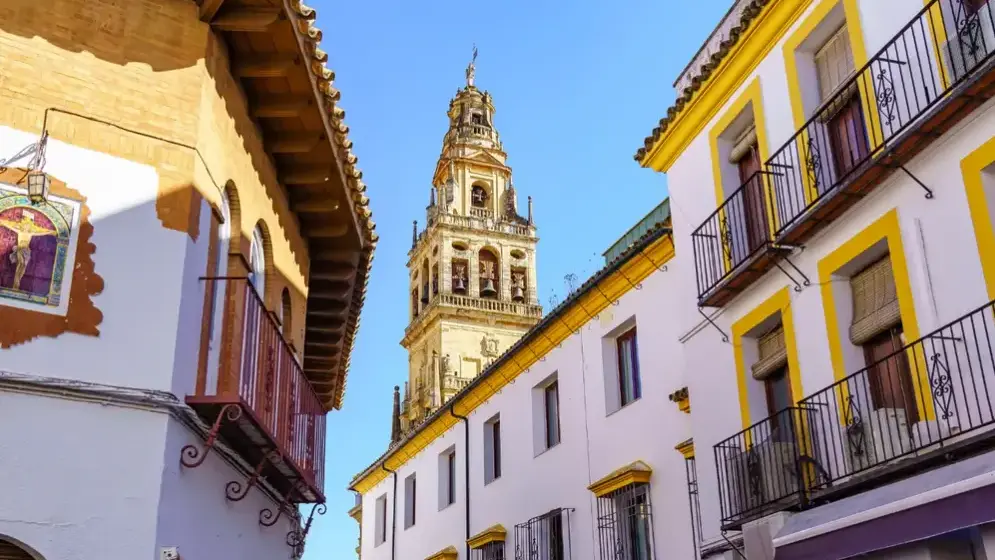
Come in from the bridge side, or from the Calahorra Tower end if you have walked across. From outside you can read the three-part façade, the fluted columns and the curved pediment, and judge for yourself how low the arch sits. Beside it rises the Triunfo de San Rafael, which was entering restoration in July 2026, so look for scaffolding before you frame a photograph.
Deep dive · Article
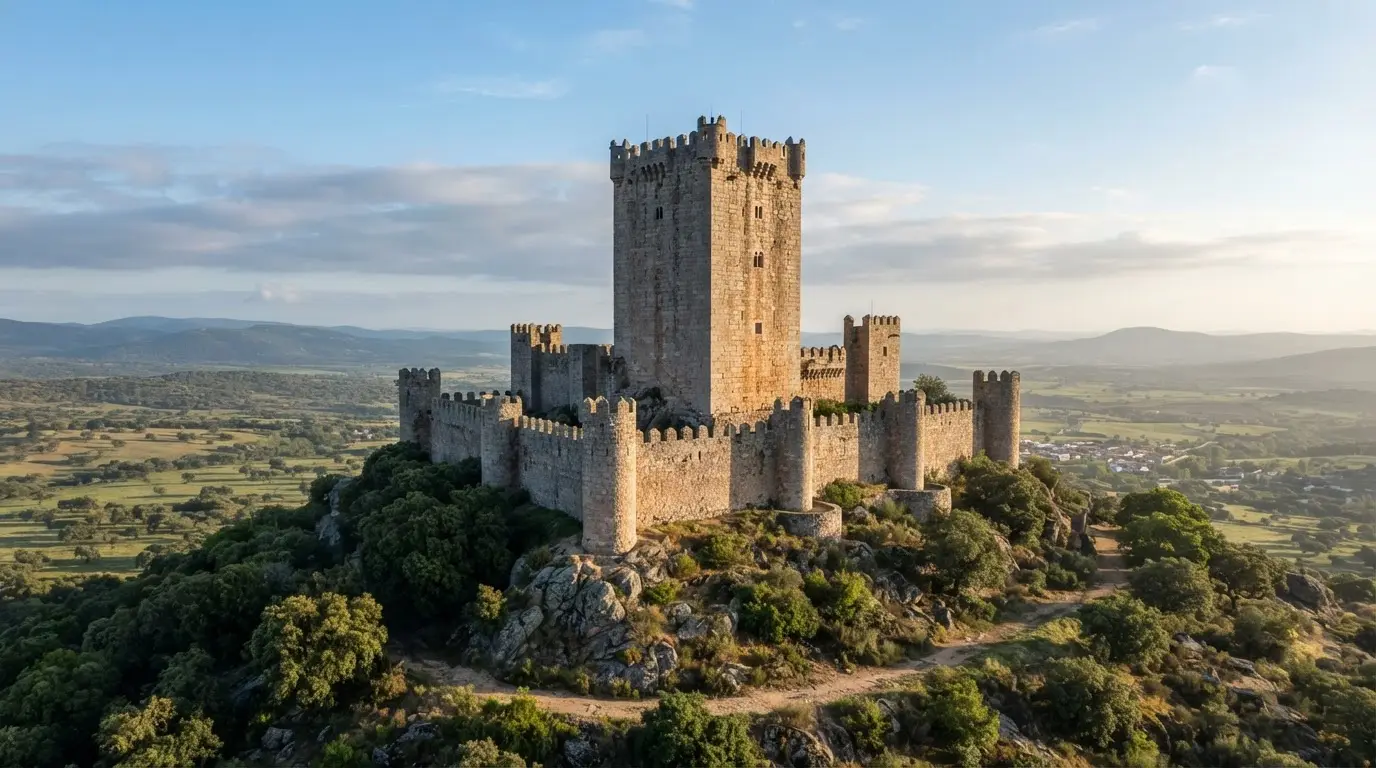
47 Metres Tall and Almost Unknown: Spain's Tallest Keep
Belalcázar Castle's 47 m keep is listed by the Junta de Andalucía as Spain's tallest. How it grew, what to see inside and how to book the free guided visit.
From here the gate is a stop on the Moorish architecture walk, and the Mezquita-Cathedral is the obvious next stop. Walk through the arch and look back at the inner face, rebuilt in 1928 to repeat the outer one.