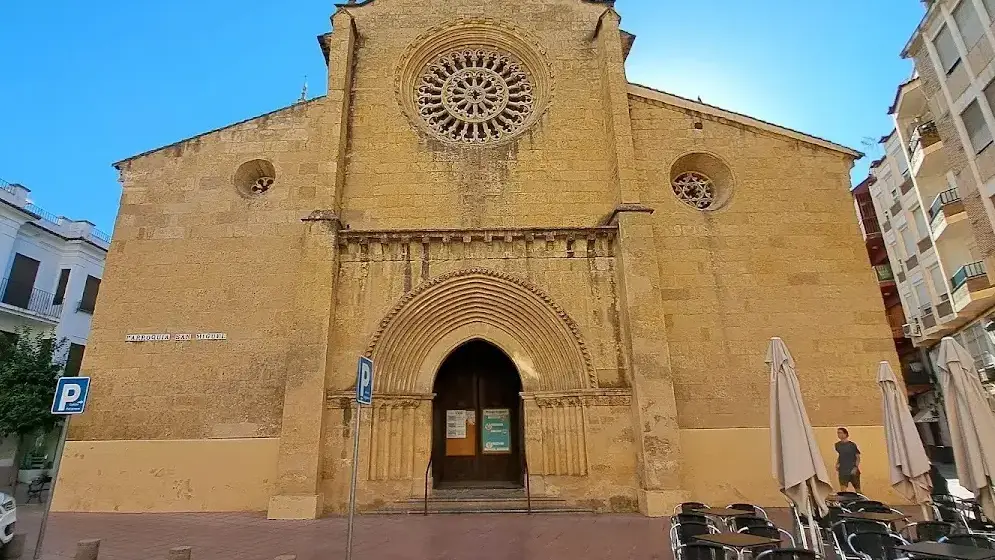

The Iglesia de San Miguel combines Gothic and Mudéjar styles in the manner typical of Córdoba's Fernandine churches. The main façade is dominated by a Gothic rose window that sends coloured light across the interior walls. The church opens onto the Plaza de San Miguel, a quiet square in the San Lorenzo quarter where locals gather beneath orange trees.
When to Visit
Best season
Year-round
Quietest hours
Weekday mornings (rose window effect around 11:00)
Visit duration
20 – 30 minutes
An Architecture of Transition
Built after the Reconquista of Córdoba by Ferdinand III in 1236, the church is one of fourteen Fernandine churches raised to establish Christian worship in the city. Its architecture reflects the realities of the period: northern Christian styles (Gothic, Romanesque) were used for the overall structure, while Mudéjar craftsmen handled much of the decorative work, applying their familiar geometric vocabulary to a Christian programme. The result is a building that looks like neither a northern Gothic church nor an Islamic monument, but something specific to this city.
The Fernandine churches were not just religious buildings — they functioned as the anchor points of a new administrative geography, each one placed at the heart of a new Christian parish carved out of what had been Muslim urban space. San Miguel served the quarter that now bears its name, and that parish identity has persisted to the present day.
Late afternoon in the Plaza de San Miguel for orange trees and local life
The quiet square comes alive around 6-7 pm when neighbours gather beneath the orange trees. The church interior is best in the morning for the rose window light, but the plaza atmosphere peaks in the evening. The corner bar has been serving the same regulars for decades.
Discovering the Interior
Three naves lead to a presbytery with an 18th-century marble altarpiece, added during later Baroque renovations. The rose window projects coloured light onto the white walls — most clearly on sunny mornings around 11am. Polylobed arches and certain patterned details echo Islamic precedents and show the hand of Mudéjar craftsmen who applied their decorative techniques regardless of the building's Christian function.
The church has been restored several times but retains much of its medieval fabric. The lateral portals — often overlooked because visitors enter through the main façade — carry carved details that are worth examining before you go inside.