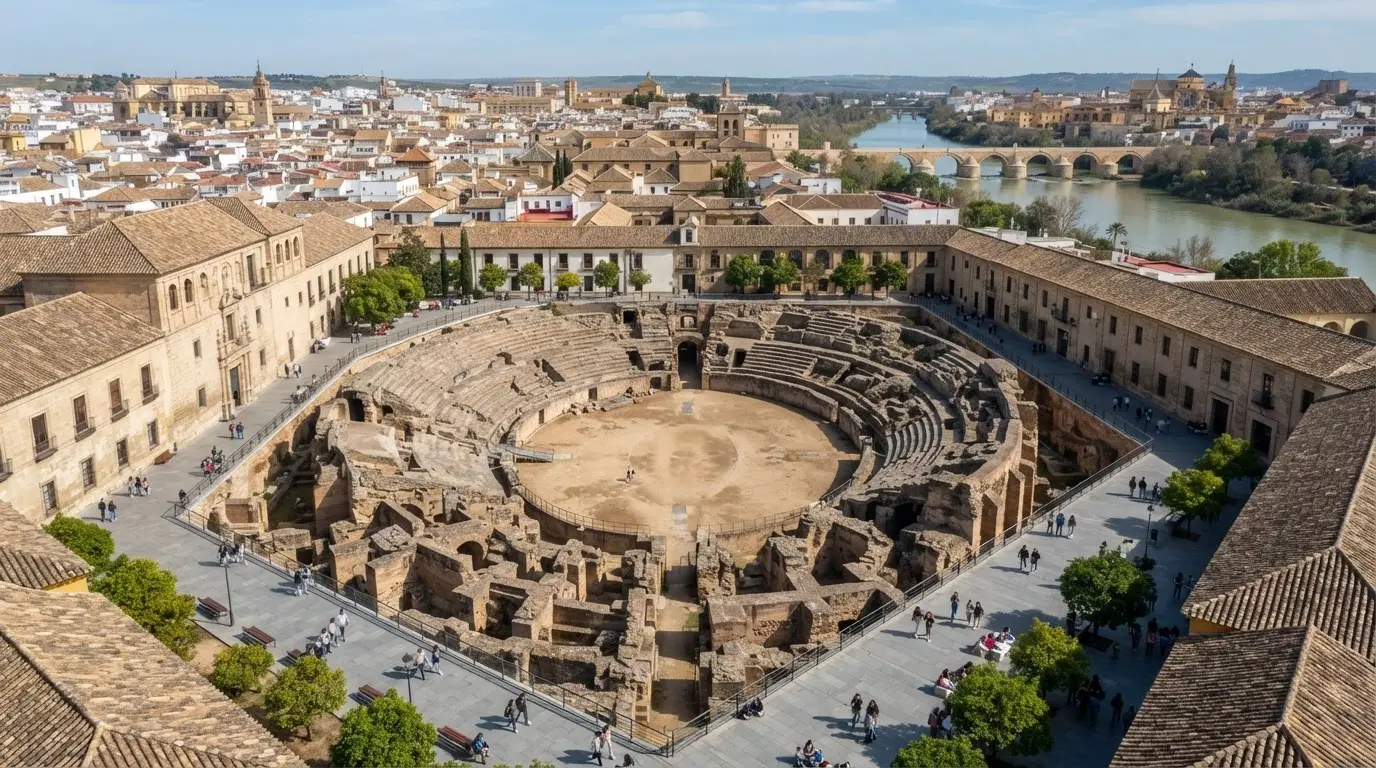
Córdoba's Roman amphitheatre was discovered in 2002 beneath the university building. At 178m, third-largest in the empire, and still not open to the public.
Ten years covering Córdoba's UNESCO heritage sites, sourcing from Junta de Andalucía documentation.
Updated Published
history-buffsphotographersarchitecture
In November 2002, excavations beneath the Rectorado de Córdoba, the university's main administrative building, uncovered what archaeologist Desiderio Vaquerizo later identified as the largest roman amphitheatre in Hispania Baetica. The structure measures 178 metres on its major axis[2] and could hold somewhere between 30,000 and 40,000 spectators. It had been sitting under the building, undetected, since the 4th century CE. You cannot walk in and buy a ticket. That is the first thing to know.
In this article
Jump to a section
⌄
What workers found beneath the university in 2002
The excavations that uncovered the amphitheatre were routine, in the sense that Córdoba's old town throws up Roman stonework with predictable regularity. The building on the site, the Rectorado, formerly the Faculty of Veterinary Medicine, had been there for decades. Nobody working in it had any reason to suspect what was underneath.
In November 2002, workers broke through to masonry at a scale that stopped the work. The initial read from on-site engineers was that they had found a circus — a chariot-racing track. Circuses and amphitheatres share basic structural logic (massive elliptical or elongated arenas cut into the earth, surrounded by banked seating on curved substructures), and the early fragments were ambiguous enough to support either interpretation.
Desiderio Vaquerizo worked through the evidence and re-identified the structure as an amphitheatre. The determinative clues were the geometry (more rounded than a circus's elongated track), the orientation, and the proportions of the substructure. A circus of comparable size would have looked different in section.
What the team also found, scattered through the fill, was material that no circus would produce: gladiatorial tomb stele inscriptions, the epitaphs carved for dead fighters giving their names, origins, fighting styles, and records. These fragments did not simply confirm an amphitheatre; they told you something about who had died in it.
The find was reported internationally. Discover Magazine ran the story under the headline "Córdoba's Coliseum"[1]. The Spanish press covered it as a major archaeological event. Córdoba got on with other things, because the building sitting on top of the site was still an active university facility and the question of what to do next was going to take time to answer.
Scale: how large was Córdoba's amphitheatre?
The dimensions recorded at the Rectorado site are 178 metres on the major axis by 140–145 metres on the minor axis[2]. To put that in context: the Colosseum in Rome measures 188 metres by 156 metres. Córdoba's amphitheatre is smaller, but not by much, and it was built roughly 20–30 years before the Colosseum[1].
According to Jose Carrillo's research as reported by Discover Magazine, the Córdoba amphitheatre may have been the largest in the Roman Empire at the time of its construction — approximately 50 CE, predating the Colosseum (built 72–80 CE)[1]. Overall, taking later construction into account, archaeologists place it third-largest in the empire, after Rome and the Amphitheatre of Carthage in North Africa[2].
Capacity estimates range between 30,000 and 40,000 spectators[2]. The range is wide because the seating configuration can only be partially inferred from the surviving substructure. What is agreed is that the number was large relative to the city's population — no reliable census figure survives for Corduba in the 1st century CE, but a venue built to seat tens of thousands implies a city with a substantial resident population and a wide catchment across Hispania Baetica.
That ratio tells you something about how Roman provincial capitals worked. Corduba was the administrative seat of Hispania Baetica, the wealthiest and most Romanised province in the western empire. That province produced two emperors, Trajan and Hadrian, both born in Italica near modern Seville — a measure of how far Baetica's political weight extended within the empire, even though the emperors themselves were not Cordubans. Its olive oil, garum, and metals were traded across the Mediterranean. An amphitheatre scaled to hold tens of thousands of spectators was not vanity construction. It was infrastructure. The arena was where political loyalty was performed in public, where criminals were executed as spectacle, and where the games calendar measured civic time.
The Roman temple on Calle Capitulares, built around the same period, gives a reference point for the scale of Corduba's public building programme. A 178-metre amphitheatre and a Corinthian hexastyle temple are what a provincial capital worth governing looked like.
The gladiatorial tomb stele: what the inscriptions say
The most unusual thing about the Córdoba excavation was not the size of the structure. It was the concentration of gladiatorial tomb stele recovered from the site and its surroundings.
Gladiators who died in the arena were sometimes commemorated with inscribed stone tablets: epitaphs that recorded the fighter's name, origin, fighting category, number of victories, and occasionally the circumstances of death. These stele exist at other Roman sites, but not in the same density. The collection associated with the Córdoba amphitheatre is, according to archaeologists, the largest assemblage of gladiatorial funerary inscriptions in the western Roman Empire.
The inscriptions name fighters from across the empire. Fighting styles documented in the stele include the secutor (heavily armoured, with a visored helmet), the retiarius (fighting with net and trident), and other paired categories that Roman gladiatorial combat systematised over centuries. A fighter's record was part of his public identity; his epitaph broadcast it in stone.
What the stele collectively reveal is that Corduba maintained a substantial gladiatorial operation. Fighters were housed, trained, and buried here. The city had the infrastructure to run the games at scale, repeatedly, over a period spanning at least two centuries. The city's Roman-antiquities museum holds examples of this material, and the collection offers the closest accessible encounter with the amphitheatre's actual human record.
Some of the inscriptions also carry reserved family seating plaques: tickets, in effect, that assigned wealthy Cordubans to specific sections of the arena[2]. These reinforce what the capacity figures suggest: the games were not an occasional spectacle. They were part of the rhythmic social life of a major Roman city, structured enough that certain families held hereditary or purchased rights to the same seats year after year.
Recommended tours
Tours are selected for quality, not commission. We earn a small fee if you book — at no extra cost to you.
The density of gladiatorial tomb evidence here also raises a question about memory. The inscriptions survived because they were reused as building material in later construction, incorporated into walls and foundations across the city. The stele were not preserved in a museum or protected in a necropolis. They were recycled, which is how Roman stone usually travelled through the medieval city. Their survival in enough pieces to be read and catalogued is partly luck.
From 1st century spectacle to 4th century silence
The amphitheatre was in use from roughly the 1st century CE through the 3rd century CE, with abandonment consolidated in the 4th century[2]. The reasons are not fully documented for Córdoba specifically, but the pattern matches what happened to Roman amphitheatres across the western empire.
Constantine's edict of 325 CE restricted gladiatorial combat, and a later edict of 399 CE banned it entirely, though enforcement was uneven and regional games persisted in some areas past both dates. More practically, the western empire's fiscal and administrative contraction in the 3rd and 4th centuries meant cities lost the public subsidy infrastructure that made large-scale games possible. Amphitheatres required constant maintenance. Once the games stopped, the maintenance stopped, and the structures began to deteriorate.
In Corduba, the collapse of the western imperial administration in the late 4th century opened a period of layered reuse. The amphitheatre's substructures were too massive to clear; instead, they became the foundation layer for whatever came next. Visigothic construction built on parts of the site. Later, Umayyad Córdoba, capital of al-Andalus from the 8th century onward, added further layers, each burying the Roman structure more completely[2].
Timeline
c. 50 CE
Amphitheatre constructed
Built during the early imperial period in Corduba, capital of Hispania Baetica. Possibly the largest arena in the empire at this date.
1st–3rd century CE
Active use
Gladiatorial games, public executions, and spectacles. Gladiatorial stele accumulate in and around the site.
4th century CE
Abandonment
Imperial edicts restrict gladiatorial combat; the games cease and structural maintenance ends.
8th–10th century CE
Umayyad construction above
Córdoba becomes capital of al-Andalus. New construction on the site buries the Roman substructure further.
20th century
Faculty of Veterinary Medicine built
The University of Córdoba builds its Rectorado complex above the buried amphitheatre, unaware of what lies beneath.
November 2002
Rediscovery
Excavations for building work expose the amphitheatre substructure. Desiderio Vaquerizo identifies it as an amphitheatre, not a circus.
The medieval city that grew into the modern one had no record of the amphitheatre below it. Unlike the Roman bridge across the Guadalquivir, which was continuously maintained and remained visible, the arena was simply sealed under accumulating construction. By the time the Faculty of Veterinary Medicine was built on the block in the 20th century, the ground level was several metres above the original Roman surface.
This is how most Roman Córdoba survived: not preserved, but buried. The Roman temple went under the City Hall. The circus foundations went under the residential streets of the old town. The amphitheatre went under the university. Each discovery is an accidental excavation forced by a building project, not a systematic archaeological programme.
What the amphitheatre changes about Córdoba's Roman history
Before 2002, the working picture of Roman Córdoba was already substantial: the Roman temple on Calle Capitulares, the circus fragments near Plaza de las Tendillas, the Roman bridge across the Guadalquivir. The amphitheatre did not contradict that picture. It inflated it.
A city that built a 178-metre arena capable of holding 30,000–40,000 people[2] was not a provincial outpost. Corduba was the administrative, commercial, and cultural centre of one of Rome's wealthiest provinces. The games were locally funded and locally organised, which required a permanent gladiatorial school, a population large enough to fill the seats, and an elite wealthy enough to bankroll the events. All three conditions were evidently met.
The concentration of gladiatorial tomb stele at Córdoba reinforces this. These inscriptions were not carved by a city occasionally hosting the games. They were carved by a city that ran the games as an institution, with fighters housed and buried here between bouts, families claiming seats in the stands, and a death toll sufficient to require a substantial epigraphic record.
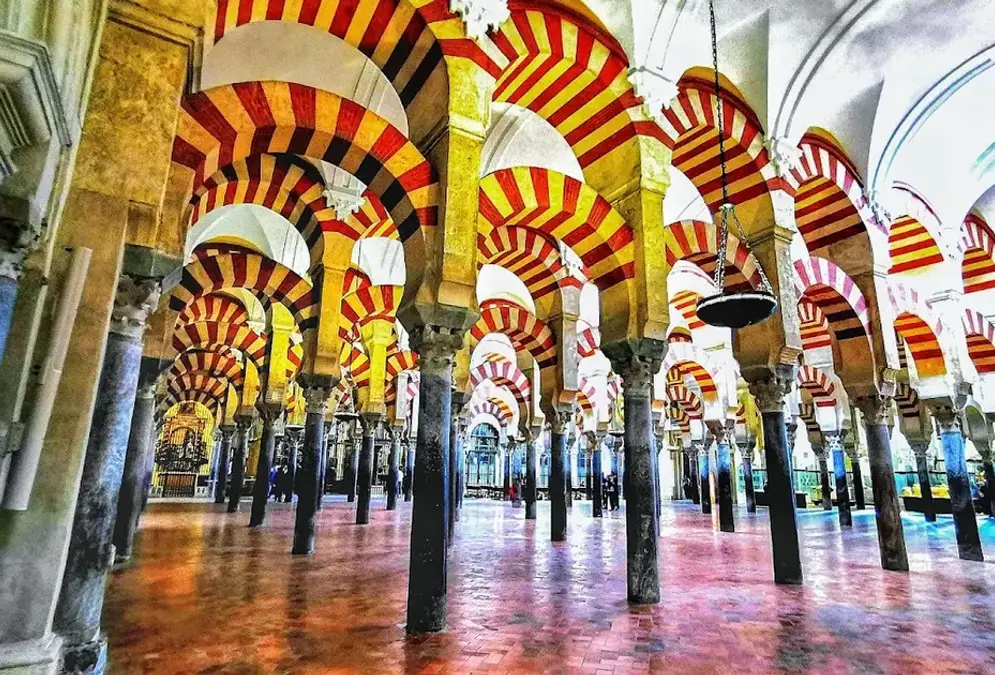
Córdoba's pre-Umayyad history tends to receive less attention than the 8th–10th century golden age that produced the Mezquita-Catedral, the library of al-Hakam II, and the philosophy of Averroes. The 2002 discovery is a corrective. The Roman city was not just a backdrop to the later Islamic one. It was a metropolis in its own right, building at a scale that competed with the capital of the empire.
The chariot-racing circus found nearby, the structure initially confused with the amphitheatre, further extends the picture[2]. A city that had both a major circus and an amphitheatre archaeologists rank among the three largest in the empire was spending serious public money on spectacle infrastructure. The games were not incidental to Corduba. They were central to its identity as a Roman city.
Visiting the amphitheatre today: what access actually means
The direct answer: you cannot walk in, look around, and leave. The amphitheatre is not a public tourist attraction in the standard sense.
The structure sits beneath the Rectorado de Córdoba, an active university administration building on Avenida de Medina Azahara. The excavated sections are accessible by appointment at the University Rectorate. This is not a ticketed site with opening hours posted on a tourism website. It is an archaeological site under an active institution, and access depends on the university's availability and the current state of ongoing work[2].
If you specifically want to see the exposed substructure, contact the University of Córdoba directly and ask about arranged visits. Some guided Roman Córdoba tours include the Rectorado site; checking with local tour operators is more reliable than walking up and knocking.
For most visitors, the practical alternative is the Archaeological Museum of Córdoba on Plaza Jerónimo Páez[5]. The museum holds gladiatorial stele fragments from the site, Roman mosaics, sculpture, and architectural elements from across the Roman city. It is open to the public, charges standard museum entry, and provides the closest accessible encounter with the amphitheatre's actual material record: the inscribed stones that name the fighters who died here.
The museum is a short walk from the Rectorado. The same half-day that covers the Roman temple on Calle Capitulares can include the Archaeological Museum. Between the temple, the museum, and whatever you can see from the street at the Rectorado, you get a reasonably full picture of Roman Corduba's scale without needing special access.
Site
Access
What you see
Cost
Amphitheatre (Rectorado)
By appointment only
Excavated substructure
Contact university
Archaeological Museum
Open to public
Gladiatorial stele, Roman artefacts
Standard museum entry
Roman Temple (Calle Capitulares)
Free, always open
6 reconstructed columns, podium
Free
Future excavation prospects are real but undefined. The university building above the amphitheatre limits what can be excavated without major institutional decisions. The site is protected; nothing will be built on it that would damage what remains. But a full systematic excavation, the kind that would produce a public-facing archaeological park, would require relocating university functions from the Rectorado. That has not happened yet, and there is no publicly announced timeline for when it might.
Frequently asked questions
Can visitors access the Roman amphitheatre in Córdoba?
Not freely. The amphitheatre sits beneath the University of Córdoba's Rectorado building on Avenida de Medina Azahara and is not a standard tourist site. Access requires an appointment through the University Rectorate. Some guided tours of Roman Córdoba include the site. The Archaeological Museum on Plaza Jerónimo Páez is the most accessible alternative, holding gladiatorial stele and artefacts from the excavation.
How large is the Roman amphitheatre of Córdoba?
The amphitheatre measures 178 metres on its major axis and 140–145 metres on the minor axis, with capacity estimates ranging from 30,000 to 40,000 spectators. Archaeologists place it third-largest in the Roman Empire overall, after Rome's Colosseum and the Amphitheatre of Carthage in North Africa. It may have been the largest in the empire at the time of its construction, around 50 CE, predating the Colosseum by roughly 20–30 years.
When was the Córdoba amphitheatre discovered?
November 2002, during excavations for building work beneath the Rectorado de Córdoba, the university's main administrative building. Workers initially mistook the structure for a circus (chariot-racing track). Archaeologist Desiderio Vaquerizo identified it as an amphitheatre based on its geometry, orientation, and the gladiatorial funerary inscriptions found in the fill.
What is special about the gladiatorial inscriptions at Córdoba?
The collection of gladiatorial tomb stele associated with the Córdoba amphitheatre is, according to archaeologists, the largest assemblage of gladiatorial funerary inscriptions in the western Roman Empire. The stele record fighters' names, origins, fighting categories (secutor, retiarius, and others), and victory counts. Some inscriptions also document reserved family seating arrangements in the arena. Examples are held at the Archaeological Museum of Córdoba.
Why is the Córdoba amphitheatre not fully excavated?
The structure sits beneath an active university administration building. A full systematic excavation would require relocating the Rectorado's functions, which has not been approved or scheduled. The site is protected and no further construction will damage what remains, but an archaeological park of the kind that full excavation would produce requires institutional decisions that have not yet been made. There is no published timeline for when comprehensive excavation might begin.
How does the Roman amphitheatre relate to other Roman sites in Córdoba?
Córdoba has several major Roman structures: the temple on Calle Capitulares (built roughly the same period, visible for free), the Roman bridge across the Guadalquivir (continuously maintained and walkable), the circus foundations near Plaza de las Tendillas, and the amphitheatre. Together they define the public-building programme of Colonia Patricia, the Roman capital of Hispania Baetica. The Archaeological Museum holds artefacts from across all these sites.
What fighting styles are documented in Córdoba's gladiatorial inscriptions?
The stele from the Córdoba amphitheatre document several standard Roman gladiatorial categories, including the secutor (heavily armoured fighter with a visored helmet), the retiarius (fighter with net and trident), and other paired fighting styles. The inscriptions name fighters from across the empire: Hispania, Greece, North Africa, and the Balkans — reflecting the empire-wide recruitment network that supplied gladiatorial schools in major provincial capitals.