
A Castilian plaza in an Andalusian city
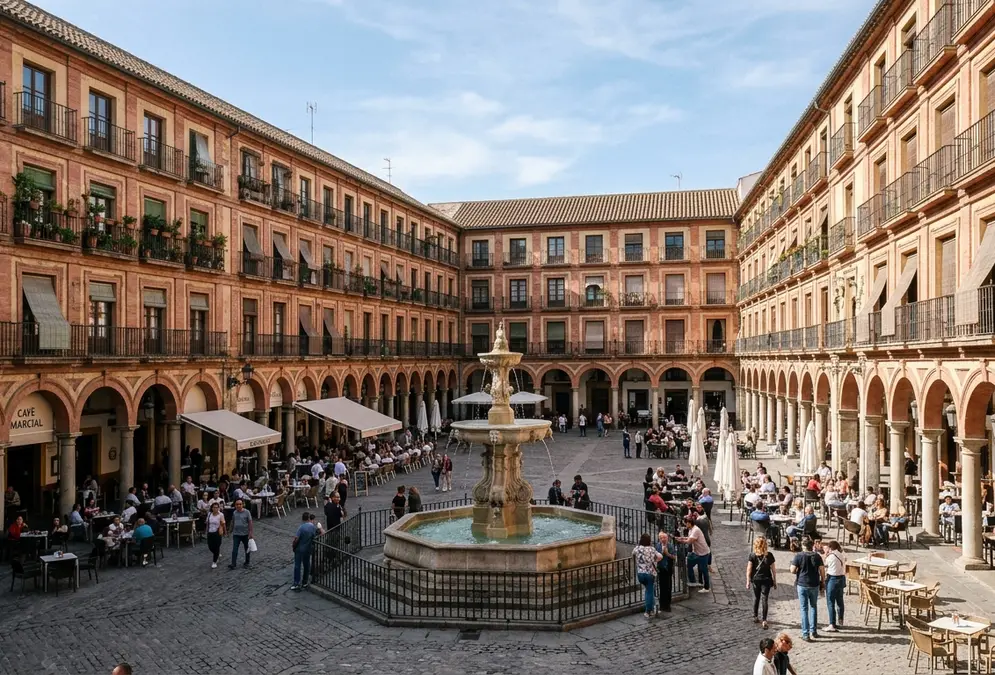
Every other significant public square in Andalusia is irregular in some way: squeezed between converging streets, shaped by a church on one side, or simply the result of centuries of opportunistic building. Plaza de la Corredera is none of that. It is a near-perfect rectangle, 113 metres long and 55 metres wide[2], with three storeys of arcaded facades running continuously around all four sides. The arcades are uniform, the buildings above them mostly from the same century. It looks like Madrid, or Salamanca, or the Plaza Mayor of any Castilian provincial capital.
This is not coincidence. When Corregidor Don Francisco Ronquillo Briceño ordered the square rebuilt between 1683 and 1687[2], he brought Castilian architectural thinking to a city shaped by centuries of Islamic and pre-Roman construction. The result has always felt slightly out of place, which is precisely why it is worth paying attention to.
The arcades on the ground floor run uninterrupted, supported by plain stone pillars with none of the ornamental detail you find on the facades of Seville or Granada. The upper floors carry balconied windows with iron railings. On sunny mornings, the geometry of shadow and light on the stone is as precise as a diagram. By late afternoon, those same arcades trap the last warmth of the day while the open centre cools.
The name Corredera has two documented origins, and sources disagree on which is correct[2]. One traces it to the corridas de toros (bullfights) once held on the site; the other to the continuous, unbroken (corridos) balconies that run around the surrounding buildings. Either way, the name predates the current 17th-century square and stuck long after its original meaning faded.
What the 1959 excavation found
When construction workers dug beneath the plaza surface in 1959[3], they were not looking for Roman archaeology. What they found was mosaic flooring from a Roman domus, a private house from the 1st to 3rd centuries AD[3]. The mosaics were intact enough to recover and document.
The most significant panel depicts the mythological scene of Polyphemus and Galatea[3]: the Cyclops who loved the sea-nymph, rendered in polychrome tesserae with the kind of technical precision that signals a wealthy patron and a skilled craftsman with a strong mosaic tradition. The scene is not unusual for Roman Hispania; what is unusual is how well it survived under a millennium and a half of subsequent construction.
The mosaics are now in the Hall of Mosaics at the Alcázar de los Reyes Cristianos[3]. If you visit the Alcázar, which most people do for the medieval fortress and the gardens, walk through the hall before going upstairs. The Polyphemus mosaic is laid flat on the floor, viewable from above through glass. The detail in the Cyclops's eye, the texture of Galatea's dress, the fish around her feet: all of it has survived.
A clarification worth making explicitly: the Roman amphitheater of Córdoba is not under Plaza de la Corredera. That amphitheater — at approximately 180 metres, the largest Roman arena structure in Hispania — had a capacity of roughly 30,000[4] and was one of the largest in the Roman Empire when built. It was discovered in November 2002[4] during construction work at the University Rectorate on Avenida Medina Azahara, on the western side of the city. The two sites confirm the same thing: Roman Córdoba underlies the modern one at almost every point you dig. The Roman Temple, found in 1951[6] on Calle Capitulares, is a third example of the pattern.
Explore nearby · Monument
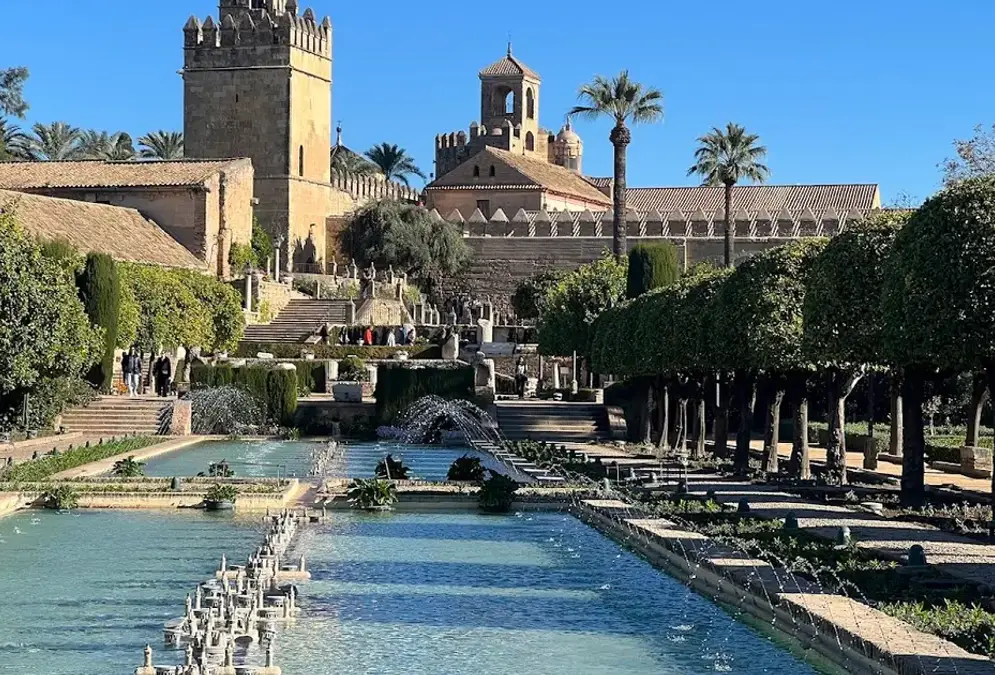
Alcázar de los Reyes Cristianos
Alcázar de los Reyes Cristianos, Córdoba: free entry on Tuesdays. A 14th-century fortress-palace with terraced Moorish-inspired gardens and Roman mosaics.
Three centuries of public spectacle
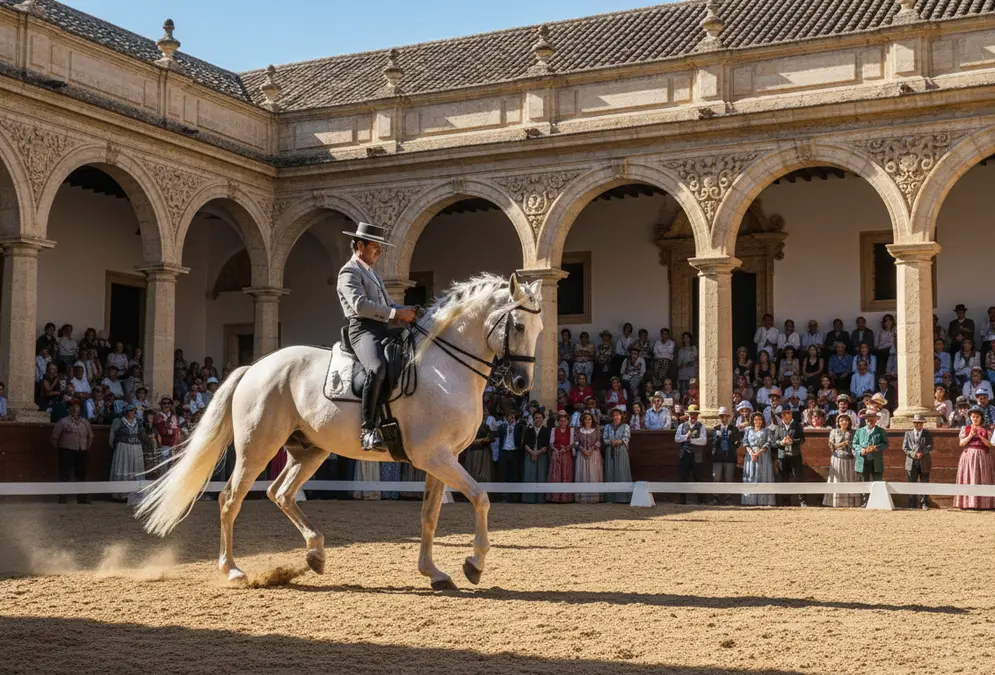
Before it was a square to have a coffee in, Plaza de la Corredera was where Córdoba watched things happen. The same enclosed geometry that makes it architecturally coherent made it functionally ideal for spectacle. The arcades served as covered grandstands, the windows above provided private viewing from the residential floors, and the open centre gave a flat stage roughly the size of a modern football pitch.
Bullfighting was held here after the square was built[1]. The rectangular form was less convenient than a circular arena, but it worked. The iron rings still visible on some of the arcade pillars are believed to be from this period, used to tether horses and control bulls before events. Bullfighting eventually moved to purpose-built rings, but Corredera's association with physical spectacle lasted.
The same enclosed geometry that makes it architecturally coherent made it functionally ideal for spectacle.
The square also witnessed auto-de-fé, the Inquisition's public ceremony of sentencing. Those found guilty of heresy were formally condemned here, in front of the population, officiated by religious and civil authority together. Córdoba had an active Inquisition tribunal — headquartered at the Alcázar de los Reyes Cristianos from 1492[7], an era later associated with inquisitor Diego Rodríguez Lucero, remembered in some accounts for a particularly severe pursuit of conversos — and a square that could hold thousands of spectators in covered galleries was the natural setting. For the longer story of how Roman layers connect to later Córdoba history, Córdoba's Roman Temple: Found Under City Hall in 1951 [6] shows the same pattern at work across the city.
Recommended tours
Tours are selected for quality, not commission. We earn a small fee if you book — at no extra cost to you.
During the Napoleonic Wars, the plaza saw public executions. French forces occupied Córdoba in 1808 and used the square as a site of punitive visibility[1]. The same logic of enclosure and spectacle that had served bullfighting and Inquisition ceremonies served as an execution ground. The 19th-century history of Corredera is its darkest chapter, and the architecture absorbed it without showing the marks.
The plaza today: market, terraces, and the octagonal fountain
On a weekday morning before nine, the square has two speeds. Under the arcades on the northern side, the daily food market is already open: fishmongers with crushed ice and whole fish, vegetable stalls, meat counters. The market runs Monday to Saturday, 8:00 to 14:30[5], and it is primarily a local market, not a tourist attraction. You will hear Córdoba dialect and see shopping bags, not cameras.
The surrounding bar terraces open for coffee at roughly the same time, and by ten o'clock the central octagonal fountain has its first pigeons. The fountain is widely believed to be a later addition rather than part of Ronquillo Briceño's original 1683[2] design, which left the centre open for the spectacles the square was built to host, though its exact date is not firmly documented. The fountain is pleasant but unremarkable. The facades above it are neither.
For lunch and evening drinks, the terraces under the arcades fill steadily. The covered position means you are out of direct sun in summer and sheltered from rain in winter, which gives Corredera a longer useful day than most outdoor spaces in the city. The food ranges from standard tapas to raciones: salmorejo, cured meats, fried fish. The quality varies. The best advice is to walk the full perimeter before sitting down. The northern arcade, closer to the market entrance, tends to have the more workaday bars; the eastern and southern arcades are more settled.
Deep dive · Article
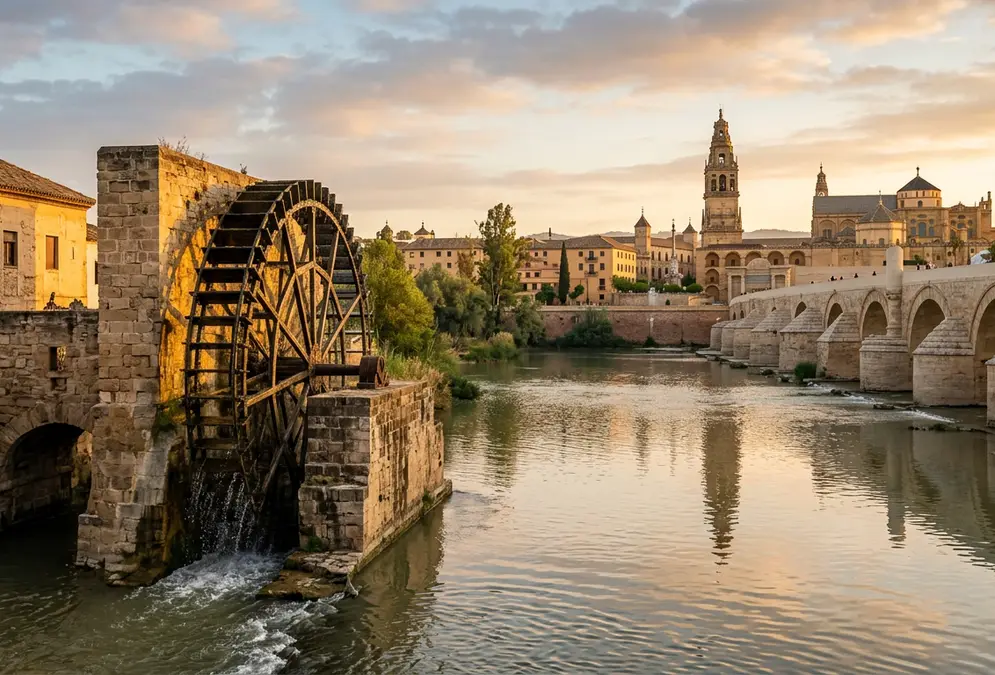
Albolafia waterwheel history: Abd al-Rahman II's Córdoba
The Albolafia waterwheel first appeared on Córdoba's coat of arms in the 1300s, vanished for centuries, and returned in 1983 — not Abd al-Rahman II's work.
The square also hosts occasional events including a Medieval Market in January[1]. On those days the population density triples and the geometry of the arcades, designed for spectacle, does exactly the job it was built to do.
When to go and where to sit
The square rewards two different visits: early morning on a weekday and early evening on any day. They are almost different places.
At 8:00 on a Tuesday, the food market is in full operation and the terraces are empty except for a few locals with coffee. The light at that hour catches the upper facades at a low angle, and the square has the unhurried quality of somewhere that has been doing the same thing for three centuries. This is the time to walk the perimeter carefully, look at the arcade columns, and find the iron rings.
By 19:00, the terraces have filled and the fountain is the centre of foot traffic. In spring and autumn, the arcades are still warm at this hour and the sky above the open rectangle has turned orange or pink. This is the hour the square was implicitly designed for: enclosed, sociable, watched from above.
For the best view of the facades, sit on the east side, facing west. The afternoon light hits the western arcade directly, showing the relief of the columns and the depth of the balconies. The northern arcade, where the market entrance is, has a more utilitarian feel and less visual interest from a seated position.
The Plaza del Potro is a ten-minute walk south: quieter, with a 16th-century fountain and three museums nearby. The two squares make a natural pairing if you want to understand the range of Córdoba's public spaces.
If you want to combine the Roman connection: the Alcázar de los Reyes Cristianos, where the mosaics from beneath Corredera are displayed, is a fifteen-minute walk southwest. The Hall of Mosaics is included in the standard ticket.