The 1236 Siege of Córdoba: The Night the City Fell
The Siege of Córdoba lasted five months in 1236: an unauthorized almogávar raid opened it, Ferdinand III arrived February 7, and the city surrendered June 29.
Art history background with eight years writing interpretive content on Córdoba's Caliphal heritage.
Updated Published
history-buffsphotographers
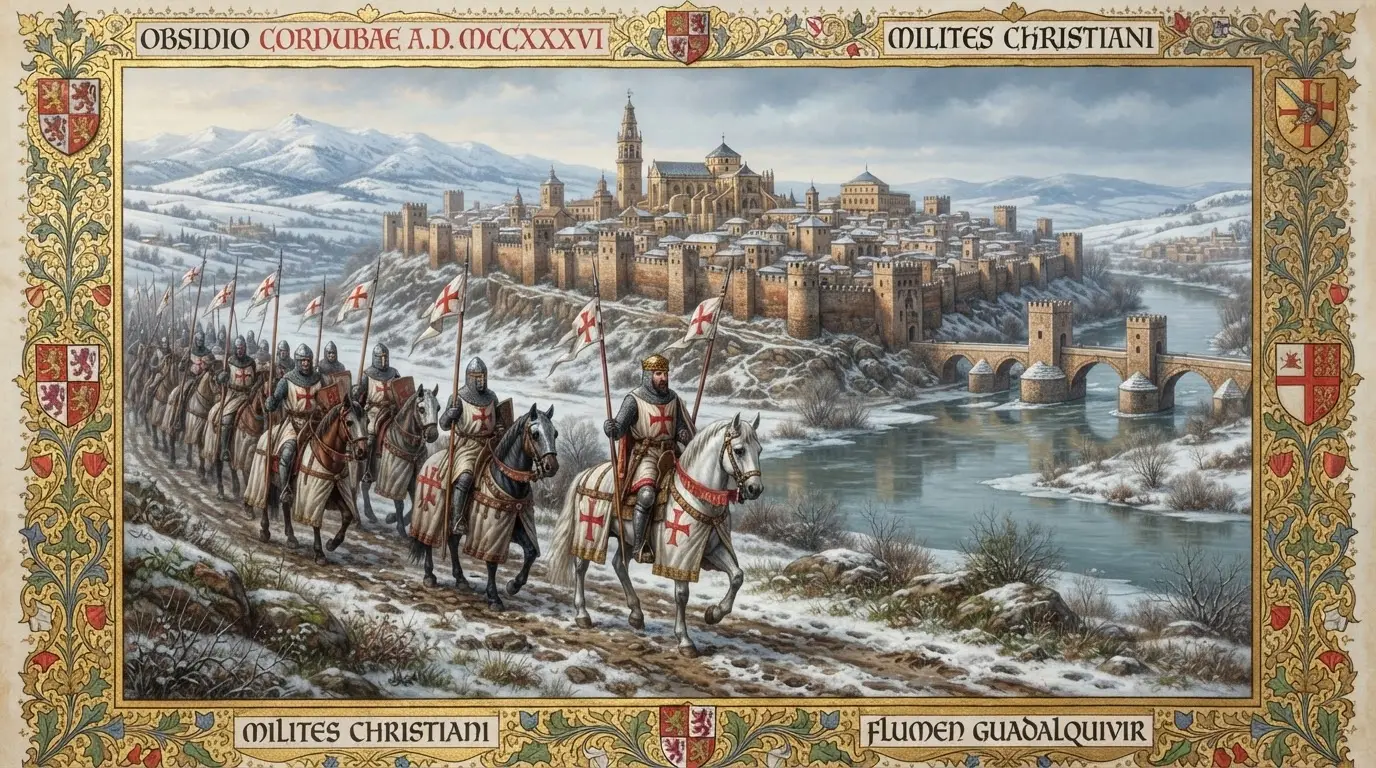
The siege of Córdoba 1236 did not begin with an army at the gates. It began with a small band of fighters in the dark, a rain-soaked tower in an outer suburb, and a border commander named Álvaro Colodro who understood that fortune does not wait for treaties. What followed was five months of standoff, a king's forced march through flooded roads, and the surrender on June 29, 1236 of the city that had once been the largest in western Europe.
In this article
Jump to a section
⌄
The night the tower fell
The year turns to 1236 somewhere in the Axerquía, Córdoba's sprawling eastern suburb. Rain. Mud. The outer walls of the walled Medina rise to the west; the Axerquía is separated from it by an inner wall, which is why the suburb mattered tactically — whoever held the Axerquía had a forward position directly against the Medina's defenses[1].
29 June 1236
The feast of Saints Peter and Paul — the date Ferdinand III accepted Córdoba's surrender after a five-month siege that began with an unauthorized tower seizure in the Axerquía suburb the previous winter.
In the last week of 1235 or the first days of January 1236 — the exact date has never been established — a small band of almogávars seized a tower in the Axerquía[1]. Their leader, Álvaro Colodro, gave his name to both the tower and the gate later built beside it. Some accounts add a second figure, Domingo Muñoz, though his role varies by source. Whether the group disguised themselves as Moors to cross contested ground undetected, or simply moved fast enough through a poorly monitored perimeter, is not recorded with certainty.
What the accounts agree on: the action was unauthorized. It exploited a structural weakness in the city's defenses and in the political situation — the outer suburb had disaffected residents who had created the opening, and the almogávars moved into it[1].
A tower seized by a handful of fighters in an outer suburb was not the same as a city taken. But it forced every hand at once. Córdoba's garrison could not ignore the position. Ferdinand III, encamped to the north and bound by a truce with the Moorish ruler Ibn Hud, now faced an impossible choice: abandon his men or break his word[1].
Who were the almogávars?
The almogávars were not soldiers in any court-recognizable sense. They were frontier fighters drawn from mountain communities along the border zones of Christian Iberia — shepherds, farmers, men who had grown up in terrain where the distinction between raid and war was largely administrative[2].
Their equipment was minimal by military standards of the time:
Two javelins (azconas)
A short thrusting spear
A falchion or short sword
No armour
The absence of armour was not poverty. It was doctrine. Speed and concealment were their advantages; plate would have negated both. An armogávar band moved through country that cavalry could not and struck positions that heavier forces could not reach without warning[2].
What made the Axerquía infiltration plausible was something beyond equipment: cultural camouflage. The almogávars who operated along the Castilian-Moorish frontier had absorbed enough Arabic language and habits to move in occupied territory without immediately announcing themselves[1]. In a suburb like the Axerquía, where Christian and Muslim populations were already mixed and the political situation was deteriorating, a small group who looked and spoke like locals could reach a poorly guarded tower before anyone organized a response.
The almogávars are most associated in later history with the Crown of Aragon — the Almogàvers in Catalan, who fought across the Byzantine east in the early 14th century. But in 1235–1236, the frontier they worked was Castilian, and the technique was the same: move fast, take an objective, hold it until a larger force arrives or the opportunity collapses.
The truce paradox and Ferdinand's forced march
Ferdinand III had a problem that no military textbook addresses: his own men had created a crisis by succeeding. He had signed a truce with Ibn Hud, the taifa ruler who nominally controlled much of what remained of al-Andalus[1]. Breaking that truce to support an unauthorized raid was a different kind of political act from launching a formal campaign.
He chose to ride south.
The conditions of that march are documented in the chronicles — not the distance or the precise route, but the weather. Rainstorms. Flooded roads. Ferdinand and what one account puts at thirty knights, another at a hundred, pushing south through Castilian winter terrain that had not been maintained for movement at speed[1]. He arrived at Córdoba on February 7, 1236[1]. Álvaro Pérez de Castro had already reinforced the almogávar position in the Axerquía, holding the bridgehead against Córdoba's garrison until the king's forces consolidated.
The political context that made this possible is worth understanding. By 1236, the Almohad Caliphate that had unified Muslim Iberia had dissolved[3]. What remained were competing taifas, Ibn Hud in the west and Ibn al-Ahmar (the Nasrid founder, later builder of the Alhambra) consolidating in the east. The two were fighting each other. Córdoba, which sat in contested territory between them, was administratively exposed and militarily under-reinforced at exactly the moment Ferdinand arrived[1].
Córdoba had been the symbolic and actual capital of al-Andalus at its height. The Alcázar de los Reyes Cristianos, later Ferdinand's headquarters, would be built on the ruins of the Umayyad palace complex. In 1236, that palace was already long gone — the Caliphate had ended in civil war in 1031. What remained was a walled Medina with a demoralized garrison caught between collapsing external powers and an enemy that had already occupied its forward suburb.
Recommended tours
Tours are selected for quality, not commission. We earn a small fee if you book — at no extra cost to you.
The army Ferdinand assembled at Córdoba was not enormous. This was not a set-piece siege like the later campaigns at Jaén (1246) or Seville (1248). It was a constrained force holding a position while pressure built on the defenders inside[3].
Five months under siege
The shape of the siege is straightforward in outline, less clear in daily detail. Ferdinand held the Axerquía. The walled Medina — the inner city, where the Great Mosque stood — remained in Muslim hands behind its own wall. Neither side had what it needed to force an immediate resolution[1].
For the defenders, the fundamental problem was relief. Ibn Hud was fighting for his own survival against Ibn al-Ahmar; he sent no substantial force to break the siege. Ibn al-Ahmar was doing something more damaging than staying out of it: within that same year he betrayed Ibn Hud outright, helping Ferdinand III take Córdoba as part of his own bid for power[9]. Córdoba's garrison held a strong defensive position inside excellent walls, but with no relief coming, each week the calculus shifted[1].
For Ferdinand, the problem was also supply and manpower. He could not storm the Medina directly — the walls were too strong and his force too small. What he could do was wait, reinforce through the spring, and ensure the defenders understood that no help was coming from outside.
The Roman bridge across the Guadalquivir, which Ferdinand's forces would have used to cross from the northern bank during the campaign, had been the city's main crossing point for more than a thousand years by this point. The bridge the army used was not the romanticized structure visitors walk today — it had been heavily modified through the Umayyad and later medieval periods, its arch count already reduced from the Roman-era seventeen to sixteen[12] — but it was the same sixteen-arch crossing that stands today, and Córdoba's economy depended on keeping it open[11].
By June, the balance had shifted enough. The garrison faced a choice between continued resistance with no realistic prospect of relief, or negotiated terms while terms were still on the table.
The surrender on the feast of Peter and Paul
June 29, 1236 is the feast of Saints Peter and Paul. Ferdinand accepted the city's surrender on a date that the Castilian chronicle tradition treated as providential — the same date the Great Mosque was formally converted into a cathedral, a coincidence the court was happy to underline[1].
The terms of the surrender were not punitive by the standards of medieval siege warfare. The Muslim population was permitted to leave with their movable possessions. What they could carry: clothing, household objects, portable wealth. What they could not take: the buildings, the infrastructure, the fields, the accumulated capital of a city that had been the intellectual and commercial center of western Europe in the 10th century.
Thousands left for Granada or crossed to North Africa[4]. The chronicle sources do not give reliable population figures for Córdoba in 1236. The city had contracted sharply from its Caliphal peak — when it had perhaps held 400,000–450,000 inhabitants[8], almost certainly the largest city in western Europe at that moment — but it was still a substantial urban center. The departure of its Muslim population within days of the surrender was one of the most significant demographic disruptions of the Reconquista — though the later 1248 expulsion from Seville likely exceeded it in absolute scale.
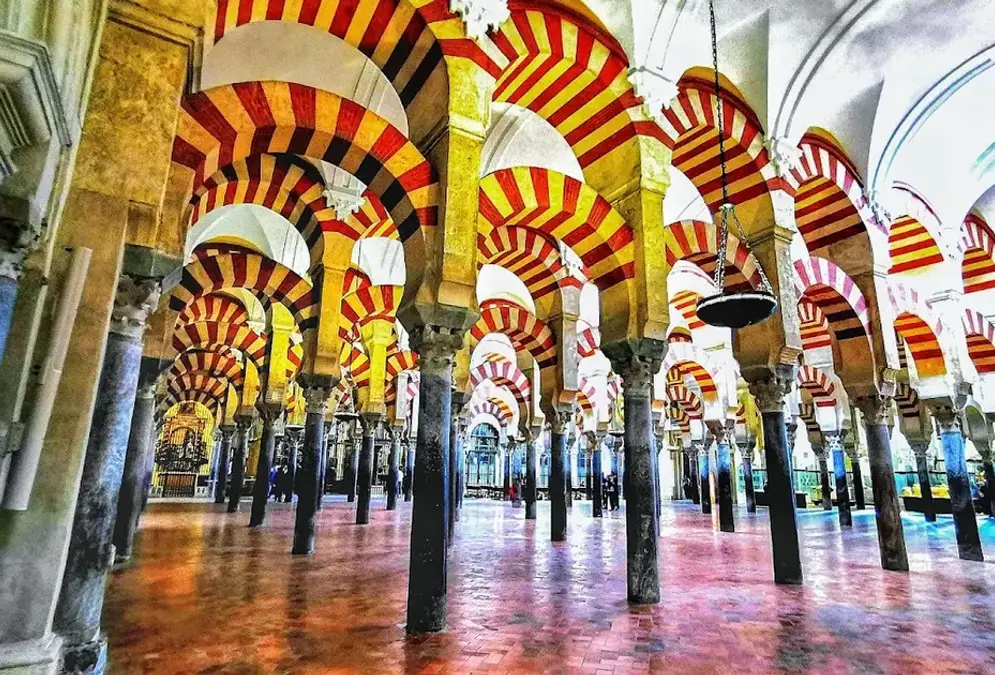
What they left behind was a city that Ferdinand now had to populate and administer. He distributed houses, plots, and endowments to the knights, clergy, and military orders who had participated in the siege. The redistribution extended to productive infrastructure: the eleven Guadalquivir mills that had ground the city's grain[10] — among them the Albolafia, whose noria lifted river water into an aqueduct feeding the Umayyad palace precinct[13] — passed to new Christian proprietors, their Arabic names replaced by saints' names and family surnames — a process traced in detail in our deep dive on the river's watermills. The Mezquita conversion 1236 account covers the conversion ceremony in detail — the crosses installed, the first mass, the layering of Christian liturgy over an intact Islamic building. The physical fabric of the Great Mosque was preserved: the garrison had been military, not iconoclastic, and the Castilian court recognized what it had taken.
The Judería, later home to the synagogue and the community that produced Maimonides, had already been the city's Jewish quarter for centuries. Those residents largely remained — their status under Castilian law was different from that of the Muslim population, and the forced departure of 1236 was specifically the Muslim community's experience, not the city's entire non-Christian population.
Why the conquest of Córdoba mattered beyond 1236
The fall of Córdoba was not a military operation of exceptional scale. It was not Seville in 1248, which required years of preparation and a properly equipped army. The 1236 conquest succeeded because the political structure that had defended al-Andalus had already collapsed from within, because the timing hit a gap between rival Muslim rulers, and because a frontier raider named Álvaro Colodro happened to see an unguarded tower on a wet winter night[1].
The symbolic weight, however, was enormous. Córdoba was where al-Andalus had been defined. The mosque Abd al-Rahman I began in 785 CE, the library al-Hakam II assembled in the 960s, the street grid of a city that had produced Averroes, Maimonides, and Ibn Hazm — all of it passed to the Castilian crown in a single morning. From the perspective of the Muslim world, this was not simply a military defeat. It was the loss of the city that had been the proof of what al-Andalus could produce[8]. The scholarly generation still in Córdoba when the walls fell had no choice but to leave: Al-Qurtubi, then in his early twenties, fled for Alexandria rather than remain under Castilian rule, carrying Córdoba's legal and scriptural training into a lifetime of exile in Egypt.
For the Reconquista's trajectory, Córdoba set the pace. Jaén fell to Ferdinand in 1246. Seville, the larger prize, fell in 1248[3]. Granada held out as the last Nasrid emirate until 1492 — surviving in part because Ibn al-Ahmar, who had already helped seal Córdoba's fate by betraying Ibn Hud rather than defending the city, understood exactly what was coming next and spent five decades building Granada's defenses instead. The Alhambra exists, in a real sense, because of the lessons of 1236.
Timeline
Winter 1235–1236
Almogávar infiltration
Álvaro Colodro leads a small band to seize a tower in the Axerquía. Exact date disputed. Ferdinand III, bound by truce with Ibn Hud, must choose whether to respond.
7 February 1236
Ferdinand arrives at Córdoba
The king rides south through rainstorms with a small force. Álvaro Pérez de Castro has already reinforced the Axerquía position. The formal siege of the walled Medina begins.
Spring 1236
Five-month standoff
The garrison holds the Medina. No relief comes from Ibn Hud or Ibn al-Ahmar, who are fighting each other. Ferdinand consolidates, cuts supply lines, and waits.
29 June 1236
Surrender and conversion
The Medina surrenders on the feast of Saints Peter and Paul. The Muslim population departs with movable possessions for Granada and North Africa. The Great Mosque is formally converted.
1246
Jaén falls
Ferdinand III continues south. Jaén surrenders, isolating Granada further.
1248
Seville falls
The Almohad capital of Seville falls after a two-year siege. Only the Nasrid emirate of Granada survives as an independent Muslim state.
Tourists who walk across the Roman bridge and look up at the Alcázar de los Reyes Cristianos are standing inside the administrative logic of what happened in 1236. Ferdinand did not move his court into the Great Mosque; he built his headquarters on the Guadalquivir bank, where the Umayyad palace precinct had once stood. The mosque became a cathedral. The Alcázar became the site where Columbus, two and a half centuries later, would receive authorization for a rather different kind of expedition.
Alvaro Colodro's tower no longer stands. The gate named for him is gone. What remains is a city whose entire post-1236 built environment — the Alcázar, the Christian additions to the Mezquita, the patterns of the streets in the old Judería — follows directly from that unauthorized night crossing in the rain. Córdoba's deeper history runs continuously from the Romans through the Umayyads to Ferdinand's court, each layer built on what the previous one left behind. What Ferdinand's court built in the centuries after the surrender, from parish churches to the Alcázar's later role, is traced in this guide to Christian Córdoba.
Frequently asked questions
When exactly did the siege of Córdoba 1236 begin?
The precise start date is disputed in the sources. A small band of almogávars under Álvaro Colodro seized a tower in the Axerquía suburb in the last week of 1235 or the first days of January 1236 — historians typically say "winter of 1235–1236." Ferdinand III arrived at Córdoba on February 7, 1236, marking the beginning of the formal military siege of the walled Medina.
What were almogávars, and why were they important in the siege of Córdoba?
Almogávars were frontier fighters from the mountain borderlands of Christian Iberia — farmers and shepherds who fought without armour, using javelins, a short spear, and a falchion. They moved fast, operated in small groups, and in many cases spoke Arabic and could pass through Moorish-held territory with less suspicion than regular troops. These qualities made them ideal for the kind of covert infiltration that opened the siege: a small group seizing a poorly guarded tower in the Axerquía suburb before the garrison could organize a response.
What happened to the Muslim population after the surrender in 1236?
The terms Ferdinand negotiated allowed Córdoba's Muslim population to leave with their movable possessions. Thousands departed for Granada or crossed to North Africa. They could take clothing, household goods, and portable wealth, but not property or real estate. The departure was one of the most significant demographic disruptions of the Reconquista, though the 1248 expulsion from Seville was likely larger in absolute scale. The city Ferdinand then needed to repopulate and administer was substantially emptied of its previous inhabitants.
Why did the Moorish rulers not relieve the siege?
By 1236, the Almohad Caliphate that had unified Muslim Iberia had collapsed. The two main remaining powers — Ibn Hud in the west and Ibn al-Ahmar (founder of the Nasrid dynasty) in the east — were actively fighting each other. Neither was in a position to send a relief force to Córdoba, and neither had sufficient incentive to risk their own forces for a city that sat in the contested space between their territories. This political fragmentation is what made the conquest possible.
What happened to the Great Mosque after the siege of Córdoba?
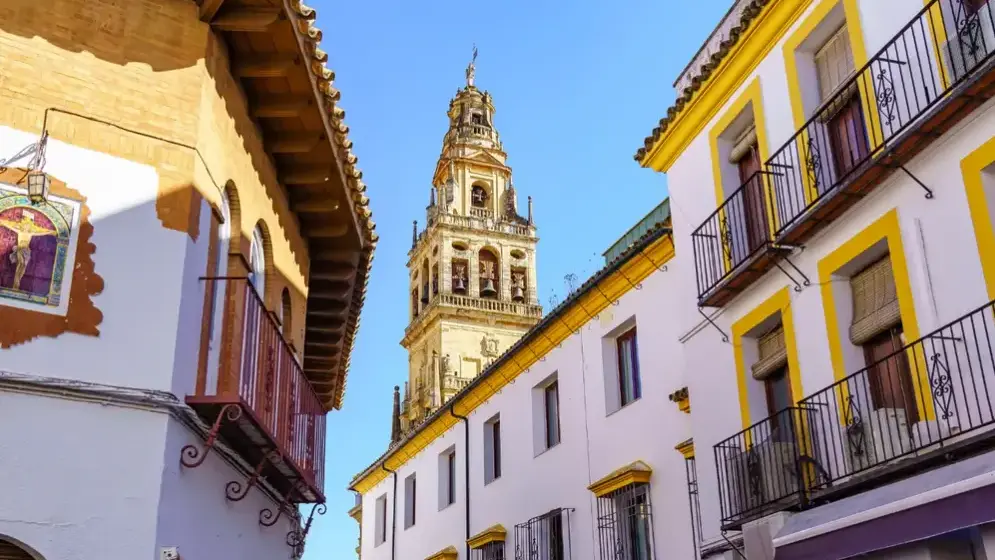
Ferdinand III formally converted the Great Mosque into a Catholic cathedral on June 29, 1236, the same day as the surrender. In practice, the physical building was barely altered for the first decades after the conquest: crosses were added to gates and the minaret, Christian altars were installed inside the prayer hall, but the structure's Islamic architecture remained intact. The dramatic changes came later, particularly the construction of a Renaissance cathedral nave in the 16th century under Charles V. The full story of what happened inside the building after 1236 is covered in the companion article on the Mezquita conversion.
How significant was the fall of Córdoba compared to later Reconquista conquests?
Córdoba's symbolic weight exceeded its military scale. It had been the capital of the Umayyad Caliphate of Córdoba, the intellectual center that produced Averroes, Maimonides, and Ibn Hazm, and at its 10th-century peak possibly the largest city in western Europe. Militarily, the 1236 conquest was less complex than the later sieges of Jaén (1246) or Seville (1248). But the loss of Córdoba signaled the collapse of Muslim political viability in the peninsula more clearly than any battle, and directly accelerated the consolidation of the surviving Nasrid emirate of Granada.
Can visitors see anything related to the 1236 siege in Córdoba today?
The Alcázar de los Reyes Cristianos, built on the Guadalquivir bank after 1236 on the site of the former Umayyad palace precinct, became Ferdinand's administrative headquarters after the conquest. The Roman bridge, which Ferdinand's forces used during the campaign, remains walkable today. The Mezquita-Catedral is the building that was formally converted on June 29, 1236, and most of what visitors see there predates the conquest. The tower Álvaro Colodro seized and the gate named for him no longer stand.
“The names of these eleven mills are Albolafia, Alegría watermill, Carbonell, Casillas, Emmedio, Lope García, Martos, Pápalo Tierno, San Antonio, San Lorenzo, and San Rafael.”
“the Umayyad dynasty's designated Muslim governor Al-Samh ibn Malik al-Khawlani ordered a bridge to be built on the ruins of what was left of the old Roman construction... its shape had 16 arcades, one fewer than originally”