
June 29, 1236: what Ferdinand III actually did
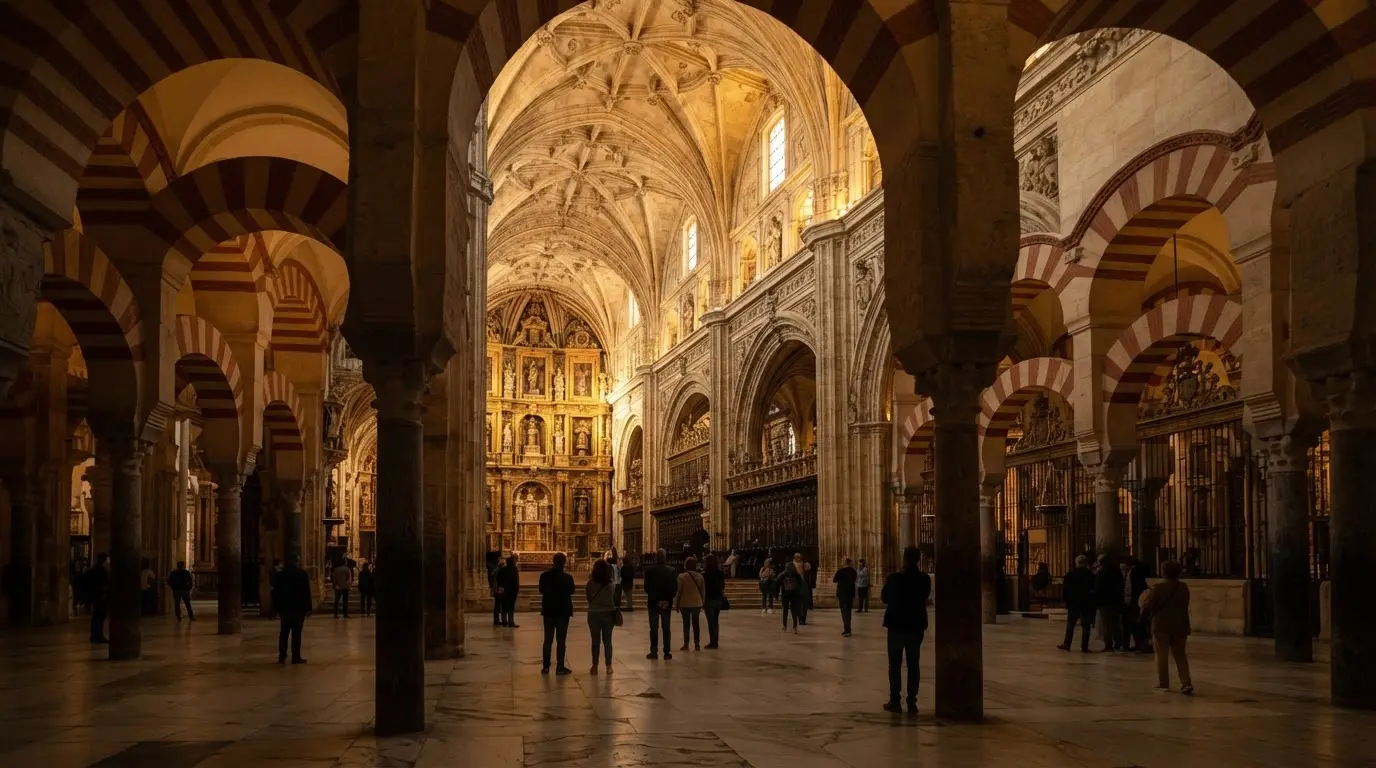
Ferdinand III of Castile entered Córdoba on a saint's day, and the symmetry was too good to waste. June 29 is the feast of Saints Peter and Paul, an auspicious date for a conquest the Castilian crown had been positioning as holy war. The city had fallen only hours earlier, the culmination of the 1236 Reconquista siege — a five-month operation that began with a small force of almogávars holding a tower inside the walls and ended with Ferdinand's forced march through a January night to arrive before rival Christian lords could claim the prize. The Great Mosque of Córdoba was formally converted into a Catholic cathedral dedicated to the Virgin Mary that same afternoon, with the first Christian mass celebrated before the day was out.[1]
June 29, 1236
What "converted" meant in practice is where the tourist narrative diverges from the historical record. The physical building was not demolished, restructured, or stripped. Ferdinand's court chose preservation. The immediate changes were almost entirely symbolic and liturgical:
- Crosses were installed at the gates and at the summit of the minaret
- Christian altars and furnishings were placed inside the prayer hall
- Bells replaced the muezzin's call from the tower
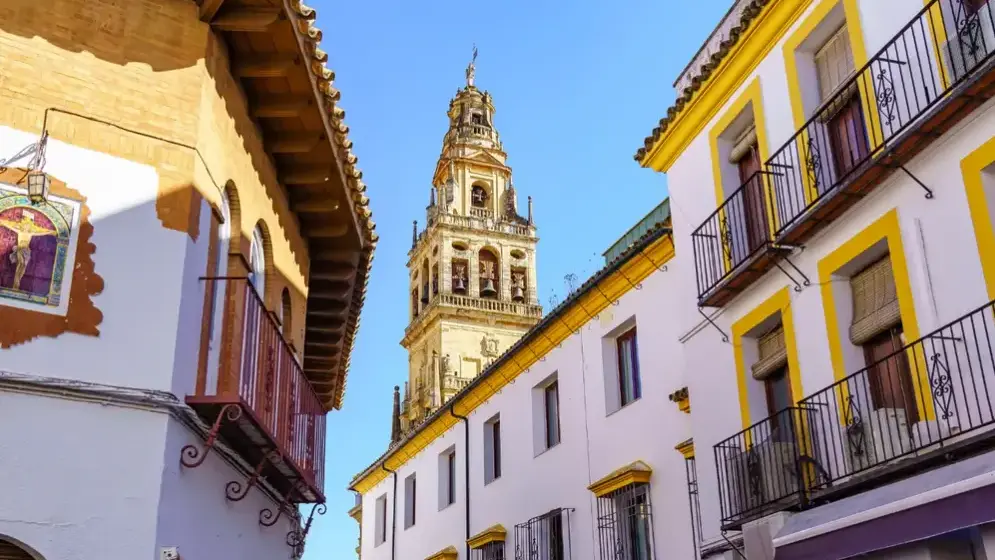
- The minaret itself was converted into a bell tower through the addition of a single cross at its apex
The structural envelope of Abd al-Rahman I's original mosque, founded in 785 CE on the site of a Visigothic church, remained intact. The hypostyle hall with its 856 columns, the two-tiered arch system in alternating jasper and brick, the maqsura screen, the Byzantine mosaics of the mihrab: none of these were touched.[2]
This was not accidental. Ferdinand's advisors were aware they had captured something exceptional. The building had no equivalent in Christendom, certainly nothing of comparable scale, sophistication, or age. Destroying it would have been straightforward. Preserving it required a decision.
Local Mudéjar craftsmen were kept on, either on formal payroll or through labor taxation, to maintain the building's systems. The technical knowledge required to service the mosque's water channels, plasterwork, and tile systems was not available among the new Christian administrators. These workers (Spanish Muslims who remained after the Reconquista) provided the institutional memory that prevented deterioration in the immediate post-conquest decades.
The qibla wall, the mihrab, and what Christian liturgy left alone
One question visitors ask at the Mezquita-Catedral is why the mihrab (the ornate prayer niche indicating the direction of Mecca) was not removed or destroyed after 1236. The answer is architectural rather than theological. The mihrab is not freestanding furniture. It is carved directly into the qibla wall, the entire southern face of the building, decorated with Byzantine mosaics commissioned by Al-Hakam II in the 960s. Removing it would have required demolishing the southern wall.[3]
Christian liturgical orientation runs roughly east-west, with the altar at the east. Islamic prayer orientation runs south-southeast toward Mecca. These two axes do not coincide in Córdoba. After 1236, Christian authorities did not attempt to reorient the building. They accepted the existing axis and layered their liturgical arrangements on top of it. Altars were installed at various points within the prayer hall. The mihrab and its mosaics remained exactly where they were, which is where you find them today.
The original Islamic minbar (the wooden pulpit from which the imam delivered sermons) was apparently preserved in storage rather than destroyed. Whether this reflected deliberate conservation or simple logistical inertia is not recorded. What is clear is that the 1236 conversion was primarily a liturgical act, not an architectural one. The building's Islamic character was visually and structurally dominant for decades after the conquest.
Explore nearby · Monument
Mezquita-Catedral de Córdoba
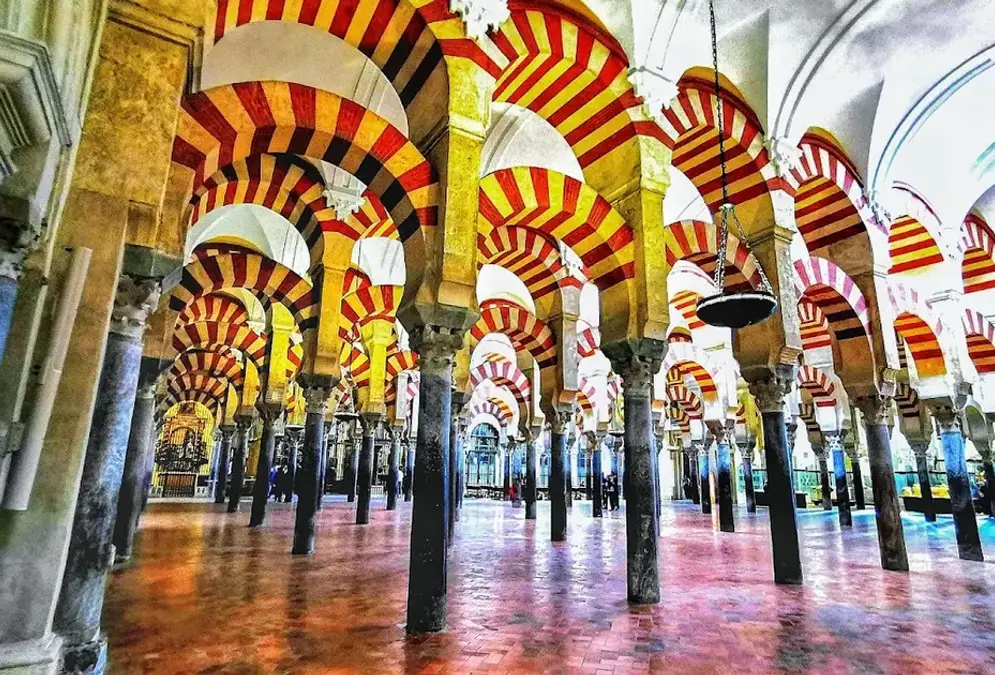
856 columns, 1,300 years of Islamic and Christian history. UNESCO monument in Córdoba, Andalusia. Red-and-white arches, Byzantine mosaics, a Renaissance nave.
The maqsura area, the screened zone adjacent to the mihrab where the caliph's household prayed, also remained intact. Its carved stucco and the decorative domes above it continued to define the southern end of the building. Any visitor standing there in the 1250s would have been looking at an Islamic interior with Christian crosses added. That was what the conversion of 1236 actually produced.
This is worth sitting with. The convivencia narrative, Córdoba as a city of three faiths in harmony, gets invoked whenever the Mezquita is discussed. The post-1236 arrangement was not harmony; it was occupation followed by architectural inertia. But the inertia had a consequence the occupiers did not plan: it preserved one of the great buildings of the medieval world.
Charles V's Renaissance insertion: the cathedral nave (1523–1607)
The building that Ferdinand III preserved in 1236 was structurally altered not by medieval soldiers but by a 16th-century bishop with imperial backing. Bishop Alonso de Manrique obtained permission from Emperor Charles V to construct a full Renaissance cathedral inside the heart of the Great Mosque in the 1520s. This was a cathedral-scale nave and transept inserted at the center of the hypostyle hall, not a small chapel.[4]
The Córdoba city council opposed the project. Their objections were recorded and were not primarily aesthetic: they understood that the mosque as it stood was an irreplaceable attraction. Visitors came from across Christendom to see it. The council's resistance was overridden by imperial authority. Charles V, who was in Spain but apparently did not visit Córdoba before granting the permission, trusted Manrique's assessment. The full story of that 1523 decision — including why the city council formally threatened execution for anyone who altered the mosque, and why the famous regret quote Charles V is credited with may never have been spoken — is traced in What Charles V Regretted About the Mezquita He Approved.
Construction began in 1523 under the architect Hernán Ruiz I. The design required demolishing a significant section of the original hypostyle hall, specifically the central area where the nave and transept would stand. The columns came down. The vaulting above them was removed. The Gothic vaulting that replaced it followed the direction of the original mosque's existing naves and aisles rather than imposing a fully alien geometry. The Renaissance insertion was at least spatially responsive, even where it was destructively so.
Work continued under successive architects and was not completed until 1607, under Juan de Ochoa.[5] The full construction span ran 84 years, longer than most medieval cathedrals. What was lost during those eight decades:
Recommended tours
Tours are selected for quality, not commission. We earn a small fee if you book — at no extra cost to you.
- The central section of the hypostyle hall — the original 8th-century core built by Abd al-Rahman I — demolished for the nave
- The visual continuity of the forest of columns that had defined the interior's spatial character
Almanzor's 10th-century eastern expansion survived the insertion. Hernán Ruiz I added Gothic vaulting onto its existing naves rather than demolishing them, so that off-center block of the mosque still stands, just under a different roof. What was not lost: the mihrab and its Byzantine mosaics, the decorative domes of the maqsura, the two-tiered arch system in the surviving sections, Almanzor's eastern expansion, and the overall structural logic of Abd al-Rahman I's original 8th-century plan.
Charles V visited Córdoba in 1526, only three years after construction began, when he saw early demolition work rather than a finished nave — the cathedral would not be completed until 1607, forty-nine years after his death in 1558. His response has been quoted so often it has become almost too familiar, but the quote itself is specific and worth preserving: "You have built what you or anyone else might have built anywhere; but you have destroyed something that was unique in the world." That is not a statement about aesthetics. It is a statement about irreversibility.
What survived, what was lost, and the accidental monument
The standard way of framing the Mezquita's hybrid character is as a tragedy with a silver lining: great architecture damaged, but the damage preserved enough of the original to remain worth visiting. That framing is not wrong, but it misses something.
The building you walk through today is not a damaged Islamic monument with a cathedral attached. It is a specific historical record of three moments:
- Abd al-Rahman I's 785 CE foundation: the spatial logic, the column grid, the two-tiered arch system, the qibla orientation
- Al-Hakam II's 960s expansion: the mihrab, its Byzantine mosaics, the maqsura domes, the most sophisticated decorative program in western Islamic architecture
- Hernán Ruiz I's 1523 insertion: the Renaissance nave, Gothic vaulting, and the truncated hypostyle hall that surrounds it
Each layer is legible. The mihrab with its Byzantine mosaics survived both 1236 and 1523 intact. The decorative domes above the maqsura survived. The two-tiered alternating arches (the visual signature of the building, the rhythm that every photograph captures) survived in the sections Ruiz I did not demolish.
Deep dive · Article
Almanzor — The Man Who Dismantled the Caliphate From Inside
Almanzor ran Córdoba for 25 years without claiming the caliphate. Fifty-seven undefeated campaigns, the bells of Santiago, a purged library — and civil war.
What is gone is the experience of the original spatial whole. In Abd al-Rahman I's mosque, you stood in a forest of columns extending in every direction, with no interruption in the grid. The perspective was uniform and overwhelming. The Renaissance nave breaks that uniformity. Where it rises, it creates a vertical space that the original mosque deliberately avoided. The hypostyle hall was horizontal, low, spreading rather than soaring.
The Almanzor additions, the eastern expansion of the 10th century that extended the column grid across a larger footprint, largely survived Ruiz I's insertion — he covered its naves in Gothic vaulting rather than tearing them down. What the Renaissance builders demolished instead sat in the center of the building, Abd al-Rahman I's original 8th-century core, where the nave and transept now stand. The full scale of the building at its 10th-century peak, when the mosque was the second-largest mosque in the Islamic world (the largest outside the Abbasid caliphate, surpassed globally only by the Great Mosque of Mecca),[1] cannot be recovered from the current structure.
What can be recovered, and what remains in the surviving sections, is enough to read how extraordinary the original was. Stand in the south section, facing the mihrab, with the decorative domes visible above and the Byzantine gold of the mosaics ahead. The two-tiered arches in alternating red-and-white recede on both sides. That space is intact. It is one of the finest rooms in Europe and it has been in continuous use for nearly 1,250 years.[1]
UNESCO recognition and the ongoing contest over the building
UNESCO inscribed the Mezquita-Catedral as a World Heritage Site in 1984, recognizing it as exceptional for its architectural synthesis across cultures. The designation carried a specific consequence: it placed the building's stewardship into an international accountability framework, which became relevant as debates about its future intensified in the early 21st century.
The Cathedral Chapter (the governing body of the Catholic diocese) administers the building today. It charges admission, controls access hours, and determines what kinds of events and uses are permitted inside. It has also funded ongoing conservation work, including the stabilization of the minaret-bell tower and maintenance of the mihrab mosaics.
The argument about what the building should be has become sharper in recent decades. Some Spanish politicians and cultural commentators have argued for the removal of the Renaissance nave to restore the mosque to something closer to its Islamic state. The Chapter rejects this, and not only for religious reasons. Removing the nave would require demolishing a 16th-century architectural work of historical significance in its own right. You cannot undo Charles V's intervention without creating a new destruction. The building has no version without scars.
A separate argument runs in the opposite direction: that Islamic prayer should be permitted inside the building alongside Christian worship, on the grounds that the mosque's origins predate the cathedral. The Spanish bishops have consistently refused. Their position is that the building functions as a Catholic cathedral (the seat of the Diocese of Córdoba) and has done so continuously since 1236. Shared religious use would compromise that function. The roots of that prohibition — and the nominal-fee property registration that underpins it — are examined in why Muslims can't pray inside today.
Both arguments treat the building's history as a resource to be deployed in a contemporary argument. Neither is entirely wrong. The mosque was built first. The cathedral came second and damaged the mosque. Both facts are real. The more useful frame is to take the building as it is: a palimpsest in which no version of the history can be erased without erasing the building itself.
The convivencia narrative does the Mezquita a disservice by turning it into a symbol of harmony. The actual history is better: three distinct civilizations built something here across twelve centuries, each leaving marks the others could not fully cover. That is not harmony. It is something rarer: a building that survived its own history and still tells it.