
Before the Mezquita: the Visigothic and Roman inheritance
The horseshoe arch is older than Islam. A 3rd-century Sasanian palace at Firuzabad in Iran already shows the form[2]: a circular curve that continues below the horizontal diameter, narrowing the opening at the base into what later writers would call a keyhole silhouette. The same geometry appears in Visigothic Spain by the 6th century, including Santa Eulalia de Bóveda near Lugo and half a dozen church remains scattered across the meseta.[3] When the Umayyad armies crossed the Strait of Gibraltar in 711 CE[4], the horseshoe arch was an established element of the Iberian built environment. They did not bring it; they found it.
The Roman background matters too. A semicircular Roman arch is a perfect half-circle: the curve begins and ends at exactly the same horizontal level. A horseshoe arch bends further, extending the curve past that horizontal until it narrows the opening below. That geometric extension has structural consequences. The spring points (where the curve leaves the support) are lower, the arch widens above them and narrows at the bottom. The result distributes lateral thrust differently and, crucially, shifts the visual centre of gravity upward.
The Visigothic builders used the form for contained openings in church naves: proportionally modest arches, stone-on-stone, with masonry above to fill the lunette. Abd al-Rahman I would take this familiar regional vocabulary and do something with it that nobody had done before.
850
What tends to get missed in the standard account is that the fusion was not accidental. Abd al-Rahman I had come from Damascus, where the Umayyad Great Mosque (built 705–715 CE)[5] was faced in rich marble paneling across its lower walls. He arrived in Iberia carrying an architectural grammar already developed at the Dome of the Rock (691 CE) in Jerusalem.[6] The Visigothic horseshoe arch was a form he recognised as useful; the Umayyad decorative tradition was what he added to it.
What Abd al-Rahman I actually built in 785-787
The mosque Abd al-Rahman I completed between 785 and 787 CE[7] was nearly square in plan, roughly 79 metres per side[8], divided evenly between the courtyard and the prayer hall.
He had demolished a Visigothic church dedicated to San Vicente to build it, purchasing the Christian half of the site before clearing it.[9] (Later expansions under Abd al-Rahman II, Abd al-Rahman III, Al-Hakam II, and Almanzor would bring the building's total to the roughly 850 columns visible today.[10])
Explore nearby · Monument
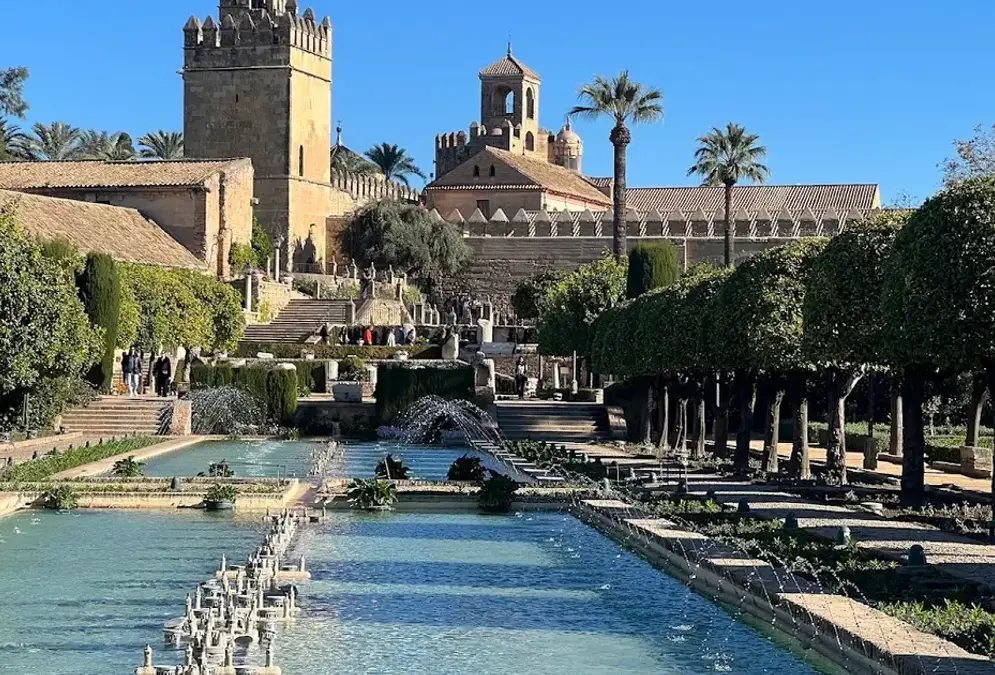
Alcázar de los Reyes Cristianos
Alcázar de los Reyes Cristianos, Córdoba: free entry on Tuesdays. A 14th-century fortress-palace with terraced Moorish-inspired gardens and Roman mosaics.
Reused columns, no two alike
Many of the columns he used came from that same church, from Roman temples across the province, and from other demolished structures. His original mosque had around 120 columns[11] reused from earlier buildings, which is why none of them share the same height. To compensate for the variation, he placed stone plinths beneath the shorter ones and adapted the capitals with timber blocks. For where the reused columns came from and what the mismatch shows, see the Mezquita's reused columns.
Short columns, a double-tiered solution
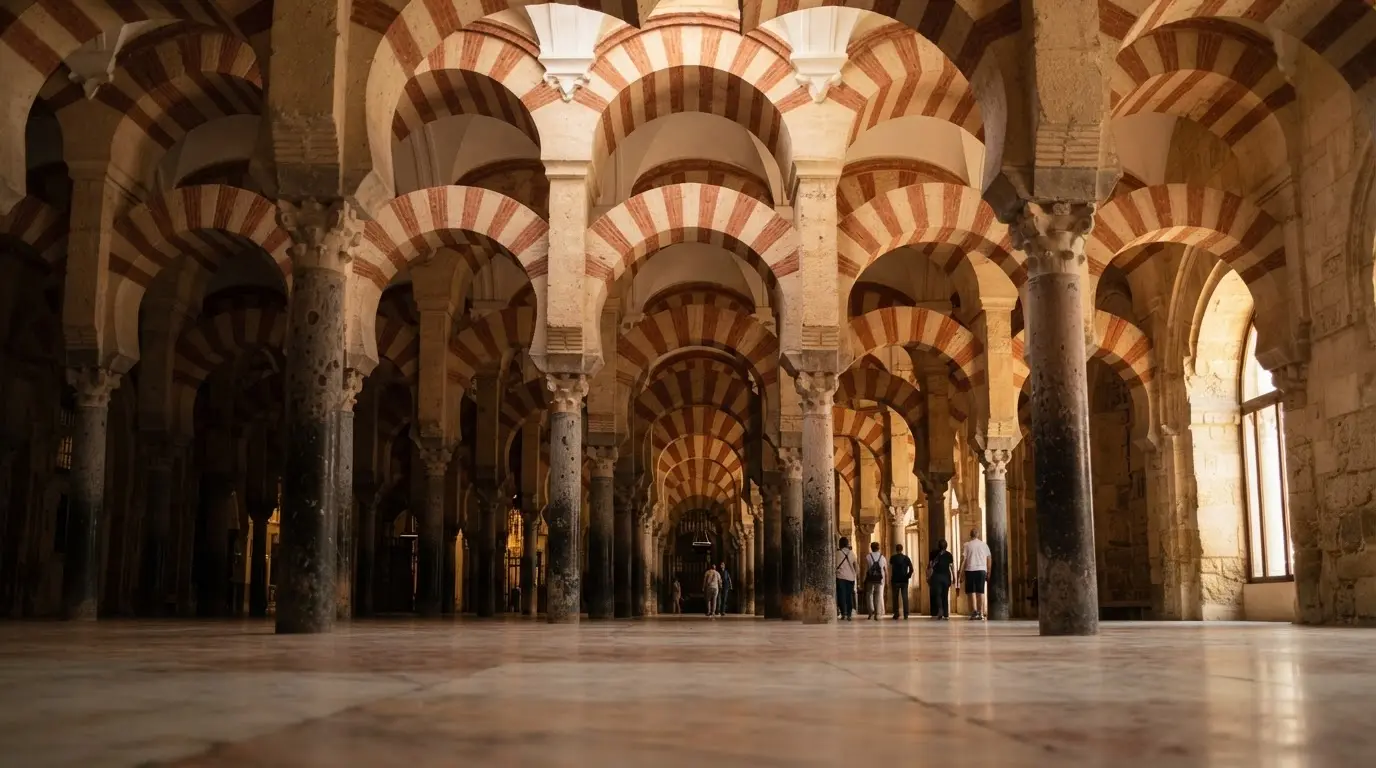
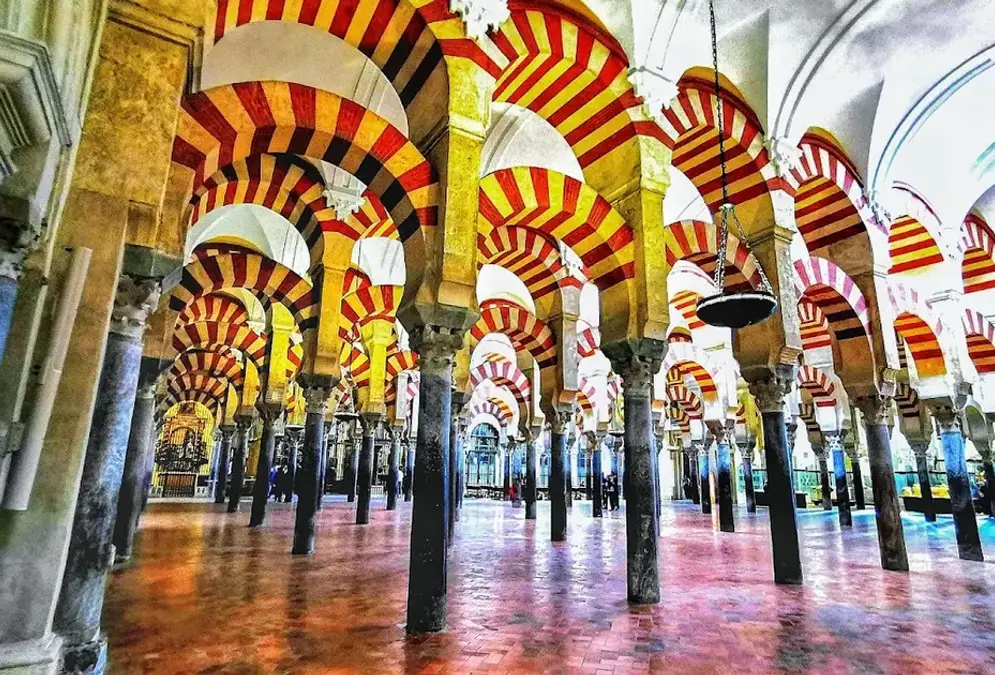
The structural problem he then faced was height. The columns were short — well under the height a single-span arcade needs to clear a prayer hall comfortably. A single arch spanning between them would have produced a low, oppressive ceiling. His solution was the double-tiered arcade system: a lower horseshoe arch sitting on the column capital, then a taller semicircular arch rising above, with the two connected by a vertical pier. The lower arches support the lateral load; the upper arches carry the weight of the roof.
The voussoir treatment makes the system visible. Alternating red brick and white limestone blocks trace the curve of every arch through both tiers. The color alternation is not merely decorative. Red brick and light limestone expand and contract at slightly different rates under thermal cycling, which may reduce stress concentrations at the joints. More importantly, the alternation does precisely what a structural diagram would do: it shows you the arch's geometry, drawing the eye through the curve.
Left open: the no-infill decision
But the detail that distinguishes the Mezquita from every earlier hypostyle mosque is this: the lower horseshoe arches are left free of masonry infill. Earlier hypostyle halls, in Damascus and Medina, filled the space between arches with solid walls. Abd al-Rahman I's prayer hall left the lower openings completely open. Stand at the entrance to the prayer hall and the columns appear to recede into infinity in every direction, because there is no visual interruption at the lower level. The Mezquita-Catedral of Córdoba is a different building from anything that preceded it, not because of the arch form but because of what was left out.
Engineering the keyhole: what the geometry actually does
The distinguishing geometry of a horseshoe arch is called stilting: the arch curve begins below the horizontal line connecting the two spring points. On a semicircular arch, the spring points are at the widest part of the opening. On a horseshoe arch, the curve has already bent inward by the time it reaches the spring points, so the opening at the base is narrower than the arch's widest span above.
This matters structurally because the spring point is where the arch transfers its thrust into the support below. A narrower spring-point base means the horizontal spread of thrust is reduced. The arch carries its load more vertically. In a row of arches on thin columns, as in the Mezquita, reducing horizontal thrust is not a minor advantage. It allows the columns to be spaced more tightly relative to their diameter without the risk of the supports being pushed outward.
The visual effect accompanies the structural one. Because the widest point of the arch is above the spring line rather than at it, the arch appears to swell above the column head and narrow toward the floor. Weight seems to gather at the top, then release downward through the column. With bicolor voussoirs tracing that path, the structure reads as a demonstration of force: you see exactly where the load is and where it goes.
Recommended tours
Tours are selected for quality, not commission. We earn a small fee if you book — at no extra cost to you.
Stilting's answer to the height problem
There is also the question of height. The Mezquita's double-tiered system reaches considerable interior height without a single span. Achieving that with single-span arches on columns this short would have required arches so wide they would have been unstable without thick piers. The stilted keyhole proportions of the lower horseshoe arches allow them to span the full aisle width without consuming the visual space that the upper arches need. The two systems coexist because the horseshoe's narrowed base leaves room for the semicircular form above; different geometries serving different structural roles.
Geometry turned ornament: the mihrab niche
The qibla wall's mihrab niche, added under Al-Hakam II, went up in two distinct phases: the niche and its domes were architecturally finished in November or December 965[12], and its Byzantine mosaic decoration — a separate, later commission — was not completed until late 970 or early 971[13]. It demonstrates the form at its most refined: a polylobed horseshoe arch fronting a shell-vaulted chamber, every surface covered in Byzantine-influenced mosaic, the geometry used not as a structural workhorse but as an ornamental argument about what an arch can be.
From Córdoba outward: Morocco, Tunisia, Egypt, Delhi
The horseshoe arch left Córdoba in multiple directions at once, and each region adapted it differently. The routes were practical: trade, pilgrimage, diplomatic contact, and the movement of craftsmen who had worked on Córdoba's mosques and then travelled on.
The most direct transmission went south across the Strait of Gibraltar:
- Al-Qarawiyyin Mosque, Fes, Morocco (founded 859 CE[14], significantly expanded from the 10th century): hypostyle hall with horseshoe arches in direct formal dialogue with the Mezquita
- Great Mosque of Kairouan, Tunisia (9th–11th century expansion): developed pointed variants of the horseshoe arch, inflecting the form toward what would become the Fatimid and Aghlabid architectural vocabulary
- Fatimid Cairo (10th–12th century): stilted and pointed horseshoe arches in mosques and gates; the form arrived via North African intermediaries rather than directly from Córdoba, which accounts for the pointed variant rather than the rounded Umayyad version
The Sicilian transmission is less often noted. Norman Sicily (12th century) incorporated horseshoe arches in royal chapels and palaces after two centuries of Arab rule, producing a hybrid that influenced Romanesque building on the Italian mainland.
The farthest east the form reached within the medieval period was Delhi: the Quwwat-ul-Islam mosque's later extensions and the Qutb Complex (expanded 1311 CE[15]) show horseshoe arch profiles in screen walls, arriving via the Central Asian and Persian transmission belt rather than directly from Spain. By that point, the form had passed through so many regional hands that its Iberian roots required a specialist to trace.
Averroes left Córdoba around the same period that the horseshoe arch was being reproduced in Moroccan and Tunisian mosques. The intellectual and architectural exports of the Umayyad caliphate moved along the same routes.
What each region did with the form reveals what they thought they were inheriting. Tunisia pointed it, straining toward a vertical energy that the rounded Umayyad version avoided. Egypt stilted it further, making the keyhole silhouette more pronounced. The Norman builders in Palermo kept the rounded Umayyad form but stripped the bicolor voussoirs, leaving the shape without its color grammar.
The 19th-century revival and what it got wrong
The Moorish Revival — a style that peaked after the mid-19th century[16] — returned the horseshoe arch to European and American building without the engineering rationale that had originally produced it. Architects in Granada, Paris, London, and New York applied the keyhole form to railway stations, department stores, synagogues, and casino facades, usually in plaster over cast iron or brick, with the structural logic entirely absent.
The revivals were driven by the same colonial encounter that produced Orientalism more broadly. Nineteenth-century European architects who documented North African buildings brought the forms home. German Romantic painters discovered the Alhambra. Spanish architects began recovering Andalusian precedents as a form of national distinctiveness. When the original Crystal Palace moved from Hyde Park to Sydenham and reopened in 1854, Owen Jones designed an Alhambra Court for it — a full-scale Moorish interior that brought the horseshoe arch into the living experience of the Victorian public.[17] By the end of the century, the horseshoe arch was available as a stylistic quotation anywhere a designer wanted to signal exoticism, antiquity, or Islamic association.
Synagogues adopted it frequently in the second half of the 19th century, remaining a preferred synagogue style until the early 20th century[18], which is historically coherent: the horseshoe arch was a Sephardic visual memory, connecting Ashkenazi congregations in Germany and the United States to medieval Iberian Jewish life. The Córdoba Synagogue (built 1315[19]), a short walk from the Mezquita, uses the form in its interior arcading. the philosopher Maimonides and the three-cultures heritage that later revivalists were reaching toward lived in the streets nearby.
Deep dive · Article
47 Metres Tall and Almost Unknown: Spain's Tallest Keep
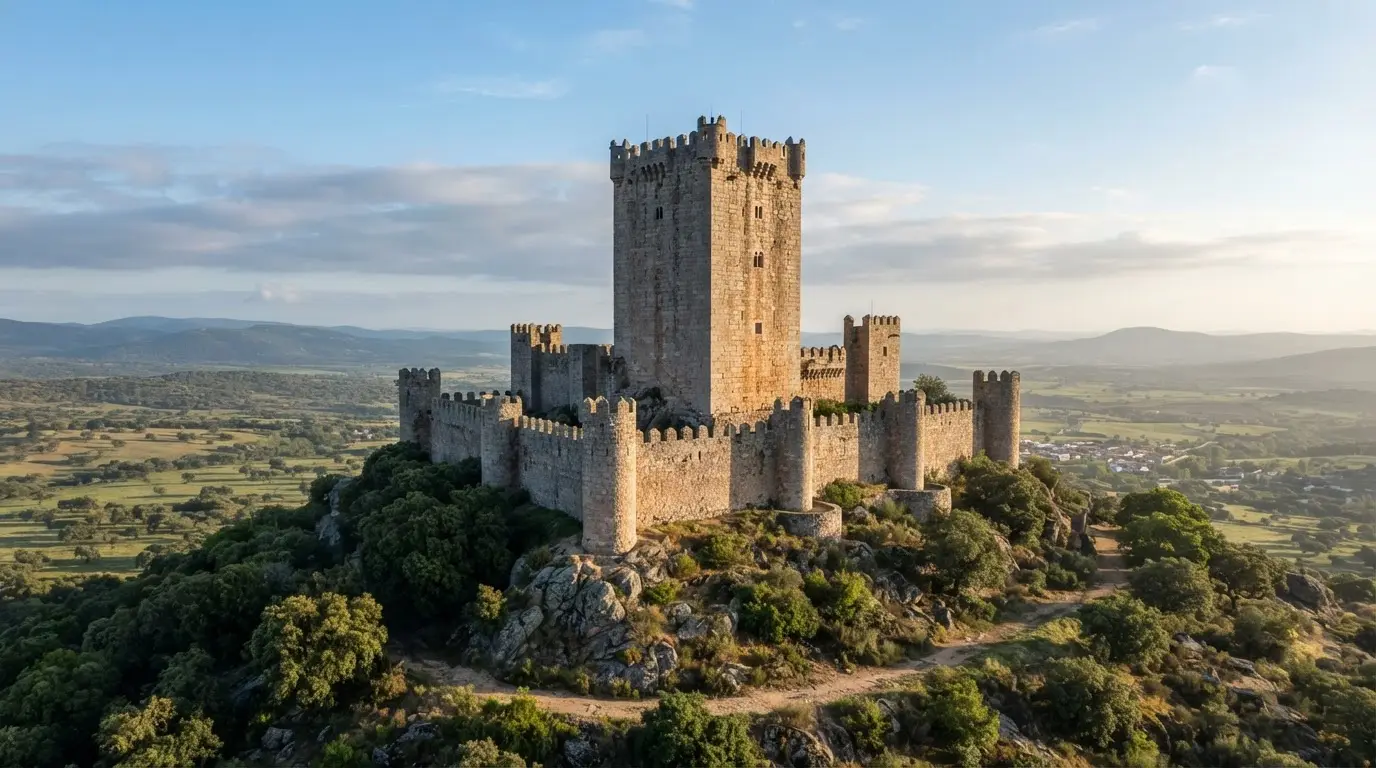
Belalcázar Castle's 47 m keep is listed by the Junta de Andalucía as Spain's tallest. How it grew, what to see inside and how to book the free guided visit.
What the Moorish Revival missed was the structural argument. The horseshoe arch in the Mezquita is not a decorative application of a curved motif; it is a solution to a specific engineering problem: how to achieve height on short recycled columns, with bicolor voussoirs to make the geometry legible, and open lower arches to make the space read as infinite. Nineteenth-century builders using cast iron had no such problem, so their horseshoe arches are quotations without content: the shape without the thought behind it.
Reading the arch when you visit
Stand at the entrance to the prayer hall and give your eyes thirty seconds to adjust. The immediate visual fact is the forest of columns: they appear to multiply in every direction without resolving into a clear perspective. This is the open lower-arch system working as Abd al-Rahman I intended. Remove the infill, and the eye has no wall to stop on; the columns continue past each other into ambiguity.
Read next · Article
Is the Mezquita a Mosque or Cathedral?
UNESCO's official name for this Córdoba monument is 'Historic Centre of Cordoba,' not Mosque-Cathedral: built as a mosque in 785, a cathedral since 1236.
Then look at a single arch in front of you. The red and white voussoirs alternate precisely, each wedge-stone cut to the same width, meeting at the keystone. The color sequence is consistent: red brick, white limestone, red brick, all the way around both the lower horseshoe and the upper semicircular arch above it. In strong morning light (the hall faces south, so direct sun enters through the main doors between October and March), the alternation casts a faint shadow from each brick proud of the stone, making the arch appear almost three-dimensional.
The proportion to note is where the arch's widest point sits relative to the supporting capital below. The curve reaches its maximum width about a third of the way up the arch, not at the base. That is the stilting at work: the arch swells above the column head, then narrows at the opening. You are standing in the narrowed part; the structure widens above you.
If you move to the Villaviciosa Chapel (mid-prayer hall, the first significant Christian addition, consecrated to Catholic worship on 29 June 1236[20], with its Gothic nave added under Bishop Íñigo Manrique (1486–1496)[21]), you can compare the Gothic vaulting placed directly above the existing Umayyad columns. The architects who put the chapel there did not remove the horseshoe arches; they incorporated them as supports. The structural logic that Abd al-Rahman I developed was sound enough that Christian builders used it seven centuries later without modification.
The mihrab at the far end of the original prayer hall is the Mezquita's most elaborate application of the horseshoe arch: a polylobed form fronting a shell vault, the voussoirs replaced by a continuous mosaic field supplied by the Byzantine emperor Nikephoros II Phokas at Al-Hakam II's request.[22] The form is recognisably Umayyad Córdoban; the materials are Byzantine. That is the Mezquita's three-cultures argument compressed into one doorway. For opening hours, ticket prices, and what else to see nearby, the full visitor guide to the Mezquita-Catedral covers the rest of the visit.