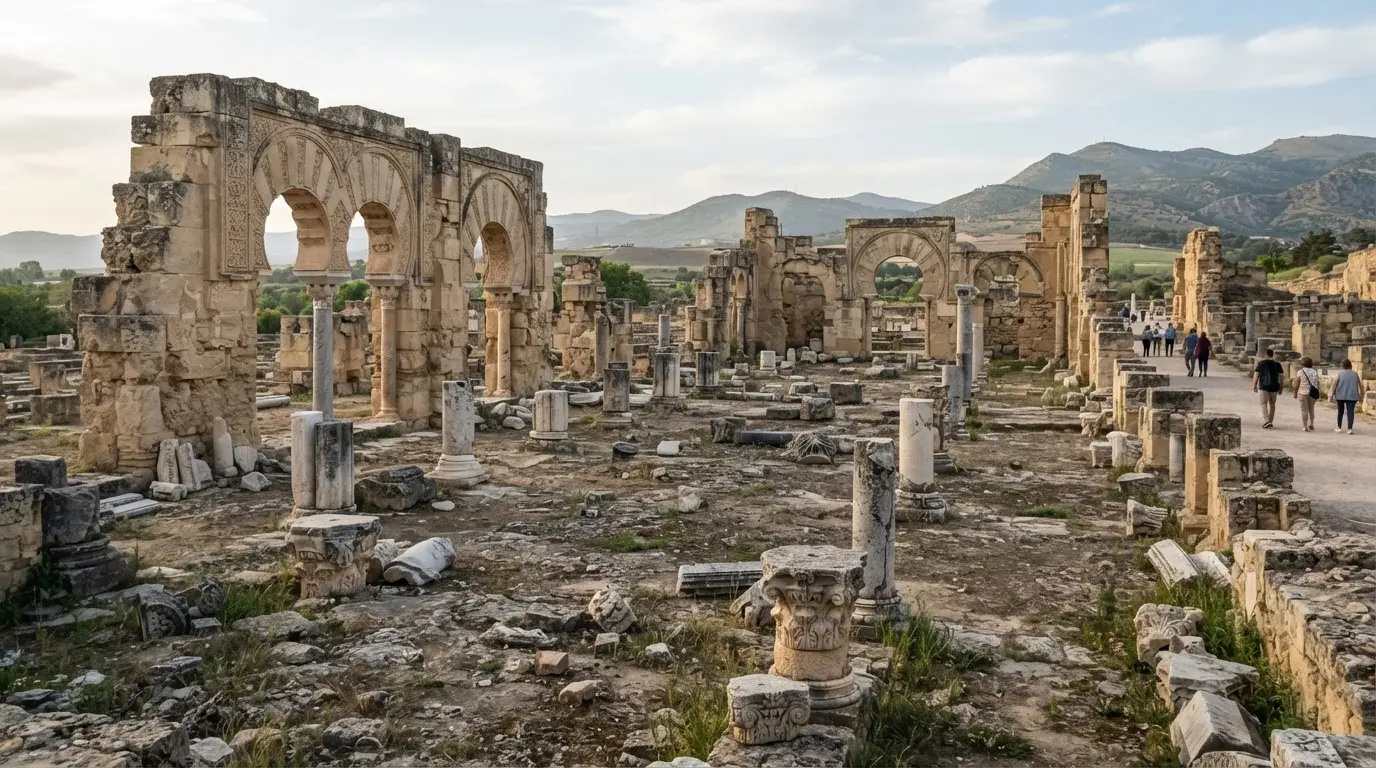
Abd al-Rahman I survived the massacre of his Umayyad family in 750 CE, fled six years across North Africa, and founded the Emirate of Córdoba at just 25.
Art history background with eight years writing interpretive content on Córdoba's Caliphal heritage.
Updated Published
history-buffsart-lovers
The man who built the Great Mosque of Córdoba arrived in Spain with nothing: no army, no treasury, no title. He had spent six years crossing North Africa to escape the soldiers hunting him. Abd al-Rahman I, grandson of the Caliph Hisham ibn Abd al-Malik, was nineteen years old when the Abbasid revolution destroyed the Umayyad dynasty in 750 CE, and he would go on to rule Córdoba for thirty-two years, found the Emirate that outlasted every rival, and leave behind a building that still stands on the bank of the Guadalquivir.
In this article
Jump to a section
⌄
The dynasty that fell in a night: the Battle of the Zab
The Umayyad Caliphate had ruled the Islamic world from Damascus for nearly a century when the Abbasid revolution ended it. In January 750 CE, the last Umayyad caliph, Marwan II, met the Abbasid forces at the Battle of the Great Zab in northern Mesopotamia. He was routed. He fled south through Syria, Palestine, and Egypt, and was killed in August 750 near Busir on the Nile, roughly six months after the battle that decided everything.[1]
The Abbasids moved quickly. Their consolidation of power was systematic and violent: they invited surviving Umayyad princes to a peace banquet at Abu Futrus and killed them at the table. Across Syria and Iraq, the dynasty that had governed the caliphate from the Atlantic to Central Asia was hunted down family member by family member. Most were caught. The Umayyad line very nearly died in that single year.
750 CE
The year the Abbasid revolution ended the Umayyad Caliphate. Within months, systematic massacres at Abu Futrus and across Syria nearly extinguished the dynasty. Abd al-Rahman I was one of very few survivors.
Abd al-Rahman was approximately nineteen years old when the Zab was fought.[2] He was a grandson through the line of Hisham ibn Abd al-Malik, which made him a prime target for Abbasid elimination. He had grown up in Palmyra, the Syrian city that carries the meaning of its name in the palm trees shading its ruins. He had lived inside the apparatus of Caliphal power: courts, libraries, administrators, soldiers. He understood what dynasties required and what their fall looked like.
He escaped with one companion: a Greek freedman named Bedr, who had served the Umayyad household and remained loyal. No chronicle gives the exact moment of their departure, or the route through the Palestinian hills. What the sources agree on is that Abd al-Rahman and Bedr left together, traveled without declaring their identity, and that the soldiers looking for them were not far behind.
Six years across the Maghreb
The flight lasted six years. What survives in the chronicles is impressionistic rather than detailed: a young man moving through hostile territory, avoiding cities, traveling incognito, keeping to routes where Abbasid authority was thin. Palestine to Egypt. Egypt west along the coast of Cyrenaica (modern Libya), where Abbasid agents were searching for survivors. Then further west through what is now Tunisia.
In Morocco, the pursuit caught up with him. The Abbasid governor of North Africa sent soldiers. Abd al-Rahman was with his younger brother at the time, and in the confusion of the river crossing, the brother was captured. Abd al-Rahman alone reached the far bank. He was now in the territory of the Nafza Berbers, his mother's people. His mother had been a Berber woman from this region, and her tribe provided what the rest of the Islamic world had refused: refuge.[3]
He spent time among the Nafza gathering contacts and intelligence about what lay beyond. Bedr, the same freedman who had left Damascus with him, was sent ahead alone across the strait to al-Andalus. The mission was reconnaissance. The Iberian Peninsula was the westernmost province of the Islamic world, as distant from the Abbasid heartland in Iraq as it was possible to get. Bedr returned with a report. The province was fractured. Yusuf al-Fihri, the Abbasid-backed governor, had lost the loyalty of significant parts of the jund, the Syrian military units that had been the backbone of Umayyad authority there. Many of those soldiers still remembered the Umayyad name with respect, if not active loyalty.
The political map of al-Andalus, as Bedr described it, was an opening. Abd al-Rahman, at twenty-four or twenty-five, made the decision to take it.
Timeline
731 CE
Born in Palmyra
Abd al-Rahman I born in Palmyra, Syria, grandson of Caliph Hisham ibn Abd al-Malik.
750 CE
Battle of the Great Zab
Abbasids defeat the last Umayyad caliph Marwan II. Systematic massacres begin. Abd al-Rahman (~19) escapes with his freedman Bedr through Palestine and Egypt.
750–755 CE
Flight across North Africa
Six years crossing Cyrenaica, Tunisia, and Morocco, evading Abbasid agents. Finds refuge with the Nafza Berbers, his mother's people. Bedr scouts al-Andalus.
755 CE
Lands at Almuñécar
Abd al-Rahman crosses the Strait and lands at Almuñécar, on the coast east of Málaga, where he begins recruiting Umayyad mawali and Syrian soldiers.
756 CE
Battle of the Guadalquivir
Defeats governor Yusuf al-Fihri. Captures Córdoba and declares himself Emir, founding the independent Emirate of Córdoba.
785–786 CE
Great Mosque founded
The Mezquita is built on the site of a converted Visigothic church. Construction completed within one year using reused Roman and Visigothic materials.
788 CE
Abd al-Rahman I dies
He dies after a 32-year reign, succeeded by his son Hisham I. The Emirate will last another 250 years.
Landing in al-Andalus: the Battle of the Guadalquivir
He crossed in 755 CE, landing at Almuñécar, a port on the coast east of Málaga. The location was practical: close enough to the Strait to allow a fast crossing, far enough from Seville and the Abbasid governor's principal authority to allow time to recruit. The mawali (freedmen clients of the Umayyad household) and the old jund soldiers of Syria who had settled in al-Andalus responded quickly. The Umayyad name still carried weight. Men who had served the dynasty for generations in Damascus, who had been transported to Iberia a generation earlier as frontier garrison troops, found themselves with a reason to coalesce.
The governor, Yusuf al-Fihri, understood the threat. He moved his forces south from Córdoba. The two armies met somewhere along the Guadalquivir in 756 CE, and Abd al-Rahman won decisively. Contemporary accounts describe the field strewn with the bodies of the governor's forces. Yusuf fled but was eventually killed. Abd al-Rahman entered Málaga, then Seville, then Córdoba, each city opening before him as the news of the Guadalquivir spread.
He declared himself Emir of Córdoba in 756 CE. The title was deliberate: not Caliph, which would have been a direct provocation to Baghdad, but Emir, an independent ruler acknowledging no superior. He never sought recognition from the Abbasid Caliphate. The Abbasid caliph al-Mansur, who had overseen the destruction of Abd al-Rahman's family, was said to have called him the "Falcon of Quraysh," a grudging acknowledgment of the most capable enemy he had failed to catch.[4]
Recommended tours
Tours are selected for quality, not commission. We earn a small fee if you book — at no extra cost to you.
The first years were hard. Al-Andalus was not a unified polity. There were rival governors in Toledo, Zaragoza, and elsewhere who submitted slowly or not at all. There were Berber uprisings. There was a Frankish raid from the north that reached Zaragoza in 778, the same campaign that produced the later legend of Roncevaux. Abd al-Rahman held the center, Córdoba, and worked outward from it. By the end of his first decade in power, the essential shape of the emirate was fixed.
Building an emirate: consolidation across three decades
The Emirate of Córdoba was, from its first year, a deliberate rejection of the Abbasid order. Abd al-Rahman I did not merely occupy a governorship; he built a state. He appointed his own qadis (judges), his own provincial governors, his own military commanders. He created a court at Córdoba that consciously replicated the structures of Umayyad Damascus, not out of nostalgia alone, but because those structures worked. They were familiar to the Syrian soldiers and administrators who formed his base, and they gave the emirate the institutional grammar it needed to endure.
Córdoba under Abd al-Rahman grew quickly. The city had been a Roman capital, then a Visigothic one, and it carried the infrastructure of both: the Roman bridge over the Guadalquivir was already nearly eight centuries old when Abd al-Rahman crossed it for the first time in 756 CE, and it remained the main artery between the city and the south. The Visigothic palaces and churches that Abd al-Rahman inherited gave his court physical legitimacy as well as administrative convenience.
Rebellion followed rebellion across his thirty-two-year reign: from governors who resented the new order, from Berber communities whose relationship with the Umayyad administration had always been fraught, and from families whose local authority predated Abd al-Rahman's arrival. He suppressed them all. The military campaigns were sometimes brutal, but the pattern is consistent: military force followed by administrative absorption. Defeated rivals were replaced by governors loyal to Córdoba. Territory that had been contested became, over time, emirate territory.
The fiscal apparatus he built mattered as much as the army. Tax collection in al-Andalus had been erratic before 756 CE, with rival governors pocketing revenues that should have funded the central administration. Abd al-Rahman regularized it. He paid his soldiers from a central treasury, which meant his soldiers' loyalty ran to him rather than to local commanders. That distinction, between a mercenary force loyal to whoever was paying and a standing army loyal to a dynasty, was the structural difference between his emirate and the fragmented polity he had replaced.
The Great Mosque: an architectural revolution in one year
He founded the Great Mosque of Córdoba in 785 CE, approximately thirty years after his Guadalquivir victory. The site was already religiously charged: the Visigoths had built a basilica there dedicated to Saint Vincent, and before that, the foundations may have been Roman. The archaeological evidence for what exactly stood on the site — the San Vicente debate, Félix Hernández's 1930s excavations, and the pre-Islamic layers still visible through the Mezquita's floor — is examined in Córdoba before the Mezquita: what stood here before 785. When Umayyad forces first entered Córdoba in 711 CE, the building had been divided between the Christian and Muslim communities, each using half for worship. By Abd al-Rahman's time, the Christian community had bought out their half, and the building had been converted entirely to Islamic use.
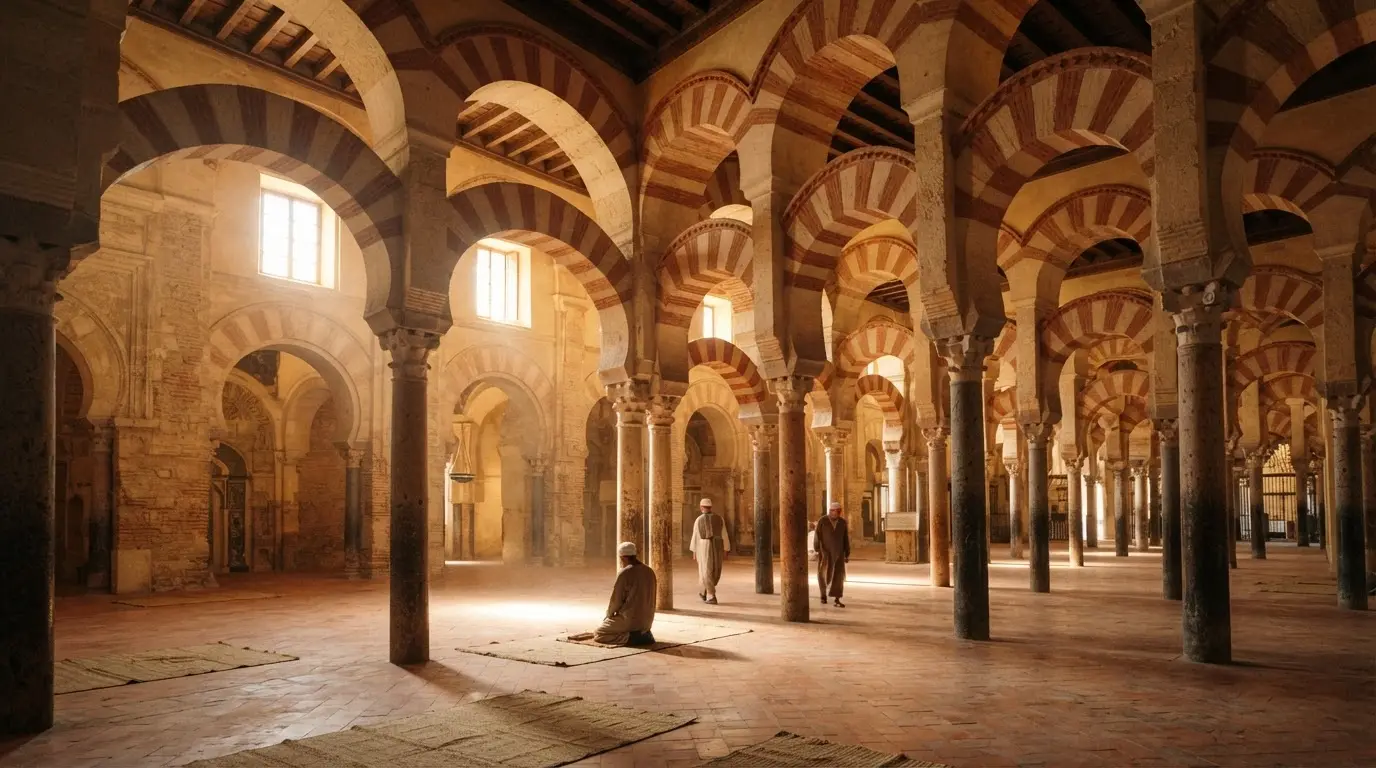
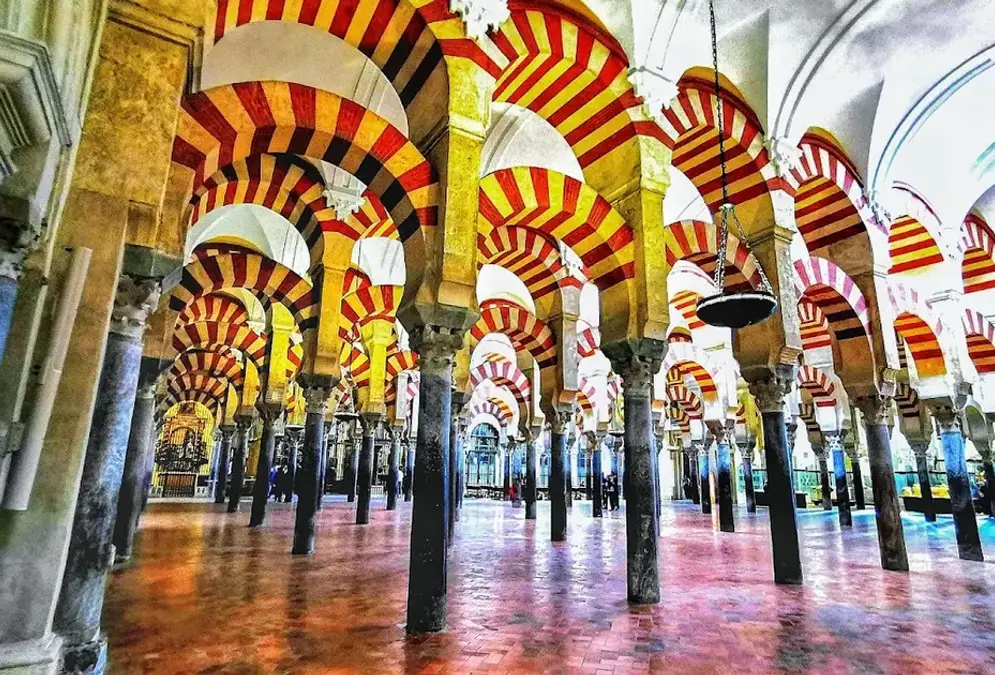
Abd al-Rahman purchased the Christian portion of the original basilica for 100,000 dinars[7] and demolished it. Construction of the new mosque began in 785–786 CE and finished within one year, in 786–787 CE, the relatively short timeline aided by a decision that defined the building's character: he reused the existing Roman and Visigothic columns and capitals rather than quarrying new stone.[5] The result was a forest of columns with mismatched proportions, solved by a structural innovation of striking originality. What the mismatch shows is covered in why the Mezquita's columns don't match.
The columns were too short. To reach the height Abd al-Rahman wanted for the prayer hall, the builders designed a double-arched system: a lower horseshoe arch rising from the column capital, then a second semicircular arch above it, the two tiers together achieving the necessary ceiling height. The arches were built in alternating red-brick and white-stone voussoirs, the striped pattern that still defines the interior of the Mezquita-Catedral today. The horseshoe arch itself was not new to Iberia; the Visigoths had used it before. But this double-arched system, with its specific geometry and its visual rhythm, became a model for Islamic architecture across North Africa and al-Andalus.
The design was also forward-looking. The original eleven naves were laid out perpendicular to the qibla wall, modeled on precedents in Damascus and Jerusalem's al-Aqsa Mosque. But Abd al-Rahman's builders left room for expansion: the qibla wall ran the full width of the prayer hall, and successors could extend northward without disturbing the spatial logic of the original. Abd al-Rahman II, al-Hakam II, and al-Mansur each did precisely that, adding sections over the next two centuries. The building that visitors enter today is still, at its oldest core, Abd al-Rahman I's mosque.
The Rusafa, the palm tree, and the exile's long shadow
Sometime in the 780s CE, Abd al-Rahman built a palace and estate northwest of Córdoba and named it Rusafa, after the ancestral palace on the Euphrates in Syria where he had spent his childhood. He cultivated gardens around it, planted with trees and fruits brought from the eastern Mediterranean, recreating the Syrian landscapes he had not seen since the age of nineteen. He grew palm trees there, which were not common in Iberia. Palmyra, his birthplace, takes its name from the palm: Tadmur in Aramaic, Palmyra in Latin, the city of palms. He had carried the symbol with him across a continent.
The poem about the palm tree is the most personal document from his reign. Or rather, the poem attributed to him. Whether the verses are genuinely his or later attributions remains debated among scholars; some place the poem with his nephew Abd al-Malik al-Marwani rather than Abd al-Rahman himself.[6] But the poem's existence in the record, and the fact that his contemporaries found it credible as his voice, tells us something about how he was perceived. The poem addresses a lone palm tree growing far from its homeland, and speaks in the first person about exile and longing. It is a lament written by a man who had survived everything and still missed the place he had left.
That melancholy set a tone. Andalusian poetry for the next three centuries returned repeatedly to the theme of exile, of the east remembered from the west, of loss measured against achievement. The literary historians trace the pattern back to Abd al-Rahman's verses. Whether or not he wrote them, the Córdoba he built was haunted by its own origin story: a dynasty that had fled destruction and re-formed itself in the furthest corner of the Islamic world, never fully forgetting what it had left behind.
He died in 788 CE, succeeded by his son Hisham I. The emirate he had built from nothing in 756 CE lasted until 1031 CE, when it fragmented into the taifas, the small independent city-states that divided the Iberian peninsula after the Caliphate's collapse. The succession was not always smooth: his grandson Al-Hakam I — who ruled from 796 to 822 CE — kept the emirate intact through two massacres and the forced expulsion of an entire suburb, the consolidation that made later glories possible. Generations later, his great-great-great-great-great-grandson Abd al-Rahman III declared a full Caliphate in 929 CE, making Córdoba one of the three great centers of Islamic civilization alongside Baghdad and Fatimid Cairo. The philosophers Averroes and the physician-philosopher Maimonides, born in Córdoba more than three centuries later, were inheriting a city whose intellectual culture the first Abd al-Rahman had made possible, not by intent but by survival. He had simply refused to let the dynasty end.
Frequently asked questions
Who was Abd al-Rahman I?
Abd al-Rahman I (c. 731–788 CE) was an Umayyad prince and grandson of Caliph Hisham ibn Abd al-Malik. Born in Palmyra, Syria, he survived the Abbasid massacre of the Umayyad family in 750 CE and fled across North Africa for six years. He landed in al-Andalus in 755 CE, defeated the Abbasid-backed governor at the Battle of the Guadalquivir in 756 CE, and declared himself Emir of Córdoba. He ruled for 32 years, built the Great Mosque, and founded the dynasty that produced the Caliphate of Córdoba.
Why did Abd al-Rahman I flee to Spain?
In 750 CE, the Abbasid dynasty overthrew the Umayyad Caliphate in a violent revolution and systematically hunted down surviving members of the Umayyad family to prevent any future challenge to their rule. Abd al-Rahman I, then about nineteen, escaped with his freedman Bedr and crossed North Africa for six years. He chose al-Andalus because it was the furthest Islamic territory from Abbasid power in Iraq, and because scouts reported that the region's military governor had lost the loyalty of the Syrian troops there.
What connection does Abd al-Rahman I have to the Mezquita I visit today?
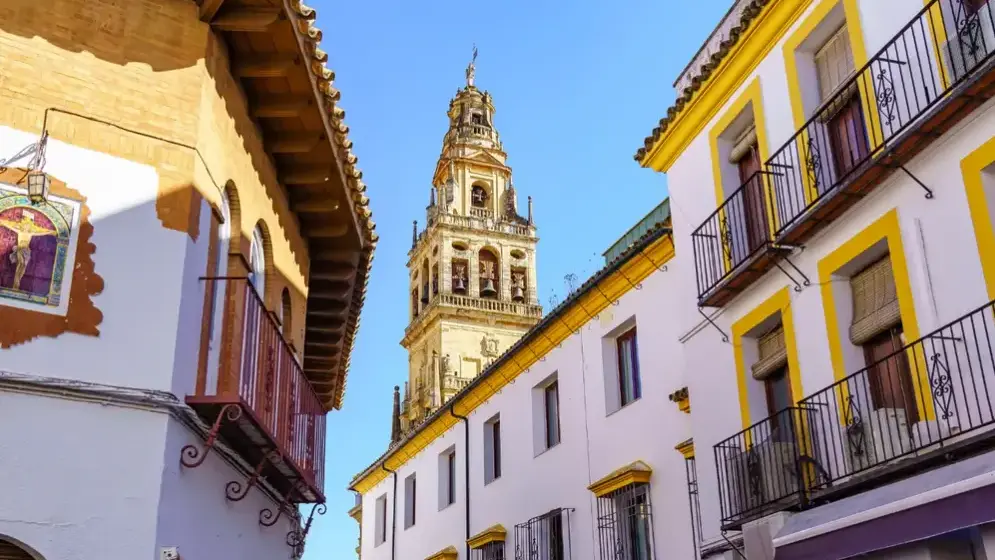
Abd al-Rahman I founded the original Great Mosque (Mezquita) of Córdoba in 785–786 CE on the site of a converted Visigothic church. The structure you visit today retains the essential spatial logic and the alternating red-and-white arch system he introduced. Later rulers expanded the building — Abd al-Rahman II, Al-Hakam II, and Al-Mansur each added sections — and a cathedral was built inside after the Christian Reconquista of 1236. The founding design, orientation, and double-arch rhythm all originate with Abd al-Rahman I.
When was the Great Mosque of Córdoba built?
Abd al-Rahman I ordered construction in 785–786 CE, roughly thirty years after founding the Emirate. He bought the site from the Christian community for 100,000 dinars, demolished the existing church, and completed the mosque within a year by reusing Roman and Visigothic columns. His successors expanded the building over the following two centuries.
What is the Rusafa palace?
Rusafa was a palace and garden estate Abd al-Rahman I built northwest of Córdoba in the 780s CE, named after his ancestral palace in Syria on the Euphrates. He planted it with palm trees and Mediterranean plants as a physical recreation of the landscapes he had left behind. The Córdoba Rusafa was later destroyed; it survives only in literary references and in the name of a district northwest of the city.
Was Abd al-Rahman I a poet?
He was known as a poet by his contemporaries. The most famous poem attributed to him is a lament about a lone palm tree growing far from home, generally read as a meditation on his own exile from Syria. Whether this specific poem is genuinely his is debated by scholars; some attribute it to his nephew. But his poetic sensibility was considered a defining trait in his own lifetime, and the themes he introduced — exile, longing for the east — shaped Andalusian literary tradition for centuries.
How did Abd al-Rahman I's reign influence Córdoba's golden age?
He created the institutional and architectural foundations without which the later golden age was impossible. The independent Emirate gave the city political autonomy from Baghdad, allowing it to develop its own court culture and intellectual life. The Great Mosque gave it a monumental center. His grandson Abd al-Rahman III built the Caliphate of Córdoba on this foundation in 929 CE, making the city one of the great centers of medieval learning. The Córdoba that produced Averroes and Maimonides in the 12th century was built on structures Abd al-Rahman I had established four centuries earlier.