Al-Hakam I ruled Córdoba from 796 to 822 CE. Between the golden narratives lie three events: a banquet massacre, a suburban uprising, and 20,000 exiles.
Art history background with eight years writing interpretive content on Córdoba's Caliphal heritage.
Updated Published
history-buffs
Al-Hakam I ruled the Emirate of Córdoba for twenty-six years, from 796 to 822 CE, and his reign sits in the archive of Andalusian history between two better-lit rooms. His grandfather Abd al-Rahman I founded the dynasty; his great-great-great-grandson Abd al-Rahman III declared the Caliphate. Al-Hakam belongs to the corridor between them, a corridor he kept passable through two massacres and a forced diaspora that sent thousands of Córdoba's residents across the Mediterranean and into history as unlikely empire-builders.
In this article
Jump to a section
⌄
A throne under immediate threat: the first years, 796-806
Al-Hakam I became emir in 796 CE, inheriting a position that was less a seat of power than a target[1]. His father Hisham I had ruled for seven years with relative stability, but Hisham's death reopened a question that never fully closed in the Umayyad Emirate: which branch of the family held legitimate authority, and who was prepared to contest it violently.
The challengers were his own uncles, Sulayman and Abdallah, both sons of the emirate's founder Abd al-Rahman I. They had their own networks of supporters inside Córdoba's Arab aristocracy, their own claims to succession, and their own impatience. Al-Hakam spent the first years of his reign suppressing their challenges, negotiating, and where negotiation failed, moving against supporters with enough force to signal consequences.
He was not yet the man the chroniclers describe from 806 onwards. But the pressure shaped him. An emir whose uncles disputed his throne from within the family compound could not afford to read disloyalty as theoretical. Every feast where nobles gathered was a potential conspiracy. Every conversation held without him was a potential meeting.
Timeline
796 CE
Al-Hakam I takes power
Inherits the emirate after the death of his father Hisham I. Immediate challenges from uncles Sulayman and Abdallah follow.
November 806
The banquet massacre
72 Umayyad nobles invited to a reconciliation dinner are executed. Their bodies are crucified along the Guadalquivir. Some accounts report up to 5,000 total deaths.
March 24, 818
The Rabad uprising begins
Residents of the Shaqunda suburb rise in revolt against fiscal oppression and the killing of a townsman by a palace guard.
April 818
Suppression and expulsion
Al-Hakam's cousin Ubayd Allah crushes the revolt over three days. Approximately 300 leaders are crucified. The entire suburb is razed and 10,000-20,000 residents expelled within four days.
818-827 CE
The diaspora spreads
Exiles establish the Andalusian Quarter in Fez. Over 10,000 reach Alexandria. A contingent participates in the conquest of Crete around 827, founding the Emirate of Crete.
May 21, 822
Al-Hakam I dies
Dies after a 26-year reign, succeeded by his son Abd al-Rahman II. The emirate he leaves is, for the first time, genuinely centralized.
His response to this condition, once it crystallized into specific form, was so extreme that medieval historians recorded it with something between awe and horror.
November 806: the dinner that was not a dinner
The conspiracy that al-Hakam moved against in November 806 had a specific origin[1]. His cousin Muhammad ibn Qasim, a man within the inner family circle, had been approached by Umayyad nobles seeking to replace al-Hakam with a more pliable emir. Muhammad ibn Qasim did something that defined his place in history: he told al-Hakam.
What al-Hakam did with that information was not arrest the conspirators. He invited them to dinner.
The pretext was reconciliation, a gesture of de-escalation, the kind of meal that rulers staged to signal that a dispute had passed. Seventy-two nobles and their attendants accepted the invitation[1]. They arrived at the palace in the Alcázar district with, presumably, the specific relief that men feel when they believe they have survived a dangerous moment.
The slaughter began at the table. Some accounts in the Arabic chronicles report that the killing extended far beyond the 72 principal guests, with total deaths reaching approximately 5,000 if retinues, household members, and those rounded up in the aftermath are included[1]. The scale of that secondary figure is impossible to verify and may represent the maximum estimate of a chronicler writing a generation later. The core fact, the 72 nobles executed at a banquet under a flag of reconciliation, is consistent across the sources.
What happened next was the act that made the event memorable beyond its body count. Al-Hakam ordered the corpses crucified and displayed along the south bank of the Guadalquivir, in sight of the city[1]. The display was not retribution; it was communication. Everyone in Córdoba who walked the river path could read the message: this is what conspiracy against the emir produces, and the emir will not be merciful about it.
72 nobles
The number of Umayyad aristocrats executed at al-Hakam's reconciliation banquet in November 806. Their bodies were crucified along the Guadalquivir's south bank, in sight of the city. Some chronicles report total deaths reaching 5,000 when retinues are included.
The aftermath was institutional as well as theatrical. Al-Hakam established al-Haras, a personal bodyguard unit composed of foreign Christian soldiers[1]. The choice of foreigners was deliberate: men without family connections in Córdoba's Arab aristocracy, without loyalties to any local faction, whose only patron was the emir who paid them. The lesson of the banquet was not simply that he would kill conspirators. It was that he would no longer rely on the existing power structures for his own protection.
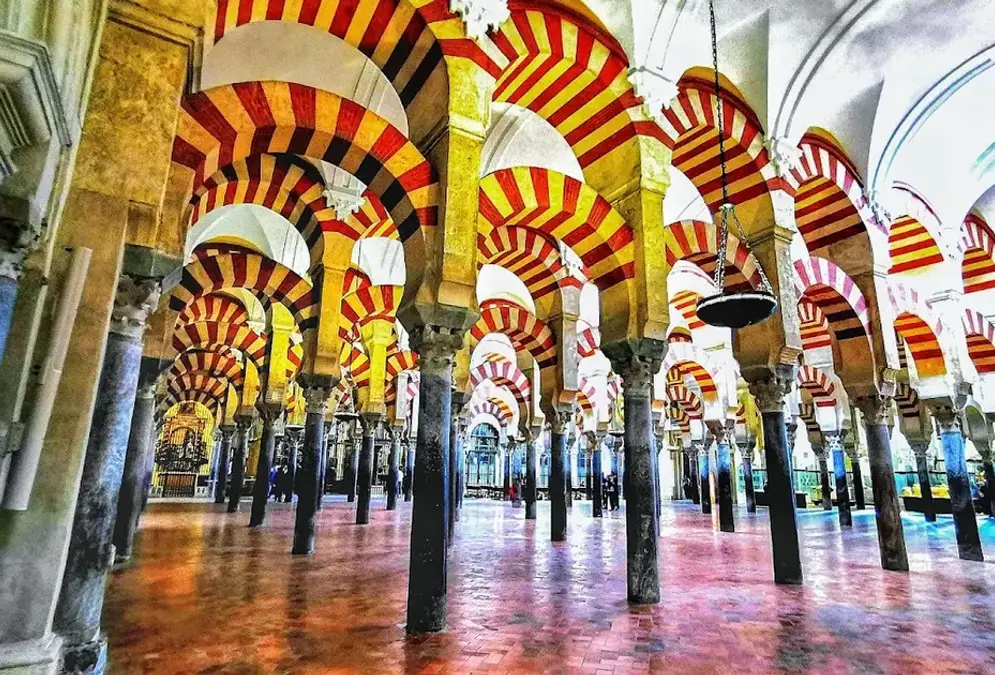
The Great Mosque of Córdoba, begun by his grandfather Abd al-Rahman I in 784, stood less than a kilometre from the palace where the massacre took place. Al-Hakam continued its construction during his reign. The same hands that ordered the crucifixions also built columns.
Who was in the Rabad, and why they rose: the 818 uprising
The Rabad (also transliterated as Arrabal) was the suburb of Shaqunda, on the south bank of the Guadalquivir, directly across from the Alcázar complex where al-Hakam lived[1]. It was not a slum. It was a dense, commercially active neighborhood of artisans, merchants, and Malikite religious scholars, the kind of place that generates both wealth and grievance.
The grievances in 818 were specific. Al-Hakam had increased fiscal demands on the city's population, requiring taxes and corvée labor at a rate that the merchants and craftsmen of the Rabad found intolerable[1]. Parallel to the economic complaint ran a moral one. The emir permitted the sale of wine in Córdoba, in violation of the strict interpretation of Islamic law that the Malikite jurists in the Rabad followed and preached[1]. These jurists, scholars of the legal tradition founded by Malik ibn Anas and by that point dominant throughout Andalusia and North Africa, had been organized and politically vocal for decades. Their objections to al-Hakam's governance were not mere theological complaints; they represented a broad coalition of merchants, artisans, and recent converts, the Muladis, who had accepted Islam but retained their urban, pre-Umayyad social organization.
The immediate trigger was smaller than any of this[1]. A palace guard killed a townsman. The killing was either an accident or a minor altercation that escalated, but in the political temperature of the Rabad, it was the event that turned organized discontent into movement. The Malikite leadership called a general strike. Workshops closed. The market went quiet. Then it went loud.
On March 24, 818, the Rabad rose against the palace[1]. The rebels moved toward the Alcázar district. Al-Hakam, who had survived one near-deposition through a banquet twelve years earlier, was inside the palace when the crowd reached the walls.
Recommended tours
Tours are selected for quality, not commission. We earn a small fee if you book — at no extra cost to you.
Al-Hakam's response to the Rabad uprising was not defense. It was a counterattack that lasted three days and erased a suburb.
His cousin Ubayd Allah led the military force that entered the Rabad through a concealed side gate, bypassing the rebels' defensive positions[1]. The entry was a tactical decision as much as a military one: it avoided the frontal engagement the rebels expected and placed soldiers inside the neighborhood before the population could organize a coherent resistance.
The fighting and the killing lasted three days. When it ended, approximately 300 rebellion leaders were publicly crucified[1], the same display method al-Hakam had used after the 806 banquet, the same location along the Guadalquivir. The repetition was almost certainly conscious. This was his signature.
Then came the order that exceeded the suppression: the entire suburb was to be razed, and all surviving residents expelled from Córdoba and from al-Andalus entirely, within four days[1]. Not the rebels. Not the organizers. Everyone.
The number of people expelled ranges across sources from 10,000 to 20,000[1]. Given the density of a suburb like the Rabad, both figures are plausible. What they represent, regardless of the exact count, is the forced depopulation of a functioning urban district in seventy-two hours, the removal of an artisan and merchant class that had been part of Córdoba's economy for generations.
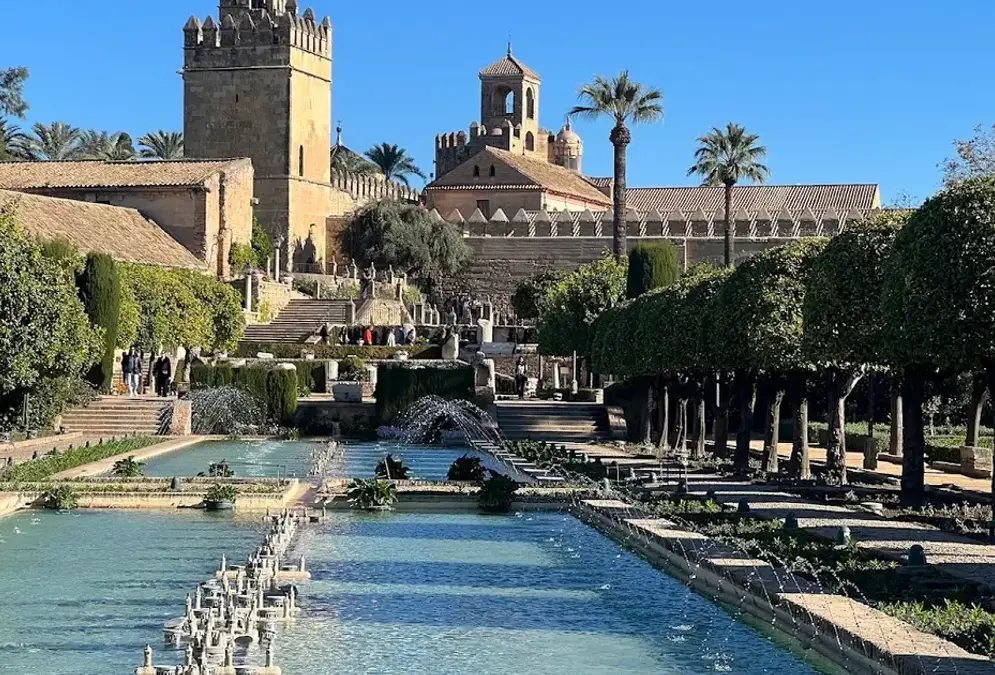
The physical site where the suburb stood was never rebuilt as a residential area. Archaeological work on the Campo de la Verdad and Miraflores side of the river, facing the Alcázar across the Guadalquivir, has documented evidence linked to the 818 destruction of Shaqunda[2]. The traces are there in the ground, under the modern city, marking the end of the Rabad.
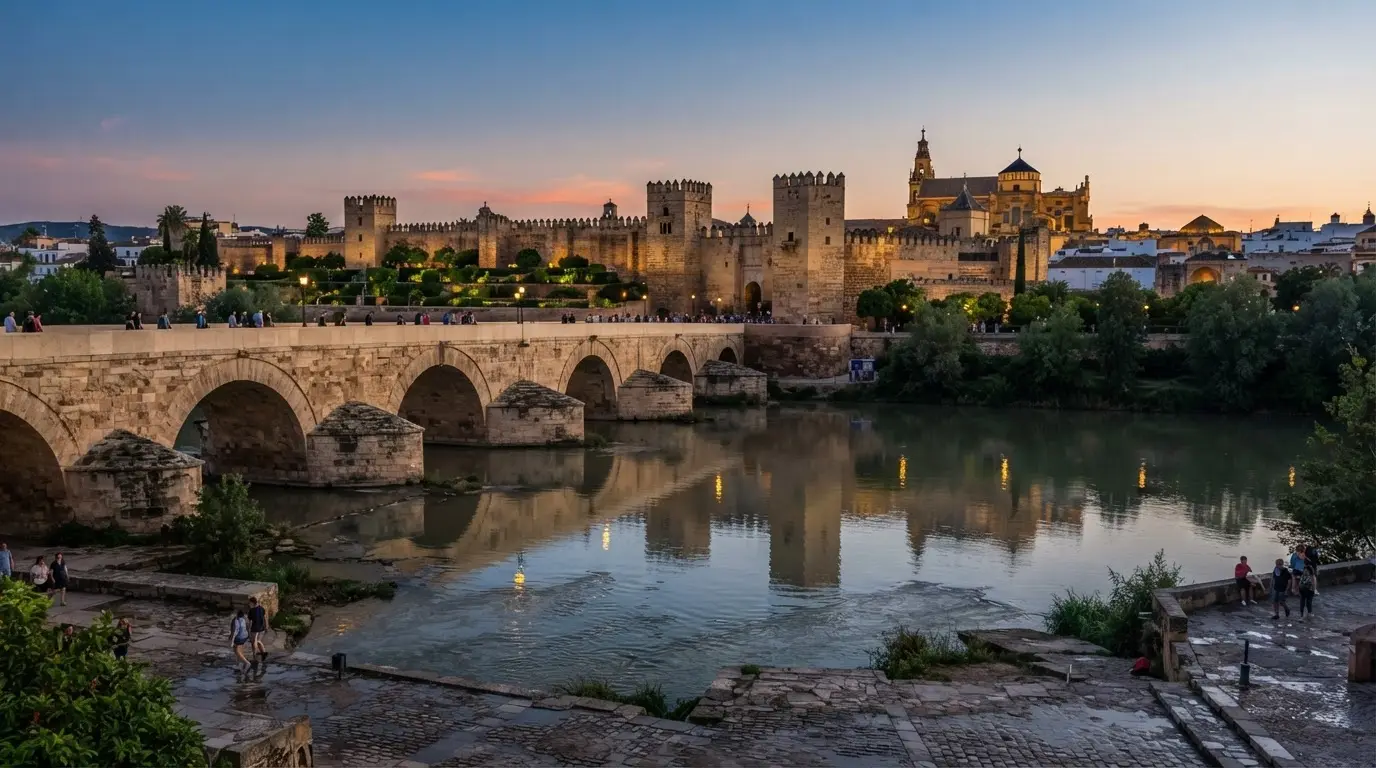
Standing today on the south bank of the Guadalquivir, on the path between the Roman Bridge and the Torre de la Calahorra, you are standing in what was Shaqunda. No monument marks the crucifixion sites. The destruction layer is not visible. But the Roman Bridge of Córdoba that connects the two banks crossed this same river in 818, and the Alcázar walls across the water are built on foundations that date to al-Hakam's time.
The diaspora: how Córdoba's expelled built three new worlds
The 10,000 to 20,000 people expelled from the Rabad in 818 were given four days to leave Córdoba and al-Andalus[1]. Four days to abandon houses, workshops, libraries, and the dense web of local relationships that an urban merchant class spends generations building. Where they went, and what they built, is the most consequential unintended consequence of al-Hakam's reign.
Approximately half settled in Fez, Morocco, where the Idrisid dynasty welcomed them[1]. They established what is still called the Andalusian Quarter of Fez, a neighborhood whose urban morphology and architectural character remain distinct from the surrounding medina. Modern visitors to Fez can walk streets that preserve the spatial organization of 9th-century Córdoban artisans. The quarter is a direct physical trace of al-Hakam's expulsion order, transported 500 kilometres across the Strait of Gibraltar.
The second group, over 10,000 people, sailed east to Alexandria, Egypt[1]. Alexandria already had an Andalusian community; the Rabad exiles joined and grew it. Within a generation, many of them had transitioned from refugees to maritime operators. The Arabic sources describe them becoming corsairs, pirates operating from Alexandrian ports across the eastern Mediterranean trade routes. Men who had been craftsmen in Córdoba's Rabad became sea-raiders out of Egyptian harbors.
The third trajectory is the one that most defies expectation. Andalusian-led forces, in a contingent that included or was connected to the Rabad diaspora, participated in the conquest of Crete around 827 CE[3]. They established the Emirate of Crete, an Islamic state on the island that lasted from 827 to 961 CE, over a century. The Byzantine Empire spent most of that period trying to retake it. Men whose fathers and grandfathers had made shoes and sold cloth in a Córdoban suburb ended up as the ruling class of a Mediterranean island.
These three destinations represent three different responses to forced exile:
Fez: assimilation into a welcoming Islamic state, cultural transplantation, the preservation of Andalusian urban forms in North Africa
Alexandria: diaspora commerce shading into piracy, the conversion of civilian skills into maritime violence
Crete: military conquest and state-building, exiles becoming conquerors, the furthest possible travel from the moment of expulsion
None of this was planned by al-Hakam. His expulsion order was a security measure, a way of ensuring that the surviving Rabad population could not regroup in Córdoba and try again. What it produced was a Córdoban diaspora that left identifiable traces across the Mediterranean for the next two centuries.
The paradox: poet, patron, and executor
Al-Hakam I presents a problem for narrators who prefer clear moral categories. The man who ordered the crucifixion display of 806, who erased an entire suburb in 818, and who scattered tens of thousands of people across the Mediterranean was, by the testimony of his contemporaries, an accomplished poet, a skilled orator, and a patron of learning and high culture[1].
He was physically distinctive: contemporary descriptions give him as tall, dark, and slim, notable enough in appearance that the sources recorded it[1]. He led troops personally into battle on multiple occasions rather than directing from rear positions. He promoted scholars and maintained the libraries and scriptoria that Córdoba's reputation for learning depended on.
This combination is uncomfortable but not contradictory. Medieval rulers across cultures operated in contexts where the display of violence was a tool of governance, a language that populations understood and that deterrence required. Al-Hakam's use of crucifixion as public spectacle, along riverbanks where the whole city could see, was calibrated. He was not killing randomly. He was communicating a specific message about what happened when you organized against Umayyad authority.
The revolts that continued after 806 and through the Rabad uprising, and similar disturbances in Toledo, Zaragoza, and Mérida during his reign[1], suggest the message needed repeated sending. The emirate he inherited from his father was not a pacified state; it was a collection of competing power centers that Umayyad authority held together by a combination of prestige, negotiation, and force. Al-Hakam's contribution was a clarification of which of those three did the actual work.
His son Abd al-Rahman II inherited a state that was, for the first time, genuinely centralized. The nobles who might have organized an alternative succession were dead or exiled. The foreign bodyguard al-Haras had been established and institutionalized. The precedent, that challenges to Umayyad authority would be met with exemplary and very public violence, had been set twice in two decades.
Abd al-Rahman II used that inheritance to build a sophisticated court culture, expand the Great Mosque of Córdoba again, and welcome the Baghdad-trained musician who reshaped Córdoban taste, the man who transformed Córdoban taste in food, fashion, and music for generations. The cultural flowering of Abd al-Rahman II's reign was possible in part because his father had secured the ground it grew on. That is the uncomfortable arithmetic at the center of al-Hakam I's story: the violence and the culture were not opposites. They were sequential.
The Córdoba that ibn Hazm described two centuries later, a city of extraordinary refinement and intellectual ambition, grew from soil that al-Hakam had tilled with methods ibn Hazm himself would have found abhorrent.
Frequently asked questions
Who was al-Hakam I?
Al-Hakam I was the Umayyad Emir of Córdoba from 796 to 822 CE, son of Hisham I and a concubine named Zokhrouf. He consolidated Umayyad power through brutal suppression of rivals, most notably a banquet massacre in 806 where 72 nobles were killed, and the violent suppression and razing of the Shaqunda suburb in 818. Despite this, he was also an accomplished poet, orator, and patron of learning. His 26-year reign established the precedent that challenges to Umayyad authority would be met with public, exemplary violence.
What happened at the 806 banquet massacre in Córdoba?
In November 806, al-Hakam I invited 72 Umayyad nobles and their attendants to a reconciliation dinner after learning of a conspiracy to replace him. The guests were executed at the table. Their bodies were crucified and displayed along the south bank of the Guadalquivir river, in sight of the city. Some Arabic chronicles put the total death count, including retinues and those arrested afterward, at around 5,000. Following the massacre, al-Hakam established al-Haras, a foreign Christian bodyguard unit, to replace his dependence on the Arab aristocracy for personal security.
What was the Rabad uprising in Córdoba?
The Rabad uprising of March 24, 818 was a revolt centered in the Shaqunda suburb on the south bank of the Guadalquivir. It was triggered by a palace guard killing a townsman, but the underlying causes were al-Hakam's oppressive taxation, corvée labor demands, and his tolerance of wine sales, which the Malikite jurists in the neighborhood opposed on religious grounds. The uprising united merchants, artisans, Muladis (Muslim converts), and Malikite religious leaders. Al-Hakam's cousin Ubayd Allah crushed it over three days through a surprise assault via a concealed gate. Approximately 300 leaders were crucified, and the entire suburb was subsequently razed.
What happened to the Muslims expelled from Córdoba in 818?
After crushing the Rabad uprising, al-Hakam expelled all surviving residents, estimated at 10,000 to 20,000 people, from Córdoba and al-Andalus within four days. The exiles dispersed across three main destinations: approximately half settled in Fez, Morocco, where they established the Andalusian Quarter, still identifiable today. Over 10,000 sailed to Alexandria, Egypt, where many became corsairs operating in the eastern Mediterranean. A third group participated in the conquest of Crete around 827 CE, establishing the Emirate of Crete, which lasted over a century until 961.
Where did the Rabad exiles go after leaving Córdoba?
The Rabad exiles went to three primary destinations. Fez, Morocco received approximately half, where they founded the Andalusian Quarter, a neighborhood whose distinct character persists in the modern medina. Alexandria, Egypt received over 10,000 refugees who joined existing Andalusian communities and became maritime raiders. And Crete, where Andalusian-led forces conquered the island around 827 CE, founding an Islamic emirate that controlled Crete for 134 years. These three trajectories represent assimilation (Fez), diaspora piracy (Alexandria), and military conquest (Crete).
Can you see any trace of al-Hakam I's reign in Córdoba today?
No monument or marker in Córdoba specifically commemorates al-Hakam I. However, archaeological work on the Campo de la Verdad and Miraflores side of the river, facing the Alcázar across the Guadalquivir, has documented evidence linked to the 818 destruction of the Shaqunda suburb. The south bank of the Guadalquivir, where the Shaqunda suburb stood and where crucified bodies were displayed, is now the path between the Roman Bridge and the Torre de la Calahorra. The Alcázar itself stands on palatial foundations from this period, though the current structure dates primarily to the 14th century Christian reconstruction.
How did al-Hakam I relate to the Great Mosque of Córdoba?
Al-Hakam I continued construction work on the Great Mosque begun by his grandfather Abd al-Rahman I in 784. His reign is not associated with the major expansions credited to Abd al-Rahman II, Abd al-Rahman III, and al-Hakam II, but the mosque was an active construction and religious site throughout his tenure. The mosque stands in the same district as the Umayyad palace complex where the 806 banquet took place, and the two structures were at the center of Umayyad Córdoba's political and religious life during his reign.