
Roman Corduba: capital of Baetica
Córdoba was founded as a Roman city around 169 BC during the campaigns of the consul Marcus Claudius Marcellus. It sat on the north bank of the Baetis, the river now called the Guadalquivir, at a natural crossing point, and it grew quickly into the administrative capital of Hispania Ulterior, later reorganized as the province of Baetica. By the first century CE it was one of the largest cities in the western Roman Empire, with forums, temples, amphitheatres, and a population that ancient sources place in the tens of thousands.
The physical evidence of this Roman city is not hidden. According to local accounts, a section of the Republican-era city wall survives in the car park immediately south of the Mezquita, visible behind a glass panel at street level. The blocks are large-format limestone, fitted without mortar, built in the second or first century BC. Travelers who arrive at the monument from the riverside car park walk directly past it, though most do not stop. The Roman Temple on Calle Claudio Marcelo, reconstructed in the 1950s, gives a better sense of what the city looked like at its height: a Corinthian-column temple on a podium, placed on the city's central plateau.
~169 BC
The site of the Mezquita itself fell within the old Roman city grid, in a quarter that functioned as residential and civic space during the imperial centuries. No major Roman temple has been identified beneath the mosque's footprint, though excavations have turned up Roman-period ceramic material and foundation stones consistent with first and second-century construction. What the Mezquita site was not was an uninhabited margin of the city: it was inside the walls, integrated into the urban fabric of a provincial capital that also produced Seneca the Elder and Seneca the Younger. The Romans also established the first hydraulic infrastructure along the riverbank — norias and weir systems on the Baetis that the Moorish engineers later inherited and expanded into the eleven-mill complex whose history runs from Roman Corduba to Isabella I: see our deep dive on the river's noria mills.
The Byzantine interlude: 552 to 572
Between the collapse of Visigothic authority in the south and its reassertion, the Byzantine Empire held a strip of southeastern and southern Spain for approximately twenty years. The Emperor Justinian I sent a fleet and an army in 552 CE at the invitation of a Visigothic faction seeking help in a succession dispute. The Byzantines took the opportunity to establish a province they called Spania, with its capital at Carthago Spartaria (modern Cartagena). At its greatest extent this territory reached west along the coast through Malaga, and it may have briefly included Córdoba itself, though the precise northern and western limits of Byzantine Spania remain debated among historians.
The occupation was short-lived. The Visigoths under Leovigild began the reconquest in the 570s. By 572 CE the Byzantines had been pushed back to their coastal enclaves, and within a generation they held only a fragment of the original territory. By 625 CE the last Byzantine position in Spain had fallen.
What the Byzantine interlude meant for Córdoba is less clear. If the city was within Byzantine Spania, it would have experienced the Greek administrative apparatus and the construction priorities of the eastern imperial church — both of which favored elaborate mosaic programs and episcopal architecture. Whether the Paleo-Christian structures later found beneath the Mezquita reflect Byzantine building programs or earlier Visigothic ones cannot be determined from the physical remains alone. What is certain is that southern Spain between 552 and 572 was a contested border zone between two Christian polities, both of whom built churches and set bishops over their territory.
Visigothic Córdoba: 130 years of a Christian city
The Visigoths had established themselves as the dominant power in the Iberian Peninsula by the mid-sixth century. Córdoba was one of their major cities: not the capital (that was Toledo under the mature Visigothic kingdom) but a significant episcopal and administrative center in the south. Between the consolidation of Visigothic rule and the Arab conquest of 711 CE, Córdoba spent roughly 130 years as a functioning Christian city under Visigothic governance.
This was not a culturally isolated period. Visigothic Córdoba had bishops, councils, and a literate ecclesiastical culture that was in regular contact with the rest of the western church. The Third Council of Toledo in 589 CE, at which King Reccared converted from Arianism to Nicene Christianity, transformed the religious landscape of the whole kingdom. Córdoba's church hierarchy was part of that shift. The city's bishops appear in the records of subsequent councils: Córdoba was a place with institutional weight.
The last Visigothic king to rule before the Muslim conquest was Roderic (Rodrigo), who died at the Battle of Guadalete in 711 CE, the engagement that effectively ended organized Visigothic resistance. But the groundwork for the collapse had been laid under the previous reign: Wittiza (694–710 CE) presided over a kingdom already fracturing through dynastic competition and noble rebellion. The Muslim forces under Tariq ibn Ziyad crossed the strait in 711 CE and found a polity already in civil war. Córdoba fell quickly after Guadalete; the city surrendered without prolonged siege.
Explore nearby · Monument
Mezquita-Catedral de Córdoba
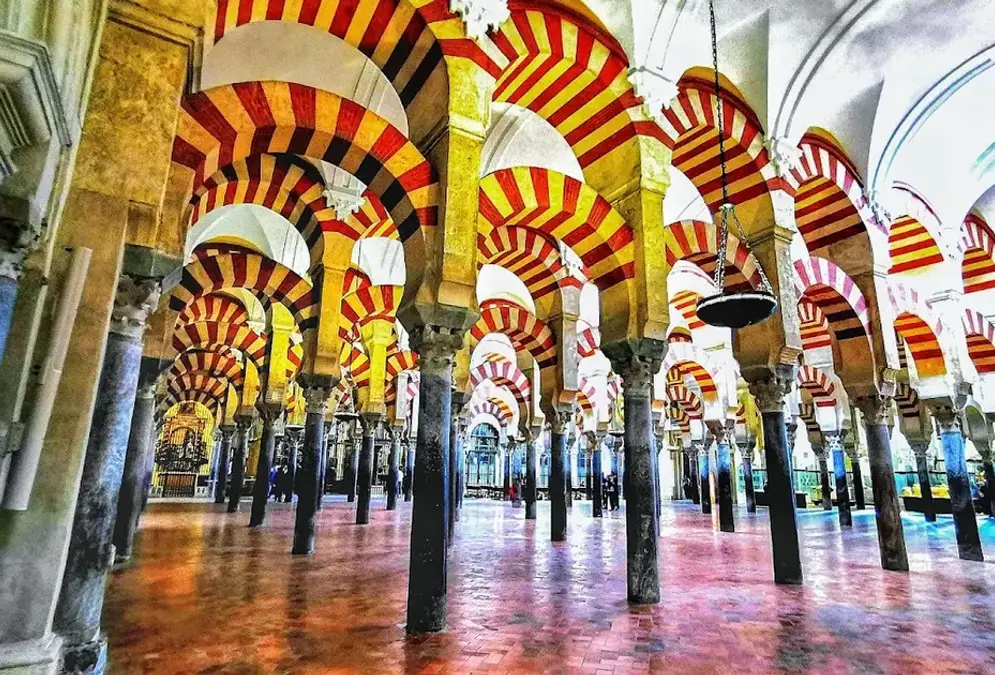
856 columns, 1,300 years of Islamic and Christian history. UNESCO monument in Córdoba, Andalusia. Red-and-white arches, Byzantine mosaics, a Renaissance nave.
What survived in Córdoba after 711 was not nothing. The dhimma system that the Arab conquerors applied to Christian populations guaranteed the right of continued worship under prescribed conditions. Córdoba's Christian community, the Mozarabs as they would come to be called, maintained churches, bishops, and a functioning religious life well into the eighth and ninth centuries. They are documented. They petitioned, complained, converted, and occasionally martyred themselves — most dramatically in the Córdoba martyrdom movement of 850–859, when 48 Mozarabic Christians voluntarily walked into Umayyad courts over that nine-year span to denounce Muhammad, splitting the community between those who thought dhimmi coexistence was sustainable and those who believed it was not. The Christian city did not simply vanish in 711.
Recommended tours
Tours are selected for quality, not commission. We earn a small fee if you book — at no extra cost to you.
What was on the Mezquita site: the San Vicente debate
The traditional account, repeated in guidebooks and tourist plaques across Córdoba, runs as follows: on the site of the Great Mosque stood the Visigothic basilica of San Vicente Mártir, the cathedral church of pre-Islamic Córdoba. Abd al-Rahman I purchased the Christian half of the building for 100,000 dinars[1] and demolished it in 785–786 CE to begin his mosque. This story has been the standard account since at least the tenth century: the earliest surviving account is attributed to the historian Al-Razi, with the same story later repeated by Ibn al-Qutiyya, who died in 977 CE. It is also the version the Mezquita-Cathedral's own archaeological documentation presents at the monument.
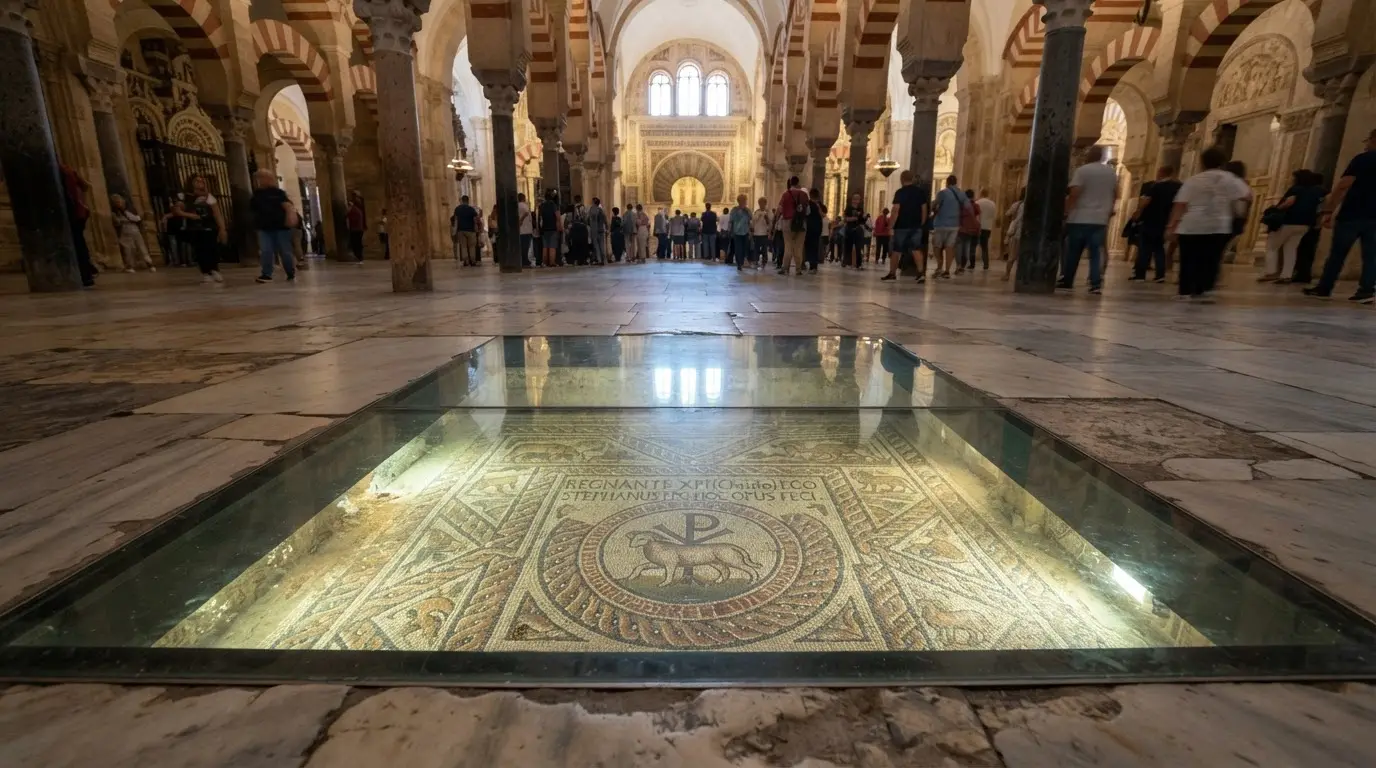
The physical evidence for some kind of pre-Islamic religious structure on the site is real. Excavations conducted between 1931 and 1936 by the architect Félix Hernández Giménez uncovered, beneath the mosque's floor, the remains of a rectangular building with an apse at its east end and a baptistry pool. Mosaic fragments recovered from this layer carry Christian iconography: a chrismon (the Chi-Rho monogram), dove motifs, and geometric patterns consistent with sixth-century Hispano-Roman church decoration. A mason's inscription reading "EX OFFICINA LEONTI" (from the workshop of Leontius) provides a rough date for the mosaics' manufacture, placing the building's construction in the sixth century. You can see some of these mosaics through glass floor panels in the Mezquita today, visible from the prayer hall above.
What is debated is whether these remains constitute the evidence of a full episcopal basilica as the traditional account claims. The Spanish archaeologist Fernando Arce-Sainz has argued that the excavated remains show no cemetery associated with the building — an expected feature of any major Visigothic church used by a significant urban population — and that the distribution of Christian iconographic material is too limited to support the identification of a major cult site. The scholar Susana Calvo Capilla has proposed that the structure may have been part of an episcopal complex (a bishop's residence with a private chapel) rather than a full parish basilica with the status of a cathedral church.[1]
The question of the purchase narrative is equally contested. The contemporary written sources do not corroborate the story of a negotiated sale: no 8th-century Arab or Christian document records the transaction. The earliest accounts appear in later chronicles, and their authors were writing with the benefit of two or three generations' hindsight and their own theological interests. What is clear is that some pre-Islamic Christian structure stood on the site — the physical evidence from Hernández's excavations is not in dispute. The precise character of that structure, its liturgical status, and the legal circumstances of its transfer remain open questions in the scholarly literature.
What is clear is that some pre-Islamic Christian structure stood on the site — the physical evidence from Hernández's excavations is not in dispute. The precise character of that structure, its liturgical status, and the legal circumstances of its transfer remain open questions in the scholarly literature.
784: what Abd al-Rahman I found and what he built over it
By 784 CE, the site the Umayyad emir chose for his mosque had already been in Islamic use for over seventy years. After the conquest of 711, Córdoba's main church had been split: Muslim and Christian communities shared the building, each using half for their respective worship, a pragmatic arrangement documented in early Arabic sources and plausible given the mixed population of the city in the decades immediately after the conquest.
Abd al-Rahman I had been ruling Córdoba since 756 CE. He had spent three decades consolidating the emirate against internal revolts and external threats: Carolingian pressure from the north, Abbasid diplomatic pressure from the east, Berber uprisings from the south and west. By the early 780s the political situation had stabilized enough to allow him to address the symbolic deficit of a capital city without a proper congregational mosque. What Córdoba needed, to function as a legitimate Islamic court city, was a Friday mosque on a scale commensurate with the emirate's ambitions.
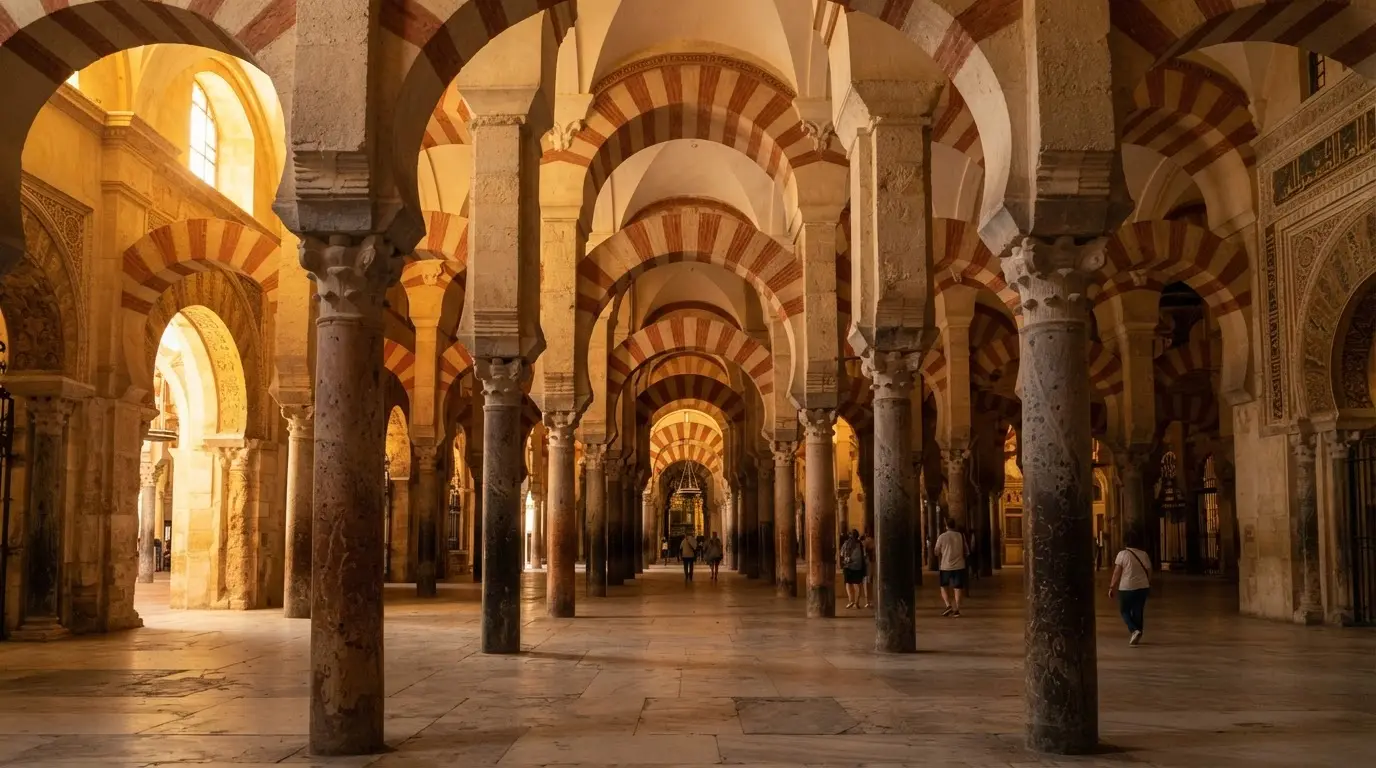
The construction began in 785–786 CE and was completed within approximately one year. This pace was made possible by the decision to reuse existing Roman and Visigothic architectural materials: the distinctive columns of jasper, marble, and granite that support the Mezquita's double arches came from demolished Roman structures and the dismantled elements of whatever stood on the site before. The builders did not quarry new stone; they assembled an existing city's material culture into a new form. The horseshoe arch, later to become the visual signature of Andalusian Islamic architecture, was itself a Visigothic form that Abd al-Rahman's builders adopted, adapted, and multiplied.
Deep dive · Article
Abd al-Rahman III: The Morning Córdoba Became a Caliphate
Abd al-Rahman III was the first Caliph of Córdoba, declared on January 16, 929, ruling a city of up to 500,000 people and building Medina Azahara in 936.
The emir who built it died in 788 CE, three years after the mosque's founding. He had come to Iberia as a refugee with one companion in 755 CE and left it as the founder of a dynasty that would last 275 years. The mosque he ordered is still standing. The pre-Islamic structure it replaced, whatever its exact form and status, is visible only in fragments through glass panels in the floor. For the full story of what happened to the building after 785, see Abd al-Rahman I and the founding of the Mezquita and the Mezquita's transformation in 1523.
Visiting pre-Islamic Córdoba today: what you can actually see
Most of what survives from pre-Islamic Córdoba sits alongside or beneath the city's Islamic monuments, which means visitors often walk past it without realizing. These are the specific locations worth a deliberate stop.
The Roman wall fragment in the Mezquita car park. On the south side of the Mezquita, in the multi-storey car park off Calle Torrijos, a section of the Republican-era Roman city wall is, according to local accounts, preserved behind glass at ground level. The blocks are original, unfaced, and substantial: the kind of construction that was meant to last, and has. No entrance fee, no queue, open whenever the car park is. Most visitors to the Mezquita never see it.
| Site | Period | What you see | Practical notes |
|---|---|---|---|
| Roman wall, Mezquita car park | 2nd–1st c. BC | Republican-era city wall blocks, reportedly behind glass | Free, open all hours in the car park |
| Glass floor panels, Mezquita | 6th c. CE | Paleo-Christian mosaics, apse outline, baptistry | Included in the standard Mezquita ticket; best light in mornings — check the official site for current pricing |
| Alcázar de los Reyes Cristianos | 2nd–3rd c. CE | Roman mosaic collection from a Roman-era fortified site nearby | Open Tue–Sun; check the official site for current pricing and free-entry windows |
| Museo Arqueológico de Córdoba | 5th–8th c. CE | Visigothic capitals, carved panels, liturgical objects | Open Tue–Sat 09:00–21:00, Sun 09:00–15:00; check the official site for current pricing and any free-entry conditions |
The Visigothic mosaics through the glass floor panels. Inside the Mezquita-Cathedral, several sections of the floor have been fitted with glass viewing panels that look down into the earlier archaeological layer. You can see the mosaic fragments from Félix Hernández's excavations: the chrismon, the dove patterns, the geometric borders, and the stone outlines of the walls below. The light conditions matter: the mosaics are easier to read in the morning when light enters through the Patio de los Naranjos. The baptistry pool identified in the 1930s is partially visible from one of the panels near the qibla wall.
The Alcázar de los Reyes Cristianos. The Christian royal palace built after the 1236 Reconquista sits on ground that carried a Roman-era castellum (a fortified structure) — the sources do not support the more specific claim, repeated in some guides, that this was a named praetorium or a Visigothic royal residence. The extensive Roman mosaic collection in the Alcázar's ground-floor rooms came from the surrounding area, including pieces excavated at nearby Plaza de la Corredera in 1958–59 and dated to the 2nd–3rd century CE. The history of Córdoba hub maps the city's layered past from Roman through Islamic and Christian periods.
The Archaeological Museum. Housed in the Renaissance Palacio de los Páez, the Museo Arqueológico de Córdoba holds the densest collection of Roman, Visigothic, and early Islamic material from the city and province. The Visigothic room has capitals, carved stone panels, and liturgical objects from the period between the fifth and eighth centuries: the material culture of the city whose church the Mezquita replaced, or at least partially occupied.