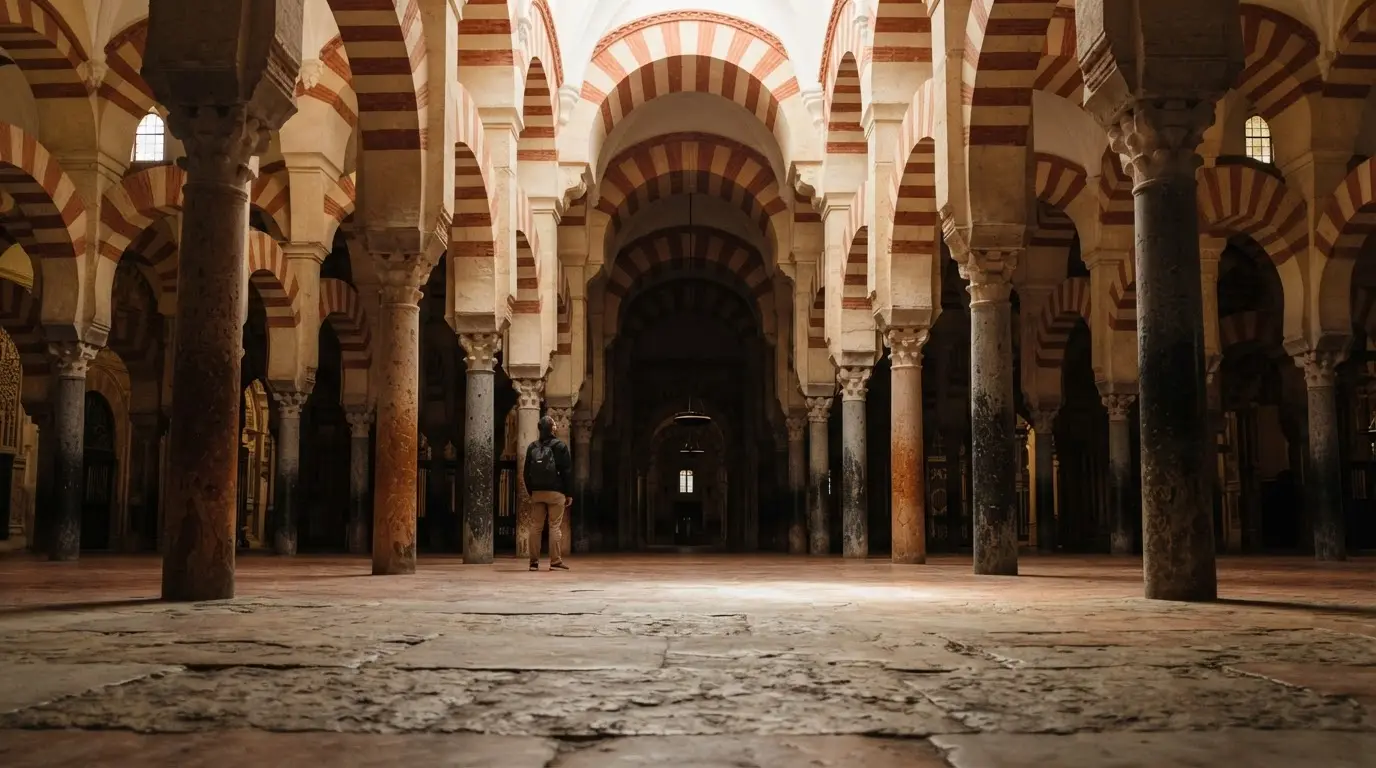

How the Mezquita became a Romantic sight
Travellers had written about the building for a long time: after Ambrosio de Morales, a long tradition grew among visitors who, particularly in the Romantic period, took an interest in it[5]. Interest never matched the Alhambra's, and the gap shows in neo-Arabic architecture, where the Mezquita fared worse than the Granada palace as a model for 19th-century designers[6]. Chicago's 1893 Spanish Section still evoked it with 144 columns and 163 arches[7], and in 1913 the Cuban architect José Toraya traced Havana's Palacio de las Ursulinas on its arcade[8], yet even at Chicago, in one of the most particular evocations of the Córdoba mosque, the Alhambra still dominated perception[9]. That lag is odd for a building that gave the horseshoe arch its Islamic reputation.
Words did what earlier drawings had not. Spanish-language scholarship calls those drawings a little-valued precedent overshadowed by English and French testimonies[10]. Royo-Naranjo and Laguna Bolívar present Córdoba as an example of the ideal city for the first romantic tourists[11], and they argue that the travellers' testimonies shaped how the city's tourist image took form[12]. Ford's Handbook for Travellers in Spain, published by John Murray in 1845, ran to further editions in 1847 and 1855[13] and has been called a defining moment in the genre[14].
One Romantic of the century was born in the city and did not write from the road. Ángel de Saavedra, the Duke of Rivas, was born in Córdoba in 1791[15], was exiled to Malta and Paris[16], met a flourishing centre of romanticism in London under Alcalá Galiano's guidance[17] and later directed the Academia de San Fernando[18].
The foreign voices are these three:
- Richard Ford, in 1831, whose Córdoba drawings include the city front towards the Guadalquivir[19]
- Théophile Gautier, in 1840
- Edmondo De Amicis, around 1872
Gautier's 1840 visit: a citadel, a forest and a wart
Gautier came to Córdoba in 1840 with the art collector Eugène Piot and published his account in 1843[20]. He arrived over the Guadalquivir bridge, and from there the Mosque rose above the walls and roofs more like a citadel than a temple[21]. The exterior, a long walled mass of masonry, still reads that way.
Inside, the image that came to him was a forest[22]. He counted 860 columns, was told they were only half the number in the first mosque[23], and still ruled that Córdoba's Mosque was without a rival in the whole world[24]. Short of breath, then, but not short of opinions.
“"you seem rather to be walking about in a roofed forest than in a building."[22]”
The Renaissance nave was another matter. Gautier pinned the design on Hernán Ruiz and went straight for the insult, a "parasitical church"[1]; De Amicis would later wish the church away more politely. He also passes on the remark attributed to Charles V once the work stood finished: had he known, he would never have let anyone touch the old building[25]. The metaphor is vivid and one-sided, since it makes the mosque the body and the cathedral a disease, a framing that suited a traveller who came for the Orient and found Catholicism in the way.
Ford, De Amicis and the plaster over the arabesques
The three travellers agreed on one grievance: whitewash and plaster. Gautier complained that thanks to whitewash a wall a century old could not be told from one raised yesterday, a remark about Córdoba's buildings in general rather than the Mezquita alone[26]. Plaster had flattened the ornament along with the age.
Richard Ford's version comes from a letter written from the Alhambra, where he was lodged in 1831[27]. He had spent three days in Córdoba and found in the old mezquita a wood of pillars, some eight hundred odd[28]. His target was an earlier generation of plasterers, who had covered the painted arabesque and "delicate damascene work of the Moor" in plaster of Paris, a coat that had been taken off only a few years before he arrived[29].
Explore nearby · Monument
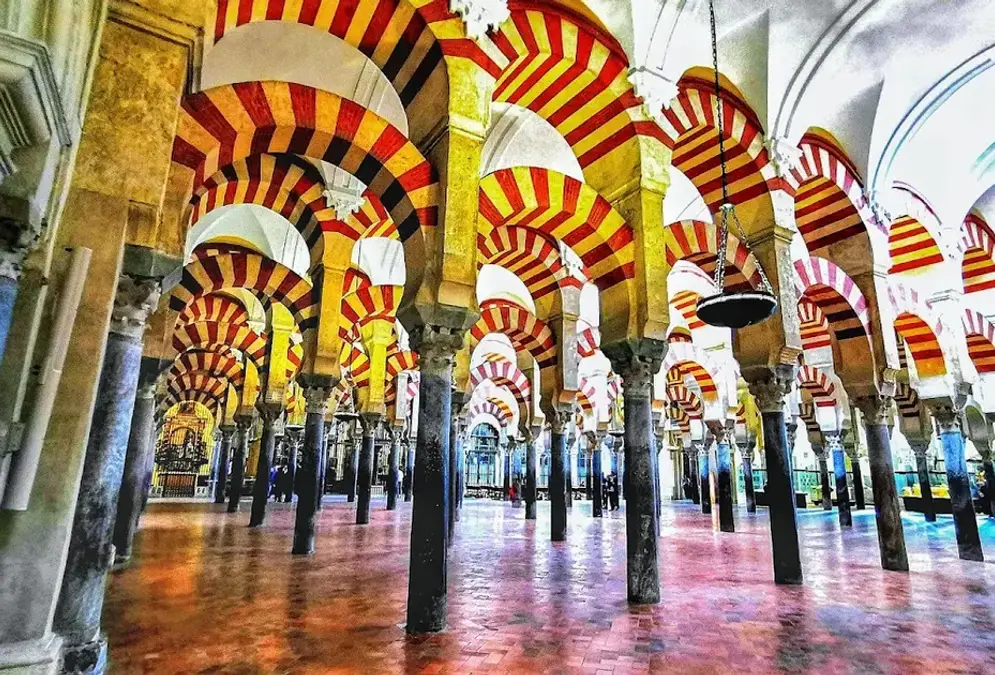
Mezquita-Catedral de Córdoba
856 columns, 1,300 years of Islamic and Christian history. UNESCO monument in Córdoba, Andalusia. Red-and-white arches, Byzantine mosaics, a Renaissance nave.
De Amicis, around 1872, called the mosque a forest of marble whose boundaries one cannot discover[30], and he wrote that a building converted into a cathedral must always remain a mosque[31]. He too noticed the arabesques of old doorways that surface now and then from under what he called the detestable plaster of the Christians[32]. His verdict on the nave echoes Gautier's, if more politely: without the church the mosque's appearance would be much improved[33].
Read together, the three lines point the same way. Gautier's "parasitical church", Ford's plaster of Paris and De Amicis's "detestable plaster" all cast later work on the building as an imposition, and the praise for the columns arrived in the same breath as the contempt for the additions.
Restorers at work before and after the travellers
Repair was under way before any of the three arrived. Spanish-language art-history scholarship dates Duroni's works on the mihrab mosaics to 1815 to 1819, and calls them cuidadas labores, careful labours, which is the scholars' characterisation of an Italian architect's campaign rather than a record of what it involved[34].
The mosque's own timeline separately dates Patricio Furriel's restoration of the mihrab to 1816[35], and the glass tiles on a coloured base that Furriel applied were easy to tell from the originals[36]. Gautier, for his part, thought the preserved mihrab zone matched the Thousand and One Nights for richness, beauty and fairy elegance[37].
The institutional turn came later. Ricardo Velázquez Bosco's restoring activity runs from 1879 to 1923 on that timeline[38], and his work focused on recovering the Islamic legacy, which meant dismantling the Baroque vault and altarpieces of the Villaviciosa chapel[39]. On 21 November 1882 a Royal Order declared the cathedral a National Monument. Note the wording: the monument was the Holy Church Cathedral[40].
Testing their claims inside the Mezquita today
The Mezquita-Catedral still lets a visitor check each traveller's claim against the fabric.
- The forest: Gautier counted 860 columns and heard it was half the first mosque's number[23]; Ford's "eight hundred odd" leaves you a margin for your own tally[28].
- The nave: Gautier's wart and De Amicis's wish for a mosque without a church are two opinions about the same Renaissance structure[1][33].
- The mihrab: Furriel's glass tiles were made easy to tell from the originals[36], so a close look at the mosaics separates 19th-century repair from earlier work.
Deep dive · Article
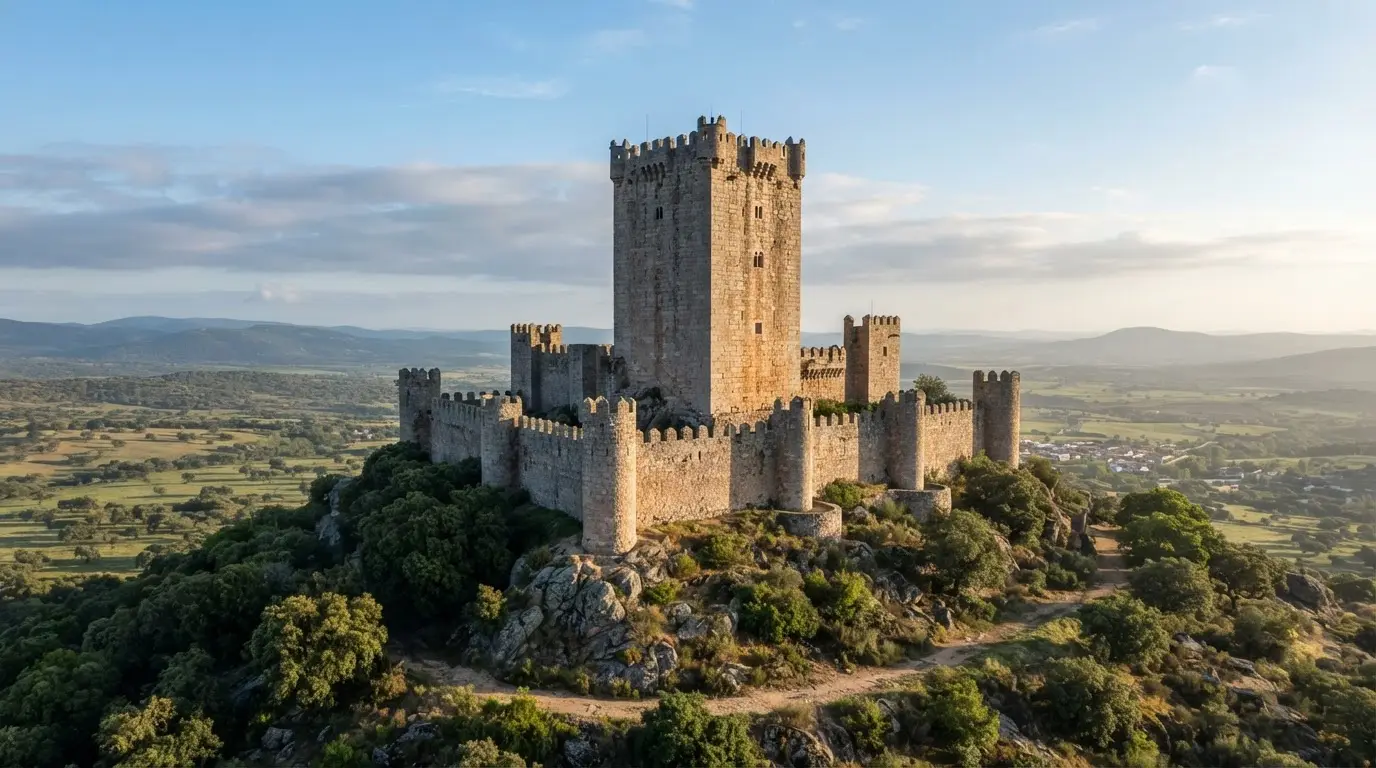
47 Metres Tall and Almost Unknown: Spain's Tallest Keep
Belalcázar Castle's 47 m keep is listed by the Junta de Andalucía as Spain's tallest. How it grew, what to see inside and how to book the free guided visit.
Recommended tours
Tours are selected for quality, not commission. We earn a small fee if you book — at no extra cost to you.
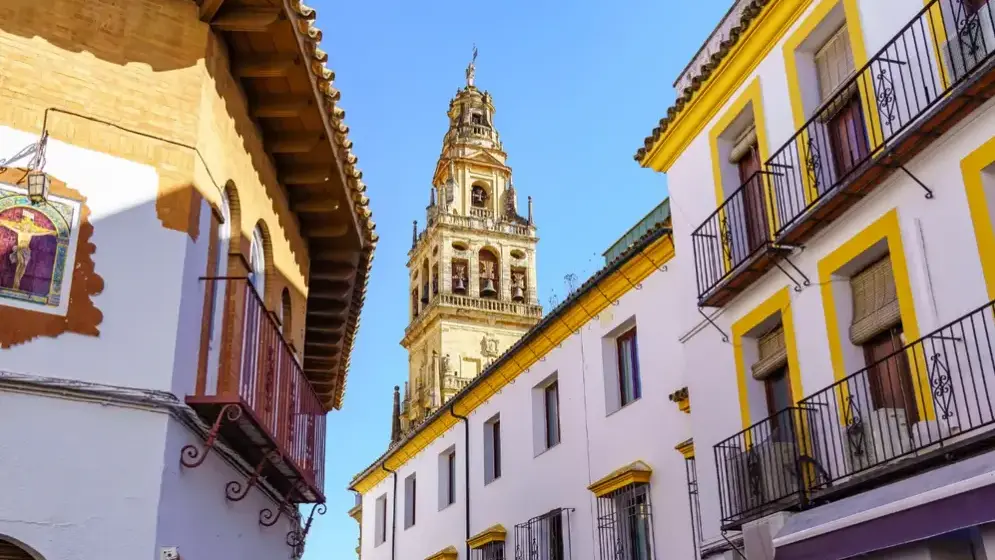
Ticket prices and visiting hours are on the monument's own page. Go with Gautier's forest in mind and De Amicis's complaint close behind: the building has kept both stories, and the quarrel between them is part of what you are looking at.