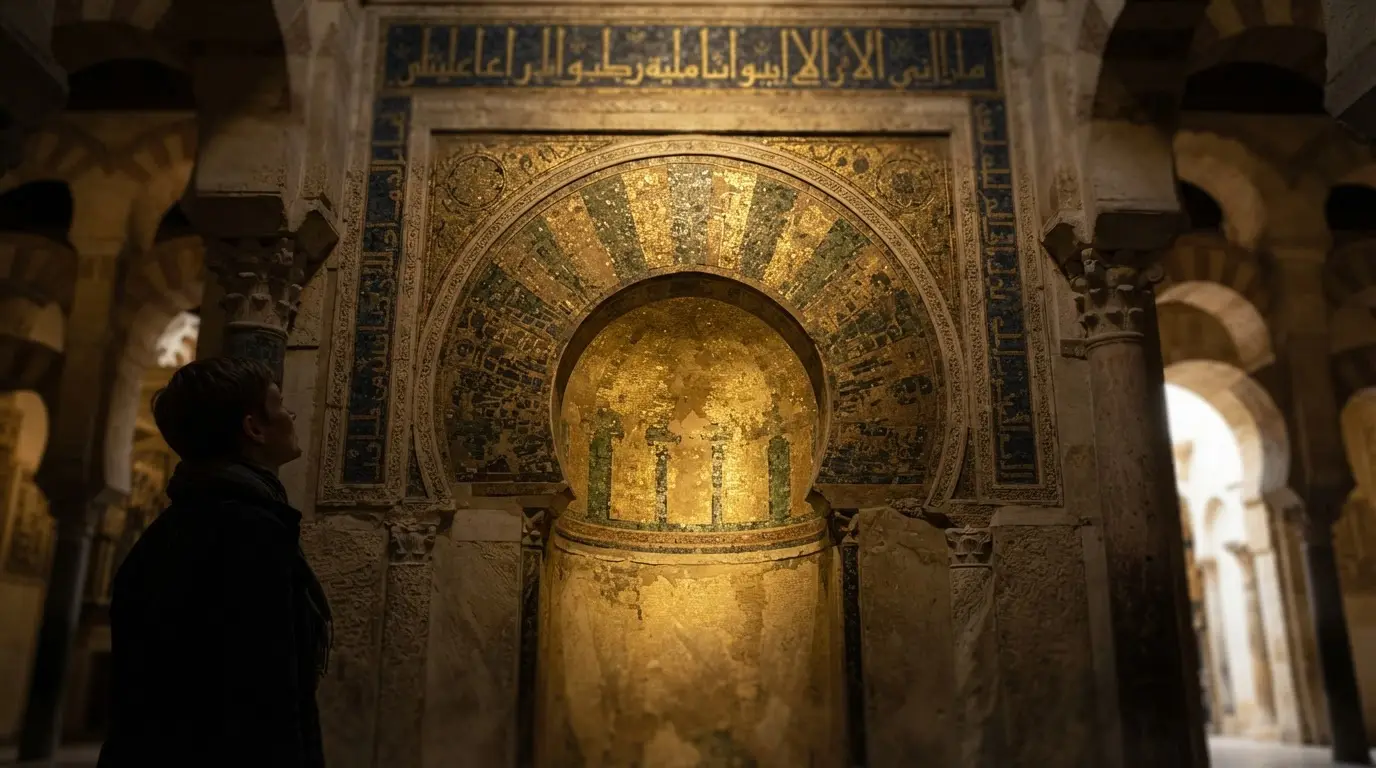

Why Byzantine glass sits on the caliph's qibla wall
Stand at the qibla wall and the gold stops behaving like the rest of the building. Elsewhere the Mezquita is stone, brick and painted plaster; the glass mosaic sits on the mihrab façade around the prayer niche and its horseshoe arch, in the dome of the entrance hall, and on the façades of the Sabat and Bab Bayt al-Mal doors[5]. Most of the cubes are gold leaf with shades of green and blue, plus a little red, purple and yellow[6].
The model was Umayyad Damascus, whose great mosque was so prestigious that al-Hakam II took it as inspiration for the qibla wall of the mosque he had enlarged[7]. The Umayyads had lost Syria long before, and the mosaics gave the Córdoba caliphate a visual link to that vanished eastern caliphate[8]. Nothing comparable existed elsewhere: no other Islamic monumental mosaic is known from the tenth century[9].
What a visitor registers first is not the pattern but the light. Each cube holds a film of gold leaf inside glass, so the surface glints and changes with the angle of view, while the stone and plaster beside it stay matt.
Everything about the mosaics therefore points beyond al-Andalus for its source. The chronicles and the laboratory agree on that much, if on little else.
What the chronicles say about the gift
The fullest account is Ibn Idhari's, written around 1312, long after the event. In it a gift reaches Caliph al-Hakam from the king of Rum, meaning Byzantium, in the form of 320 quintars of mosaics[10].
A specialist travelled with the consignment, the story goes on, and taught his craft to local slaves[11]. He is simply "a specialist" in that telling, and no name comes with him. Later readers turned the passage into a mosaic school at Córdoba, but that sequel is doubted, because the alleged school left no other trace in the historical or archaeological record of al-Andalus[12].
Two strands in the account are worth holding apart. The arrival of material from Byzantium is the part the glass later confirms; the teaching of slaves is the part nothing else supports, so it is best read as a chronicler's explanation for how a lost art could have briefly flourished at court[12].
The quantity is slippery too. Ibn Idhari's number is a count of units, and what a modern reader makes of it depends on what a unit weighed.
Which emperor, and in which year?
The emperor is the weakest link in the story. The twelfth-century geographer al-Idrisi names Constantine VII Porphyrogenitus as the sender[16]. Work on the mihrab began around 965, though, and on that reckoning the authors of a 2021 study of the glass argue that the ruler in Constantinople should have been Nikephoros Phokas, who reigned from 963 to 969[17]. A third possibility is that the plan began under Abd al-Rahman III and the tesserae travelled with an embassy of Romanos II, who reigned from 959 to 963 and was Constantine VII's son, around 961[18].
The firmest date comes from an inscription at the Bab Bayt al-Mal door, which says its decoration was finished in 354 H, or 965 AD[19]. The scholar Ocaña Jiménez argues for late 360 H, or 971 AD, because the inscription sits in a restored part of the mosaic and may have been wrongly attributed[20]. Six years is enough to move the sender from one emperor to another, which is why the question stays open.
Explore nearby · Monument
Mezquita-Catedral de Córdoba
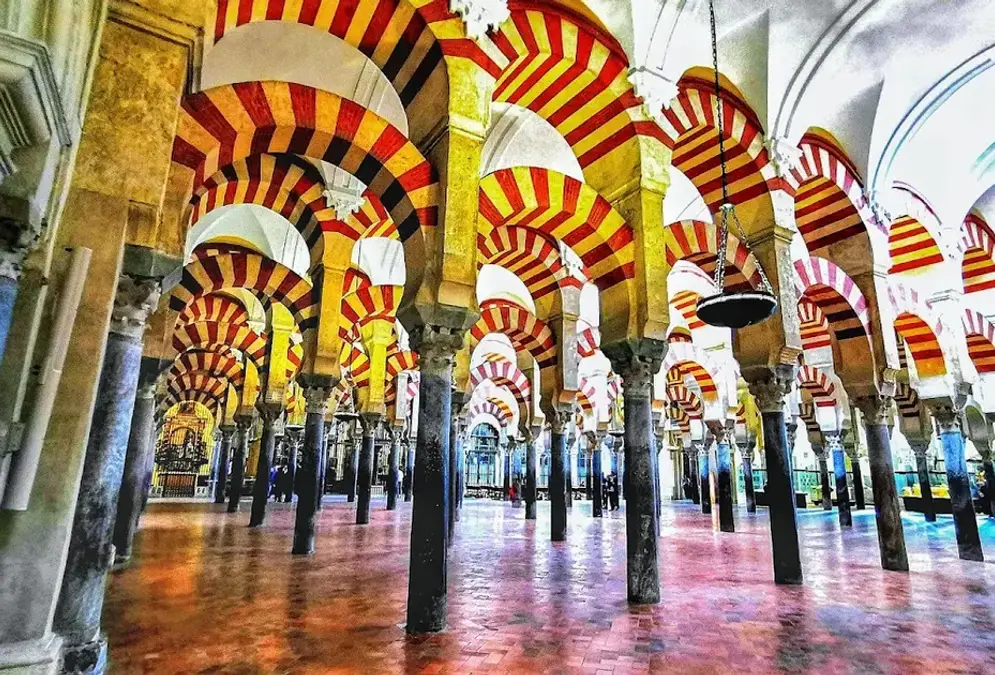
856 columns, 1,300 years of Islamic and Christian history. UNESCO monument in Córdoba, Andalusia. Red-and-white arches, Byzantine mosaics, a Renaissance nave.
What the glass chemistry shows
Chronicles can be argued with; glass is harder to argue with. The six authors of the 2021 analysis, Gómez-Morón, Palomar, Cerqueira Alves, Ortiz, Vilarigues and Schibille, found that about three quarters of the 61 original tesserae they tested carry the high-boron signature[2], and conclude that their data prove the imported material came from Byzantium, whichever emperor sent it[21].
The same chemistry complicates the craft-transfer story. Some tesserae carry a fingerprint that suggests local raw materials were mixed with imported high-boron glass, which points to local mosaic glassmaking[22]. A visiting craftsman topping up imported stock fits that better than a school that left no trace.
What the analysis cannot do is name a workshop or a hand. It says where the glass was made, not who set it in the wall, which is why the mosaicist of the chronicles remains a figure of the text rather than of the record.
Size varies with height. The cubes set in the domes, among them the ribbed dome at the mihrab, run from 1 to 1.5 square centimetres, against 0.2 to 0.8 on the façades at lower levels[23].
Covered, patched and copied: the restoration record
Once the mosque became a cathedral after the 1236 conversion, the mosaics at Bab Bayt al-Mal were eventually hidden behind Pablo de Céspedes's canvas of the Last Supper, from 1595[24]. Water did more lasting harm than any hand: leaks and damp in the walls made the mortar bedding of the cubes disintegrate[25]. Repairs came in three waves.
The record runs as follows:
- 1771: the French architect Baltasar Dreveton repaired the mihrab dome at a cost of 24,000 reals[26].
- 1817 to 1818: Patricio Furriel, hired by the acting governor Tiburcio María de la Torre, restored the mihrab mosaics and filled lost areas with painted mortar and colourless glass fixed with screws or glue[27][28].
- 1916: a facsimile of the Bab Bayt al-Mal mosaic made by the Maumejean atelier in Madrid with the Venetian mosaicist F. Morolin, commissioned by the architect Velázquez Bosco, was installed[29].
Recommended tours
Tours are selected for quality, not commission. We earn a small fee if you book — at no extra cost to you.
The nineteenth-century brief was to restore the Islamic mosaics without altering their overall appearance[30]. That is a defensible aim and a nuisance for visitors, since a good repair is by design hard to pick out.
The colourless glass is a neat solution for a wall lit by lamps: the painted mortar underneath supplies the colour, and the glass on top supplies the shine, so the fill reads as part of the surface from a distance[28]. Up close, the join is where the eye should go.
The mihrab today: what is original and what to look for
The Bab Bayt al-Mal façade is the instructive case. No original mosaic remains there, because it was completely restored in the "stylistic restoration" manner of Viollet-le-Duc[31].
The mihrab is where the chemistry and the restorers' record meet: glass imported from Byzantium on one reading, patched in 1817 to 1818 on another[27]. Neither cancels the other, and the gap between them is the interesting part of the wall.
Look up as well as across. The larger cubes set in the domes read differently from the small ones lower down, and the difference is a quick way to feel how the programme was scaled for the viewer on the floor[23].
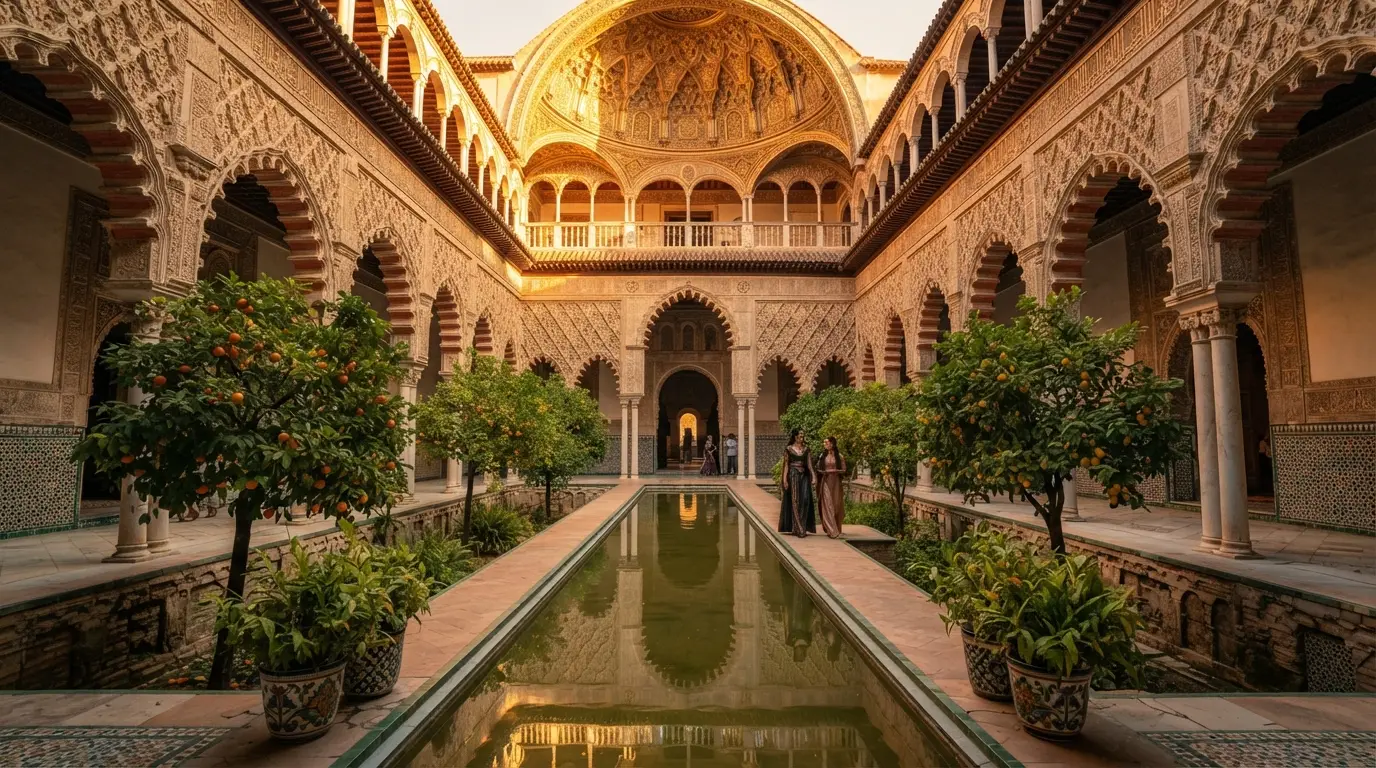
Deep dive · Article
Game of Thrones' Dorne: Córdoba's Real Architecture
HBO's Game of Thrones built Dorne's look from medieval Córdoba's Umayyad architecture: horseshoe arches, muqarnas domes, though filming happened in Seville.
Walk to the qibla wall inside the Mezquita-Catedral, look at the cubes rather than the arch, and note where the colour turns suspiciously even. A restoration of the maqsura and its mosaics was reported to have begun in January 2024, with about three years expected[32], so the view may change; check current access with the cathedral's visitor information before building a visit around it.