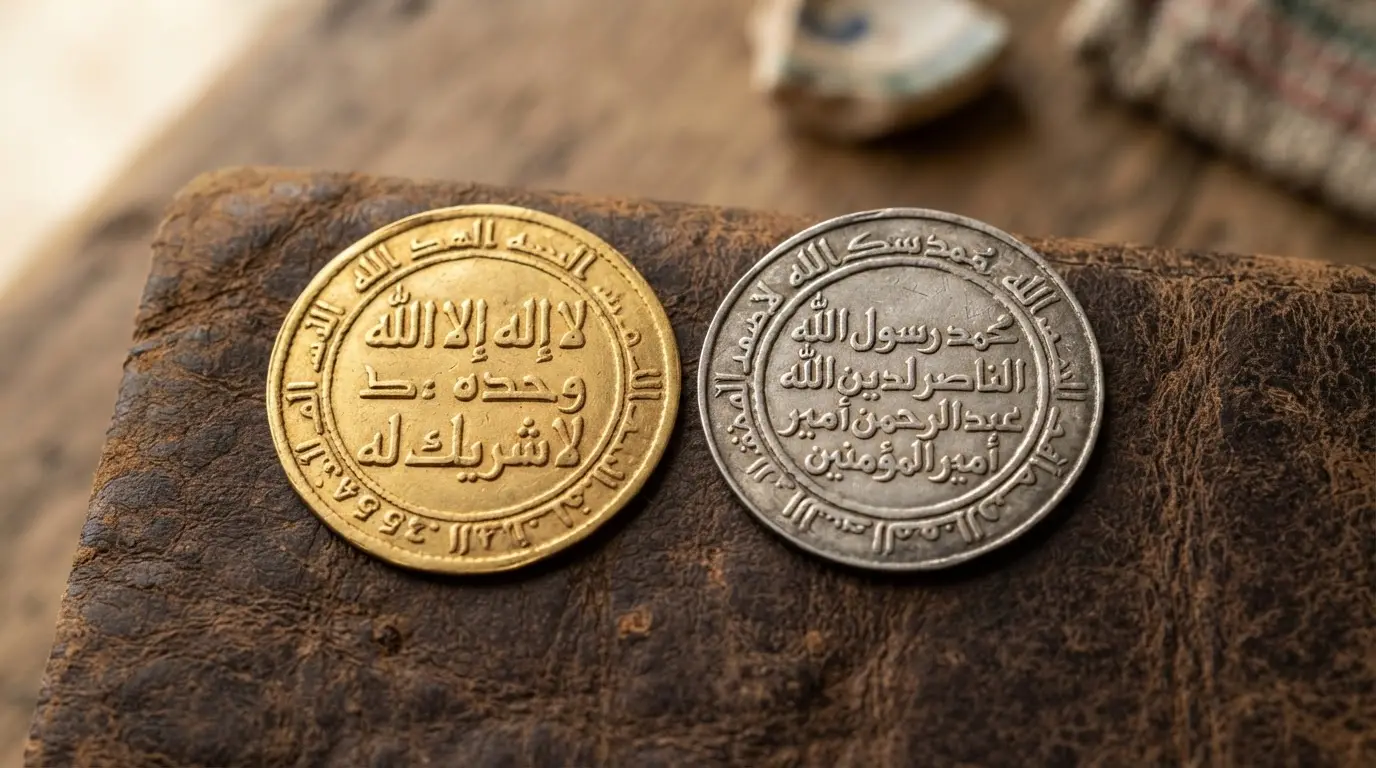

929: Córdoba begins striking its own gold
A caliph's authority in the Islamic world was measured in two places: the Friday sermon and the coin in circulation. Córdoba's break from Baghdad, proclaimed in the Great Mosque on 16 January 929, needed a second confirmation that could travel further than any sermon.
That confirmation came within the same year: in 929, Abd al-Rahman III had a new gold dinar struck bearing his own name and titles, the first new Umayyad gold coin issued in Spain since the Umayyads had ruled as emirs under nominal Abbasid religious authority[1].
Al-Andalus had used coin as currency since at least the late 8th century, but it took the 10th century's flow of gold along trans-Saharan trade routes for Córdoba to mint both metals at real volume[2], the same expanding gold supply that let Abd al-Rahman III strike his new caliphal dinar at scale.
How a coin was made: from bullion to die-struck dinar
Minting a caliphal coin started with metal, not design. At the Dar al-Sikka, Córdoba's mint house, officials first tested incoming bullion for purity, then melted and refined it to the standard the state required[3]. Only after refining did the metal become ingots, rolled thin and cut into blank discs ready for striking.
Striking itself was manual and repetitive. A blank disc sat on the obverse die; the reverse die dropped on top; a mint worker struck it with a mallet, and the design impressed on both faces at once. The bronze dies eventually wore down and had to be replaced.
The classical gold dinar elsewhere in the Islamic world was struck to a standard of 4.25 grams, a weight known as the mithqal[4]. Andalusian coins didn't hold to that precision as tightly: weights ran less accurate than the classical eastern dinar, and dies were struck more carelessly, with subordinate officials sometimes adding their own names in small script beneath the caliph's[5].
| Dinar | Dirham | |
|---|---|---|
| Metal | Gold | Silver |
| Everyday role | High-value gifts, treasury reserve | Circulating currency of daily trade |
The mint was one of several workshops the caliphate ran directly, alongside the tiraz silk workshops that produced its ceremonial textiles.
Reading a caliphal coin: script, no faces, and why
A Córdoban dinar carries no portrait, no emblem, nothing but arranged Arabic script, and that was already the rule two centuries before Abd al-Rahman III took the throne. Since a reform in 696–697 CE, Islamic coinage had rejected nearly all figural imagery, using text as the sole decoration on both faces[6]. The convention held everywhere the Umayyads and their successors struck coin, Córdoba included.
The standard legend followed a fixed template: the shahada, «There is no god except God alone, there is no partner with Him», paired with a formula naming the mint and the year, and on the reverse a Qur'anic verse. Change the mint name, the date, and the ruler's own name, and you have the template behind every Umayyad dirham struck across the caliphate's territory.
What did change, coin to coin, was the ruler's own name, and that mattered more than decoration ever could. Islamic coins recorded the mint's place and date, the ruler's name, his father's name, and his heir or envoy[7]. A caliph who wanted his authority recognized had a new coin struck in his name; a rebel who wanted to claim that same authority did exactly the same thing, immediately, in whichever town he controlled. Striking a new coin, not proclaiming a sermon, was the fastest way medieval Iberia had of broadcasting who was actually in charge.
Explore nearby · Museum
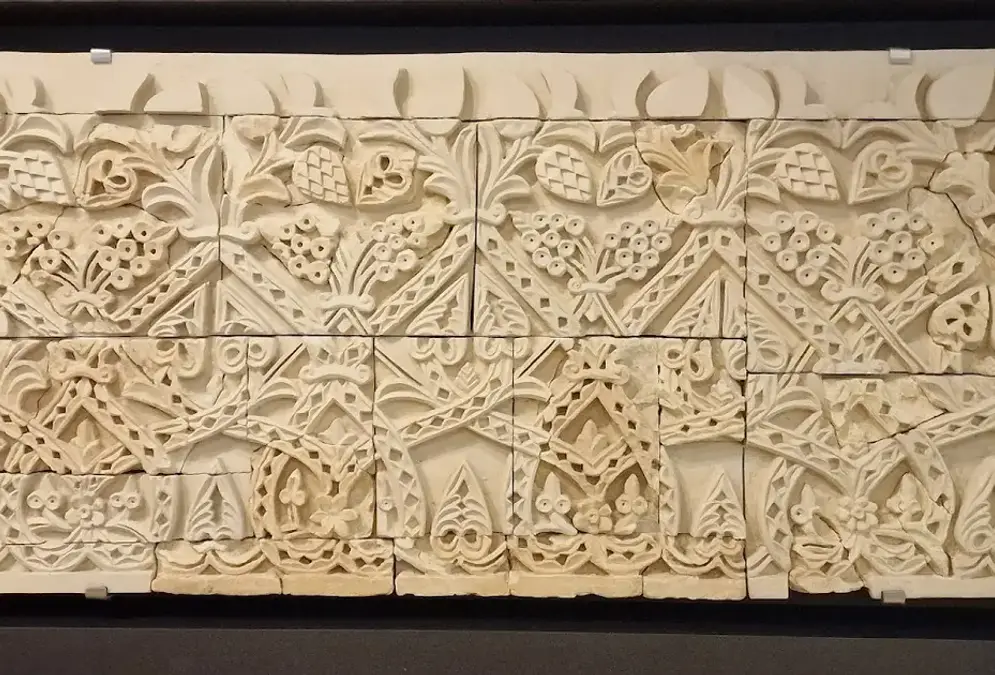
Museo Arqueológico de Córdoba
33,500 pieces in a Renaissance palace built over a Roman theatre: mosaics, Iberian sculpture, Caliphal ceramics. Free for EU citizens. Closed Mondays.
The mint moves: Madinat al-Zahra and the price of a caliphate
Abd al-Rahman III's dinar was minted in Córdoba until 947, when a new mint opened inside Madinat al-Zahra, his newly built palace-city eight kilometres to the west. Coinage stayed there until it moved back to Córdoba around 975 to 976[8], tracking the caliphate's shifting seat of government: administration and currency production moved together, first out to the palace-city, then back to the old one.
Islamic law bound the mint to a fixed standard. The caliph was personally responsible for the purity and weight of every coin, set by shari'a at seven mithqals of gold to ten dirhams of silver[9].
The mint's fortunes over the following decades mirrored the caliphate's own: expansion, then dispersal after 1009, and eventual silence once the state that had commissioned these coins ceased to exist.
Recommended tours
Tours are selected for quality, not commission. We earn a small fee if you book — at no extra cost to you.
Islamic silver's long reach: dirhams and the Viking trade
The Guadalquivir had already seen Norse ships once, when a fleet raided Seville in 844. By the 10th century, contact between the Norse world and Dar al-Islam had shifted from raid to trade: Norse merchants exchanged furs and enslaved people for Islamic silver dirhams, moving that silver north along routes reaching deep into Scandinavia. The sources behind this account describe that dirham economy broadly; they don't identify how much of the silver recovered in the north came specifically from Córdoba's own mint.
The scale of the wider trade is stark. Scandinavian museums hold nearly 500,000 silver dirhams today, more than anywhere else in the world[11].
Deep dive · Article
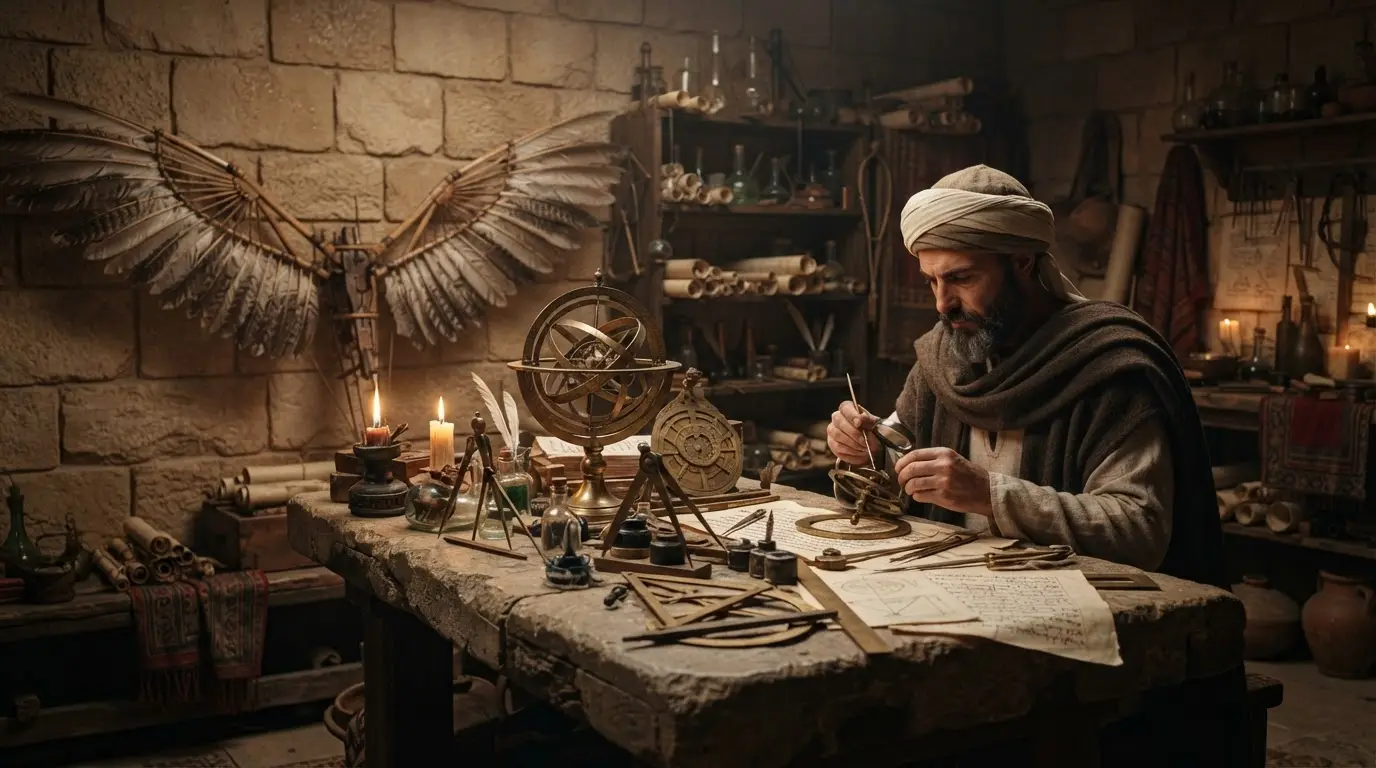
Abbas Ibn Firnas: Córdoba's Polymath Who Dreamed of Flight
Abbas Ibn Firnás built lenses, glass, and astronomical tools in 9th-century Córdoba. His famed flight rests on a single account, written 750 years later.
That trade did not last. By the mid-11th century, as Christianity took hold across Scandinavia, Norse commerce with the Islamic world for dirhams had effectively ended[12].
Decline: the fitna and the end of a caliphal currency
The mint's decline tracked the caliphate's own. After 1010, as the fitna tore Córdoba's central authority apart, local strongmen across al-Andalus began striking their own coins, copying Umayyad designs and reusing the names of former caliphs[13].
The underlying logic never changed: whoever struck the coin claimed the authority behind it. When a new caliph came to power, he had a new coin struck in his name to make the change official[14]. During Almanzor's decades running the caliphate in a child caliph's name, authority still flowed through Umayyad coinage bearing that caliph's name; once the caliphate itself fractured, the Taifa kingdoms that followed each struck coin under their own names instead.
What those Taifa coins looked like is itself a measure of decline: production scattered across many local mints instead of one, no single dinar carrying weight across the whole peninsula the way Abd al-Rahman III's coinage once had. The mint that struck his declaration of independence in 929 outlived him by seventy years before it, too, answered to nobody in particular.