How a Small Córdoba Town Became the World Capital of Quince Candy
A Córdoba province town of 30,000 makes more than 10,000 tonnes of quince paste a year. The 1840 shop that grew into an industrial export trade, explained.
Seven years covering Córdoba's gastronomy, taberna culture, and the Montilla-Moriles DO.
Published
food-lovershistory-buffs
Puente Genil is a farming town in Córdoba province that most visitors never hear of, yet its confectioners have supplied Spain's cheese boards since before the country had cars on its roads. One company there now makes more than ten thousand tonnes of quince paste a year, from an orchard planted with eighty thousand trees. The town's own population is smaller than that tree count.
Quince is barely edible straight off the tree: hard, sour, and astringent enough to dry out a mouth in one bite. Cydonia oblonga isn't native to Spain either. It grew first in Asia Minor and the Caucasus, and reached the Iberian Peninsula with Greek and Roman traders; today the harvest still runs through autumn across Andalusia, Murcia and Valencia.[1] Cooked down slowly with sugar, that same unpromising fruit becomes carne de membrillo, the dense amber paste that sits on every Spanish cheese board.
Andalusia grows quince across several provinces, but one town south of the city of Córdoba built an entire local economy on it. Membrillo San Lorenzo, one of the two producers still trading there, describes Puente Genil as the paste's cradle, pointing to the area's climate as the reason quince does so well nearby.[2] That's a producer's own pitch rather than an independent ranking, but the industry that grew out of the claim is real enough to trace.
Córdoba has its own confectionery tradition too, the almond mazapán shaped in the historic centre's pastry shops, but that stays small-batch. What happened in Puente Genil scaled into something else.
1834: a merged town, a new confectionery
Puente Genil is a relatively young administrative creation. The town became a single municipality only in 1834, when two riverside settlements, La Puente de Don Gonzalo and Miragenil, were joined together, six years before its signature trade even started.[3]
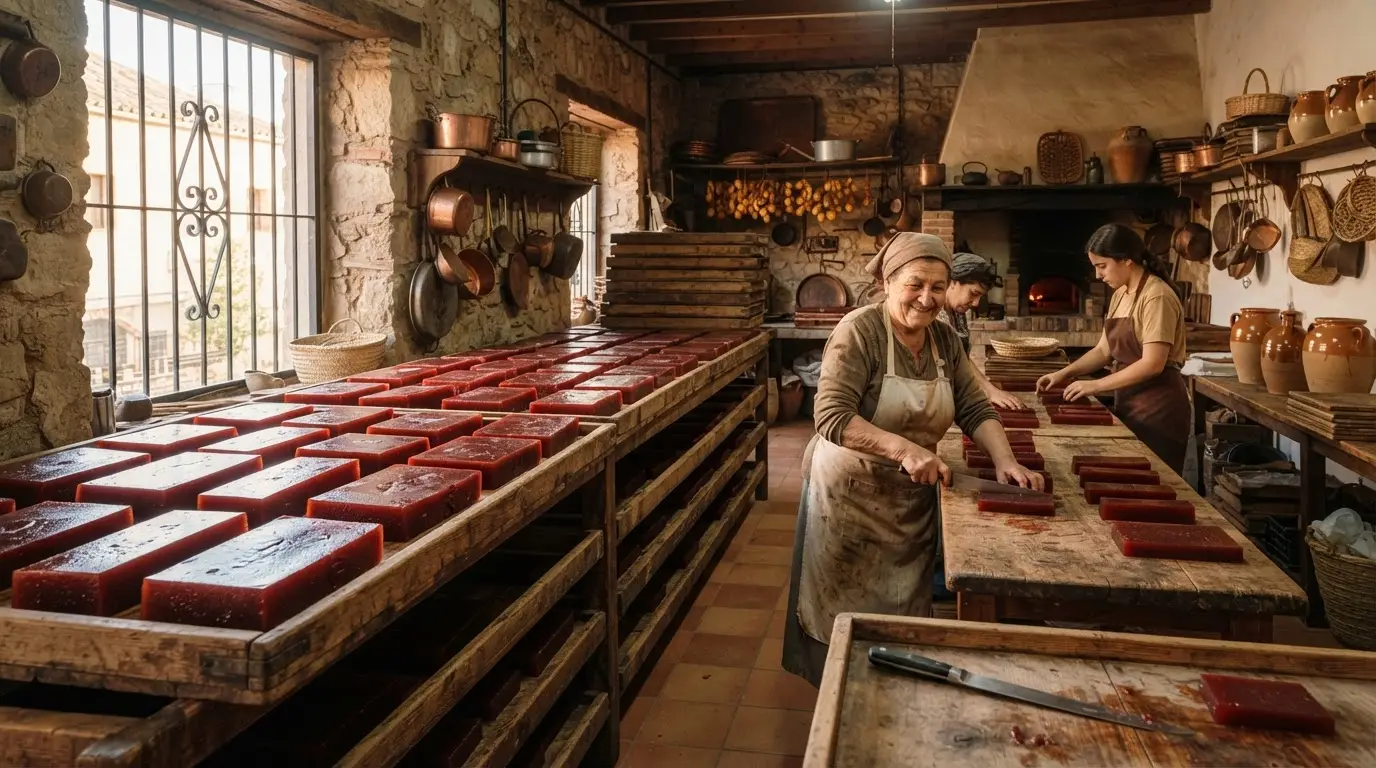
In 1840, Rafael Rivas Pérez set up a confectionery in the newly merged town and built it around one fruit. The shop grew, over more than a century, into Membrillo El Quijote, the company whose name is stamped on tins of quince paste today.[4]
By the late 19th century, membrillo confection stood out within Puente Genil's food industry,[5] part of a broader late-19th-century industrialisation that also built up flour, olive oil and orujo-oil production in the same period.[13] Rivas Pérez's shop no longer had the trade to itself.
San Lorenzo was one of many membrillo makers the town has had over the decades: in 1942, Lorenzo Estepa Aguilar founded, independently of Rivas Pérez's firm, the group of companies that became Membrillo San Lorenzo, one of the few still operating today.[6] Two decades later, El Quijote modernised production: in the 1960s, Miguel Chacón Rivas, who succeeded the founder, moved the company onto vacuum-sealed packaging that could survive a longer trip to market.[7] A century after Rivas Pérez's shop opened, Puente Genil had multiple producers in the trade and a product built to travel.
Timeline
1834
Puente Genil formed
Two river settlements, La Puente de Don Gonzalo and Miragenil, merge into one municipality.
1840
El Quijote founded
Rafael Rivas Pérez opens the confectionery that becomes Membrillo El Quijote.
Late 19th c.
Industrialisation
Membrillo confection becomes the town's standout industry.
1942
San Lorenzo founded
Lorenzo Estepa Aguilar builds the group of companies that becomes Membrillo San Lorenzo.
1960s
Vacuum packaging
El Quijote adopts vacuum-sealed packaging, letting the paste travel further.
The plantation and the pairing that went global
In 1981, El Quijote incorporated as a limited company and made its biggest bet yet: a quince orchard it calls the largest of its kind in the world, more than 80,000 trees, held through two associated companies, one of them named Membrillos Extremeños, a hint that not every tree in that count is rooted in Puente Genil itself.[8] Whatever the exact geography, the investment locked in decades of raw material.
Membrillo San Lorenzo took a similar path on its own scale. The company now runs 20,000 m² of production facilities outside the town, a scale it says answers a market that keeps getting more demanding and more global.[9] Both firms left the shape of a single shop behind decades ago.
What carried the paste beyond Spain wasn't the plantation alone. Manchego did more for the trade than any factory investment: the classic wedge-of-cheese-plus-paste plate is the reason quince paste travelled past Spain's borders at all, becoming shorthand for how the two are meant to be eaten together.[10] Visitors chasing that pairing don't need to detour to Puente Genil for it: Córdoba's own food tour puts Manchego and membrillo on the same plate a few streets from the Mezquita.
Puente Genil today: the arithmetic behind 'world capital'
Puente Genil itself has a population of around 30,000 and sits about 70 km from the city of Córdoba.[11] Set that beside what one factory alone produces there: El Quijote's Puente Genil site covers more than 26,000 m², employs sixty people, and turns out upward of 10,000 tonnes of quince paste every year.[12] A town smaller than several Córdoba neighbourhoods supplies cheese boards it will never see.
The 'world capital' claim in this article's own headline rests mostly on the producers' own figures rather than an independent industry census, worth remembering before repeating it as settled fact. What isn't really in dispute is the shape of the story: two of Puente Genil's many historical membrillo makers are still standing today, one tracing to Rivas Pérez's 1840 shop and the other founded independently in 1942, and a fruit nobody eats raw still defines a town most of Spain has never visited.
Before you go
Neither producer lists a public visitor programme on its own site. Confirm directly with El Quijote or Membrillo San Lorenzo before building a special trip to Puente Genil around a factory visit.
Córdoba itself carries a parallel confectionery inheritance worth comparing to Puente Genil's industrial one: the flaky, cabello-de-ángel-filled pastel cordobés has nothing to do with quince, but it comes from the same instinct, building a local identity around one stubborn, labour-intensive recipe. A cooking class in the city won't teach you to make membrillo, but it runs on the same patient, ingredient-first logic that built Puente Genil's industry one batch at a time.
Frequently asked questions
Why is Puente Genil known for quince membrillo?
Puente Genil, a Córdoba province town, has made quince paste since 1840, when Rafael Rivas Pérez opened the confectionery that grew into Membrillo El Quijote. The town has had many membrillo makers over the decades; Membrillo San Lorenzo, founded independently in 1942, is one of the few still operating today. Both firms still trade, and El Quijote's own plantation and packaging investments turned a single shop into an export business.
Is Puente Genil really the world capital of quince paste?
The claim rests mainly on the producers' own figures rather than an independent industry ranking: El Quijote describes its 80,000-tree orchard as the world's largest of its kind and reports more than 10,000 tonnes of annual output from its Puente Genil site. Those are real, sourced numbers, but there's no outside census confirming Puente Genil outranks every other quince-producing region worldwide.
What does quince paste (membrillo) pair with?
The classic pairing is Manchego cheese, a combination credited with carrying Spanish quince paste into international markets and making it one of the most recognised cheese pairings anywhere. In Córdoba, food tours typically serve membrillo alongside Manchego rather than on its own.
“Originally from Asia Minor and the Caucasus, the Greeks and Romans originally brought it to Spain. This golden yellow fruit is harvested in the fall, mainly in Andalusia, Murcia, and the Valencia region.”
“In the south countryside from Cordoba, Puente Genil is considered as the quince jelly cradle, thanks to the perfect climate conditions of this area which benefit the farming of the fruit.”
“Membrillo El Quijote S.A. was born in the middle of 1840 when Rafael Rivas Pérez opened a confectionery in Puente Genil (Córdoba) and specialized in making quince paste.”
“Puente Genil underwent an important industrialisation process in the late 19th century, standing out in the food industry in relation to membrillo confection.”
“The history of Membrillo San Lorenzo begins in 1.942, when Don Lorenzo Estepa Aguilar decided to create a group of companies dedicated to several professional sectors in Puente Genil (Córdoba).”
“Starting in the 1960s, his successor, Miguel Chacón Rivas, began a stage of technological changes in the manufacture of this sweet, pioneering automatic vacuum heat-sealed packaging.”
“In 1981, the company made a strong commitment to the future, establishing it as a Limited Company and investing in the largest quince plantation in the world, with more than 80,000 trees (Agricola El Quijote SA and Membrillos Extremeños SL) and thus ensure the raw material for the production of your product.”
“we have modern facilities of 20.000 m2 outside Puente Genil (Córdoba), which are equipped with the best technician equipments to accept, with guarantees of success, the challenge of an every time more demanding and globalized market.”
“The classic pairing of Manchego cheese with quince has been exported beyond Spain with great success and this has positioned quince paste all over the world as one of the main and most recognized pairings for cheese.”