
Two soups, one region, one real puzzle
The standard comparison between salmorejo and gazpacho runs: one is thick, one is thin; one has bread, one has peppers. That much appears on every food blog covering Andalusian cooking. What those comparisons skip is the actual question: why did two cities sharing the same climate, the same produce markets, and the same culinary tradition end up with fundamentally different cold soups?
Seville and Córdoba are closer together than London is to Birmingham. A 19th-century merchant could travel between them in a day. They traded goods, shared recipes, and both had access to tomatoes by the time the modern versions of these soups solidified in the 18th and 19th centuries.[1] This is not a case of geographic isolation producing different foods. It is a case of specific local resources pushing different solutions to the same problem: what do you eat cold on a 40-degree afternoon in Andalusia?
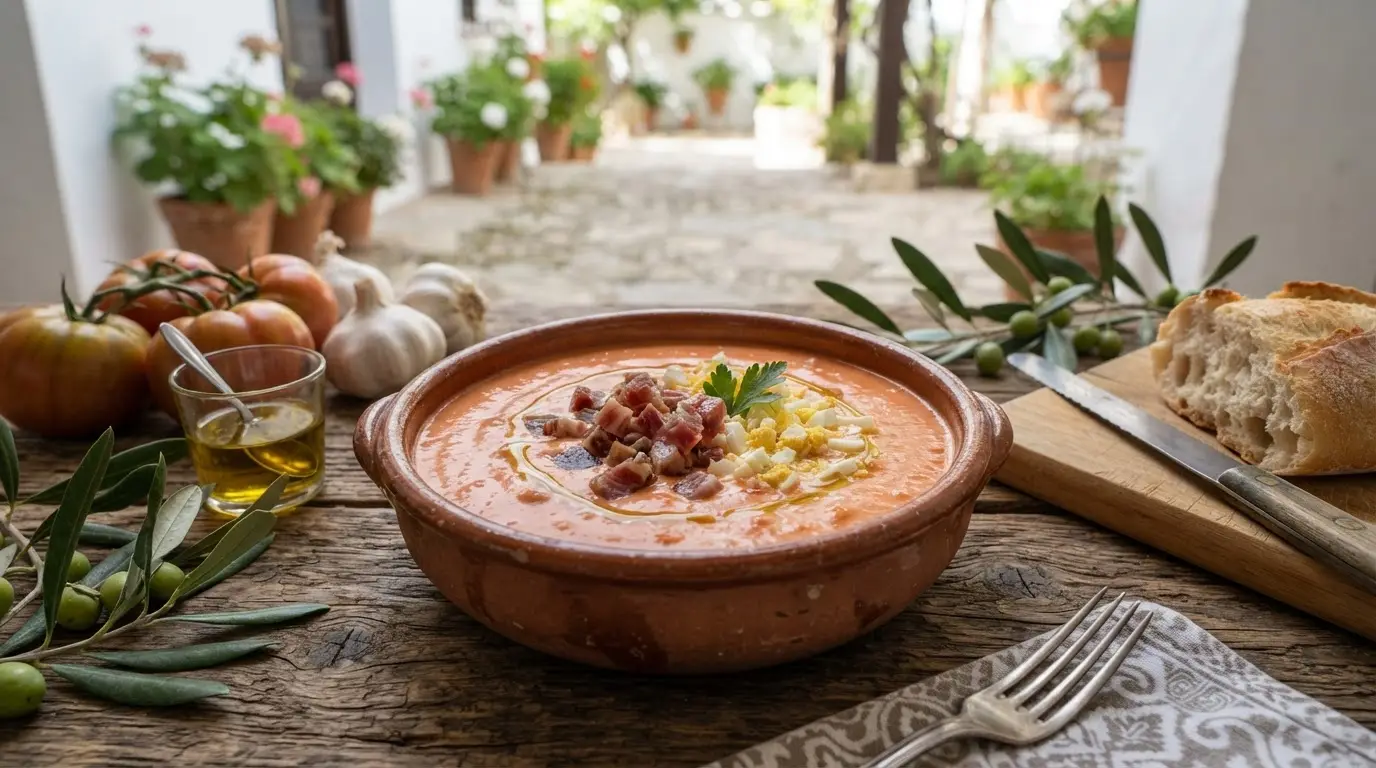
The answer in Córdoba was salmorejo: tomatoes, stale bread, garlic, and a lot of olive oil, blended into something thick enough to hold its shape in a bowl, garnished with diced jamón ibérico and chopped hard-boiled egg.[1] The answer in Seville was gazpacho: tomatoes, cucumber, green bell pepper, a little onion, vinegar, and minimal bread, blended thin enough to pour.[5]
Three local factors drove the Córdoba divergence: the province's unusual concentration of PDO olive oil regions, a specific local bread called pan de telera, and a taberna culture that needed food which could be made in the morning and served cold all day. None of these factors existed in exactly the same configuration in Seville.
| Feature | Salmorejo cordobés | Gazpacho andaluz |
|---|---|---|
| Texture | Thick — holds shape in a bowl | Thin — pourable from a glass |
| Bread | Central ingredient (~1:5 ratio with tomato by weight — about 200g bread per kg tomato) | Minimal or absent |
| Tomato | Raw, vine-ripened, no other vegetables | Raw, plus cucumber and bell pepper |
| Olive oil | Heavy (roughly 1 part oil to 10 parts tomato by weight) | Light |
| Vinegar | Not typically used — tomato provides acid | Added separately |
| Toppings | Jamón ibérico, hard-boiled egg | Plain or with croutons |
| Service | Bowl and spoon | Glass or bowl |
| Origin city | Córdoba | Seville / throughout Andalusia |
The ancestor both cities share: mazamorra and the bread-soup lineage
Before tomatoes existed in Andalusia, both Córdoba and Seville made versions of the same cold bread soup. Mazamorra cordobesa — stale bread, garlic, olive oil, sherry vinegar, cold water — is documented in Córdoba from at least the 8th century.[2] Modern versions of the dish often substitute blanched almonds for much of the bread, producing the paler, richer variant many diners know today. Its bread-pounding technique is sometimes compared to moretum, a Roman herb-and-cheese spread — garlic, herbs, fresh cheese, olive oil, and vinegar pounded together and eaten with bread — that was common across the Roman world. No source documents a direct lineage between the two, or ties moretum specifically to Roman-era Corduba, so the connection is best read as a loose parallel rather than a proven ancestor.
The technique that defines both modern soups — pounding stale bread with fat and acid until the wheat proteins bind everything into a stable emulsion — has no documented Roman-Corduba origin; it is first traceable to medieval Iberian and Al-Andalus cooking. No eggs, no cream — just bread doing structural work. The logic was that stale bread, which has no other use, could be transformed into something thick and filling by working it against liquid and oil.
Explore nearby · Monument
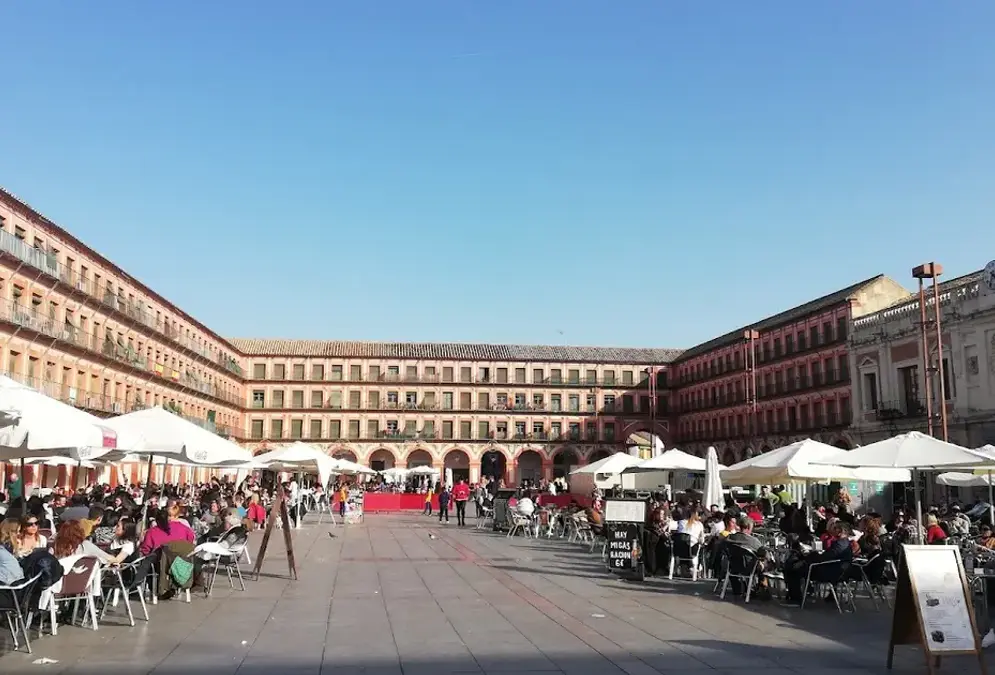
Plaza de la Corredera
Andalusia's only Castilian arcaded square, built in 1683 over a Roman forum. Once a bullfighting ring, now lined with bar terraces and a Sunday flea market.
Moorish-era cooks in Córdoba worked within that bread-garlic-oil-vinegar base, producing mazamorra cordobesa: cold, thick, eaten with olives and grapes as toppings. Exactly when the almond variant entered the recipe is not documented. What is clear is that some form of this pre-Columbian cold soup is what Córdoba's cooks made for centuries before tomatoes arrived — covered in more depth in the mazamorra cordobesa history.
Tomatoes arrived in Spain in the 16th century, entering through Seville's port from Mexico and Peru.[5] Both cities eventually incorporated them. The first written references to something called salmorejo appear in the 17th century, but the word then described a transitional preparation — used as a sauce with roasted meats, not as a cold soup.[1] Gazpacho followed a similar gradual trajectory. What separated the two cities was what happened when cooks began using tomato as the primary ingredient rather than a flavouring — and that is where local resources started to matter.
Why Córdoba went thick: olive oil, bread, and taberna logic
Three assets specific to Córdoba pushed its cold soup toward the thick, bread-heavy emulsion that salmorejo became. Understanding them makes the divergence from Seville's gazpacho less mysterious.
Olive oil geography. Córdoba province holds four PDO (Protected Designation of Origin) olive oil regions: Baena, Priego de Córdoba, Lucena, and Montoro-Adamuz.[1] It's one of the highest concentrations of protected olive oil designations found in any single Spanish province. Salmorejo requires a generous quantity of oil — roughly one part olive oil to ten parts tomato by weight[1] — to achieve its characteristic emulsion. In Córdoba, that oil was not an expensive ingredient. It came from the next valley. A cook in Seville had access to good olive oil but not in the same local abundance, and the gazpacho formula she used reflected that: far less oil, more water, a lighter result.
4 PDO regions
Pan de telera. This bread is specific to Córdoba. Its dense white crumb comes from high-protein wheat flour, and it dries into a hard, compact state when left overnight — exactly the condition that makes it absorb a tomato-oil emulsion without disintegrating or turning gluey.[1] The bread-to-tomato ratio in a properly made salmorejo runs roughly 1:5 by weight — about 200 grams of bread to a kilogram of tomatoes[1] — a modest share of the dish by weight, but enough of the right bread to set the emulsion's thickness. Bakers in Seville made different bread; cooks in Seville made a different soup. This was not a deliberate culinary choice. It was a consequence of what the local bakery produced.
Recommended tours
Tours are selected for quality, not commission. We earn a small fee if you book — at no extra cost to you.


Taberna culture. Córdoba's 19th-century tabernas likely favoured food that could be made early in the morning and served cold through the heat of the day, without needing a fire kept going. Salmorejo fit that logic well. Mixed before 8am from yesterday's bread and overnight-rested tomatoes, it held its texture and flavour for eight hours at room temperature in a cool cellar. Gazpacho, with its higher water content, was more susceptible to separation and required more frequent stirring. The thick emulsion was, quite simply, a better taberna product.
These three factors compounded. The Córdoba cook who had PDO olive oil in abundance, telera bread drying on the shelf, and a taberna to run before dawn had every practical reason to make the thick version. The Seville cook, working with lighter bread and less local oil, made the thin version. Over a century of repetition, the two preparations became fixed as the expressions of their respective cities.
What is actually in each soup
This is not a recipe comparison — both soups have dozens of documented variants. It is a comparison of what the traditional preparations contain and why each ingredient matters.
Salmorejo cordobés uses four ingredients: ripe tomatoes, stale pan de telera bread (soaked and squeezed), raw garlic, and extra virgin olive oil. Salt. Nothing else goes in the bowl. The tomato provides both body and acid; the bread provides structure; the oil provides richness and emulsification; the garlic provides flavour. The result is a thick, deeply orange-red emulsion with a texture between cold risotto and a very thick soup. Garnish with diced jamón ibérico and hard-boiled egg.[1]
Two things are notably absent from salmorejo:
- Vinegar (the tomato provides all the acid needed)
- Any other vegetables (cucumber, bell pepper, onion are all excluded)
Gazpacho andaluz starts from a different premise.[5] Its base vegetables are tomatoes, cucumber, green bell pepper, and onion — all blended raw with garlic and olive oil. A small amount of bread, if any, is added for body. Sherry vinegar goes in separately to sharpen the flavour. The result is a thin, red-orange liquid, light and slightly acidic, which is poured into a glass or a wide bowl and consumed as a refreshing drink as much as a food.
The functional difference is clear in texture: tilt a bowl of salmorejo and it barely moves. Tilt a glass of gazpacho and it pours. That is the entire history of the two soups in one gesture — Córdoba maximised the bread, Seville minimised it.
One consequence of the bread ratio: salmorejo is more calorie-dense. A 200ml serving contains more carbohydrate and fat than the same volume of gazpacho. In the 19th-century taberna context, that density was a selling point. Working-class customers in Córdoba needed food that would hold them through a physical workday. A glass of thin cold soup would not have done it.
The identity claim: why salmorejo carries Córdoba's name everywhere
Salmorejo has something that gazpacho does not: a city attached to its name. Walk into a Seville supermarket and the bottled version on the shelf reads salmorejo cordobés. Not salmorejo. Not Andalusian salmorejo. Cordobés. The city's name is part of the product's commercial and cultural identity even when the product is made and sold 150 kilometres away from Córdoba.[3]
Gazpacho carries no city name. It is Andalusian, or simply Spanish — a regional category with no specific municipal ownership. Different towns make their own versions. Nobody labels their bottle "gazpacho sevillano" as a point of distinction.
The asymmetry is telling. Salmorejo became Córdoba's dish not through any official designation but through the compounding of local specificity. The PDO olive oils, the pan de telera, the taberna tradition — these factors made a version of the cold soup that was meaningfully different from anything made elsewhere, even if neighbouring towns attempted approximations. When the dish spread beyond Córdoba in the 20th century, it carried its origin as a quality signal.
The full salmorejo origin story traces how the dish moved from working-class taberna staple to nationally recognised Córdoba symbol, including the role of the Cofradía Gastronómica in standardising the recipe against commercial shortcuts.
This identity pattern appears in other Córdoba foods. The city's name attaches to preparations where local specificity produced something genuinely unreproducible without the same inputs. The silver filigree work uses techniques specific to Córdoba's craft tradition; the Córdoba gastronomy hub traces how that same logic applies across the city's food culture.
Eating both in Córdoba today
You can order both soups in Córdoba, which makes direct comparison straightforward. They appear on virtually every menu in the historic centre from April through October.
Salmorejo is on every menu because it is the city's signature dish. Quality varies considerably. The version worth eating uses tomate en rama — vine-ripened tomatoes, harvested in clusters, with the vine attached, peak season from July to September. A bowl made in July from Campo de Lucena tomatoes and Priego de Córdoba oil tastes different from the same bowl made in January from chilled supermarket stock. The garnish matters too: proper jamón ibérico (not serrano) and a chopped hard-boiled egg, added at service.
Red flags on a menu salmorejo:
- Colour that is too pale orange (insufficient tomato or watered-down emulsion)
- Texture that pours like a thin soup (under-emulsified or insufficient bread)
- Sweet aftertaste (out-of-season tomatoes with added sugar, a shortcut used by some tourist-facing kitchens)
Gazpacho in Córdoba is made by Cordoban cooks using Córdoba olive oil, so it tends to be better here than in most places. But it is not the city's signature dish. It sits on menus as a refreshing option, served cold from the fridge, more of a palate opener than a main event.
Deep dive · Article
Caliphate Food in Córdoba: How Noor Rebuilt a Lost Kitchen
Paco Morales spent years in medieval manuscripts before opening Noor. What caliphate food córdoba actually was — and how he rebuilt it without a single tomato.
In July, when tomate en rama comes in from Campo de Lucena, I go looking for the tabernas that still serve salmorejo from a barro pot rather than a chilled steel bowl: it arrives cool rather than fridge-cold, and it holds. Order the gazpacho in the same sitting and the gap widens further: one holds heat and weight against the tongue, the other clears it. A kitchen that gets the barro-pot salmorejo right earns a repeat visit; one that serves it chilled in steel does not.
If you want to understand the comparison physically, order both at the same table. The salmorejo arrives in a wide bowl, barely trembling when set down. The gazpacho arrives in a glass or a narrow bowl, liquid visible. The smell is different: salmorejo has a deeper, more complex garlic-oil presence; gazpacho smells lighter, greener from the cucumber and pepper. The salmorejo will keep you satisfied for two hours. The gazpacho will refresh you for twenty minutes.
The Córdoba gastronomy section covers restaurants where both soups are made properly, alongside the other dishes that define the city's food culture. If salmorejo's historical development interests you, the salmorejo history article traces the full arc from Roman moretum to the modern bowl.