Caliphate Food in Córdoba: How Noor Rebuilt a Lost Kitchen
Paco Morales spent years in medieval manuscripts before opening Noor. What caliphate food córdoba actually was — and how he rebuilt it without a single tomato.
Ten years covering Córdoba's UNESCO heritage sites, sourcing from Junta de Andalucía documentation.
Updated Published
food-lovershistory-buffscouples
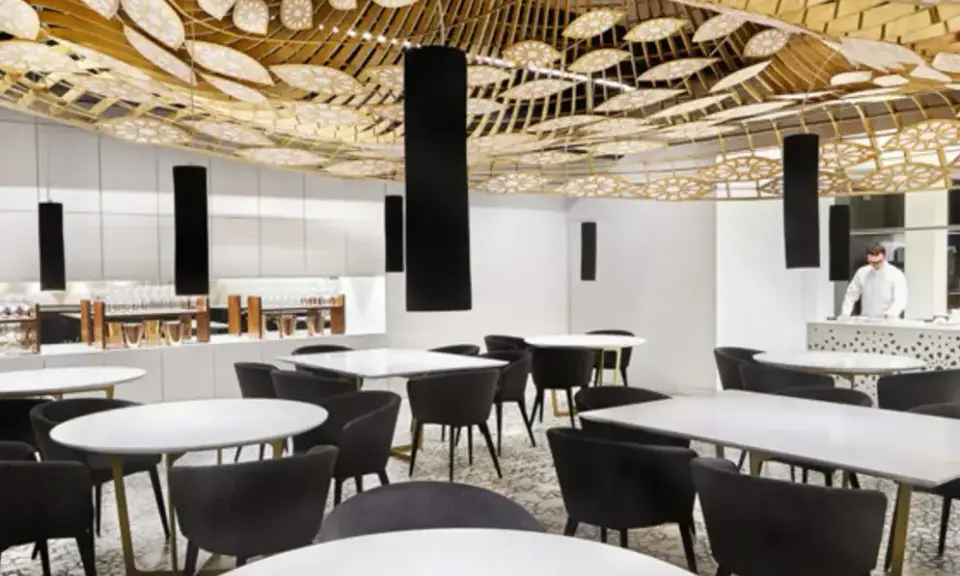
When Paco Morales opened Noor in Córdoba in 2016, the founding premise was strict: cook only with ingredients that existed in 10th-century Al-Andalus, no tomatoes, no chocolate, no chillies, none of the New World produce that remade European cooking after 1492. The method he developed to do this responsibly, working from medieval manuscripts and botanical records rather than guesswork, is what he calls gastroarchaeology. The Caliphate kitchen it produced in those first years was less a recreation than an excavation.
In this article
Jump to a section
⌄
What gastroarchaeology actually means
The word sounds like a coinage designed to impress. In practice, it describes something precise.
Gastroarchaeology, as Paco Morales uses it, is the systematic recovery of historical flavours from documentary evidence rather than from living culinary tradition. An archaeologist uncovers material remains; a gastroarchaeologist uncovers recipes and ingredients from manuscripts, city archives, botanical treatises, and accounts of historical feasts. The end product is not a museum exhibit. It is a dish that can be cooked and eaten, something you can experience rather than read about.
The discipline requires two kinds of rigour. First, historical accuracy: using only what was actually available in the target era, which means eliminating post-1492 New World produce for the founding Caliphate period. No tomatoes, no potatoes, no chillies, no chocolate, no vanilla, no maize. These are ingredients so embedded in modern Spanish cooking that removing them forces the kitchen to think from first principles. Second, culinary translation: taking a medieval recipe and making it coherent on a modern plate, using contemporary technique without inserting alien flavour logic.
Morales built the method in collaboration with Rosa Tovar, a Spanish food scholar and cookbook author who had spent years studying Al-Andalus culinary heritage. He described meeting her as the beginning of everything: from their first meeting, he said, they began to work.[1] Tovar brought fluency in the primary sources, knowledge of what medieval Andalusian households and courts were actually cooking, and judgment about which manuscript traditions were reliable. The kitchen provided the testing ground.
The research team also included culinary historians, archaeologists, and interior designers, each responsible for a different layer of the historical reconstruction. Each dish at Noor was accompanied by a card explaining its historical context and the documentary source that suggested it, though the specific manuscript titles cited on those cards were not named in contemporary food journalism of the time.
Timeline
2016
Noor opens
Paco Morales launches Noor in Córdoba, exploring 10th-century Umayyad Caliphate cuisine as the founding proof of concept for gastroarchaeology.
2017
11th-century Taifas season
The second season advances to the Taifa period, establishing the one-century-per-season progression that has driven every Noor menu since.
2023
Third Michelin star
Noor receives its third Michelin star at the Guide Spain 2024 Gala on 28 November 2023, held in Barcelona.
2026
18th-century cycle
The restaurant's current exploration covers the Modern Age in Andalusia. The gastroarchaeology method, established in the Caliphate years, continues to drive every season.
The Caliphate cycle was Noor's founding season in 2016, the proof of concept for this approach. Each subsequent season advances roughly one century: 11th-century Taifas in 2017, the 12th and 13th centuries next, the 14th-century Nasrid period after that. As of 2026, the restaurant is exploring the 18th century. The method remains constant across every cycle; the historical raw material changes.
The manuscripts behind the method
Medieval Arabic culinary manuscripts are not the kind of documents that travel lightly into a working kitchen. They were written in Arabic, they use ingredient names that have shifted meaning over centuries, and their recipe quantities are often absent altogether, calibrated for a household that already knows what it is doing. Translating them into precise modern recipes requires both linguistic scholarship and culinary judgment.
One of only two cookbooks to survive from Al-Andalus is the Fudalat al-khiwan, written by Ibn Razin al-Tujibi around 1260 CE. Ibn Razin was born in Murcia, fled the Reconquista, and wrote his cookbook in exile in Tunis, reconstructing an Andalusian culinary world that was being destroyed as he wrote. The book contains close to 475 recipes covering roasts, stews, breads, condiments, preserves, and sweetmeats. It draws on both Muslim and Jewish Andalusian cooking traditions, and its status as the primary surviving Andalusi cookbook was cemented when a complete manuscript was found at the British Library,[2] resolving decades of uncertainty about whether any intact copy existed. An English translation by Nawal Nasrallah appeared from Brill in 2021, and Daniel L. Newman translated it for Saqi Books under the title The Exile's Cookbook, published in 2022/2023.[3]
For the broader spice palette and flavour logic of the Islamic world that fed into Al-Andalus, scholars also turn to the Kitab al-Tabikh of Ibn Sayyar al-Warraq, written in Baghdad around the 10th century CE. This is an Abbasid, not an Andalusian, source — the two culinary traditions were connected but distinct, much as the courts of Baghdad and Córdoba were simultaneous rivals and mutual influences. What it documents is the shared Islamic culinary grammar from which Andalusian cooking developed its own voice.
For the botanical record, Ibn al-Awwam's 12th-century Kitab al-filaha (Book of Agriculture), written in Seville, documents which crops were cultivated across Al-Andalus: which spices were grown locally, which were imported through the Arab trade networks that connected Córdoba to the Indian Ocean world.[4] That network brought cardamom, cloves, and galangal westward from South and Southeast Asia; it brought mastic from the Aegean; it brought saffron from La Mancha, already under cultivation in what would become Spain.
Noor's research team drew on manuscripts of the kind these represent, working with the same primary sources that food historians use to reconstruct Al-Andalus cuisine. The cooking that came out of that process in the Caliphate years was not a performance of medieval food. It was an attempt to understand what the flavours actually were.
What people ate in 10th-century Córdoba
The Umayyad Caliphate of Córdoba reached its political peak under Abd al-Rahman III, who ruled from 912 to 961 CE and declared himself Caliph in 929. His court, and that of his son Al-Hakam II, was a centre of learning, science, philosophy, and culinary refinement. The food served there drew on multiple traditions: Arab cooking from the eastern Islamic world, Berber influences from North Africa, remnants of Roman and Visigothic Iberian cuisine, and the contributions of Jewish households and merchants who formed an integral part of Córdoba's intellectual and commercial life.
The protein sources of the Caliphate kitchen were lamb, chicken, pigeon, and kid goat; fish from the Guadalquivir and preserved fish from coastal trade. Bottarga (cured fish roe) appears in sources as a delicacy. Grains included wheat for flatbreads and couscous-like preparations, and semolina. The legume repertoire was substantial: chickpeas, lentils, and broad beans were everyday staples rather than luxury ingredients.
Fruits were central to the flavour logic of the era in ways that can surprise a modern palate:
Pomegranates, figs, dates, and quinces appeared in both sweet and savoury preparations
Dried apricots and tamarind were used as souring agents
Citrus, primarily sour oranges, contributed acidity to sauces
Almonds and pistachios gave body to dishes that later European cooking would thicken with flour
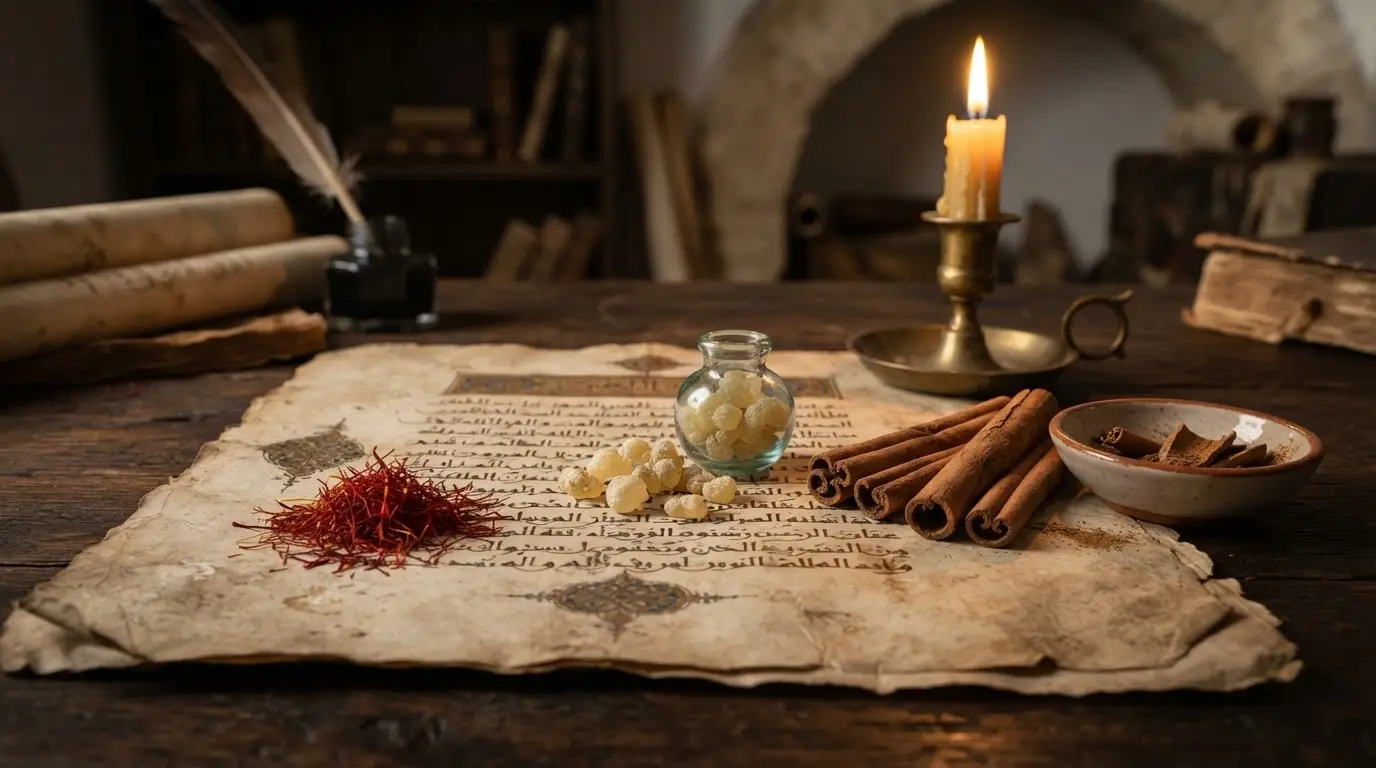
The spice trade was the hinge on which Caliphate cooking turned. Spices were luxury goods imported through Jewish merchant networks trading across Iraq, China, Yemen, and India.[4] Saffron was cultivated locally in what is now La Mancha; cinnamon came from South Asia; cumin and coriander were widespread in savoury cooking; cardamom, cloves, and galangal were among the more expensive aromatics. Mastic, the aromatic resin of the Pistacia lentiscus tree, was used in sauces, confectionery, and flavoured drinks. Sumac provided tartness as a souring agent in place of lemon, and asafoetida added a pungent depth to meat and vegetable dishes.
Recommended tours
Tours are selected for quality, not commission. We earn a small fee if you book — at no extra cost to you.
Equally revealing is what was absent. There was no black pepper as a commodity item. Long pepper, the variety used in Roman cooking, was more common in early medieval Islamic cuisine. There were no tomatoes, no chillies, no chocolate. The souring came from sumac, tamarind, verjuice, and preserved lemon. The sweetness came from honey and date syrup; refined sugar existed but was a luxury import from the East.
The flavour profile that emerges from this inventory is distinct from modern Andalusian cooking but not alien to it. Berenjenas con miel — fried aubergine with honey, still on every tapas menu in Córdoba — is a direct relic of exactly this sweet-savoury logic. Orange blossom water and rose water perfumed sweets and drinks. The courtly dining culture that organised this food into courses had been shaped, a century before the Caliphate's peak, by arrivals from the Abbasid world such as Ziryab in Córdoba, the Baghdad-trained musician and polymath who reached the city in 822 CE.
How the Caliphate kitchen was rebuilt at Noor
Paco Morales had worked at El Bulli and Mugaritz before returning to his hometown of Córdoba to open Noor. The training at those restaurants gave him the technical vocabulary of contemporary fine dining; what he lacked when he began the Caliphate project was a working knowledge of medieval Andalusian flavour logic. That is what the collaboration with Rosa Tovar supplied.
The fundamental constraint was ingredient discipline. Morales put it directly: no New World produce, only modern dishes built from recipes of this period.[6] In practice this meant every dish required a double check: was this ingredient available in Al-Andalus in the 10th century? The answer forced the kitchen toward a different grammar. Without tomatoes, acidity came from sumac, tamarind, and preserved citrus. Without chillies, heat came from long pepper and ginger. Without chocolate or vanilla, confectionery sweetness came from date syrup, honey, and mastic.
“
“We don't use any produce from the new world, but instead create modern dishes according to recipes from this magnificent period.”
Paco Morales, chef-patron of Noor
The dishes that resulted from the Caliphate cycle were documented in contemporary food writing from 2016 to 2019. They included preparations built around:
Saffron and cinnamon as the primary aromatics for meat dishes
Couscous and semolina preparations in forms closer to their North African origins than to modern Spanish adaptations
Almonds and pistachios used both as thickeners and as flavour in their own right, in combinations that the medieval manuscripts describe for court banquets
Bottarga and preserved fish as umami sources in place of the cured pork products that define modern Andalusian cooking
Mastic, sumac, and asafoetida as the base aromatics in sauces where a contemporary kitchen might use garlic, pepper, and wine
Each dish, when it came to the table, was accompanied by a card explaining its historical origin and the documentary evidence that underpinned the reconstruction. The diner was not just eating; they were being shown the research that made the dish possible. That framing is central to what gastroarchaeology means as an experience rather than as a culinary category.
Morales earned three Michelin stars for Noor at the Guide Spain 2024 Gala on 28 November 2023, confirmed through the 2025 and 2026 editions.[7] The Michelin description of the kitchen — a place that revives the spirit of Andalucian cuisine through modern ideas and techniques — applies equally to the Caliphate founding cycle and to every season since.
The Caliphate legacy and what it changed
Noor's Caliphate cycle has had consequences that go beyond the restaurant itself. By demonstrating that Al-Andalus cuisine could be reconstructed responsibly, using primary sources and strict ingredient constraints, and by earning serious critical attention for doing so, it made the case that medieval Andalusian food history is not just an academic curiosity. It is edible, and it produces dishes worth eating on their own terms rather than as historical novelties.
The work Morales and Tovar did for the Caliphate years also pushed back against a common assumption: the idea that modern Andalusian food is a direct continuation of what was cooked in the region before 1492. It is not. The Reconquista, the expulsion of the Moriscos in 1609, and the arrival of New World ingredients created breaks that severed the thread of Al-Andalus culinary tradition. What Noor recovered in its founding years was not a remembered tradition but a reconstructed one, assembled from manuscript sources the way an archaeologist reconstructs a broken vessel from shards.
Medina Azahara, the Caliphate palace complex ten kilometres west of Córdoba, provides the spatial context for the cuisine Noor was exploring. Abd al-Rahman III began construction in 936 CE; at its peak the complex held the administrative apparatus of a state that governed much of the Iberian Peninsula. The banquets held there, documented in contemporary chronicles, were the clearest expressions of the culinary culture that Morales was working to understand. Visiting Medina Azahara alongside reading about the Caliphate kitchen gives the food its physical setting, the walls and gardens and fountains in which it was originally served.
The question Noor's gastroarchaeology raises, which the Caliphate cycle posed most sharply, is what we lose when a culinary tradition is severed. The spices, the flavour logic, the manuscript record — these survived in archives and in the food cultures of Morocco, Algeria, and Tunisia, where Andalusian exiles carried them after the Reconquista. Some of what Noor recovered for Córdoba's table had been preserved, in modified form, across the Strait of Gibraltar for five centuries. The kitchen and the historical record are not separate things. They were always the same document, written in different scripts.
Reading the Caliphate kitchen today
The Caliphate cycle at Noor is closed. Morales has moved on, season by season, through the centuries that followed, and as of 2026 the restaurant is working through the 18th century. The methodology, however, is not closed. Every cycle uses the same tools: manuscripts, archives, botanical records, ingredient constraints, and collaboration with food scholars.
For visitors to Córdoba interested in the history behind this approach, several threads are worth following. The Arabic manuscript tradition that underpins Noor's research is documented in English in Nawal Nasrallah's translation of Ibn Razin al-Tujibi, published as Best of Delectable Foods and Dishes from al-Andalus and al-Maghrib (Brill, 2021) and as The Exile's Cookbook (Saqi Books, 2022/2023).[3] Both editions include scholarly apparatus; the Saqi Books edition is more accessible as reading.
The agricultural infrastructure that made Caliphate cuisine possible, its irrigation systems, its palace gardens, its spice stores, is visible in fragments at Medina Azahara, the palace city Abd al-Rahman III began building in 936. The excavations there have recovered botanical evidence including olive pits, grape seeds, and traces of the tree crops that stocked the Caliphate kitchen. The site's museum displays this material alongside architectural reconstructions that put the food in its physical context.
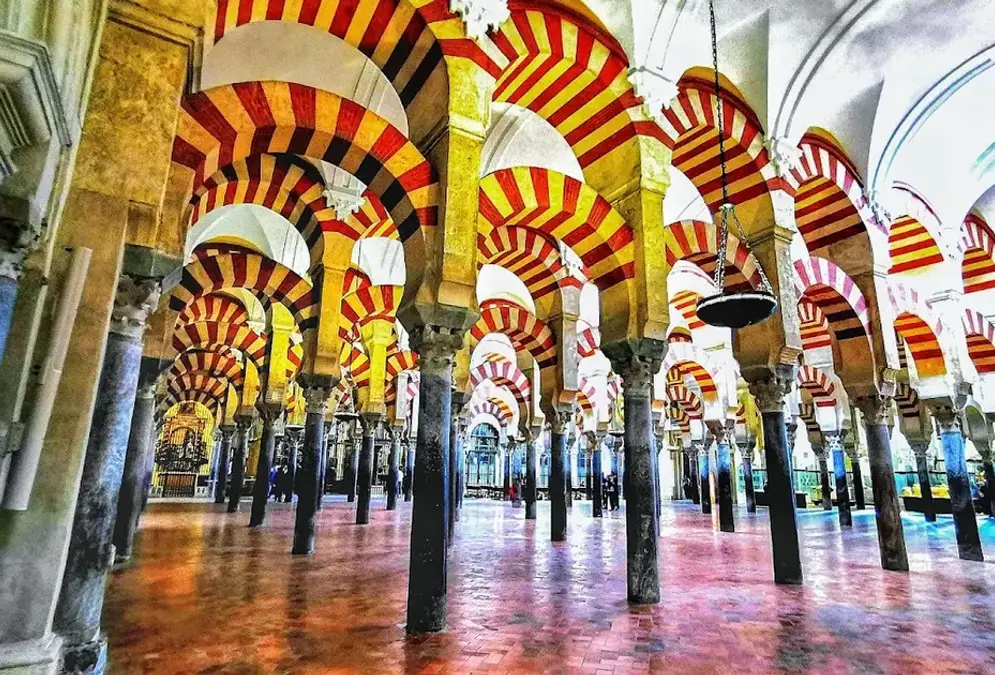
The food history that Noor drew on is also the history of Córdoba's medieval monuments. The Great Mosque was under construction during the same decades that the culinary manuscripts were being written, and the spice routes that supplied the Caliphate kitchen ran through the same city that built those arches. Understanding the caliphate food of Córdoba and understanding its architecture are ways of understanding the same civilisation.
The Abd al-Rahman III and the Caliphate covers the political context of the Caliphate peak in detail. The taste of that period, its saffron and mastic and almond-thickened sauces, is the food archaeology that Noor spent its founding years excavating.
Frequently asked questions
What is gastroarchaeology?
Gastroarchaeology is a term coined by Paco Morales to describe the practice of reconstructing historical flavours and dishes from primary documentary evidence: medieval culinary manuscripts, city archives, and botanical records. Just as an archaeologist recovers cultural objects from material remains, the gastroarchaeologist recovers lost tastes from written sources, working with food historians to translate centuries-old recipes into dishes that can be cooked and tasted today.
How does Noor restaurant recreate caliphate food from Córdoba?
Noor's team, led by chef Paco Morales and food scholar Rosa Tovar, researches medieval Arabic manuscripts and historical archives to identify recipes and ingredients from the period being explored. Strict authenticity rules apply: no ingredient that did not exist in the target era is used, which for the founding Caliphate cycle meant excluding all post-1492 New World imports. Each dish was accompanied by a card citing its historical origin and source text, and the kitchen used modern techniques to realise historically documented flavours in a fine-dining context.
What did people eat in 10th-century Córdoba?
The Caliphate court ate a sophisticated diet shaped by Arab, Berber, Roman, and Jewish culinary traditions. Lamb, chicken, and pigeon were common meats; couscous, flatbreads, and semolina were staple grains; almonds, pistachios, and figs appeared in both savoury and sweet dishes. Spices, imported through Arab merchant networks from India and the Levant, included saffron, cinnamon, cumin, cardamom, and mastic. Souring agents such as sumac, tamarind, and preserved citrus replaced modern vinegar. There were no tomatoes, chillies, or chocolate: all post-1492 New World imports.
What spices did the Umayyads use in Córdoba?
The Umayyad and Caliphate courts at Córdoba drew on a wide spice palette imported through Arab trade routes: saffron (cultivated locally in what is now La Mancha), cinnamon, cumin, coriander, ginger, cardamom, cloves, galangal, nutmeg, and aniseed. Mastic, the resin of the mastic tree, was used in sauces and confectionery. Sumac and asafoetida added tartness and depth. Orange blossom and rose water perfumed sweets and drinks. Long pepper was more prevalent than black pepper in this period.
When did Noor get its third Michelin star?
Noor received its third Michelin star at the Michelin Guide Spain 2024 Gala on 28 November 2023, held at the CCIB in Barcelona. The restaurant retained three stars in the 2025 and 2026 editions.
Does Noor still serve a 10th-century Caliphate menu?
No. The 10th-century Caliphate was Noor's founding season in 2016. Each subsequent season advances roughly one century: 11th-century Taifas in 2017, then the 12th–13th centuries, then the 14th-century Nasrid period. As of 2026, Noor's menus explore 18th-century Andalusia. The gastroarchaeology method remains constant; the historical period changes each season.
What is the most complete surviving cookbook from Al-Andalus?
The Fudalat al-khiwan, written by Ibn Razin al-Tujibi around 1260 CE, is one of only two cookbooks to survive from Al-Andalus and the most complete of the two. Ibn Razin was born in Murcia and compiled the work in exile in Tunis after fleeing the Reconquista. It contains close to 475 recipes drawing on Muslim, Christian, and Jewish Andalusian culinary traditions. A complete manuscript was identified at the British Library, and English translations appeared from Nawal Nasrallah (Brill, 2021) and Daniel L. Newman (Saqi Books).