Seven years covering Córdoba's gastronomy, taberna culture, and the Montilla-Moriles DO.
Updated Published
food-lovershistory-buffs
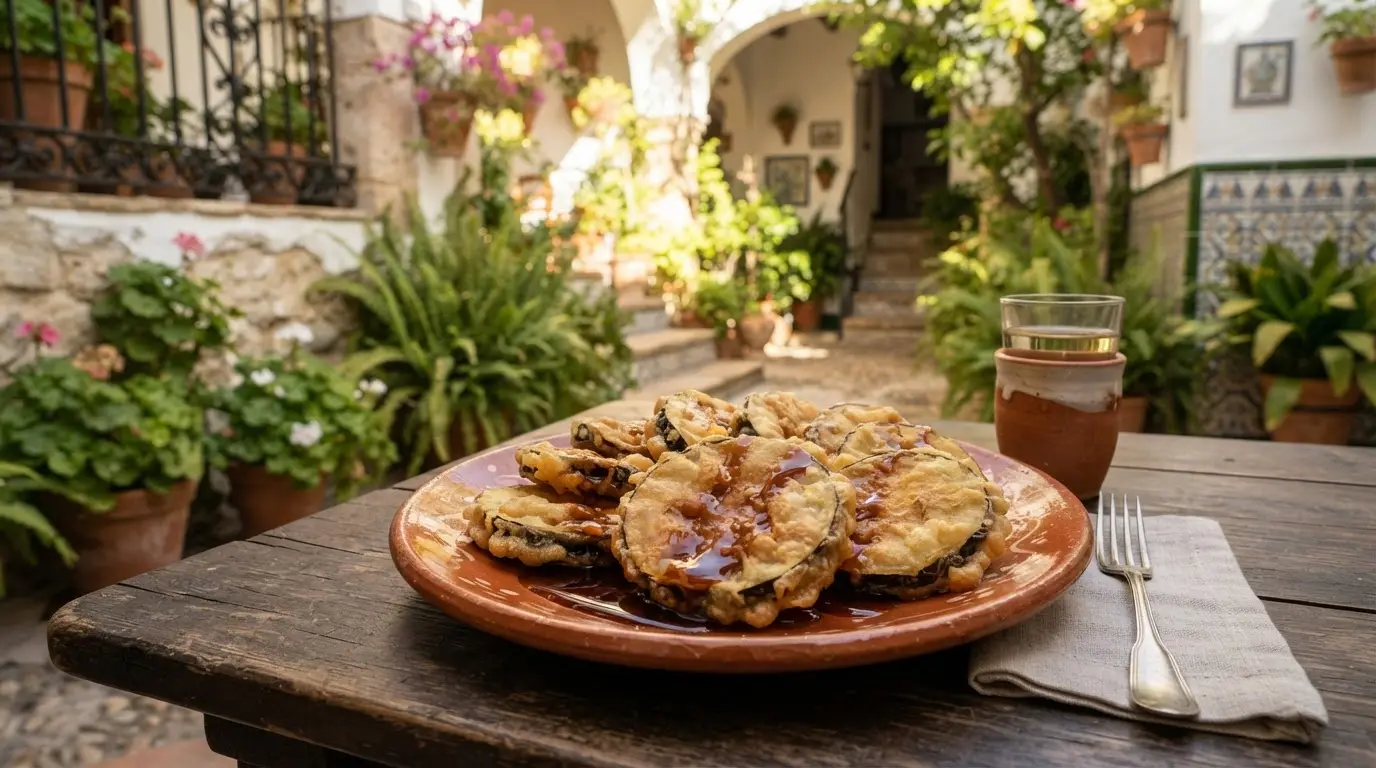
Berenjenas con miel sits at the outer edge of Spanish tapas, where a pool of dark honey drizzled over fried aubergine makes first-timers pause and reconsider what they thought Andalusian food was. The dish is a direct relic of Al-Andalus sweet-savoury cooking, documented in 12th-century cookbooks and kept alive through the Reconquista by Morisco households who had no particular reason to stop making it. Order it with miel de caña in Córdoba and you are eating something that has changed almost nothing in eight centuries.
In this article
Jump to a section
⌄
The dish as a living relic
Most tapas taste like what they are: ingredients assembled into something satisfying. Berenjenas con miel does something different. The sweetness is not a glaze applied to meat, the way a teriyaki logic might suggest. It is honey poured over something essentially savoury, a thing that the contemporary European palate, trained on the separation of courses and flavours, is not instinctively expecting. The discomfort is the point.
In Córdoba, the miel de caña version is the one worth ordering. Miel de caña is not exactly honey in the floral sense. It is a dark, thick syrup reduced from sugar cane juice, something between molasses and treacle, with a bitterness underneath the sweetness. Poured over aubergine slices still hot from olive oil, it sinks into the crust and begins to caramelise at the edges. The result is not sweet food. It is food where sweetness is a flavour alongside salt, umami, and the slight smoke of well-fried aubergine.
The dish sits on menus across Andalusia today, from Granada to Málaga. But Córdoba is where it originates, where it was first documented in the context of Al-Andalus cuisine, and where the miel de caña tradition remains standard rather than fashionable. Most tourist-facing bars have switched to wildflower honey, which is milder and less polarising. That is a substitution worth knowing about: if the honey on your plate looks golden and translucent rather than dark and viscous, you are eating an approximation of the dish, not the thing itself.
What makes it worth investigating beyond the immediate eating experience is the supply chain of ideas that produced it. Moorish Spain brought the aubergine to Iberia. It brought the beekeeping culture that made honey abundant. It brought the culinary philosophy that saw no reason to keep sweet and savoury in separate rooms. Understanding where those elements came from is the same as understanding why Córdoba eats the way it does, and why the Mezquita-Cathedral and this tapa are products of the same civilisation.
8th–15th c.
Al-Andalus lasted roughly seven centuries as a functioning Islamic civilisation on the Iberian Peninsula. Its agricultural and culinary innovations (eggplant, sugar cane, systematic beekeeping) became permanently embedded in Andalusian food culture long after the political entity ceased to exist.
How eggplant reached Córdoba
Eggplant is native to the Indian subcontinent and moved westward through Persia into the Arab world well before the Islamic expansion began. Arab agricultural writers documented it extensively; it was already a common kitchen ingredient across the Levant and North Africa when the first Muslim forces crossed into Iberia in 711 CE.
The Arabic word al-bāḏinjān became the linguistic vehicle that carried the plant into European languages. In the Iberian Peninsula, it passed through a series of phonetic transformations: from al-bāḏinjān to alberengena in medieval Castilian, then berengena, then the modern berenjenas. Portuguese produced bringella; French ended up with aubergine, which is simply the Arabic word processed through Catalan on the way north — the attested chain is Arabic → Catalan (alberginera/albergínia) → French, with no Provençal step.[5] The etymology traces the Arab influence on Spanish and European culture as precisely as any historical document.[1]
Ibn al-'Awwām, the 12th-century Sevillian botanist and agronomist, documented eggplant cultivation in Al-Andalus in his agricultural treatise Kitab al-Filaha, identifying four cultivated varieties: white, reddish-purple, black, and brown. The classification was practical: different varieties suited different preparations and different soil conditions in the Córdoba region. Ibn al-'Awwām wrote not as a culinary historian but as a working agricultural authority documenting what Iberian farmers were actually growing, which makes his account more reliable than retrospective cultural narratives.
Eggplant thrived in Iberia's Mediterranean climate. It needed the long dry summers, the warm winters, and the irrigation infrastructure that Arab engineers had built across Andalusia. The Medina Azahara palace complex approximately eight kilometres west of Córdoba, constructed from 936 CE[4], had extensive gardens and agricultural support systems that likely included eggplant cultivation among dozens of other crops. The palace's context makes clear that by the Caliphal peak, eggplant was not an exotic import but a domestic staple.
The medieval cookbooks and the sweet-savoury logic
The clearest evidence for what Al-Andalus cooks were doing with aubergine and honey comes from the medieval Andalusian cookbook that has survived in translated form: the Kitab al-Tabikh fi al-Maghrib wa al-Andalus.
The Kitab al-Tabikh fi al-Maghrib wa al-Andalus (Book of Cooking in the Maghreb and Al-Andalus) dates to the Almohad period of the 12th–13th centuries and is the oldest known cookbook from the Iberian Peninsula.[2] It is sometimes cited in Spanish scholarship as the Manuscrito Anónimo de al-Andalus — the name given by Ambrosio Huici Miranda in his 1966 translation — but both names refer to the same text. It contains 462 recipes, of which 311 involve meat. But the remaining recipes are significant: vegetable dishes appear across the text, and honey appears as a seasoning for preparations that contemporary Western cuisine would classify as savoury. Vegetables cooked with honey, lamb finished with sweet sauces, and fried preparations drizzled with sweeteners recur throughout the manuscript. The logic was not additive (not sweet and then savoury as separate courses) but integrated, where sweetness was one instrument in a chord.
Sweet-savoury preparations appear throughout the cookbook as standard household cooking, not as special-occasion luxury dishes. This matters for understanding berenjenas con miel: the combination was not a sophisticated culinary experiment but a normal expression of how Al-Andalus kitchens understood flavour.
The Islamic culinary philosophy that produced these cookbooks drew on Persian, Arab, and Levantine traditions that had been working with sweet-savoury combinations for centuries before Al-Andalus existed. The most documented individual carrier of that tradition into Córdoba is the court polymath who arrived under Abd al-Rahman II, the Baghdad-trained musician and court polymath who arrived under Abd al-Rahman II in 822 CE and is credited by 11th-century chronicles with introducing sequential dining — soup, then main, then fruit and sweets — along with Abbasid spices and fruit syrups to the Córdoba elite, a generation before the cookbooks were compiled. Medieval Islamic medical theory, derived from Galenic humoral medicine, also influenced what foods were combined: honey was considered warming and purifying, aubergine was cooling and astringent, and combining them balanced the humoral properties of the dish. Whether cooks consciously applied this logic or simply followed flavour habits shaped by it is unclear, but the theoretical framework was present in the same culinary culture.
Recommended tours
Tours are selected for quality, not commission. We earn a small fee if you book — at no extra cost to you.
Honey in Al-Andalus: beekeeping, miel de caña, and the economics of sweetness
Honey in medieval Europe was not an ingredient people used freely. It was an expensive sweetener with limited supply, closer to saffron in kitchen economics than to the commodity it became in later centuries. Al-Andalus was an exception. The Iberian Peninsula's flora (thyme, rosemary, orange blossom, lavender, cistus) produced honey of exceptional quality and variety, and Muslim beekeepers in southern Iberia developed apiculture systematically enough to supply both local consumption and export markets by the 13th century.[3]
Córdoba province was a centre of this production. The orange blossom honey of the province, miel de azahar, came from the same citrus groves that gave Córdoba's spring its characteristic scent. Rosemary honey from the sierra north of the city was used medicinally and in cooking. Wildflower honey from the mixed herb scrubland of the Pedroches valley was the most abundant variety.
The Moors also introduced sugar cane to the Iberian Peninsula, bringing cultivation techniques from North Africa and the Levant that established plantations along the Andalusian coast and in the lower Guadalquivir valley from around the 8th century. Cane honey, miel de caña, was the byproduct of cane juice reduction before crystallised sugar was extracted. It had a different character from flower honey: darker, more complex, with a slight bitterness from the phenolic compounds in cane. It was cheaper than flower honey because it was a processing byproduct rather than a primary product.
In Córdoba specifically, miel de caña became the standard sweetener for fried aubergine. This was not arbitrary. The cane honey's bitterness and depth of flavour worked against the bland starchiness of the aubergine and the relative neutrality of the olive oil frying medium in a way that lighter flower honey did not. That flavour logic is still legible in the dish today. Bars that have switched to supermarket wildflower honey produce a flatter version of the same preparation.
The olive oil used in frying matters as much as the honey. Al-Andalus maintained extensive olive cultivation across Córdoba province, the same groves that underpin today's PDO designations at Baena and Priego de Córdoba. Frying in olive oil rather than lard or other animal fats was both practical (olive oil was cheaper and more available than other fats in the region) and consistent with Islamic dietary requirements. The combination of olive oil, aubergine, and honey was simultaneously economical, religiously permissible, and, as the medieval cookbooks demonstrate, genuinely considered delicious.
Survival through the Reconquista
The Reconquista was not a clean historical break. The Christian conquest of Córdoba in 1236 under Ferdinand III did not empty the city of its Muslim population overnight; it began a long, complicated process of demographic shift, conversion, and cultural negotiation that took centuries to resolve. Many Muslims converted to Christianity and became Moriscos: nominally Christian, culturally Andalusian, cooking in kitchens that still used olive oil rather than lard and still paired aubergine with honey.
Food was one of the few domains where Morisco identity could be maintained privately. The Inquisition paid close attention to dietary habits as markers of hidden Islamic practice: eating meat slaughtered according to halal requirements, refusing pork, fasting during Ramadan. Berenjenas con miel did not carry these markers. It used no specifically prohibited ingredient, required no religiously significant technique, and contained nothing that distinguished it from a food that any Christian cook might also make.
This is the mechanism that kept the dish alive. It was culturally neutral enough to survive appropriation. More precisely, it never became marked as Islamic in the way that lamb prepared without pork fat was marked. Christian cooks in post-Reconquista Córdoba adopted it without needing to reclassify it. It became Andalusian food rather than Moorish food, which is exactly how things persist.
The final expulsion of the Moriscos in 1609 removed the last people with direct cultural memory of Al-Andalus. But by then, berenjenas con miel was already embedded in the broader Andalusian kitchen. The ingredients were local and abundant. The preparation required no special knowledge. The flavour combination had been cooking in Córdoba for four centuries before the expulsion happened.
What distinguishes this dish from other food-history stories is the directness of the line. Unlike salmorejo, which took two millennia and a transatlantic crop exchange to reach its current form, the berenjenas con miel equation is almost entirely legible in a single bite: aubergine introduced by Arabs, honey from Arab beekeeping culture, sweet-savoury logic from the Islamic culinary tradition. If you want to eat something that genuinely connects to the Medina Azahara and the Caliphal civilisation it represented, this is a more direct route than most museum exhibits. The salmorejo origin history follows a parallel but more complicated arc.
Timeline
711 CE
Arab conquest of Iberia
Arab forces cross into Iberia. Eggplant cultivation and sweet-savoury cooking philosophy arrive with the Islamic expansion.
8th–10th century
Sugar cane introduced
Sugar cane introduced to the Iberian Peninsula by the Moors. Miel de caña production begins in the lower Guadalquivir valley.
c. 1180
Ibn al-'Awwām documents eggplant
Ibn al-'Awwām documents eggplant cultivation in Al-Andalus in Kitab al-Filaha, identifying four cultivated varieties in the Córdoba region.
12th–13th century
Kitab al-Tabikh compiled
Kitab al-Tabikh compiled in Al-Andalus, documenting 462 recipes including vegetables with honey and sweet sauces — the culinary context for berenjenas con miel.
1236
Christian conquest of Córdoba
Christian conquest of Córdoba. Morisco communities preserve Al-Andalus foodways in private, including sweet-savoury vegetable preparations.
1492–1609
Expulsion of Moriscos
Final expulsion of Moriscos. By this point, berenjenas con miel is embedded in Andalusian cooking and survives under regional rather than religious identity.
What makes a good berenjenas con miel today
The preparation is not complicated. The difficulty is in the choices: which honey, which oil, how to get the batter right. And in the patience required to do it properly rather than quickly.
Start with the aubergine. Thin rounds from a mandoline, around three millimetres, salt-rested for 15–30 minutes to draw out moisture and bitterness, then patted dry before coating. The coating question divides Córdoba cooks: some use flour only, which fries crisp but light; others use a loose batter of flour, egg, and cold water, which produces more crunch and better honey absorption at the edges. Both are defensible. The egg version holds together better in service, which is why bars favour it.
The oil is extra virgin olive oil, enough to come a centimetre up the sides of the pan, at a temperature high enough that a slice sizzles immediately on contact, around 175°C. Below that, the aubergine absorbs oil rather than frying. Above 185°C, the outside burns before the inside cooks through. The slices go in one at a time, not overlapping, and come out when the edges are deep gold. The paper towel step matters: moisture retained from the oil dilutes the honey and flattens the texture.
Ordering this plate across enough tabernas over enough visits, I have learned to watch the honey rather than taste it first. The real thing stays glossy and slow-moving even as the plate sits and cools; the wildflower substitute sets thin and grainy within a couple of minutes, losing its sheen. The crust gives it away too, a good one still crackles faintly under the fork after the honey has soaked into the edges, a sound a flour-only batter loses long before the plate reaches the table.
Miel de caña (first choice, the traditional Córdoba standard)
Miel de azahar (orange blossom, floral and fragrant)
Rosemary honey (aromatic, good with the aubergine's earthiness)
Supermarket wildflower honey (last resort)
If you are making this at home outside Andalusia, miel de caña is occasionally available at Spanish delicatessens and online, but dark molasses or a mix of treacle and honey approximates it. The ratio matters: enough honey that each slice has a visible coating and a small pool at the base, not a drizzle that disappears on contact.
The best versions in Córdoba still appear at traditional tabernas rather than tapas restaurants designed for tourists. Taberna Salinas near the Judería and Bodegas Campos in the San Francisco neighbourhood both serve the dish at a standard that reflects the miel de caña tradition rather than the honey-as-visual-garnish approach. A food tour of Córdoba will encounter berenjenas con miel several times in an afternoon; the difference between a good version and a lazy one is immediately apparent once you know what to look for.
The dish page for berenjenas con miel has current restaurant recommendations and seasonal notes on honey variety. If you want to learn the preparation yourself, the cooking class offered in Córdoba's historic centre includes it in the curriculum, along with the kind of explanation about honey provenance that this article has only been able to gesture at.
Frequently asked questions
What is the origin of berenjenas con miel?
Berenjenas con miel originates in Al-Andalus, the Islamic civilisation that occupied the Iberian Peninsula from 711 to 1492. Arab farmers introduced eggplant to Iberia in the 8th century; Arab beekeepers developed systematic honey production across Andalusia; and the Islamic culinary philosophy documented in 12th-century cookbooks like the Kitab al-Tabikh combined sweet and savoury flavours as a standard practice rather than an experimental one. No single recipe named berenjenas con miel survives from the medieval period, but the combination fits precisely the sweet-savoury patterns documented across Andalusian cooking of that era.
How did eggplant come to Spain?
Arab forces brought eggplant (Solanum melongena) to the Iberian Peninsula during the Islamic expansion beginning in 711 CE. The plant was native to the Indian subcontinent, had moved through Persia into the Arab world, and was already a common kitchen ingredient across North Africa when the first Muslim forces crossed into Iberia. The 12th-century Sevillian agronomist Ibn al-'Awwām documented four cultivated varieties growing in Al-Andalus. The Arabic word al-bāḏinjān gave Spanish its berenjenas and French its aubergine: the etymology traces the same migration route as the plant.
What is miel de caña and why does it matter?
Miel de caña is a dark syrup made by reducing sugar cane juice, a byproduct of cane processing before crystallised sugar is extracted. The Moors introduced sugar cane cultivation to the Iberian Peninsula around the 8th century, establishing plantations along the Andalusian coast. Miel de caña differs from flower honey in flavour: darker, more complex, with a slight bitterness from phenolic compounds in cane. In Córdoba, it is the traditional topping for berenjenas con miel, and its slight bitterness counterbalances the fried aubergine more effectively than lighter wildflower honey does. If the honey on your plate is golden and translucent rather than dark and viscous, you are eating an approximation of the traditional dish.
How did berenjenas con miel survive the Reconquista?
The dish survived because it carried no explicit religious markers. The Inquisition watched Morisco households for signs of hidden Islamic practice: halal slaughter, avoidance of pork, Ramadan fasting. Berenjenas con miel used none of the flagged ingredients and required no religiously significant technique. It could be made and eaten by Christian cooks without reclassification. This cultural neutrality allowed it to be absorbed into broader Andalusian cooking as Morisco communities were progressively expelled between 1492 and 1609. By the time the last Moriscos left, the dish belonged to the region rather than to a religious community.
What do medieval cookbooks say about sweet-savoury combinations?
The Kitab al-Tabikh fi al-Maghrib wa al-Andalus, compiled in Al-Andalus in the 12th–13th centuries and considered the oldest surviving cookbook from the Iberian Peninsula, contains 462 recipes. (It is also known as the Manuscrito Anónimo de al-Andalus in Spanish scholarship — both names refer to the same text, via Huici Miranda's 1966 translation.) Honey and sweet sauces appear regularly alongside vegetables and meats, not as dessert preparations but as integrated seasoning. The sweet-savoury philosophy was not a special-occasion technique but a standard feature of Al-Andalus household cooking, consistent with broader Islamic culinary traditions that had been working with sweet-savoury combinations for centuries before Iberia.
Is berenjenas con miel vegetarian?
Yes. The dish contains no meat or fish in its traditional preparation: aubergine, flour for coating, olive oil for frying, and honey. Some versions add sesame seeds or a pinch of flaky salt, neither of which changes the vegetarian status. The dish is also naturally free of dairy. This partly explains its survival through the Reconquista period. It had no pork avoidance marker that would draw Inquisitorial attention, and it was accessible to households with varying dietary constraints.
Where can I eat the best berenjenas con miel in Córdoba?
Traditional tabernas that use miel de caña rather than wildflower honey are the ones to seek out. Taberna Salinas near the Judería and Bodegas Campos in the San Francisco neighbourhood both maintain the miel de caña tradition. The dish appears on menus across the old town, but the honey choice is the differentiator. Ask for miel de caña specifically if you want the Córdoba standard rather than the tourist approximation. A food tour of Córdoba will typically encounter two or three versions in an afternoon, which makes comparison straightforward.
What is the connection between berenjenas con miel and the Kitab al-Tabikh?
The Kitab al-Tabikh does not contain a recipe named berenjenas con miel. The dish's name in its current form is a later development. But the cookbook provides the culinary context that makes the dish historically legible. Its 462 recipes document the Al-Andalus practice of combining honey and sweet sauces with vegetables and fried preparations as standard cooking rather than luxury food. The sweet-savoury logic of the dish, the ingredients (aubergine and honey both documented in Al-Andalus cultivation and production), and the frying technique all fit precisely within what the Kitab al-Tabikh describes as everyday Andalusian kitchen practice.
How is berenjenas con miel different from other Andalusian tapas?
Most Andalusian tapas work within the savoury spectrum: jamón, boquerones, gambas, croquetas. Berenjenas con miel is the exception: the honey element takes it into sweet-savoury territory that is unusual in contemporary Spanish food culture, though it was standard in Al-Andalus cooking. This makes it the most direct tasting connection to the Islamic culinary tradition in Córdoba's tapas repertoire. Unlike salmorejo, which took two millennia and a transatlantic ingredient exchange to arrive at its current form, berenjenas con miel is a near-direct continuation of a preparation style documented in 12th-century Andalusian cookbooks.