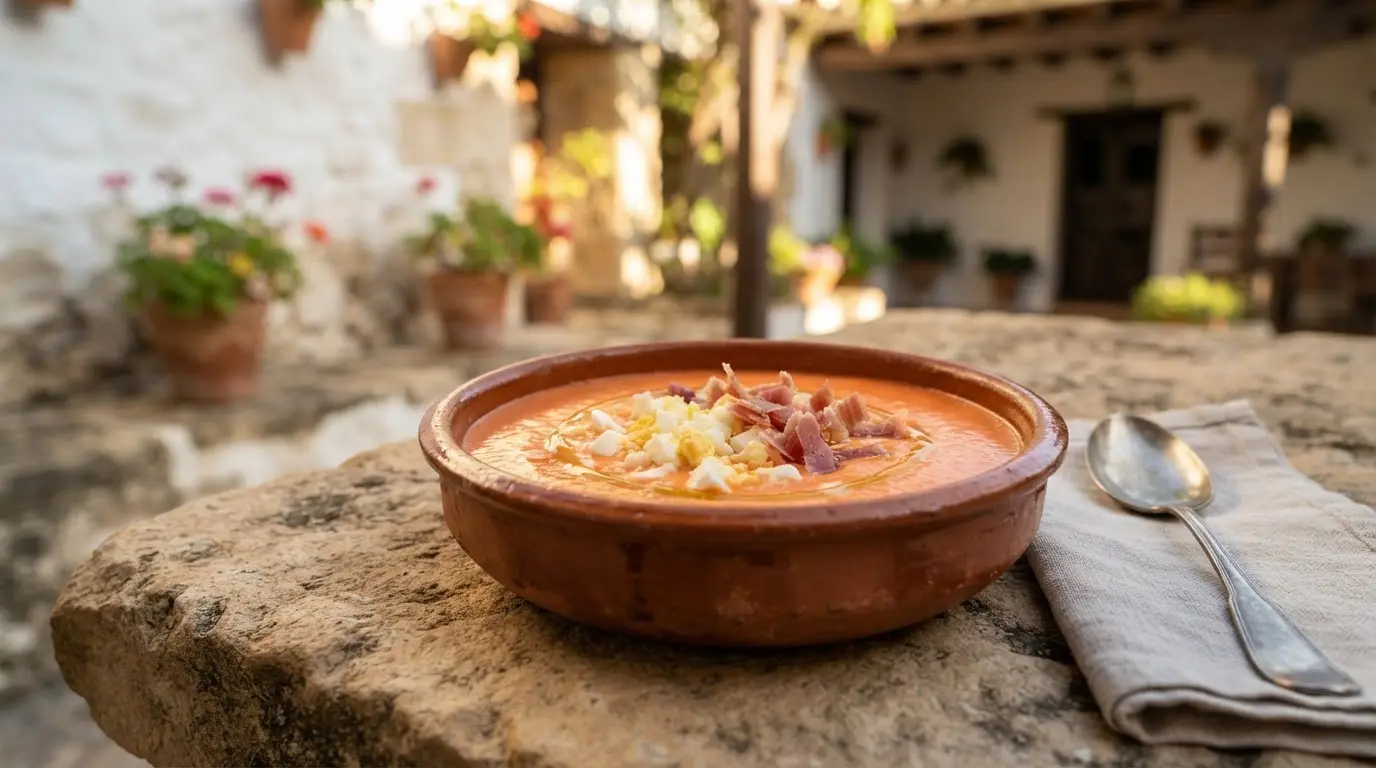

The Roman foundation: bread, vinegar, and a mortar
Córdoba was Colonia Patricia Corduba, the capital of Hispania Baetica. Roman soldiers and civilians in the city ate posca — water mixed with wine vinegar, sometimes herbs, sometimes honey. It was a drink, not a food, but the vinegar habit it established would persist for centuries in Andalusian cooking.
More directly relevant is moretum: a preparation of soaked stale bread, garlic, vinegar, olive oil, and salt, pounded together in a mortarium (a stone mortar) until it formed a rough paste. Virgil describes a version of moretum in a short poem of the same name — cheese, herbs, garlic, and olive oil, the bread worked in until the mixture coheres. The poet was writing about peasant food, which is exactly what this was.
The technique mattered more than any specific ingredient list. Crushing bread with fat, acid, and aromatics in a mortar forces the starchy proteins to bind the liquid and oil into a stable emulsion. That is the same physical process that gives modern salmorejo its thick, creamy texture. No eggs, no cream, no thickening agents — just stale bread doing structural work that Andalusian kitchens have relied on since the Roman period.
1st–5th c. CE
Puls, the Roman bread-porridge, and libum, a bread cake eaten at religious festivals, extended the same logic: wheat and water as the base of almost every prepared food. The mortarium was the processing tool. In Corduba, that tool stayed in use long after the legions left.
Mazamorra cordobesa: the white ancestor
The Umayyad Caliphate of Córdoba reached its peak under Abd al-Rahman III, who declared himself Caliph in 929 CE. At its height, Córdoba was the largest city in Western Europe, with a population believed to have reached several hundred thousand. Its cooks had access to ingredients from across the Mediterranean world and to culinary texts from Baghdad.
The 13th-century Kitab al-Tabikh (Book of Cooking), compiled in Andalusia and Baghdad, documents bread-thickened preparations with garlic, olive oil, and vinegar — a direct evolution of the Roman moretum into a more refined kitchen tradition.[1] Moorish cooks added blanched almonds to the bread-garlic-oil formula. The result was mazamorra cordobesa: stale bread, ground almonds, garlic, olive oil, sherry vinegar, salt. Cold, creamy, white.[2]
Mazamorra was not an aristocratic dish. It appears in household accounts and market inventories as cheap, filling food for working households. The ingredients were local and affordable — bread was always stale somewhere, garlic grew in every garden, olive oil from the groves south of Córdoba cost less than any other fat. The almond gave it richness without requiring meat.
The connection to Medina Azahara, the Caliphal palace city built by Abd al-Rahman III ten kilometres west of Córdoba, is not that royal cooks made mazamorra for the court. It is that the same centuries-long culinary sophistication that produced the palace's kitchens also refined the bread-emulsion technique into something recognisable as the ancestor of today's salmorejo. The city and the dish share the same period of development.
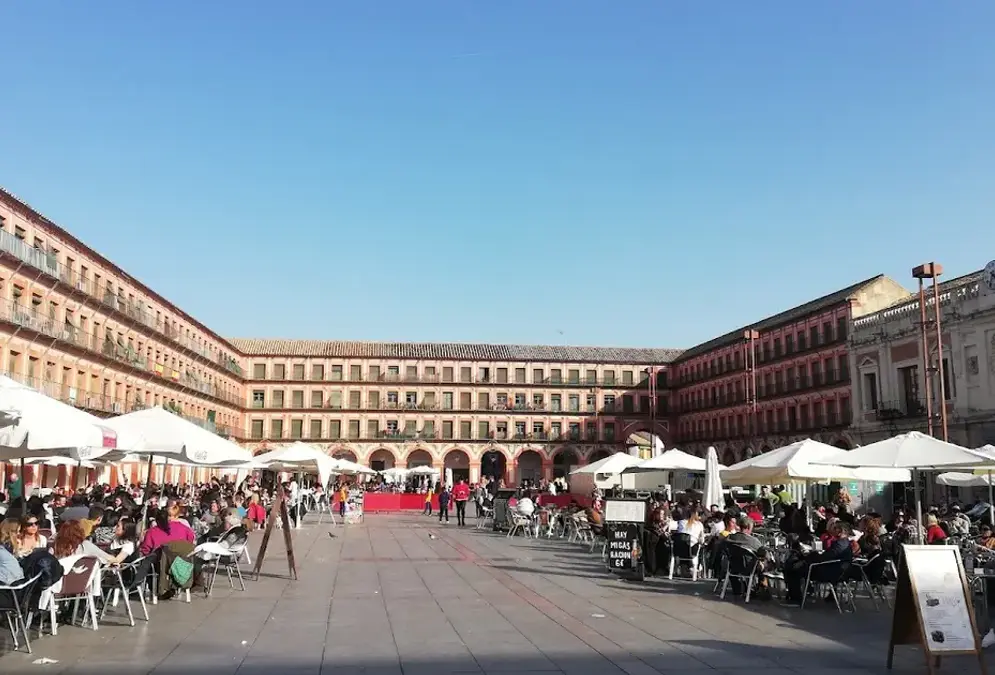
Explore nearby · Monument
Plaza de la Corredera
Andalusia's only Castilian arcaded square, built in 1683 over a Roman forum. Once a bullfighting ring, now lined with bar terraces and a Sunday flea market.
Mazamorra still exists. Order it at traditional Cordoban bars and you will receive something close to the original formula — white, almond-scented, thick. It is salmorejo's sibling, not its relic. The full story of the dish — its Roman roots, Moorish refinement, and why it survived the tomato revolution — is told in the mazamorra cordobesa history article.
The tomato arrives — and waits
Tomatoes reached Spain from Mexico and Peru in the second half of the 16th century. The Spanish crown brought them back as botanical curiosities; they circulated first as ornamental plants and then, cautiously, as food. Andalusian cooks were among the early adopters in Europe, partly because the region's hot summers suited tomato cultivation and partly because the ingredient's acidity was familiar — it sat naturally in a culinary tradition already built around vinegar.
The first written references to something called salmorejo date to the 17th century, but the word described a transitional sauce — used with roasted meats rather than as a cold soup. The tomato was in the preparation, but only as one element among several. The dish had not yet committed to the red emulsion we now associate with Córdoba.
That commitment came gradually through the 18th and into the 19th century, as vine-ripened tomatoes (tomate en rama) became abundant in Andalusian gardens and cheap enough to use in large quantity. The decisive shift was proportional: when cooks began using tomato as the primary ingredient rather than a flavouring, the white mazamorra formula turned red. Garlic, olive oil, and bread stayed. Almonds went. The acid previously supplied by vinegar was now supplied by the tomato itself.
Recommended tours
Tours are selected for quality, not commission. We earn a small fee if you book — at no extra cost to you.

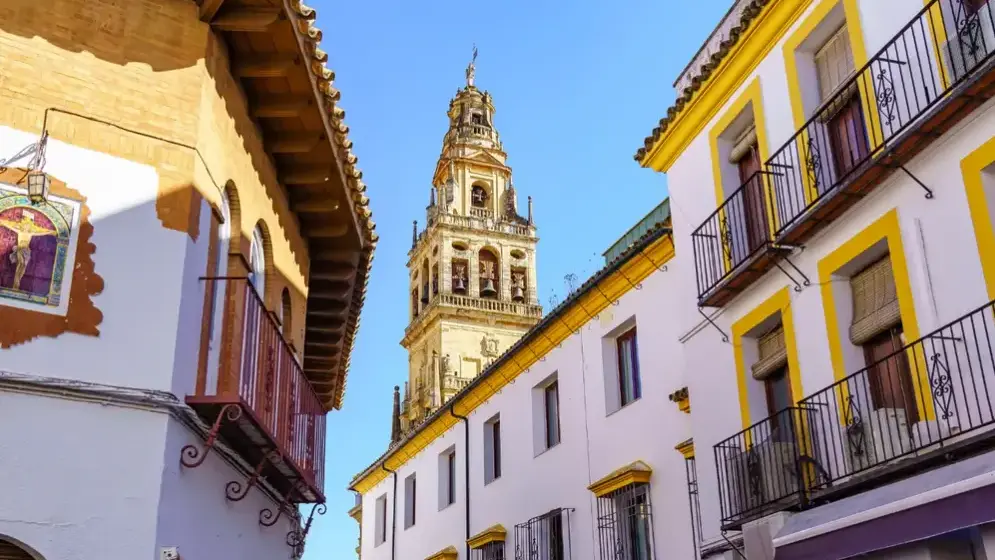

The result was structurally the same dish — a bread-fat emulsion with an acidic component — but it tasted entirely different and looked nothing like what the Moors had made. Pan de telera, Córdoba's traditional bread with its dense white crumb and high-protein flour, turned out to absorb the tomato-oil emulsion better than lighter breads.[3] That was not a deliberate innovation; it was what bakers in Córdoba happened to make, and what cooks worked with.
By the mid-19th century, salmorejo in its recognisably modern form was a working-class staple in Córdoba — cheap to prepare, filling, served cold in summer, requiring no fire after the blending.
Why Córdoba and not Seville
Seville got gazpacho. Córdoba got salmorejo.[4] The split is worth explaining because the two cities are 150 kilometres apart, share Andalusian climate and produce, and both had access to tomatoes at roughly the same time.
Three factors kept salmorejo specifically Cordoban.
First, olive oil. Córdoba province holds four PDO olive oil designations: Baena, Priego de Córdoba, Lucena, and Montoro-Adamuz. No other Spanish province has that density of protected olive oil regions. The emulsion at the heart of salmorejo depends on high-quality oil in generous quantity — roughly one part oil to two parts tomato by volume. In Córdoba, that oil was never expensive. It came from the next village.
Second, pan de telera. This bread, specific to Córdoba, has a dense white crumb and a high-protein wheat flour that absorbs emulsified liquid without disintegrating or turning gluey. The bread-to-tomato ratio in proper salmorejo runs roughly 1:1.5 to 1:2 by weight — the bread is not a minor addition. It is half the dish. Lighter breads from other regions produce a thinner result. Bakers in Seville made different bread; cooks in Seville made a different soup.
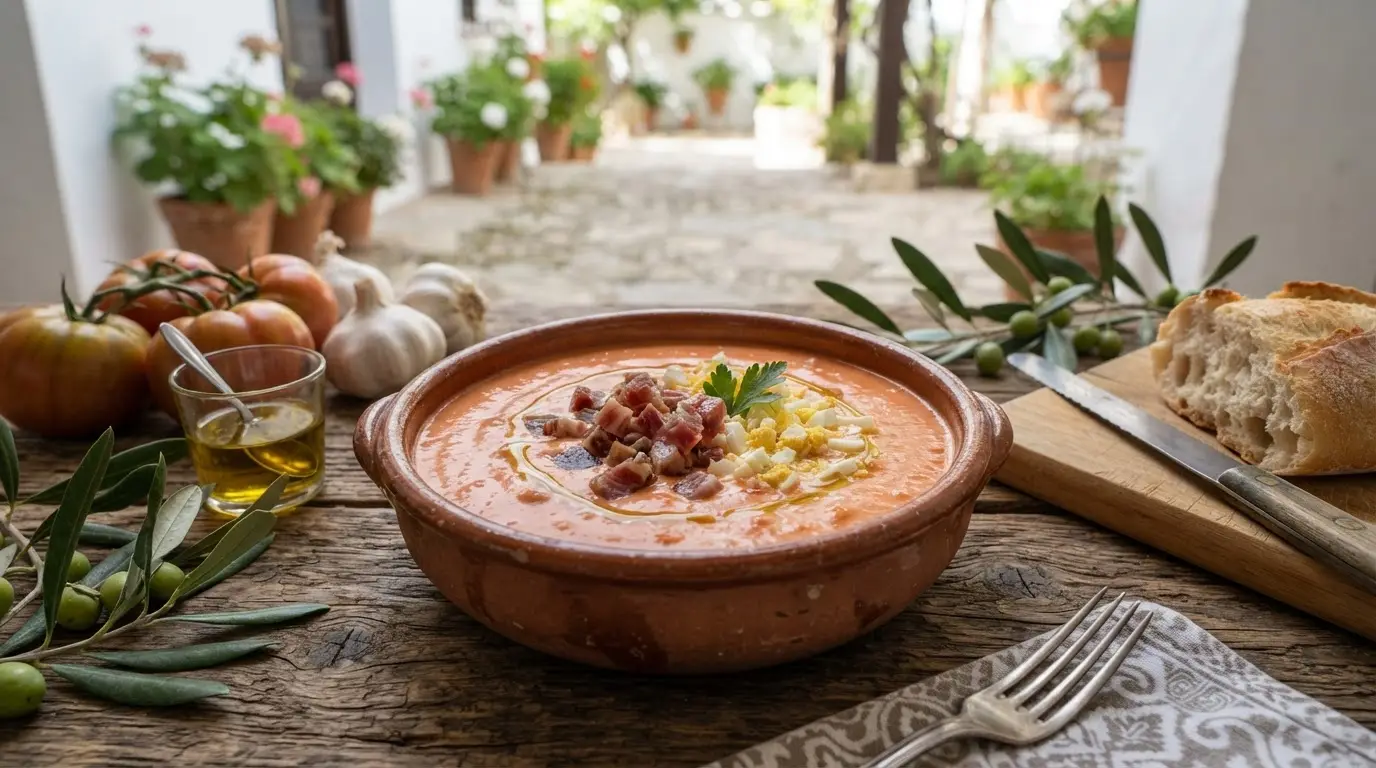
Deep dive · Article
Salmorejo vs gazpacho: why Córdoba's stays thick
Seville got gazpacho. Córdoba got salmorejo. Both cities, identical climate, 150 km apart — yet completely different cold soups. Here's why the split happened.
Third, working-class kitchen culture. Córdoba in the 19th century had a specific taberna and street-food tradition built around dishes that could be prepared in the morning and served cold all day. Salmorejo fit that model exactly — no reheating, no service complication, cheap ingredients, long service window. The dish became embedded in Cordoban food culture the way a dish only becomes embedded when the people cooking it are feeding themselves, not performing a regional identity for visitors.
Seville's gazpacho is pourable, includes cucumber and bell peppers, and uses minimal bread. The two dishes are not regional variations of the same thing; they are distinct preparations that happen to share a cold-tomato base. A food tour in Córdoba will make the difference immediately obvious — both in texture and flavour.
Standardisation, the Cofradía, and modern recognition
The invention of household electric blenders in the 1960s and 70s changed how salmorejo was made without changing what it was. Before electric appliances, the preparation required a mortar and considerable arm strength. A blender produced a smoother, more uniform result in two minutes. Salmorejo moved from working-class kitchens into restaurants, bars, and eventually tourist menus without altering its core formula.
The Cofradía Gastronómica de Córdoba formalised the dish's status through the late 20th and early 21st centuries. The brotherhood works to document and protect the traditional recipe against the shortcuts that volume service encourages — tinned tomatoes instead of fresh, inferior oil, insufficient bread content. These are not academic distinctions: a salmorejo made with watery tinned tomatoes and supermarket bread tastes noticeably different from one made with tomate en rama in September and proper Córdoba telera.
Recognition came gradually outside the city. Spanish food writers began treating salmorejo seriously in the 1980s. International food media followed in the 2000s. Today the dish appears in major gastronomic encyclopedias and on menus from London to Tokyo — often in roughly accurate approximations, occasionally in very good ones.
What has not changed is the association with Córdoba specifically. Salmorejo from a Seville supermarket is still labelled 'salmorejo cordobés'. The city's name is part of the product's identity in a way that goes beyond regional pride — it is a statement about where the recipe came from and what it requires.
The recipe is documented; the harder part is finding the bowl that hasn't been shortcut. Taberna Salinas, in business since 1879, uses the right tomato-to-bread ratio and September tomate en rama. Bodegas Campos follows the same formula in a cellar space that dates from the dish's modern era. For more addresses, what to look for on the plate, and how to spot a tinned-tomato version at a glance, the salmorejo page covers current Córdoba options.
The rabo de toro dish traces an analogous arc for Córdoba's other signature dish — working-class origins, cheap cut, slow transformation into something celebrated rather than merely eaten. The Córdoba food guide rounds up the city's other dishes and drinks alongside where locals go to eat them.
Salmorejo against its siblings: ajoblanco, porra antequerana, gazpacho
Understanding salmorejo's history means understanding where it sits among the family of cold Andalusian bread-emulsions. They are not interchangeable. Each represents a different stage or branch of the same culinary lineage.
Ajoblanco is the oldest of the group and the most directly Moorish. Bread, blanched almonds, garlic, olive oil, sherry vinegar, cold water. No tomato. It is essentially mazamorra cordobesa under a different name — the white pre-Columbian form that salmorejo replaced in Córdoba's own culinary tradition after the tomato arrived. Ajoblanco is still made in Córdoba and throughout Andalusia, and its continued presence is a direct connection to the Al-Andalus kitchen.
Porra antequerana comes from Antequera in Málaga province and is the closest relative to salmorejo: a bread-based tomato emulsion, thick and cold. It sometimes includes green bell pepper; it can use cooked tomatoes rather than raw; the bread-to-tomato ratio varies by household. The relationship between porra antequerana and salmorejo is debated — they may have developed in parallel from the same mazamorra base, or one may have influenced the other as working-class food moved between cities along Andalusian trade routes.
Gazpacho is the furthest from the bread-emulsion tradition. It contains cucumber, bell peppers, and onion alongside tomatoes; it uses much less bread or none at all; it is pourable rather than thick. The association with Seville is real — the dish became a Sevillian emblem in the same 19th-century period when salmorejo solidified as Córdoba's own. The two cities made different choices with similar ingredients.
| Dish | Origin era | Key ingredients | Tomato |
|---|---|---|---|
| Moretum / puls | Roman (1st–5th c. CE) | Bread, garlic, olive oil, vinegar | No |
| Mazamorra / ajoblanco | Moorish (8th–15th c.) | Bread, almonds, garlic, olive oil, sherry vinegar | No |
| Porra antequerana | Post-Columbian Málaga | Bread, tomato, garlic, olive oil, sometimes peppers | Yes |
| Salmorejo cordobés | Modern form 18th–19th c. | Bread, tomato, garlic, olive oil — no peppers, no cucumber | Yes |
| Gazpacho | Modern form 18th–19th c. | Tomato, peppers, cucumber, onion, minimal bread | Yes |
The practical difference that a first-time visitor notices: tilt a glass of gazpacho and it moves like water. Tilt a bowl of salmorejo and it barely shifts. That difference in texture is the entire history of the two dishes condensed into one observation — gazpacho minimised the bread; salmorejo kept it central. A tasting session at Córdoba's PDO producers makes a useful companion exercise: the same Baena or Priego de Córdoba oil that goes into a proper salmorejo is the subject of those tastings. For a closer look at why Córdoba and Seville diverged so sharply — ingredients, bread types, taberna culture, and the identity claim behind 'salmorejo cordobés' — the salmorejo vs gazpacho comparison article covers the split in full.