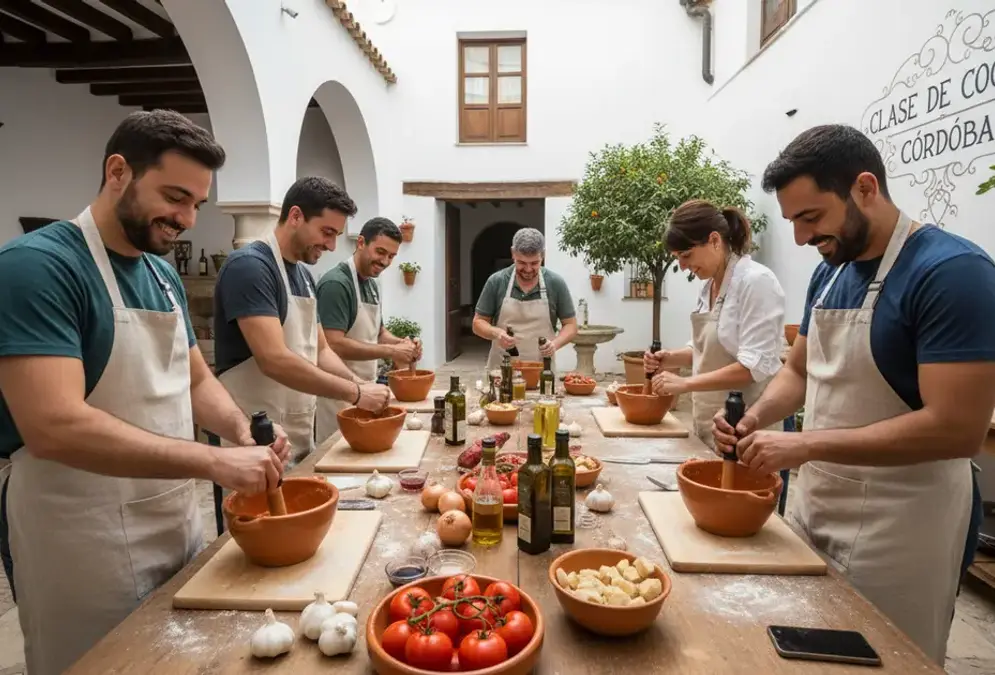

Where Córdoba's food culture gets personal
Reading about salmorejo is one thing. Making it yourself — with ripe tomatoes, good olive oil, and someone who has been preparing it since childhood standing next to you — is something else entirely. Cooking classes in Córdoba turn the city's culinary traditions into a hands-on experience you can actually take home.
Córdoba's cuisine is rooted in centuries of Moorish, Jewish, and Christian influence. The result is a repertoire that is simultaneously simple and layered: dishes built on a handful of quality ingredients, each one carrying a history most visitors never hear. A cooking class is one of the few ways to get close to that history without just eating it at a restaurant.
Salmorejo: the dish that defines Córdoba
If you learn one thing in Córdoba, make it salmorejo. Unlike gazpacho — which is thinner, more vegetable-forward, and associated with the broader Andalusian region — salmorejo belongs specifically to Córdoba. It is a cold tomato soup made from nothing more than tomatoes, bread, olive oil, garlic, and salt. What makes it remarkable is the texture: thick, almost creamy, with a deep orange-red colour and a richness that comes from emulsifying good oil into the purée.
Served cold with a drizzle of olive oil, hard-boiled egg, and thin strips of jamón serrano on top, it is one of those dishes that makes you wonder why anyone would want to eat anything else on a hot afternoon. Most classes start here. Rightly so. For a deeper look at the dish itself — its history, how to judge it, and where to order it in the city — see the salmorejo guide.
Bag in Box Cordoba: cooking in a winery
Bag in Box Cordoba runs one of the more distinctive cooking experiences in the city. The setting is a traditional winery in the city centre, with oak barrels as the backdrop for the class. They offer a one-hour salmorejo session from €23 per person — a focused introduction that covers the preparation in full detail without taking up half your day. The two-hour class at €50 adds paella to the programme.
Both classes are taught in Spanish and English, which makes them accessible without being dumbed down. Groups are capped at ten people, so you actually get to cook rather than stand and watch. The paella class covers rice ratios, sofrito technique, and timing — the things that are hard to learn from a recipe alone. You eat what you make, paired with local wines.
Finca Las Encinas: cooking in the Córdoba countryside
For something more immersive, Finca Las Encinas operates from a rural property in Iznájar, in the southern part of Córdoba province. They run half-day sessions for around €45, but the programme goes up to four-day cooking holidays that cover a much wider range of Andalusian dishes: flamenquín, berenjenas con miel, Spanish tapas, and more.
The countryside setting changes the pace entirely. You are working with produce that often comes from the property or nearby farms, in a kitchen that feels like a home rather than a workshop. It suits travellers who want to slow down and spend more time with the food rather than squeeze a class between other sightseeing. The extended programmes cover flamenquín — Córdoba's breaded pork roll — and berenjenas con miel alongside the more universal dishes.
What to expect
Most city-centre classes run in the morning or early afternoon, when the market produce is fresh and the heat has not yet peaked. You'll typically work with the instructor on each stage of the dish — chopping, mixing, tasting, adjusting — rather than following a demonstration from a distance. At the end, you eat together.
The dishes on offer across operators include salmorejo, paella, flamenquín (a pork roll breaded and fried, very Cordoban), berenjenas con miel (fried aubergine with honey), and various tapas. If you have dietary restrictions, it is worth asking in advance — most operators can adapt the menu.
Pairing the experience
Cooking classes work well alongside other food-focused activities in Córdoba. The food tour Córdoba covers more ground across the old town, while the guided Montilla-Moriles tasting session gives you a solid introduction to the wines you will likely be drinking alongside your meal. For a deeper look at the olive oil that appears in almost every Cordoban dish, the olive oil tasting in the province's DOP regions is worth adding to the itinerary.
For visitors who enjoy hands-on cultural experiences, artisan workshops in the Judería offer a different kind of making — leather, ceramics, and silver worked by craftspeople in the same historic quarter.
Cooking classes in Córdoba feature in our Top 10 Activities & Experiences in Córdoba — a curated guide to the experiences that give visitors the deepest connection to Córdoba's culture and gastronomy.