outdoorphotographers
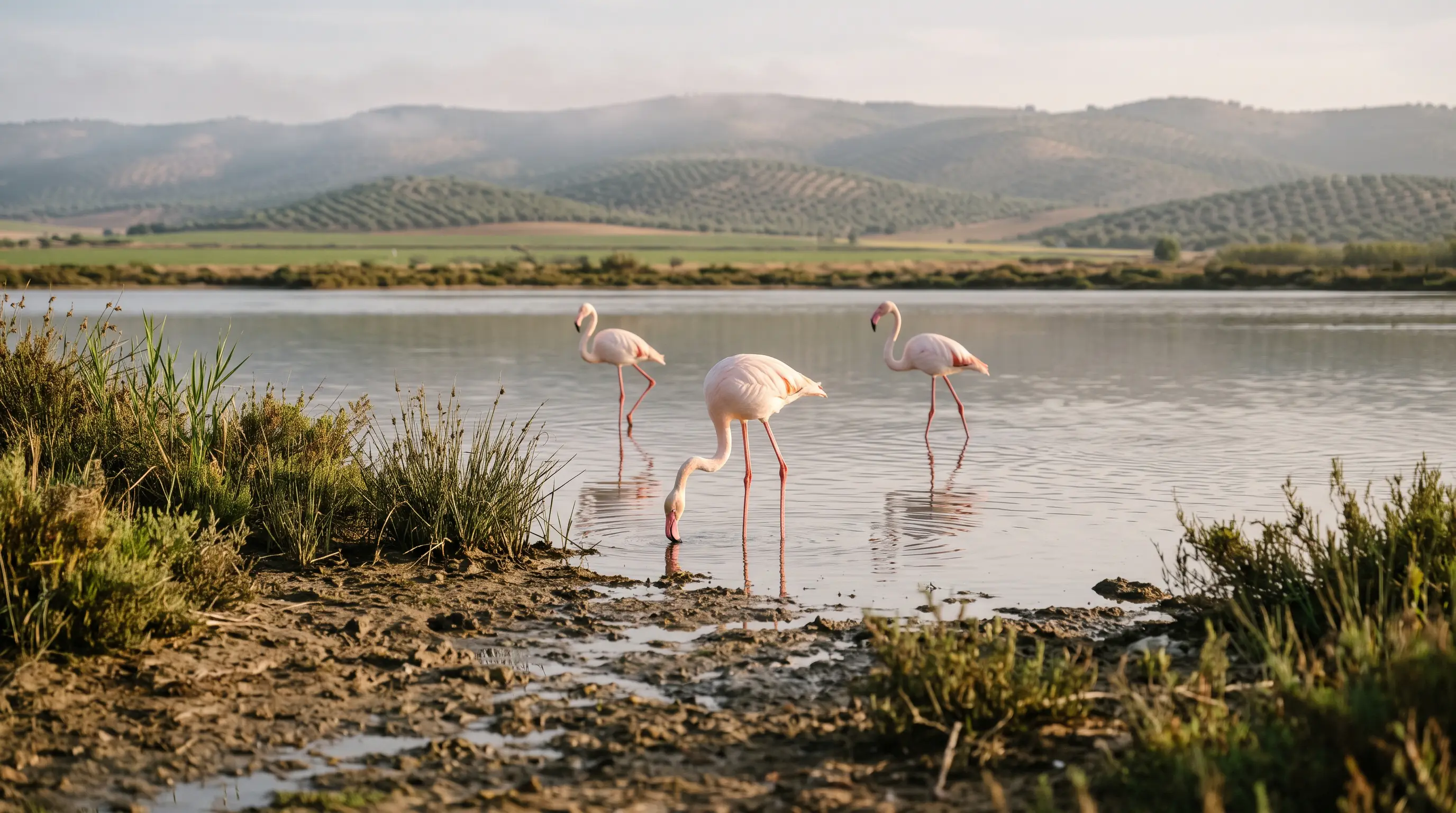
AI illustration of three greater flamingos wading in shallow lagoon water at early morning, one dipping its bill, olive-covered hills behind

Laguna Zóñar Flamingos? Where to Actually See Them Near Córdoba

Laguna de Zóñar is a deep lake famous for the white-headed duck. Flamingos turn up at Tíscar and Amarga when rain fills them. Free entry, a hide, two trails.

Portrait of Carmen Ruiz Montoya
Written by

Eight years of field research on hiking routes and natural parks in Córdoba province.

Published
Laguna de Zóñar is not where Córdoba's flamingos live: it is a deep, permanent lake, often described as Andalusia's only natural lake[1] and up to 16 m deep in the rainy season[2]. Flamingos favour shallow seasonal water, so the place to look is Tíscar near Puente Genil[3]; Laguna Amarga in Lucena is a permanent lagoon and only the secondary site, the second with flamingos on record after Tíscar[4]. Whether any are there depends on how much rain has fallen, so treat a sighting as a bonus, not a promise.
Zóñar maximum depth
16 m
Rainy-season maximum depth of the reserve's permanent lake[2]
Tíscar from Puente Genil
8 km
Seasonal brackish lagoon among irrigated crops and countryside[9]
White-headed ducks, 1977
22
All that remained in Western Europe, found at Zóñar[21]

Are there flamingos at Laguna de Zóñar?

Zóñar is not a flamingo lagoon. It is a deep, permanent lake, and the birds that define it are the white-headed duck, grey heron, mallard and great crested grebe[5]. Its water stays all year, fed by rain and by underground aquifers[6], and flamingos belong to a different kind of water. For a reader who came for pink birds that is the honest answer, and it saves a wasted drive: the lake is a reason to go, but not for flamingos.
That other kind is the seasonal lagoon. These fill only from the rain that falls on their own catchment and, being shallow, are habitat for wading birds such as pink flamingos[7]. The whole group has been protected since October 1984, when Zóñar and five other lakes were declared a Protected Nature Reserve[8]. Think of the group as one reserve with several personalities, not one lake with a flamingo problem.
Amarga muddies the rule. Though it is one of the permanent lagoons, it is the second protected lagoon in the south of Córdoba where pink flamingos are recorded, after Tíscar[4]. Check the water before you choose where to go, not just the name on the map.

Where the flamingos turn up: Tíscar first, then Amarga
Tíscar is the lagoon to aim for. It is a seasonal brackish lagoon among irrigated crops, eight kilometres from Puente Genil[9], with a public observatory that anyone can use throughout the year to watch birds without disturbing them[10]. In practice a seasonal lagoon means the water, and the birds, change from one visit to the next.
Numbers are the shaky part. In one winter census by Junta de Andalucía environment agents, relayed by the Reserves' director to EFE, Tíscar held 111 pink flamingos and 61 lapwings[11][12], which shows what a good day looks like and is not a figure to plan around. The water varies too: on 1 March 2026 the Junta reported the lagoon overflowing its spillway at more than 2 m deep[13]. If a recent report shows water at Tíscar, go; if the lagoon has been dry, spend the time at Zóñar instead.
Hikers on the suspended walkway of Caminito del Rey with sheer gorge walls rising 700 metres above the Guadalhorce River

Things to do · Activity

Caminito del Rey

Walk Spain's most thrilling suspended walkway on a day trip from Córdoba. 7.7 km through 700-metre gorges. Sells out fast – book your 2026 tickets early.

Laguna Amarga near Lucena is the fallback. Its name comes from the bitter taste the salt gives its water[14]. Treat it as a second chance on the same trip, not a reason to make a separate one. Here is how the three lagoons divide the work:
  • Zóñar for the visitor centre, the trails and the white-headed duck, whatever the water level at the others.
  • Tíscar for the best chance of flamingos when rain has filled it.
  • Amarga as the second try, on the same condition.

What decides whether the flamingos are there
Rain-filled water decides, and the calendar only loosely. Cordópolis reported the southern Córdoba lagoons at their best level in a decade after heavy winter rain[15]. The Junta's own report of 1 March 2026 recorded almost 600 l/m² at the Aguilar de la Frontera weather station since 1 October 2025[16]. A lagoon that swings between years like that cannot promise a flamingo, and any count you read, including the 111 above, is a snapshot of one day rather than a seasonal average.
Tíscar is described as the winter habitat of ducks, geese, waders and flamingos[17], but the calendar is a weak guide and the water decides. A visit planned around a month alone can miss in either direction.
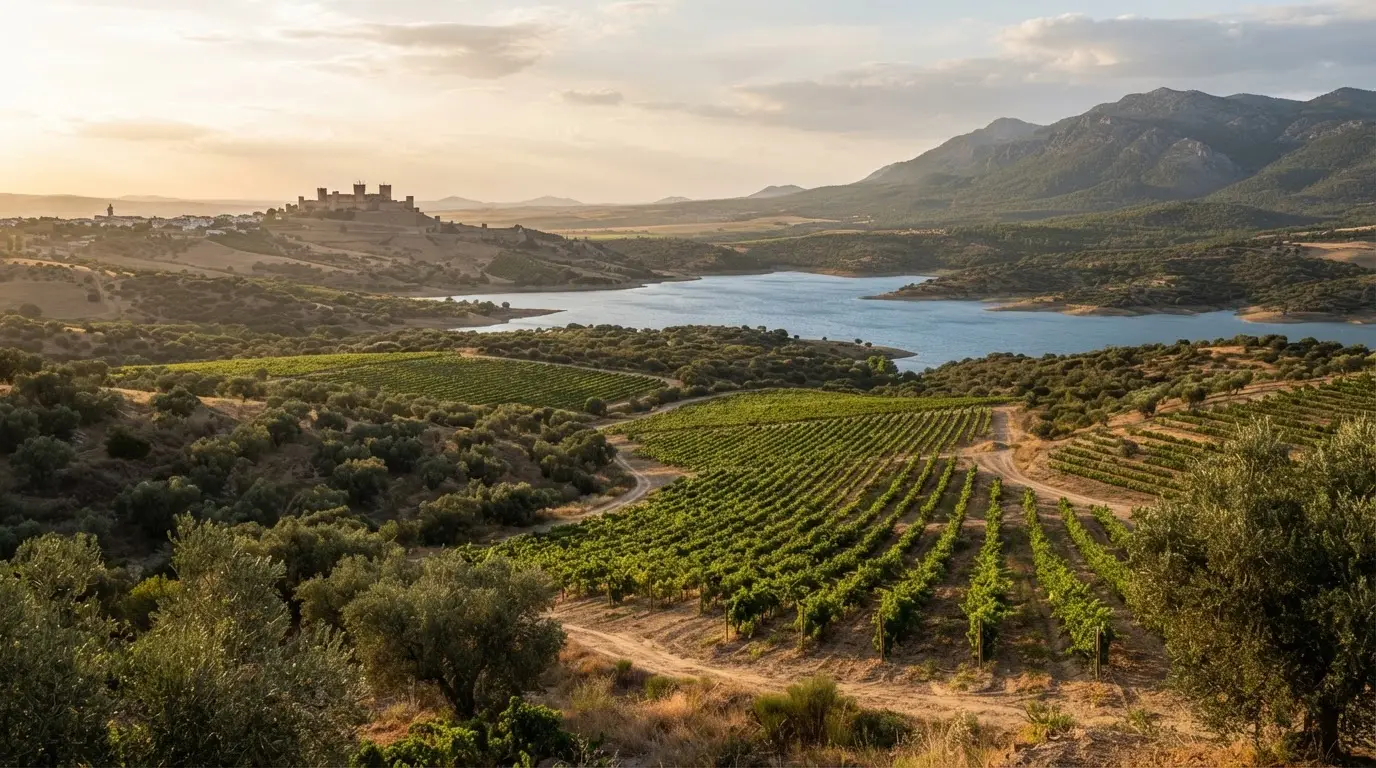
Cordoba cultural landscapes route illustrated as a wide Guadalquivir vega at golden hour, olive rows and vineyards in the foreground, a castle on a distant rise and reservoir water glinting beyond

Deep dive · Article

Andalusia Maps a New Route Through Eight Córdoba Landscapes

Andalusia's heritage institute has published a GPX and KML route linking eight Córdoba landscapes, from Medina Azahara to Santa Eufemia. Here is each stop.

Flamingo movements across Spain follow the same logic. In drought years, when flamingos do not nest at Fuente de Piedra, the breeding population disperses to other wetlands elsewhere in the country[18]. Before fixing a date, it helps to know what Córdoba is like in winter, the season of the rain that fills them.

Why Zóñar is still worth the drive

Zóñar's reserve covers 66 hectares, a small footprint for a lake this deep, and the visitor centre is the best seat on the water, with panoramic views of the lake[19]. A Junta report of 1 March 2026 had the lake above 13 m and still filling[20], against the 16 m it can reach in the rainy season[2].
The lake's claim to fame is a rescue that is not finished. In 1977 only 22 white-headed ducks remained in Western Europe, all of them at Zóñar[21]; in 2020, by Junta data, just two of the 37 pairs breeding in Andalusian wetlands nested at Zóñar and the adjoining General lagoon[22]. The visitor centre is the place to look for one yourself, once you have confirmed it is open:
  • Look for the threatened white-headed duck from the visitor centre[23].
  • Take in the interactive exhibition and the viewpoint on the botanical trail, which gives a wide panorama of the lake[24].
  • Walk the Sendero Botánico La Carrizosa or the Sendero del Observatorio, the two trails that start at the visitor centre[25].

Recommended tours

Tours are selected for quality, not commission. We earn a small fee if you book — at no extra cost to you.
Spring and autumn offer favourable conditions for birdwatching[26], and binoculars earn their place in the bag. Walkers who want longer routes than the two reserve trails will find them in hiking and nature around Córdoba.

Planning the trip: what to check first

Check the Junta de Andalucía's official page before you set out. Entry to the lagoon itself is free, but the visitor centre keeps visiting hours[27], so confirm there that it is open before you go, and access to some areas can depend on conservation measures or the weather[28]. Bring binoculars either way.
The visitor centre sits in the south of Córdoba province, about 4 km from Aguilar de la Frontera[29]. Tíscar is a separate stop, reached by a dirt track from the hamlet of Puerto Alegre[30], so read whether you need a car around Córdoba before you plan the day. Aguilar de la Frontera, the nearest town to the visitor centre, is the natural place for a meal stop before or after.

Check before you drive out

The visitor centre keeps its own hours, so confirm them on the Junta de Andalucía's official page before you set out. Tíscar and Amarga are the variable stops: let the water decide, and treat any flamingo as a bonus.
The sensible order is Zóñar first, because its water and its visitor centre are the fixed points; Tíscar and Amarga are the variables. As with most day trips from Córdoba, the car and the weather shape the day more than the sights do.
Go with patience rather than a shot list. A hide rewards the person who sits still, and a flamingo that does appear on a rain-filled lagoon is a better story than one promised by a listing.

Frequently asked questions

Are there flamingos at Laguna de Zóñar near Córdoba?

Zóñar is a deep, permanent lake known for the white-headed duck, and flamingos are not part of its usual birdlife. They are recorded at the shallow seasonal lagoon of Tíscar near Puente Genil and, second, at Laguna Amarga in Lucena, depending on how much rain has fallen.

Where can you see flamingos near Córdoba?

Tíscar, near Puente Genil, is the first place to try, with Laguna Amarga in Lucena as the second. Both belong to the same group of southern Córdoba reserves as Zóñar, and whether flamingos are present follows the water, so look for a recent report before driving out.

Is Laguna de Zóñar free to enter?

Entry to the lagoon itself is free, but the visitor centre keeps visiting hours. Check the Junta de Andalucía's official page for the current times before you go.

What is Laguna de Zóñar best known for?

The white-headed duck. In 1977 only 22 were left in Western Europe, all at Zóñar, and the lake became a symbol of the species' recovery.

Is Zóñar a lake or a lagoon?

Both words are used. The map name is laguna, and it is often described as Andalusia's only natural lake. It is deep, up to 16 m in the rainy season, and it keeps its water all year.

Does Laguna de Zóñar dry up?

No, its water stays all year, fed by rain and underground aquifers. Seasonal lagoons such as Tíscar are different and hold water for only part of the year, which is why flamingo sightings there come and go.

When is the best time for birdwatching at Zóñar?

Spring and autumn offer favourable conditions, though access to some areas can depend on conservation measures or the weather, so check current information first. Flamingos are a separate question: they follow the water at Tíscar and Amarga, not the calendar.

How do you get to Laguna de Zóñar?

Head for Aguilar de la Frontera: the visitor centre is about 4 km from the town, in the south of Córdoba province. Tíscar is a separate stop, 8 km from Puente Genil along a dirt track from the hamlet of Puerto Alegre, so allow extra time if you add it.

Sources

30 references Show
  1. eldiario.es (opens in a new tab)

    “a poco menos de cinco kilómetros de la localidad cordobesa de Aguilar de la Frontera, emerge el único lago natural de Andalucía.”

  2. en.andalucia.org — Lagoons in the south of cordoba (opens in a new tab)

    “In the rainy season it can be up to 16 metres deep, making conditions ideal with the presence of abundant vegetation and food.”

  3. Junta de Andalucía — Reserva natural laguna de tiscar (opens in a new tab)

    “Algunas de las aves que se pueden encontrar en esta laguna son: flamenco común, cigüeña blanca, porrón moñudo y cerceta pardilla.”

  4. solopuentegenil.com (opens in a new tab)

    “la laguna Amarga, en Lucena, la tercera de las permanentes de las protegidas en el Sur de Córdoba y la segunda donde hay flamencos rosas después de Tíscar”

  5. birdingplaces.eu (opens in a new tab)

    “Entre las más frecuentes están la garza real, el ánade azulón, y el somormujo lavanco.”

  6. infobae.com (opens in a new tab)

    “Aquí el agua permanece durante todo el año gracias a la combinación de lluvia y aportes subterráneos procedentes de los acuíferos de la zona.”

  7. Junta de Andalucía — Accessible (opens in a new tab)

    “and because they are shallow, they provide a habitat for wading birds such as pink flamingos.”

  8. Junta de Andalucía — 631ae660 8afd 9fa4 ca5d c76cabfc97c1 (opens in a new tab)

    “Laguna de Zóñar and five other lakes were declared a Protected Nature Reserve on 25 October 1984”

  9. en.andalucia.org — Lagoons in the south of cordoba (opens in a new tab)

    “Just eight kilometres from the town of Puente Genil, Surrounded by countryside and irrigated crops, you will find a seasonal brackish water lagoon”

  10. visitpuentegenil.es (opens in a new tab)

    “que cualquier persona puede visitar a lo largo de todo el año para observar las aves sin llegar a molestarlas”

  11. solopuentegenil.com (opens in a new tab)

    “El pasado lunes había en Tíscar 111 flamencos rosas y 61 avefrías”

  12. solopuentegenil.com (opens in a new tab)

    “Estas aves, entre las veintiséis especies diferentes censadas a lo largo del mes enero por los agentes de Medio Ambiente de la Junta de Andalucía, son las más destacadas”

  13. aguilardigital.es (opens in a new tab)

    “la laguna de Tíscar se encuentra rebosando por su aliviadero con más de dos metros de profundidad”

  14. en.andalucia.org — 15565101 (opens in a new tab)

    “The name of Amarga lake comes from the characteristic taste produced by the salt in its water ("amarga" is the Spanish word for bitter).”

  15. cordopolis.eldiario.es (opens in a new tab)

    “han dejado la inundación de estos parajes en el mejor nivel desde hace una década y en óptimas condiciones para la actual primavera”

  16. aguilardigital.es (opens in a new tab)

    “la precipitación acumulada desde el 1 de octubre de 2025 hasta el día de hoy, en la estación de AEMET de Aguilar de la Frontera llega casi a los 600 l/m²”

  17. en.andalucia.org — 15574101 (opens in a new tab)

    “Tíscar is the winter habitat for numerous species of ducks, geese, waders and graceful flamingos.”

  18. atlasaves.seo.org (opens in a new tab)

    “Los periodos de sequía, cuando los flamencos no nidifican en Fuente de Piedra, se produce una dispersión de la población reproductora”

  19. Junta de Andalucía — 631ae660 8afd 9fa4 ca5d c76cabfc97c1 (opens in a new tab)

    “The Reserve covers 66 hectares and among its highlights is the Visitor Centre, from where you can enjoy panoramic views of the lake.”

  20. aguilardigital.es (opens in a new tab)

    “la Reserva Natural de la laguna de Zóñar supera los 13 metros de profundidad y avanza en su proceso de llenado”

  21. Junta de Andalucía — Accessible (opens in a new tab)

    “In 1977 there were only 22 white-headed duck in Western Europe, and all were found in these waters.”

  22. cope.es (opens in a new tab)

    “de las 37 parejas de malvasía que se reprodujeron durante 2020 en trece humedales de la Comunidad Autónoma solo dos lo hicieron en el conjunto que forman Zóñar y el General”

  23. Junta de Andalucía — 255035 (opens in a new tab)

    “Aquí el visitante podrá identificar especies como la llamativa y, a la vez, amenazada malvasía.”

  24. Junta de Andalucía — 255035 (opens in a new tab)

    “Desde el mirador que incluye el sendero botánico, que recorre los alrededores del centro, se puede apreciar una amplia panorámica de la laguna”

  25. birdingplaces.eu (opens in a new tab)

    “There are also two trails around the Zonar reserve, the Sendero Botánico La Carrizosa and the Sendero del Observatorio, both at the visitors' centre.”

  26. infobae.com (opens in a new tab)

    “La primavera y el otoño ofrecen condiciones favorables para la observación de aves.”

  27. birdingplaces.eu (opens in a new tab)

    “The entrance to the lagoon itself is free, the visitor center has visiting hours.”

  28. infobae.com (opens in a new tab)

    “El acceso a determinadas zonas puede depender de las medidas de conservación o de las condiciones meteorológicas, por lo que conviene consultar la información actualizada antes de desplazarse.”

  29. Junta de Andalucía — 631ae660 8afd 9fa4 ca5d c76cabfc97c1 (opens in a new tab)

    “The Laguna de Zóñar Visitor Centre is located in the south of the province of Cordoba, just 4 kilometres from Aguilar de la Frontera.”

  30. visitpuentegenil.es (opens in a new tab)

    “Esta laguna se localiza a ocho kilómetros de la localidad, siguiendo el carril de tierra que parte de la aldea de Puerto Alegre.”