
A Cave in the Sierras Subbéticas, Not the One You're Thinking Of
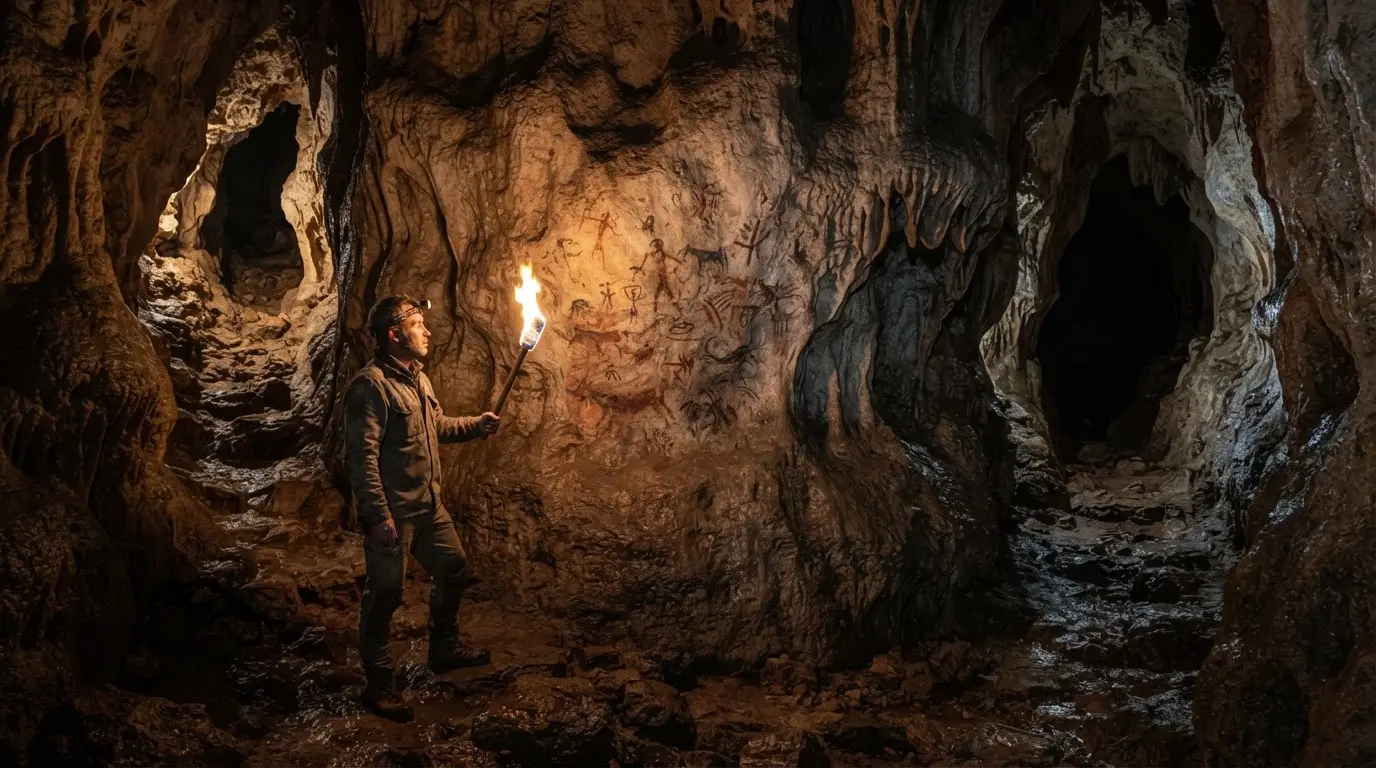
The cave opens on the northern slope of the Macizo de Cabra, part of the karstic Sierras Subbéticas in southeastern Córdoba province.[1] Zuheros, one of the Pueblos Blancos villages near Córdoba, sits at the foot of that same massif. Most visitors stop in the village; the cave sits higher up the same slope, past where the streets end.
It is often confused online with a same-named 'mummy cave.' The Cueva de los Murciélagos de Zuheros has no connection to the Cueva de los Murciélagos de Albuñol, a Granada-province site known for its ancient esparto sandals. They share a name and little else.
Excavators have documented a stratigraphy running from the Middle Paleolithic through the Neolithic to the Roman period:[2]
- Middle Paleolithic occupation layers
- Levels from the end of the Upper Paleolithic
- An extensively represented Neolithic sequence
- Copper Age and Bronze Age material
- Late Roman-period deposits
That depth is why the Junta de Andalucía's own heritage record calls the cave one of Andalusia's most important Neolithic sites, and the first in the region with Upper Paleolithic-era art, the basis for its declaration as a Bien de Interés Cultural.[3]
From a 1969 Dig to a 2006 Reinterpretation
An excavation in 1969 was directed by Dra. Ana María Muñoz Amilibia together with Ana María Vicent Zaragoza.[4] New campaigns followed in 1990, 1991, 1993 and 2002, opening the cave's 'Pasillo' sector and led by one of the archaeologists behind the paper that would later reframe the whole site.[5]
That paper, published in 2006 in the journal SPAL, is titled plainly Habitat and Sanctuary during the Early Neolithic.[6] Its argument cuts against decades of prior scholarship: earlier researchers, working from the 1969 dig, had used the Zuheros cave as a reference site for the Andalusian Middle Neolithic. The radiocarbon-dated stratigraphy instead places the bulk of the earliest farming occupation in the Early Neolithic, non-Cardial phase.[7]
Explore nearby · Museum
Casa-Museo del Guadamecí Omeya
The world's only museum dedicated to guadamecí — Umayyad gilt-embossed leather from 10th-century Córdoba. Free entry, five rooms, steps from the Mezquita.
The excavators split the Neolithic sequence into three ceramic-defined blocks, each corroborated by radiocarbon dates on hearth charcoal:
These are uncalibrated laboratory determinations, not calendar dates in the strict sense. The sequence itself is what let excavators separate three distinct occupation phases rather than one blurred Neolithic layer.
Five Hearths and Forty-Nine Poppy Seeds
Across the 1991, 1993 and 2002 campaigns, excavators documented five small hearths in the earliest Neolithic A levels: modest, single-use fire pits rather than a permanent domestic hearth. Notably, all five sat disassociated from any occupation floor, not part of a living surface anyone was standing on day to day.[11]
Recovering what burned in them took a specific method. Every stratigraphic unit's sediment, 100% of it, was processed through water-tank flotation using two mesh sizes: one for the bulk sediment, and a finer 0.25 mm mesh for what floated free, charcoal, seeds, microfauna, fragments too small to see during normal excavation.[12]
One hearth, excavated in 1991 in level 8-b, grid A-0-1, produced 49 seeds of Papaver somniferum, the opium poppy, alongside a single indeterminate cereal grain and a Silene sp. seed.[13] The excavators described the poppy seeds, at the time of their 2006 report, as the oldest such remains then known in the Iberian Peninsula.[14]
A small organic fragment found in the same hearth was interpreted by the excavators as a piece of vomit, whose composition would include gastric juices.[15] Read together with the poppy seeds, it points toward deliberate ingestion of the plant's latex rather than incidental cooking waste.
Idols in Clay, Figures on Stone
The excavators didn't stop at hearths. A ceramic vessel recovered from the site, catalogued as piece nº 6, carries a painted schematic face: eyebrows, a nose, eyes rendered as two concentric circles.[16] It's one of several symbolic ceramics that echo the cave's painted schematic idols on the walls.
That face has a counterpart on the cave wall. In the Corredor de las Pinturas, a painted figure known as the ídolo-placa was first published by Bernier and Fortea in 1968-69, who, working from the evidence then available, attributed it to the Bronze Age.[17]
The Panel de las Cabras, a separate set of schematic caprid figures in the Corredor de las Pinturas, was likewise first attributed to the Bronze Age. Marcos Pous reassigned that panel to the Neolithic in 1977, after new excavations in the Sala de los Estratos of Cueva Chica turned up stratified evidence the earlier attribution hadn't accounted for.[18] A separate schematic quadruped, painted in red, sits a few centimetres from the ídolo-placa on another panel of the same corridor; no source checked assigns it a reworked date.
None of this figurative art has been directly dated. No direct dating of the pigment is reported; the Neolithic attribution for the painted schematic figures rests on ceramic parallels, like the vessel's painted face, and on proximity to the radiocarbon-dated hearths, not on dating the paint.
The cave also holds separate rock art attributed to the Upper Paleolithic. One cataloguing source describes it as engravings, distinguishing it from the later Neolithic paintings, though not every account agrees on exactly what form that earlier art takes.[19]
For broader context on Córdoba province's prehistoric and Roman-era finds, the Archaeological Museum of Córdoba situates this cave's era within the region's wider excavation record.
A Protected Site, Still Being Read
In 1938, a human skeleton and grave goods were found inside a natural rock pool in the cave, a find Andalusia's regional tourism board reads as a deliberate burial.[20] A local heritage account identifies the skeleton as a woman's, buried in a fetal position.[21]
The cave's formal protections came later and in two separate steps: a Bien de Interés Cultural declaration in 1995, and a Monumento Natural designation in 2001.[22]
Recommended tours
Tours are selected for quality, not commission. We earn a small fee if you book — at no extra cost to you.
The Monumento Natural designation protects 32.46 hectares.[23]
Deep dive · Article
Córdoba Silk Industry History: The Rise of Tiraz
Córdoba ran al-Andalus's first state silk workshop, the dar al-tiraz, weaving robes of caliphal power before the industry shifted to Almería after 1031.
Zuheros already has its 'most beautiful village in Spain' listing to bring people up the hill for the castle and the white streets. The cave itself makes its own, separate case: a hearth that burned once and a chronology that took decades to reargue. For more of Córdoba province's buried history, see the pre-Roman walls found near Córdoba.