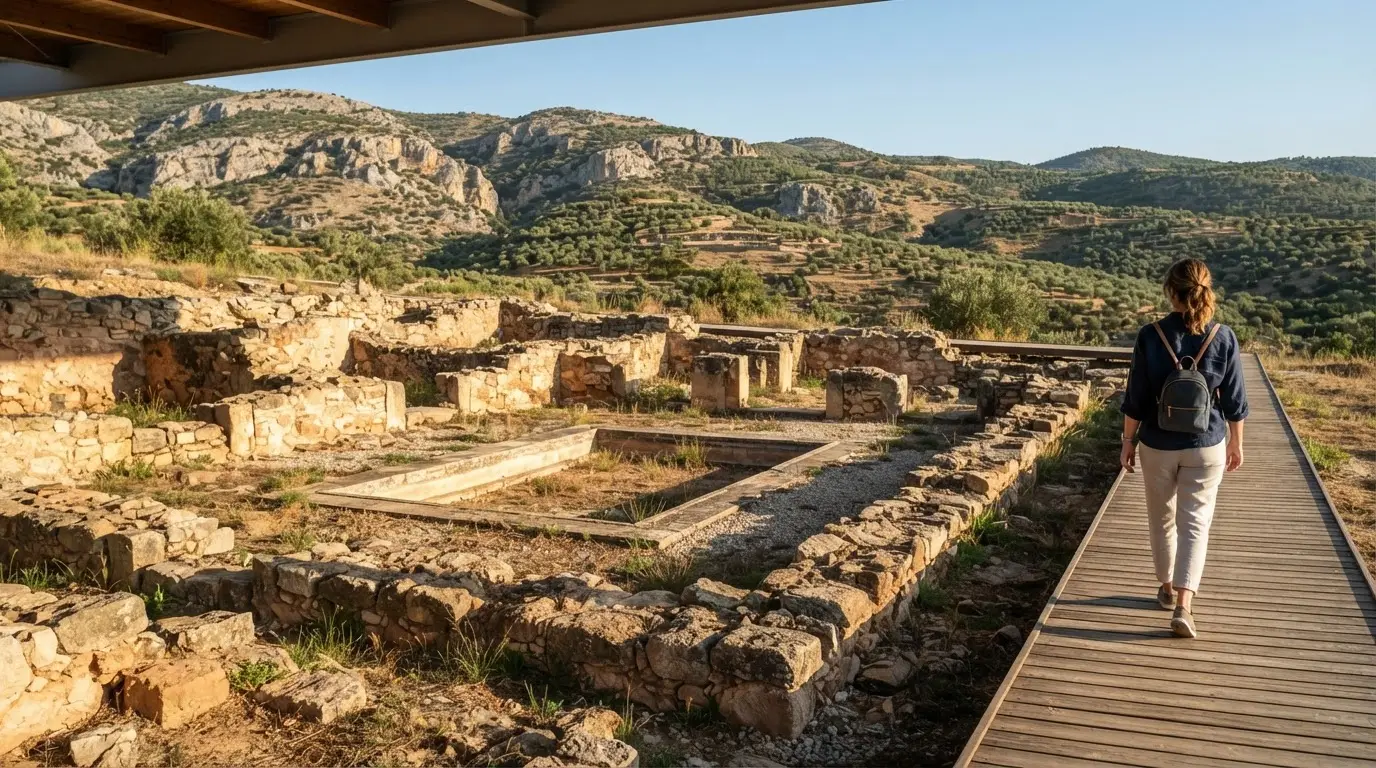

The Iberian town that ended in violence around 141 BC
Cerro de la Cruz was a late Iberian town, an oppidum in the archaeologists' shorthand, and scholars have known of it since the mid-19th century. Excavation campaigns have run on and off since the 1980s. Its end was not gradual: the settlement was destroyed violently and abandoned in the mid-2nd century BC[6], around 141 BC[1].
A violent end is bad for the people and good for archaeology. Nobody came back to tidy up or rebuild, so the ground kept the material the inhabitants left behind, along with the mutilated skeletons of some of them[6]. Slow abandonment strips a site of everything portable; this one was stopped by a single event and left as found.
That sudden stop is what makes the site valuable. Researchers publishing in 2014 call Cerro de la Cruz, for now, the best example of late Iberian urban planning and material culture in Andalusia[7]. The qualifier is honest, because few comparable sites have been dug at any scale.
The scale here is modest. The 650 m² excavated is enough for the Junta de Andalucía's heritage declaration to class the site among the few late Iberian settlements excavated intensively anywhere in Andalusia[8], yet it covers only around 1% of an estimated 50,000 m²[4]. Most of the town is still under the hill. Go expecting a sample, not a reconstructed city.
Terraces in the limestone, and no walls on the surface
A hillside this rough forced a town of terraces: the Junta describes stepped platforms excavated directly into the rock of one of the Subbética's limestone anticlines[9]. On a slope like that, everything built had to be levelled out of the stone first. The guided visit to the Cerro takes about an hour and a half[10], the longest stop of the day.
What the hill lacks above ground is a wall. The declaration records no surviving remains of walls or defensive structures on the surface[4].
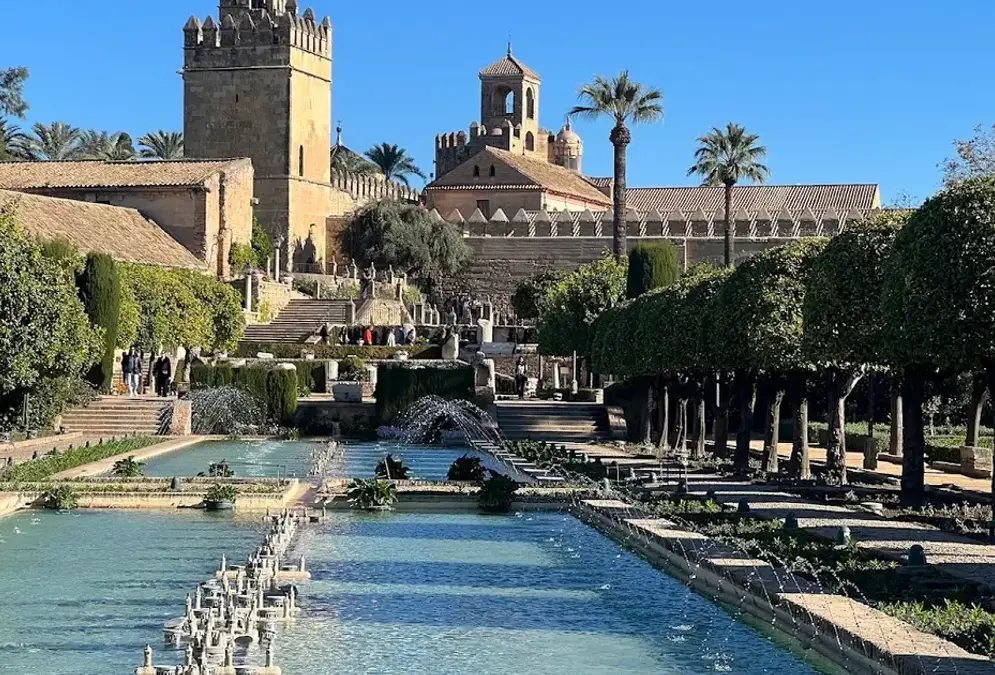
Explore nearby · Monument
Alcázar de los Reyes Cristianos
Alcázar de los Reyes Cristianos, Córdoba: free entry on Tuesdays. A 14th-century fortress-palace with terraced Moorish-inspired gardens and Roman mosaics.
That is awkward for a defended town. The defences may have been modest, dismantled, buried, or simply lie in the unexcavated 99%; the record only says nothing is visible, and a town that ended in violence is a reason to keep asking.
Córdoba city's own pre-Roman layer is harder to see still. The possible pre-Roman wall foundations on the Guadalquivir riverbank came from a magnetic survey and are not open to visitors, whereas Cerro de la Cruz has a guided visit.
Decree 30/2002 of 29 January 2002 made the hill a Bien de Interés Cultural in the category of archaeological zone[11].
El Ruedo: the Roman villa found by a road crew
El Ruedo did not come out of a research dig. It surfaced during emergency archaeology ahead of the A-340 road (Estepa to Guadix) where it passes north of Almedinilla[2], and the crews found a villa with two halves: the pars urbana, the owners' residence, and the pars rustica, the farm buildings[12].
The two sites are not contemporaries, and the gap is the point of the visit. The Junta dates the villa's structures from the mid-1st century BC to the late 5th century AD[13], so the earliest go up within a century of the hill-town's fall.
The porticoed courtyard that organises the plan, Hellenistic in style, followed in the second quarter of the 1st century AD, more than a century and a half after the hill-town fell, and the house was still occupied in the middle or at the end of the 5th[3].
Its fortunes were uneven. The villa flourished in the 1st and 2nd centuries, shrank in the 3rd, perhaps with a partial abandonment, and was rebuilt on a large scale around the turn of the 4th century[14]. A rebuild of that size reads as an owner's decision to reinvest, not a repair.
Where the story ends depends on the source. Visitor literature also runs the site, burials included, into the 7th century, so ask the guide which date they use.
The Roman houses of Colonia Patricia show how the provincial capital's elite lived in town; El Ruedo is the rural counterpart, with its farm quarter attached.
In 2004 the Junta opened proceedings to protect it as a Bien de Interés Cultural, citing its good state of conservation and the scarcity of such villas in Andalusia[15].
Perseus, Andromeda and the museum by the river
The lower part of a sculptural group of Perseus and Andromeda turned up in the north-west corner of room XVII of the villa[16], the myth of the hero who frees a chained princess. It is described as the only known work on that theme in the Iberian Peninsula and is dated to the late 1st or early 2nd century[17].
Wall painting was part of the same taste: fragments of it are abundant across the site[13]. Together with a sculpture group of this ambition, they describe an owner who wanted guests to read the house as cultured, not just prosperous.
Almedinilla's Museo Histórico-Arqueológico opened in 1999 in a former flour mill at the foot of the Sierra de Albayate, beside the river Caicena[18]. It is the third part of the joint visit, and the easiest to undervalue.
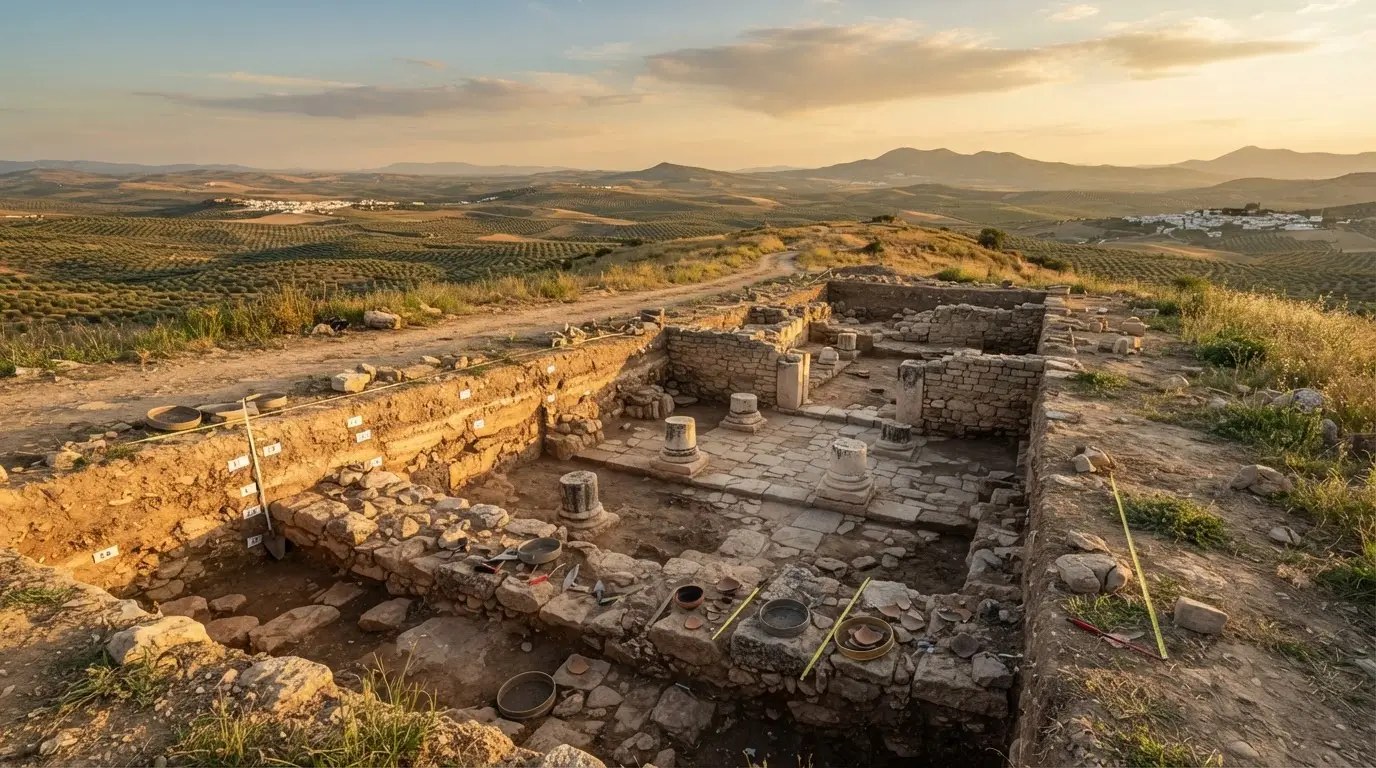
Deep dive · Article
Torreparedones Has Been Open 15 Years, and a Tenth Is Dug Up
Torreparedones, on a hilltop between Baena and Castro del Río, has been open to visitors since 2011. Only about a tenth of its 3,500-year city has been dug.
The museum is where the finds are put in order, the villa is where a Roman house and its farm were found, and the hill shows an Iberian town as it was left in one violent moment. Skip any one and the other two lose their frame.
Tickets, hours and the one phone call to make
A 2024 municipal ordinance sets a price for each site and a full combined ticket for the villa, the museum and the hill-town at €10.00 general or €7.50 reduced[5]. At the general rate, the combined ticket saves a euro over buying the three separately[19].
| Site | General | Reduced |
|---|---|---|
| Roman villa El Ruedo | €3.50 | €3.00 |
| Museo Histórico-Arqueológico | €3.50 | €3.00 |
| Iberian town, Cerro de la Cruz | €4.00 | €3.00 |
| Full combined ticket | €10.00 | €7.50 |
Residents of Almedinilla enter free, and the reduced rate applies to:
- over-65s
- teachers
- holders of a youth card
- visitors with a disability
- guests of Almedinilla lodgings
Recommended tours
Tours are selected for quality, not commission. We earn a small fee if you book — at no extra cost to you.

Hours depend on who you ask. The town hall's guided-visit schedule runs Wednesday to Sunday, 10:00 to 14:00, with Saturday also 16:30 to 19:30[20]. Almedinilla Turismo's winter schedule for the villa opens Tuesday to Sunday, at the same hours[31].
The Junta de Andalucía's museum listing has the museum open Tuesday to Sunday, 10:00 to 13:30, from April to October, plus Saturdays 18:00 to 19:00[21]. The sources split on Tuesday and on the Saturday-evening slot, and no page says which is current.
Confirm before you go
Opening hours differ between the municipal, Junta and tourism listings, and the prices above come from a 2024 ordinance. Phone the visitor centre on 957 70 33 17 before travelling[22].
Guided tours start at the Visitor Reception Centre on the A-339 at km 37 in Almedinilla[22]. Call 957 70 33 17 to confirm the day's schedule before you set out.
Book ahead. Almedinilla Turismo recommends reserving the guided villa visit[23], and for the Cerro de la Cruz it recommends it Tuesday to Friday[24]; Turespaña's listing, which relays the organiser's information, says the Cerro visit needs advance booking[25]. From October to April the complete tour starts at 11:00 Tuesday to Sunday, with a second Saturday start at 16:30[32]. The Cerro visit is offered in Spanish, English, French, German and Italian[26].
Allow a margin on time, because the listings disagree. The town hall gives 45 minutes for the museum and an hour and a half for the Cerro[30][10]; Almedinilla Turismo says about an hour for each[28][29], and 3 to 3.5 hours for the complete tour[27].
A day built around the Subbética could pair this with Zuheros castle, another village where the town hall sets tickets and hours. From Córdoba itself, the Museo Arqueológico de Córdoba gives the city-side view of the same Iberian and Roman worlds.