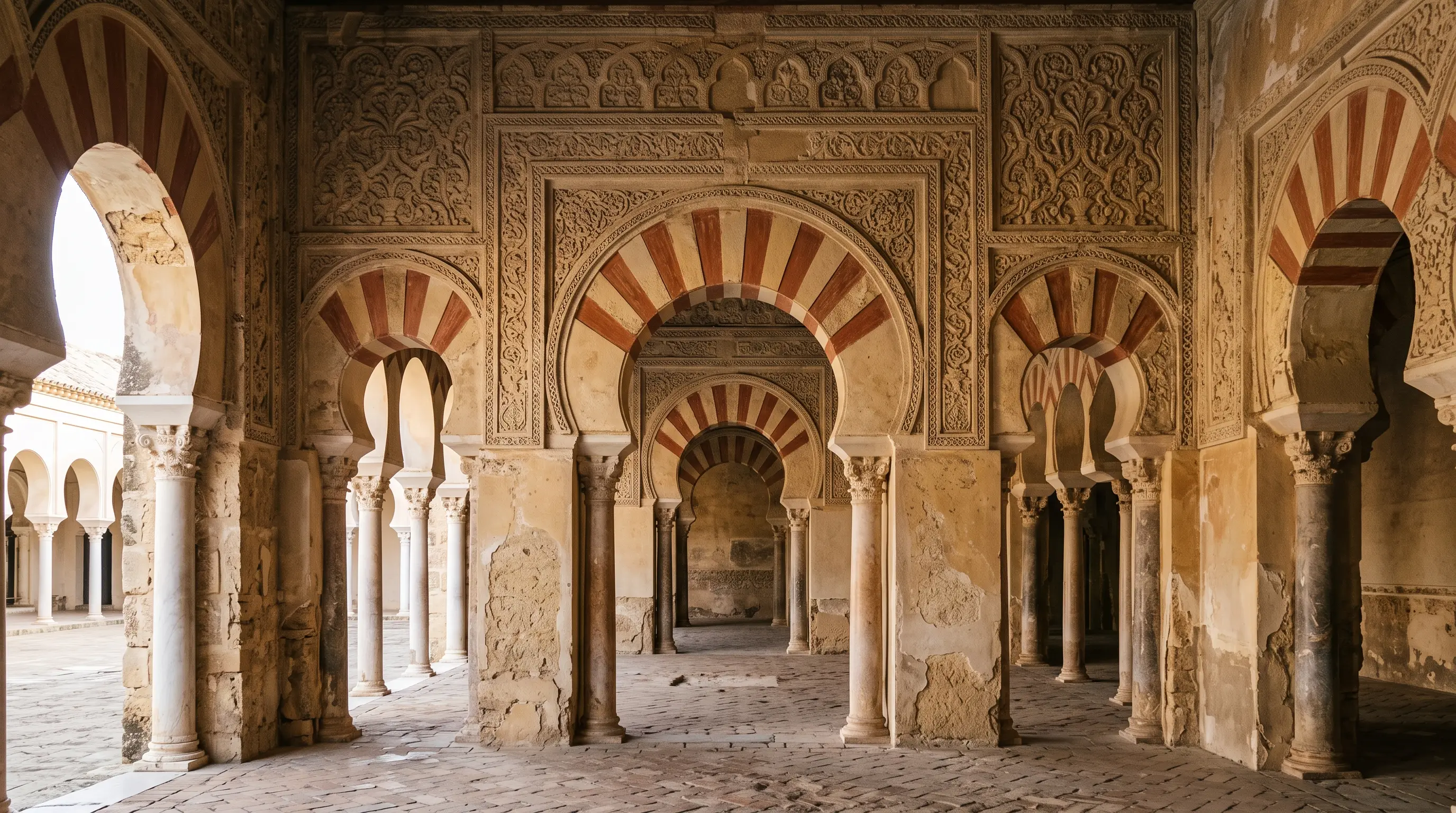

Isa al-Razi, the secretary who kept the court's notebook
The annals are credited to Isa ibn Ahmad al-Razi, an official and chronicler of the caliph's court who carefully noted both the big and the small events of palace life.[5]
The job ran in the family. His father, Ahmad al-Razi, had been official secretary, historian and court poet to Abd al-Rahman III,[6] whose caliphate al-Hakam II inherited on 16 October 961, aged 46.[7] Isa worked in the palatine circles of Madinat al-Zahra as the caliph's official chronicler,[8] so he wrote from inside the palace world, not from a later distance.
What survives is a fragment of more than 135 folia covering June 971 to July 975.[1] The historian Ibn Hayyan quoted Isa's account of al-Hakam's reign for exactly those years in his Muqtabis.[9]
Around that fragment sits an argument about authorship. Eduardo Manzano Moreno credits the Muqtabis volume to al-Razi himself, reasoning that Ibn Hayyan, like many Arabic historians, relies on older accounts.[10] The difference matters. On his reading the text is an eyewitness record by a secretary of al-Hakam's court, not a later historian's compilation. It is one scholar's attribution, and authorship is not closed.
A note on evidence runs through the rest of this piece. Dated entries below come from the Real Academia de la Historia's event summaries of the annals, which are digests, not folio-level readings. Anything about ceremony, protocol or the Salón Rico comes from later commentary, and each section says which is which.
One manuscript, one discovery: how the annals reached print
The text reached modern readers through a single manuscript, and its trail is short enough to set out in full.
- 1249: copied at Ceuta into the only manuscript that has come down to us, now held by the Real Academia de la Historia in Madrid.[4]
- 1888: Francisco Codera finds it in the library of Sidi Ben Hammouda in Constantine.[11]
- 1965 and 1967: the text is edited in Beirut, then translated into Spanish by Emilio García Gómez.[12]
- 2019 and 2023: Manzano Moreno's study appears as La corte del califa (Crítica) and then, translated by Jeremy Roe,[41] as The Court of the Caliphate of al-Andalus: Four Years in Umayyad Córdoba from Edinburgh University Press, 480 pages.[40]
- 2025: Almuzara issues a new edition of García Gómez's translation, Anales palatinos del califa de Córdoba al-Hakam II, edited by Daniel Valdivieso.[13]
Explore nearby · Monument
Medina Azahara
Medina Azahara is Córdoba's UNESCO listed Caliphate City: a 10th century palace 8 km from town, with the Salón Rico and award-winning museum. Plan your visit.
Nearly three centuries separate the last entry of 975 from the Ceuta copy, and the one account of its survival names no second witness to check it against. Everything said about these four years leans on one scribe's care. The books al-Hakam collected fared worse: his famous library left no identifiable manuscript at all.
971 to 974: embassies and a court that staged its own power
The summer of 971 is busy with diplomacy. In June or July al-Hakam II received Bon Filio, ambassador of Count Borrell II of Barcelona, who came to sign an agreement recognising caliphal sovereignty.[14] On 12 August the court took in a bigger round: envoys from Sancho Garcés II of Pamplona, from Elvira, the Leonese regent and aunt of Ramiro III, from Count García Fernández of Castile and from others.[2]
None of this was unusual by then. Ambassadors from rulers around the Mediterranean, the Iberian Peninsula and Western Europe frequented the halls of Madinat al-Zahra,[15] and the Umayyads were measuring themselves against Fatimids, Idrisids, Buyids, Byzantines and Western European powers.[16] Prestige was the currency, and the caliph had to be seen holding it.
Ceremony did the work of persuasion. Caliphal money went into processions for holidays, victories and the arrival of ambassadors, each meant to extend influence,[17] and gifts handed to ambassadors and allies were part of the same budget, though no figure for them appears in the published reviews and summaries.[39] The historian Miquel Barceló gave his study of Umayyad Córdoba's protocol a title that says as much: El califa patente, subtitled on the staging of power.[18]
Every dated entry in this section, from the 971 receptions onward, comes from the Real Academia de la Historia's event summaries of the annals, which are digests, not folio-level readings. Three more from the following years:
- 10 March 972: an embassy from the Byzantine emperor John I Tzimiskes reaches Córdoba.[26]
- 17 November 973: the regent Elvira's embassy is received, and a diplomatic incident follows that Islamic sources attribute to the insolence of the Leonese envoys.[27]
- 25 June 974: an envoy of Count Borrell II of Barcelona is sent to renew the truce with the caliph, with envoys of Otto II of Germany among the others at court.[28]
For the choreography itself, meaning who stood where and what changed hands, the García Gómez translation and Manzano Moreno's chapters are the places to look.
Succession worries, a Maghreb war and Ibn Abi Amir's quiet climb
Ceremony had a nervous undertone. The annals follow a succession question tied to the caliph's frail health,[19] and the later record shows how it ended: Hisham, whose brother Abd al-Rahman had died as a child, was proclaimed heir in his father's lifetime,[29] and on 5 February 976 the weakened caliph staged a solemn ceremony in the Córdoba palace at which an oath of loyalty was sworn to the 11-year-old prince.[30] Al-Hakam died on 1 October 976 and Hisham II succeeded him.[31] Those dates fall after the fragment ends, so they come from later chronology, not from the annals.
In the same pages Ibn Abi Amir, the official history knows as Almanzor, appears as a promising man climbing steadily and without noise.[19] He had entered Córdoba's administration in 967 as a simple assistant to the cadi,[33] and the recorded rungs begin with administrator of the estates of Prince Abd al-Rahman and of Subh, followed by director of the mint, administrator of intestate inheritances, cadi of Seville and Niebla, and finally administrator for the heir Hisham.[32] His Maghreb service as quartermaster of Ghalib's army is placed in 973 and his return, ill, in September 974, but sources differ on the exact year, so read those dates as approximate.[34]
The war abroad ran in parallel. In August 972 al-Hakam ordered General Ibn Tumlus to land a regular force at Ceuta against the Idrisid princes;[35] by December Ibn Tumlus had been defeated and killed by Idrisid rebels and Córdoba had sent its great general Ghalib to Morocco,[36] who put the revolt down in 974.[37] The next test came on the Duero: in spring 975 a Christian coalition of Leonese, Castilians and Pamplonese besieged Gormaz for more than two months, and Ghalib crushed it near Barahona.[38][20] Set side by side, diplomacy with Christian rulers in 971, war with a Fatimid rival from 972 and a frontier siege in 975 show a court running several fronts at once.
The surviving fragment ends in July 975, and al-Hakam's reign ended in 976.[21] What came after, the regency and Ibn Abi Amir's takeover, is the story of Hisham II, the boy caliph.
What survives at Madinat al-Zahra: the Salón Rico
Visitors to Medina Azahara want to stand where this court stood, and the site offers one obvious candidate. The city was the seat of the Caliphate of Córdoba and was laid waste in the civil war of 1009-1010.[22]
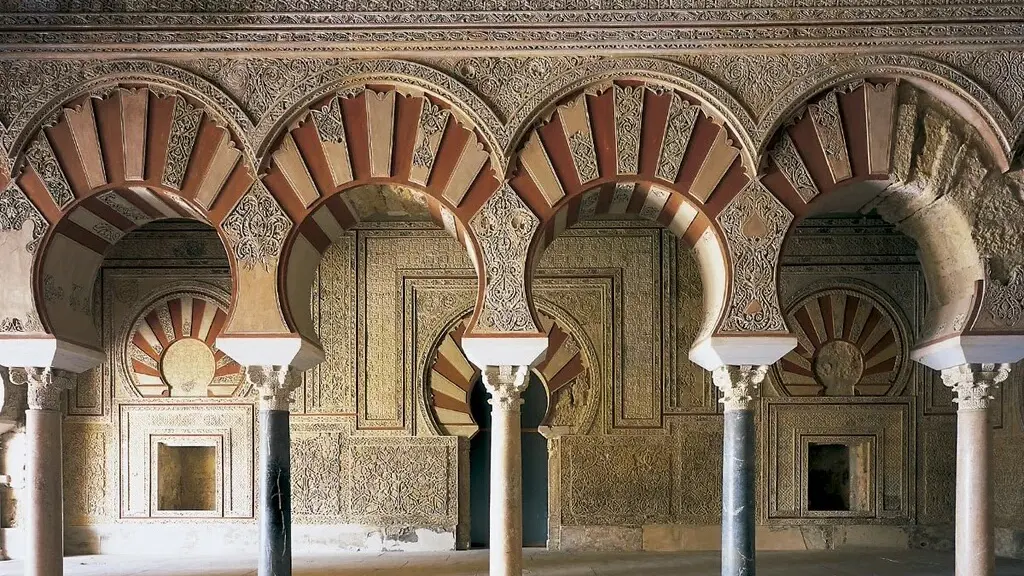
The hall's reputation comes from later commentary, not from the annals. The Salón de Abd al-Rahman III, the Salón Rico, is also called the Salón de Embajadores because it was the place where the caliph's embassies were received.[23] The usual construction date of 953 to 957, under Abd al-Rahman III and more than a decade before the annals open, rests on a single source, and the throne is only presumed to have stood in the central blind horseshoe arch, where the caliph led the reception ceremony.[24]
Presumed is the operative word. The hall's layout and the entries for 971 are separate evidence, and the summary of the August receptions places them only at the court of Córdoba.[2]
The ruins of the hall were found in 1944 by the architect Félix Hernández, and restoration continues.[25]
Take the hall for what it is, a purpose-built setting for reception ceremony, and bring the annals along as the script nobody can map onto it.
Visiting the Salón Rico: days, sessions and booking
The Junta de Andalucía's programme Salón Rico. Abierto por Obras takes visitors through the Jardín Alto and into the hall while specialists explain the restoration.[3]
Deep dive · Article
47 Metres Tall and Almost Unknown: Spain's Tallest Keep
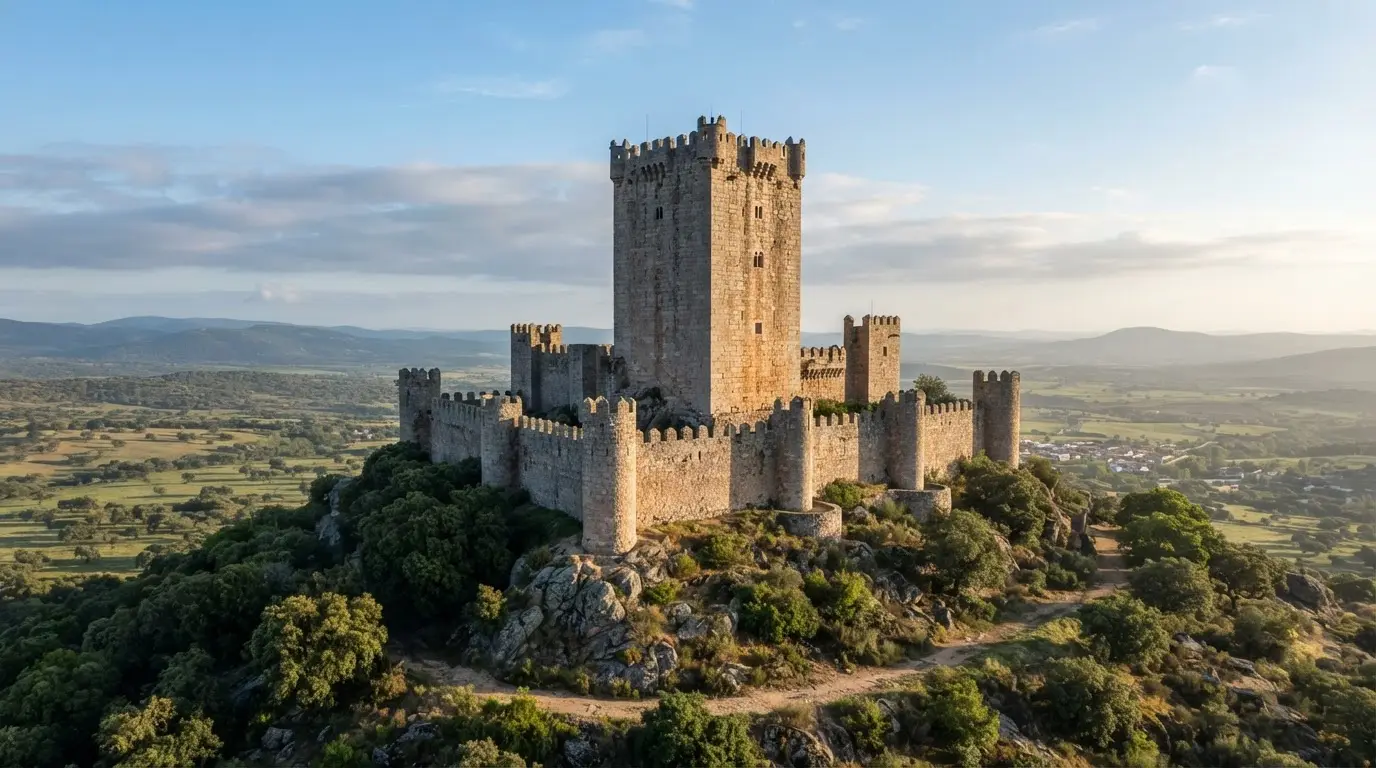
Belalcázar Castle's 47 m keep is listed by the Junta de Andalucía as Spain's tallest. How it grew, what to see inside and how to book the free guided visit.
Recommended tours
Tours are selected for quality, not commission. We earn a small fee if you book — at no extra cost to you.

No year is attached to that 12 April to 15 December window, so do not assume it matches your dates. Works to reorganise the visitor routes to the Salón Rico were due to start in September, El Debate reported in July 2026, which may change what the programme can offer.[44] Confirm sessions and registration on conocetupatrimonio.com before you plan a trip around it.