
Why the Judería is full of lanes like this
The Judería was never planned for anyone who wanted to turn a cart around. The official tourism office describes a quarter that keeps the layout of a medieval Islamic city: two main streets crossing, then "a labyrinth of smaller streets which often end in dead ends or narrow alleys"[4].
Walk it and the pattern is plain to see: dead ends, lanes where two people pass shoulder to shoulder, doorways opening straight onto them. That layout is what most visitors photograph here, and no two lanes feel quite the same width.
That is why a ranking of the narrowest lanes is slippery. Almost every cluster of whitewashed walls in the Judería has a lane that could qualify, and almost none has a published, measured width. Keep that in mind for the Arquillos.
What the Arquillos alley is, and why you only look in
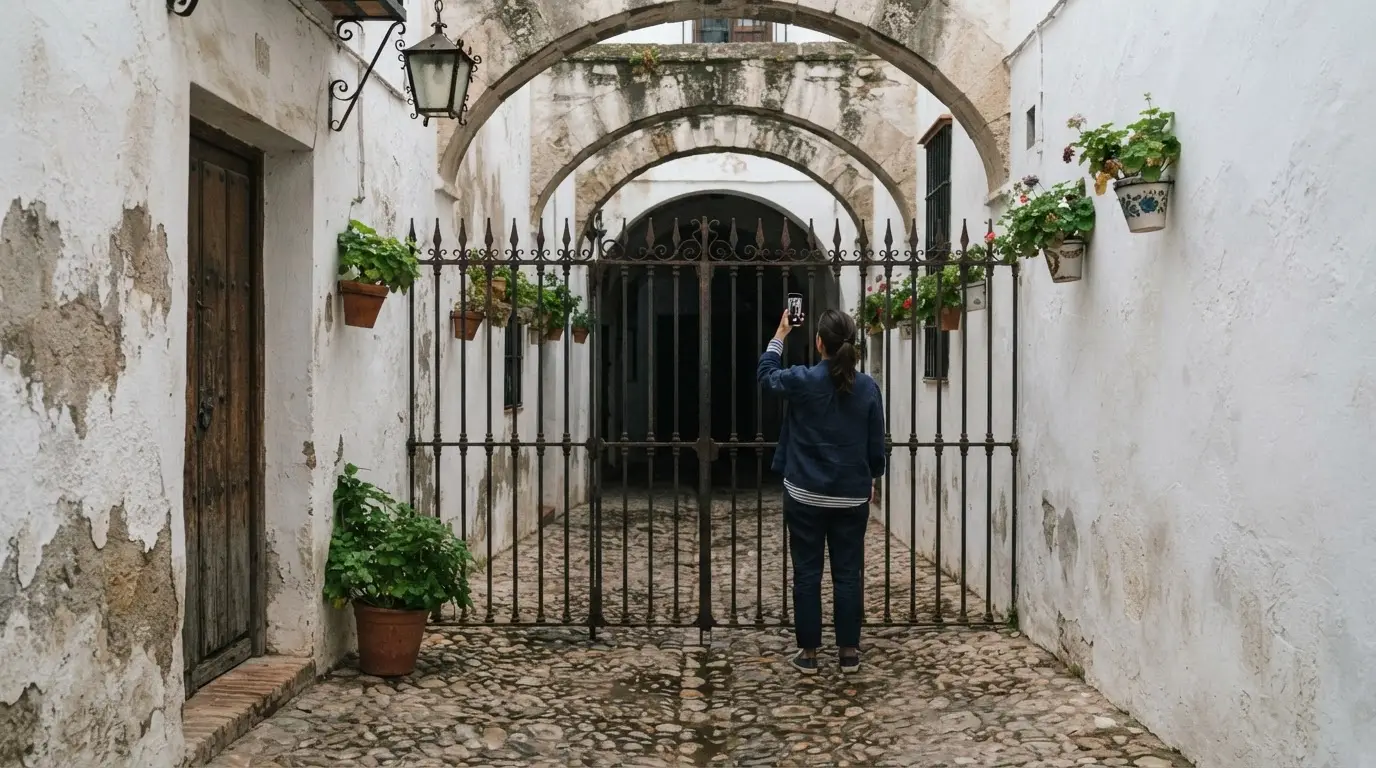
Arquillos is the diminutive of arco, small arches, and the name is literal. A visitor account describes several tiny arches inside the alley that link the walls of two medieval palaces[5]. The arches are the point of the place: a lane that is half street, half bridge between buildings.
The alley is closed off by barred gates. You do not walk it. You stand in the street and look in, and a phone camera held to the bars is the only way to take the picture home.
Its position is the useful clue. Visitor accounts put the Arquillos beside the Casa de las Cabezas, and a 2022 idealista news piece describes the house as flanked by a very narrow lane of Muslim origin[6]. Whether both descriptions name the same lane is hard to settle, because nobody has published a measurement.
Calle Cabezas and the Siete Infantes de Lara legend
Calle Cabezas, Heads Street, carries the name of a story. Tradition placed the residence of Gustios González, father of the seven infantes de Lara, on that street[7]. The house next to the Arquillos inherited the tale.
As a 2022 idealista news report tells it, legend says Gonzalo Gustioz was held prisoner on the property[8]. The word that matters there is legend. The sensational detail, the seven severed heads, belongs to the story and not to any document, so be wary of versions that count the arches to match them.
The legend did leave a mark in stone. A commemorative plaque went up when a calleja named for the seven infantes was reopened on Calle de las Cabezas[9]. Whether that lane is the Arquillos is not stated, and the safest reading keeps them apart.
The house next door: demolition, a mikveh and a closed door
The Casa de las Cabezas was demolished once. After a 1504 auto de fe, the Inquisition had it pulled down because it took the house for a synagogue[10].
A modern restoration then uncovered a mikveh, a Jewish ritual bath, which supports the story of its converso owner, and the owner opened the house as a museum in 2014[11].
Recommended tours
Tours are selected for quality, not commission. We earn a small fee if you book — at no extra cost to you.

Three layers share one corner: a legend, an Inquisition demolition and a rediscovered bath. None of them adds a centimetre of documentation to the alley itself, which is worth remembering when a guide folds all three into the Arquillos.
Look through, don't walk through
The Arquillos is gated, so you will see it from the street. The Casa de las Cabezas beside it has been a museum and a hotel, and a reopening is reported for 2027, so don't plan a visit around going inside.
Is it really the narrowest? Weighing the claim
One travel blog calls the Arquillos "probably the narrowest" alley in the city, and adds that it cannot be walked through[12].
Notice the hedge. A lane nobody can enter is also a poor candidate for any measured ranking. No width is published for it, so none appears here.
The lane that tourism officials do present as narrow is the Calleja del Pañuelo. The city's tourism site says it starts at the Plaza de la Concha and, at its narrowest point, is no wider than "a lady's handkerchief"[13]. It runs about 20 metres[2]. Tour operators and blogs quote widths that disagree with each other, so treat any exact number with suspicion.
Here is how the three best-known lanes line up:
- Arquillos: gated, "probably" narrowest per one blog, no width, looked at rather than walked.
- Calleja del Pañuelo: official handkerchief wording, about 20 metres, and walkable.
- Calleja de las Flores: a different kind of lane, remodelled in the 1950s by Víctor Escribano Ucelay[14].
Explore nearby · Monument
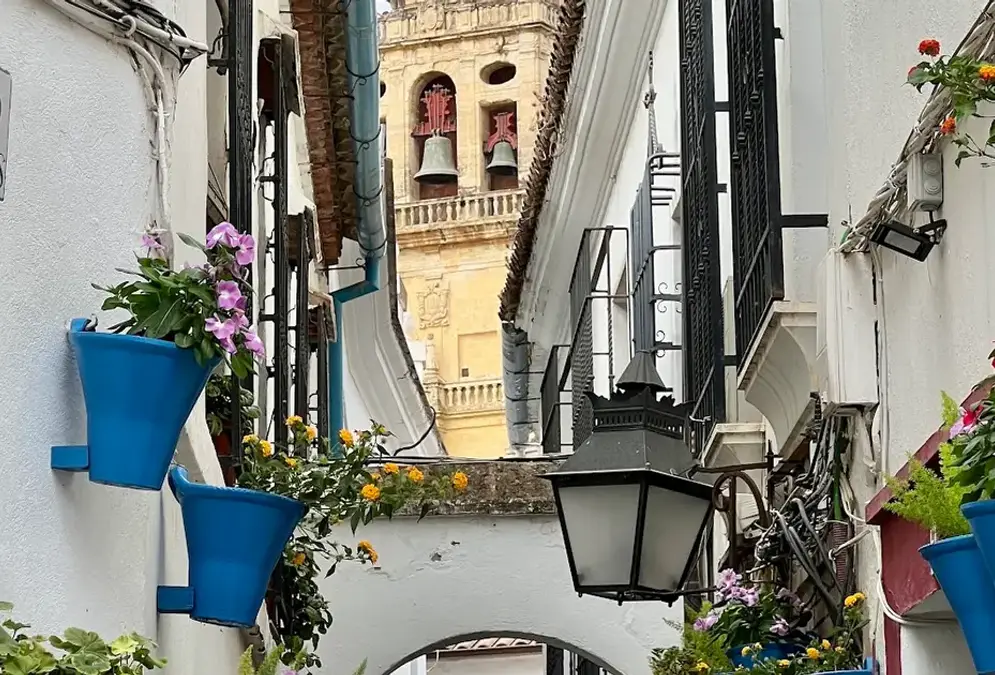
Calleja de las Flores
Whitewashed walls and red geraniums framing the Mezquita bell tower. Córdoba's most photographed alley in the Judería. Free, open 24 hours, best before 10am.
If narrowness is the test, the Pañuelo wins on evidence. If you want the story, the Arquillos. Bring anyone who wants flowerpots to the Calleja de las Flores, and expect company.
A short Judería route for lane-hunters
Three stops cover the lanes above, in an order that follows the logic of the quarter rather than a stopwatch.
- Calle Cabezas: look through the Arquillos gates, then note the Casa de las Cabezas, about 100 metres from the Mezquita[3].
- Calleja del Pañuelo: enter from the Plaza de la Concha and follow it to the end, where a tiny square holds a small fountain and an orange tree[15].
- Calleja de las Flores: a fountain on one side of its square and a view of the Mosque-Cathedral bell-tower[16]. Its arches were built in the remodelling[17], and one blog advises early morning or evening to avoid the crowds[18].
Before you detour for the house: the announced plan, from January 2026, is that new owners Hoteles Casa 1800 will reopen it as a luxury hotel in early 2027[19]. Either way, plan on seeing the outside.
Deep dive · Article
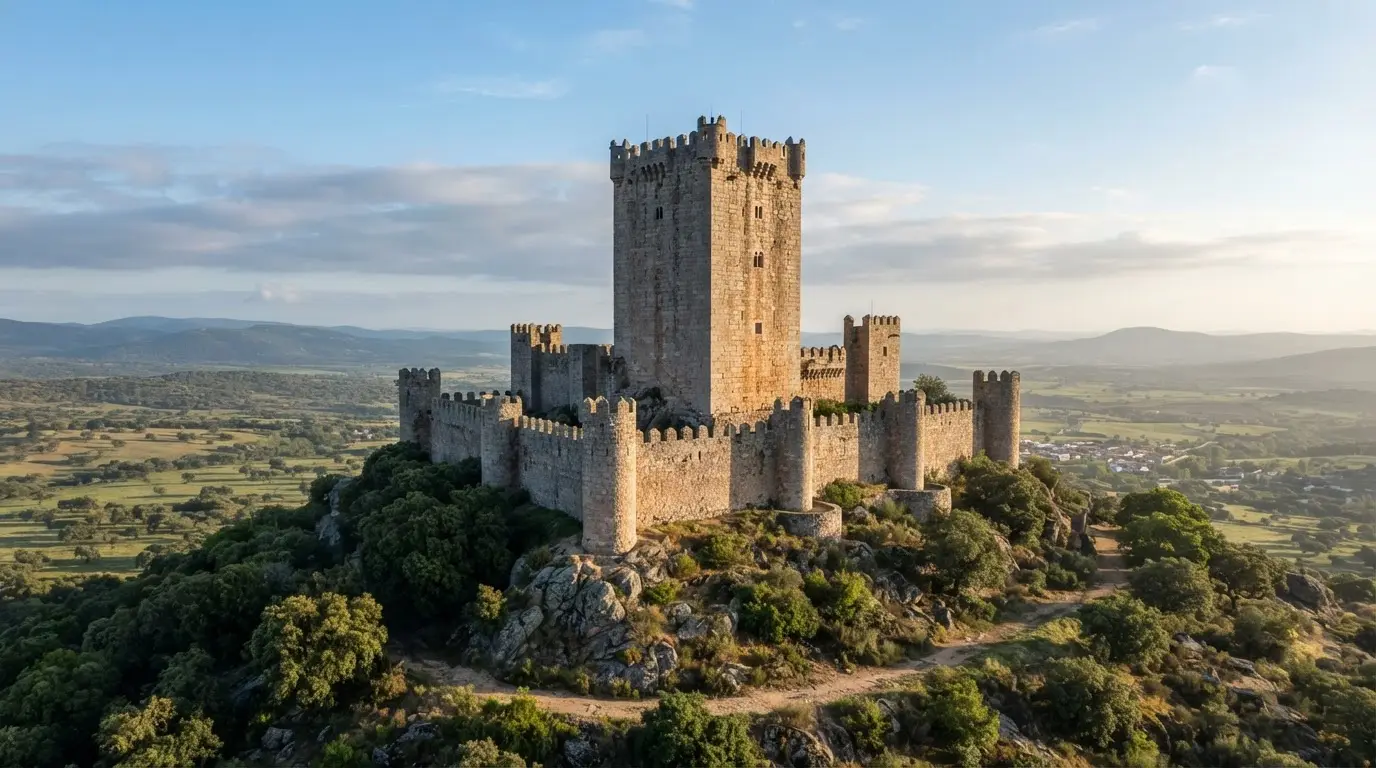
47 Metres Tall and Almost Unknown: Spain's Tallest Keep
Belalcázar Castle's 47 m keep is listed by the Junta de Andalucía as Spain's tallest. How it grew, what to see inside and how to book the free guided visit.
Many of the walls you pass here hide patios, and the best neighbourhoods in Córdoba guide shows where else to wander.