
A Bone in a Hospital Trench
Archaeologists excavated the trench on the southern slope of the Colina de los Quemados in March 2020, during work to expand Córdoba's Provincial Hospital. The same hillside saw a separate 2025 magnetic-prospection survey turn up unrecorded Iron Age wall foundations, covered in our report on Córdoba's pre-Roman walls. Hospital expansions and Córdoba's Roman-era past keep colliding this way; the city's Roman houses beneath Colonia Patricia turned up during equally unplanned construction work. By the layer this 2020 dig reached, the story had moved on by a few centuries, from a walled Turdetani settlement to whatever left an elephant's bone and a stack of catapult ammunition in the ground.
Buried in that same layer was more than the bone:
- Up to twelve stone spheres, roughly 11 cm across and weighing 1.4 kg each, of different rock types — standard ammunition for a torsion catapult[2]
- A heavy arrowhead typical of a scorpio, a siege crossbow
- A Carthaginian quadrans coin of the "Helmet" type, minted at Cartagena between 237 and 206 BC[6]
None of it reads as accidental loss. It reads as the debris of a fight.
Identifying a Bone With No DNA Left
The bone itself is unglamorous: a 10-cm, cube-shaped carpal bone, badly degraded, identified as coming from an elephant's forefoot.[5] There was no skeleton to compare it against, no tusk, no skull; just the one bone, matched by holding it against modern elephant and mammoth specimens until the shape fit.
Poor preservation ruled out an easier answer. Collagen, the protein that lets researchers run ancient DNA or paleoproteomic tests and settle a species question outright, hadn't survived.[7] What was left was bioapatite, bone's mineral fraction, which still carries a radiocarbon signal even once the organic material is gone. Dated that way, the bone came back to the late 4th to early 3rd century BC (consistent with, though not proof of, the Second Punic War).[3]
Explore nearby · Museum
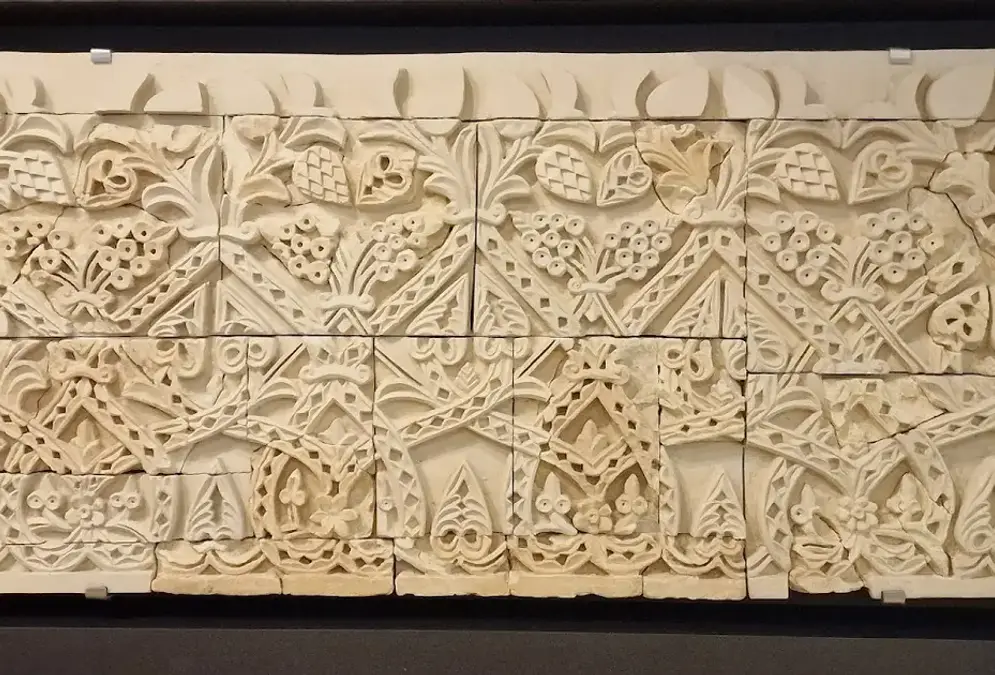
Museo Arqueológico de Córdoba
33,500 pieces in a Renaissance palace built over a Roman theatre: mosaics, Iberian sculpture, Caliphal ceramics. Free for EU citizens. Closed Mondays.
What the Study Rules Out
The paper's own language stays cautious. Its authors write that the bone "may constitute one of the few examples of direct evidence" for the use of war elephants in Classical Antiquity.[8] That's a hedge, not a headline. Before settling on a Second Punic War connection, they weighed six possible historical scenarios, ranging from Hamilcar Barca's invasion of Iberia in 237 BC to a much later use of elephants in Roman spectacles.[9] The radiocarbon date, the artillery stones, and the coin together made a direct link to the war "the most plausible option" they considered.[10] The paper does not call it proven.
One scenario the authors explicitly reject is the one most likely to make headlines. Classical sources say Hannibal drove 37 elephants out of Iberia toward the Alps in 218 BC, at the outset of his march on Italy.[11] This bone is not one of them: the study states plainly that it "would not represent one of the legendary specimens that Hannibal led across the Alps."[4] If it belongs to a documented herd at all, the more plausible candidate is one of the roughly 21 elephants classical sources say Hannibal left behind in Iberia when he marched east.[12]
Why Carthage Kept Elephants in Iberia at All
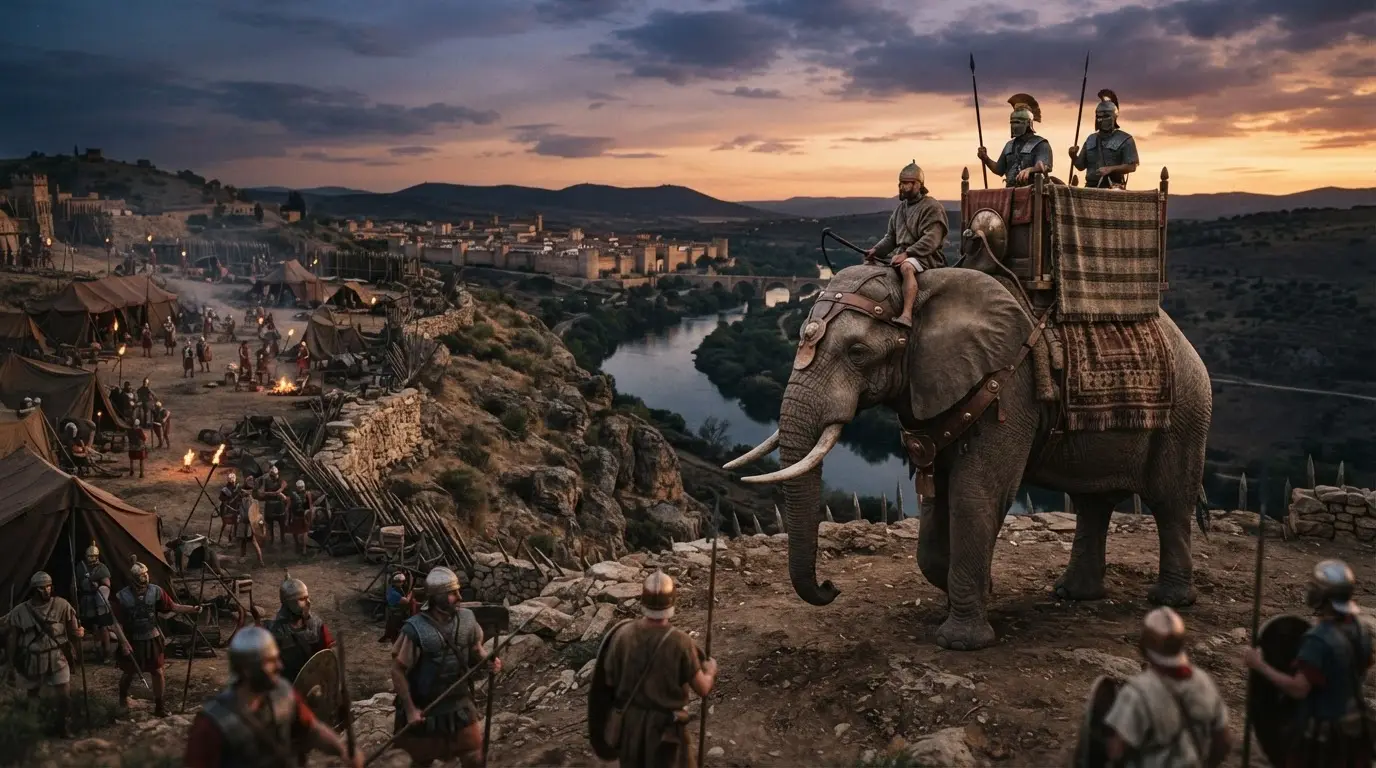
Elephants were already a fixture of Carthage's army in Iberia well before this bone was buried. Classical historians Polybius and Livy report that the generals Hamilcar Barca, Hasdrubal, and Hannibal together kept somewhere between 100 and 200 elephants stationed on the peninsula at the start of the Second Punic War.[13] They weren't decorative. Study co-author Fernando Quesada-Sanz, an archaeologist at the Autonomous University of Madrid, calls them "prestige weapons but also psychological weapons": animals meant to unsettle soldiers who had never faced one in the field.[14]
“Battle elephants at this time were prestige weapons but also psychological weapons.”
Colina de los Quemados isn't an isolated data point, either. A comparable destruction layer, with artillery stones in the same size range, has turned up at several other Iberian sites attacked or besieged during the same war: Kissa near Tarragona, Akra Leuke near Alicante, Castillo de Doña Blanca in Cádiz, Iliturgi in Jaén, and the oppidum of Puente Tablas, also in Jaén.[15] Seen against that pattern, a Carthaginian elephant losing a bone at a fortified hilltop above the Guadalquivir looks less like an anomaly and more like one entry in a documented campaign. Little of that moment survives above ground today; Córdoba's standing Roman monuments, like the Roman Temple, belong to the empire's later and more settled centuries.
An Open Question
None of the hedging makes the find inconsequential. Study co-author Fernando Quesada-Sanz said this is "the first time, as far as we know, that the actual remains of one of the elephants in the Carthaginian army has been found in European soil."[16] Lead researcher Rafael Martínez Sánchez, of the University of Córdoba, told Live Science the bone "could prove to be a landmark"[17] and that, until now, "there has been no direct archaeological testimony for the use of these animals."[18] Outside the research team, Cardiff University historian Eve MacDonald, author of Carthage: A New History and not involved in the study, called the discovery significant because it "finally provides physical evidence for the long-held belief that the Carthaginians introduced elephants to the Iberian Peninsula during the third century BC."[19] That's corroboration of a historical assumption going back two millennia. It is not confirmation of Hannibal's own herd.
What the bone can't yet answer is which elephant, whose army, or exactly which campaign it belonged to. Without collagen, the DNA testing that could pin the species (African or Asian, the two types Carthage used for different roles) stays out of reach unless a better-preserved specimen turns up elsewhere. Two centuries later, the settlement the Romans would call Corduba faced a far better documented war, when Caesar's forces besieged the city during the civil war that followed Pompey's defeat. For now, this Second Punic War moment stays a single badly weathered exhibit and six competing explanations, one of which its own researchers rate as the most likely.
Deep dive · Article
47 Metres Tall and Almost Unknown: Spain's Tallest Keep
Belalcázar Castle's 47 m keep is listed by the Junta de Andalucía as Spain's tallest. How it grew, what to see inside and how to book the free guided visit.
Recommended tours
Tours are selected for quality, not commission. We earn a small fee if you book — at no extra cost to you.