
What tiraz actually meant
The word tiraz comes from the Persian darz, meaning embroidery[1], a detail worth pausing on because it places the institution's origin outside al-Andalus entirely. In its narrow sense, tiraz is an inscribed band of Arabic calligraphy, usually the ruling caliph's name and titles, woven or embroidered onto a garment's sleeve. In its wider sense, historians use the word for the whole category of medieval Islamic embroidered textiles: armbands sewn onto khil'a (robes of honor), presented to loyal officials and given as diplomatic gifts[2].
The same word also names the factories that produced them: dar al-tiraz, workshops operating under direct state control[3]. That structure was not a Córdoban invention. The earliest datable tiraz-band textile survives from the Umayyad caliphate based in Damascus, generally ascribed to the caliph Marwan II[4], which means tiraz arrived in al-Andalus as an inherited institution, already a century old, when the last Umayyad prince fled west after the Abbasid revolution.
Every tiraz workshop in the Islamic world, Córdoba's included, split into two tiers. The khassa factories were caliphal property, exclusive and private, weaving for the ruling family alone. The 'amma factories were public, producing tiraz for commercial sale[5]. The distinction separated a political instrument, a robe bearing the caliph's own name, from an export commodity, and it is the second category that eventually made Córdoba's reputation across the Mediterranean.
Abd al-Rahman II founds a royal workshop
Córdoba's first tiraz workshop is traditionally credited to Abd al-Rahman II, the fourth Umayyad emir, who ruled the emirate from 821/822 to 852[6]. The Umayyad rulers of Córdoba built their own dar al-tiraz on the same state-supervised model used in the east: a royal facility producing fabrics under the direct control of the court, not a guild or a merchant house[7].
The timing fits the rest of Abd al-Rahman II's reign. He was, above all, a builder: his thirty years in power are documented mainly through what he added to the city, and his best-known project was expanding the Mezquita-Catedral, the mosque his great-grandfather had founded, doubling its prayer hall southward[8]. A ruler funding a textile workshop and a mosque extension in the same reign was doing the same kind of thing twice: building institutions that made Córdoba function like a capital rather than a provincial emirate. The same emir also organized the city's response to a Viking raid up the Guadalquivir in 844, a crisis covered in full in the article on Abd al-Rahman II and the Albolafia waterwheel.
Explore nearby · Monument
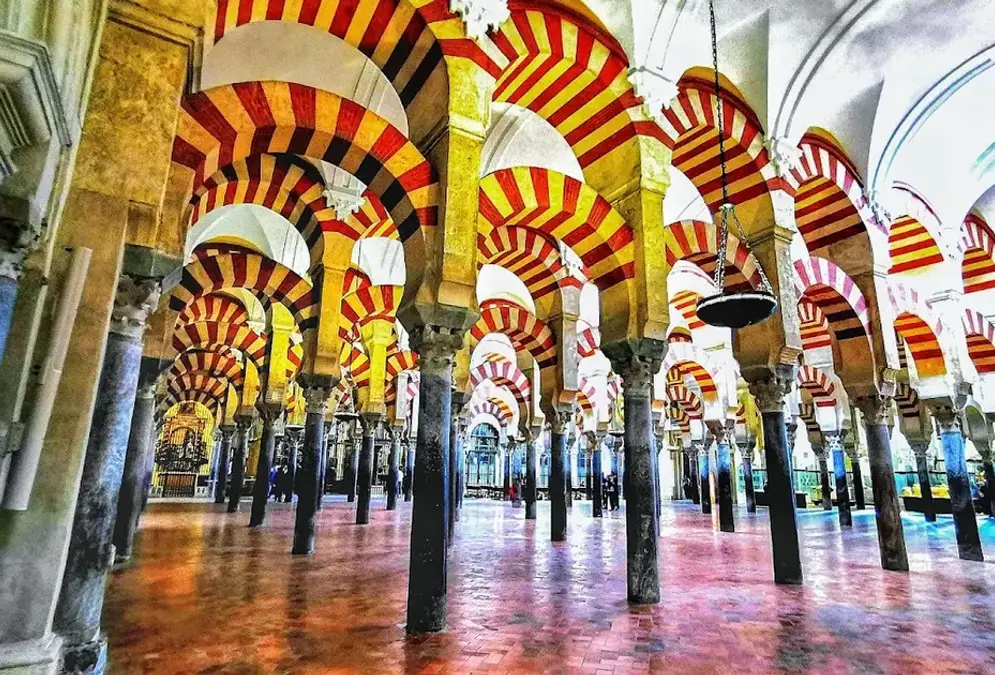
Mezquita-Catedral de Córdoba
856 columns, 1,300 years of Islamic and Christian history. UNESCO monument in Córdoba, Andalusia. Red-and-white arches, Byzantine mosaics, a Renaissance nave.
Robes of power: tiraz as political theater
A tiraz robe bearing the caliph's name was not a fashion statement. It functioned the way a coin stamped with the ruler's name functioned, the sikka parallel medieval sources make explicitly: a public declaration of political loyalty, circulated the way currency circulates, to establish whose authority a person answered to[9]. Wearing one in public, at court or in a provincial governor's hall, told everyone present exactly that.
The formal occasion for handing over such a garment was the khil'a ceremony, a robe-of-honor ritual historians trace as far back as the time of Muhammad[10]. A caliph or emir would present a khil'a to a loyal official, a military commander, or a favored courtier, sometimes as reward for service, sometimes as a pointed reminder of where that person's loyalty was expected to remain. Córdoba's tiraz workshops existed, in large part, to keep a steady supply of these garments moving through the court.
A tiraz robe bearing the caliph's name was not a fashion statement.
Tiraz also traveled abroad. Andalusi rulers are recorded sending tiraz textiles as diplomatic gifts to sovereigns in North Africa[11], and silk more broadly was routinely presented to foreign delegations visiting the caliphal court[12]. A robe of honor said one thing to a subject and something slightly different to a foreign ambassador: this is what Córdoba can produce, and this is the craftsmanship backing the Umayyad claim to legitimacy against the rival court in Baghdad.
Sourcing the silk: sericulture, looms, and the alcaicería
None of this worked without raw material, and Córdoba's supply chain for silk was itself a state-scale operation. Sericulture, the cultivation of silkworms and mulberry trees, reached the Iberian Peninsula in the 8th century, introduced by settlers from Mesopotamia known as the Qaysis, who established mulberry farms called alquerías across the Andalusian countryside[13]. Silk did not have to travel from the eastern Mediterranean; by the Caliphal period, Córdoba's own hinterland was growing it.
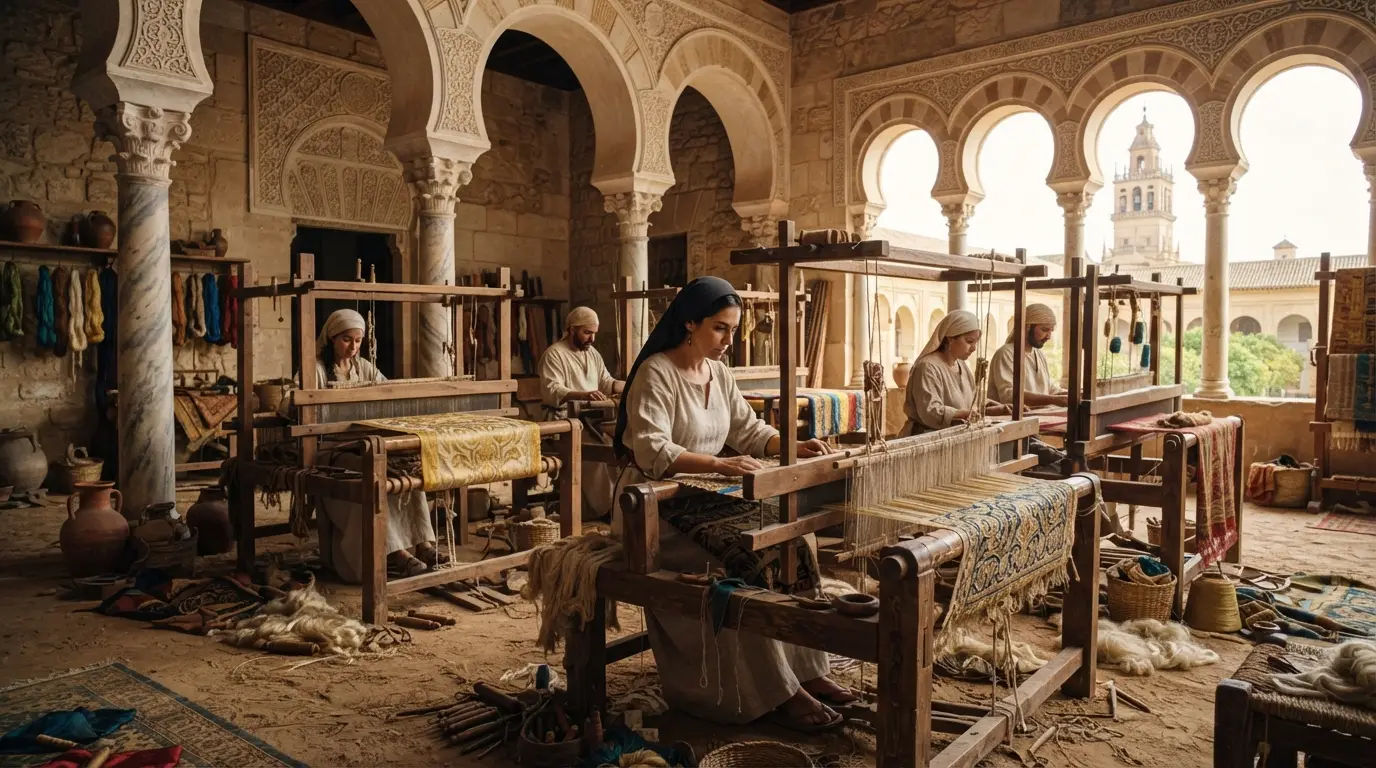
Weaving that raw silk at scale required equipment the Roman and Byzantine world had not developed. Andalusi weavers built a horizontal loom capable of producing high-quality silk in what one historian calls industrial quantities[14], a genuine technical advance rather than simply more workshop floor space. Quality control ran through dedicated infrastructure: raw silk was stored in alhóndigas (warehouses) before being sold wholesale in the alcaicerías, the silk exchanges that regulated who could buy and at what grade[15].
~13,000 looms
The state also taxed its way into the supply chain. The Mozarabic bishop Recemundo, writing in 961 in his Calendar of Córdoba, documented that silk and other materials were collected as tax to directly fund the tiraz workshops[16], textile production organized as multiple state-controlled units financed through taxation and run by appointed officials[17], not a free market the crown merely regulated from a distance.
Scale, splendor, and what survives
By the reign of al-Hakam II in the mid-10th century, Córdoba's population had grown past 500,000, large enough that the caliph enlarged the Great Mosque again to serve the city it now was[19]. A city that size did not run one workshop: the palace-city of Medina Azahara, built on Córdoba's outskirts, housed its own workshops producing luxury goods for the court, including silken robes alongside carved ivory boxes and fine ceramics[20]. Silk production was never confined to a single royal building; it was distributed across a metropolitan region built to supply a caliphal court.
The reputation this scale earned was specific and comparative. By the tenth century, Andalusi silk was regarded across the Mediterranean as better in quality than the silk coming out of Iraq and Egypt[21], a claim worth taking seriously precisely because Iraq and Egypt were the established benchmarks, not marginal competitors. Two surviving pieces make that claim concrete rather than rhetorical. A tiraz of Caliph Abd al-Rahman III, woven in Córdoba in 941–42, survived inside the reliquary of Santa Librada at Sigüenza Cathedral and is now held by the Cleveland Museum of Art[22]. A silk-and-linen turban commissioned by Caliph Hisham II, embroidered with gold and silver thread across three inscribed bands and produced in Córdoba's royal tiraz, is held at the Real Academia de la Historia in Madrid[23].
Neither object stayed in Córdoba, which is itself telling: caliphal-era luxury textiles were made to move, as gifts, as tribute, as the surviving property of a dynasty that outlasted the workshops that had produced them. What remains in Córdoba today is the craft economy those workshops fed into for centuries afterward, including the silver filigree trade that grew out of the same Caliphal court patronage and is still worked in the same streets the tiraz weavers once supplied.
Why the industry moved to Almería
Production quality never disappeared after the Caliphate's collapse in 1031; the geography of the industry did. As the caliphate fragmented into competing taifa kingdoms, Córdoba lost the centralized court that had financed and organized its tiraz workshops for two centuries. Almería, on the Mediterranean coast, took over as al-Andalus's dominant silk city. Historical accounts put roughly 800 tiraz production units in Almería by the mid-12th century, exporting silk across the Mediterranean to Italian merchants, northern European courts, and Christian church treasuries[24].
Tiraz as an institution kept fading everywhere. By the 13th century, production was in general decline: as Islamic political power weakened across the peninsula, nobles began selling their own tiraz garments on the open market as investment pieces rather than treating them as untouchable symbols of loyalty. Production continued in reduced form into the 14th century, but the political theater that had justified a state monopoly on the craft was gone[25].
Even at its height, the system had fraud built into it. The muhtasib, Córdoba's market police, had a specific and recurring scam to police: weavers illegitimately changing the inscription on a robe at the fuller's, swapping one caliph's name for another or a lower-quality band for a higher one[26]. Embroidered bands, unlike woven ones, were made separately and sewn onto the finished garment, which meant they could be removed or substituted whenever a robe went to be washed[27]. Andalusi tiraz, in fact, was generally associated more with woven patterns than embroidered ones[28], which may have made outright substitution harder to pull off at scale, though evidently not impossible.
Deep dive · Article
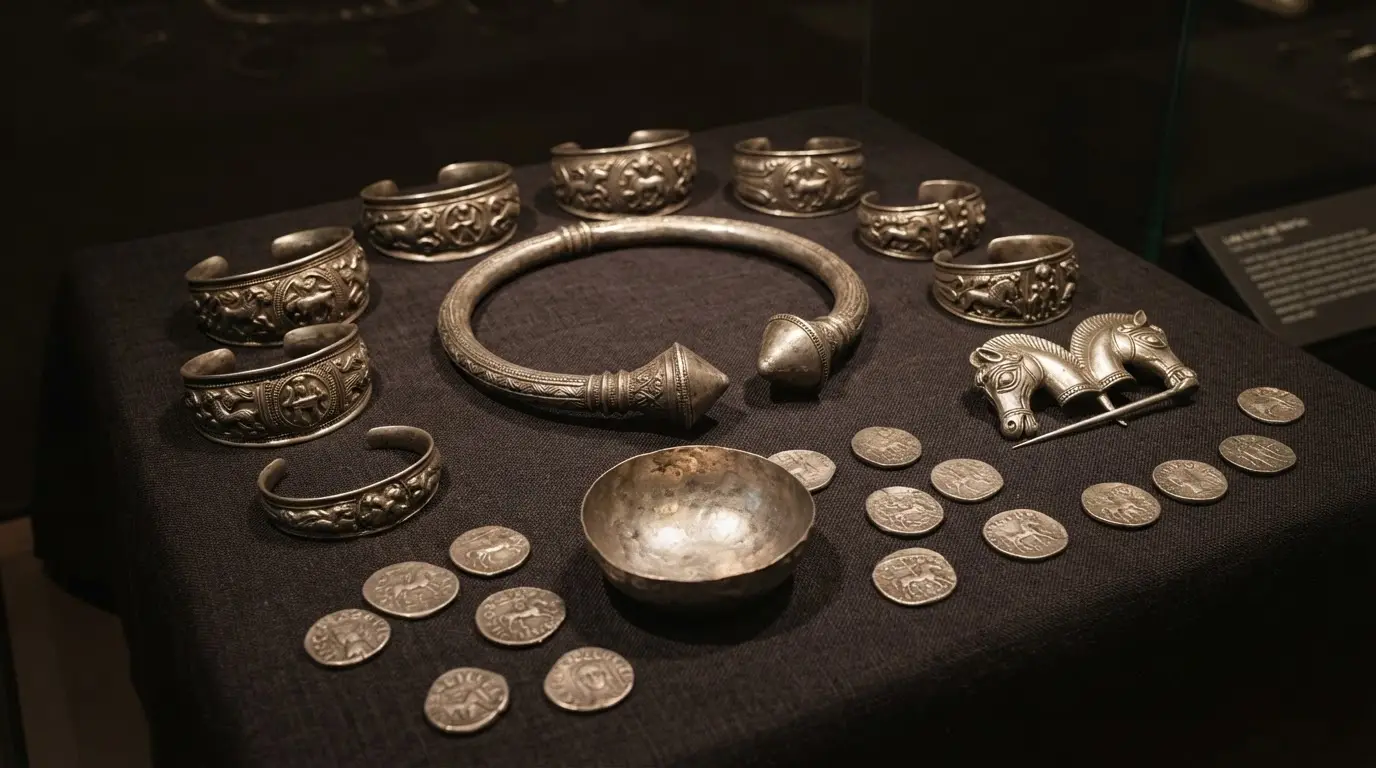
An Andalusian Treasure Has Sat in the British Museum Since 1932
A silver hoard dug up in Córdoba in 1915 left Spain against the law and has been in the British Museum since 1932. Here is how, and what a 2026 study found.
What is left of that economy in Córdoba today is not silk. The luxury-craft infrastructure the Caliphate built, state workshops, quality control, an export market built on royal prestige, outlived the specific commodity. Walk through the Judería, and the crafts still produced there, silver filigree and embossed, gilded guadamecí leather, are direct descendants of the same civic habit: turning a caliph's demand for luxury goods into an export trade that survives the dynasty that started it. The guide to Córdoba's caliphal crafts follows that same lineage across leather, silver and ivory.
Recommended tours
Tours are selected for quality, not commission. We earn a small fee if you book — at no extra cost to you.