
Origins in the Caliphal city
The name itself is an etymology lesson. Guadamecí derives from Gadamés, a North African city in what is now Libya that had long specialised in decorated leather[1]. The word entered Arabic, passed through Andalusian Arabic as ghadāmasī, and eventually settled in Spanish. By the time Córdoba's craftsmen adopted and refined the technique, the city was producing something the source city would barely have recognised.
The earliest documented use of guadamecí places it at Medina Azahara, the Caliphal palace city Abd al-Rahman III began building in 936 west of Córdoba[2]. The Umayyad Caliphate at its height supported hundreds of craft workshops, and the palace complex created demand for materials that could cover walls and floors with an appropriately imperial effect. Gilded leather panels, worked with the same botanical and geometric vocabulary (ataurique) that ran through the plasterwork and carved stone, fit that brief exactly.
By the late 10th century, workshops in the Judería and surrounding streets were producing guadamecí for export. The craft spread from Córdoba to other Andalusian cities, but the city's reputation was specific enough that buyers across the Mediterranean associated the technique with its origin. An equivalent today might be the way Champagne names a process developed in a particular place.
The Caliphate's collapse in the early 11th century disrupted but did not stop production. Under the Taifa kingdoms and then the Almohad and Nasrid periods, Córdoba retained enough of its artisanal infrastructure that guadamecí continued. What the Caliphate had created as a palace luxury, subsequent centuries turned into a trade commodity.
How guadamecí is actually made
The process is slow enough that contemporary practitioners describe it in stages that can span days. Understanding it matters not just for appreciating the craft but for distinguishing authentic pieces from machine-embossed imitations.
The skin is the foundation, and the choice is deliberate. Guadamecí uses vegetalmente curtido (vegetable-tanned) sheepskin — high-quality lamb or goat hide processed with oak bark or other organic tannins rather than the faster chemical methods that replaced them in the 19th century[3]. Vegetable tanning produces a stiffer, denser skin that accepts tooling cleanly and ages to a warm amber colour. It also takes months rather than days, which is part of why it was among the first steps the industrial revolution eliminated.
Once the skin is prepared and stretched, a thin film of silver (historically tin, sometimes vermillion) is applied to the surface. This metallic layer is what gives guadamecí its characteristic cold luminosity under paint and gilding. It also serves as the ground on which subsequent layers build, a reflective substrate that makes colours glow rather than sit flat.
Embossing comes next. The artisan uses iron stamps (brocadores) and punches to press patterns into the still-damp leather. These patterns follow the established visual vocabulary of Córdoban Islamic art: ataurique (botanical scrollwork), geometric interlace, heraldic devices in later Christian-period pieces. Estampado (stamping) is not a fast operation. A single panel of 60 by 80 centimetres might require hundreds of individual impressions to cover the surface completely[3].
With the embossed structure in place, mordientes (mordants and dyes) go on. These fix the base tones to the leather, preparing the surface for the final layers of policromo (polychrome) painting. The painter works with fine brushes, filling the embossed relief with colours that follow the raised contours — red, blue, ochre, green, black. The palette in Caliphal-period pieces is close to the painted plasterwork at Medina Azahara.
Gilding is last. Gold leaf is applied over the painted surface using mordants to fix it in specific areas, typically the raised ridges of the embossed pattern. The result is piel tintada that shines under light at angles, the flat-painted areas providing contrast to the gilded relief. A finished panel, properly lit, looks somewhere between a painting and a metalwork screen.
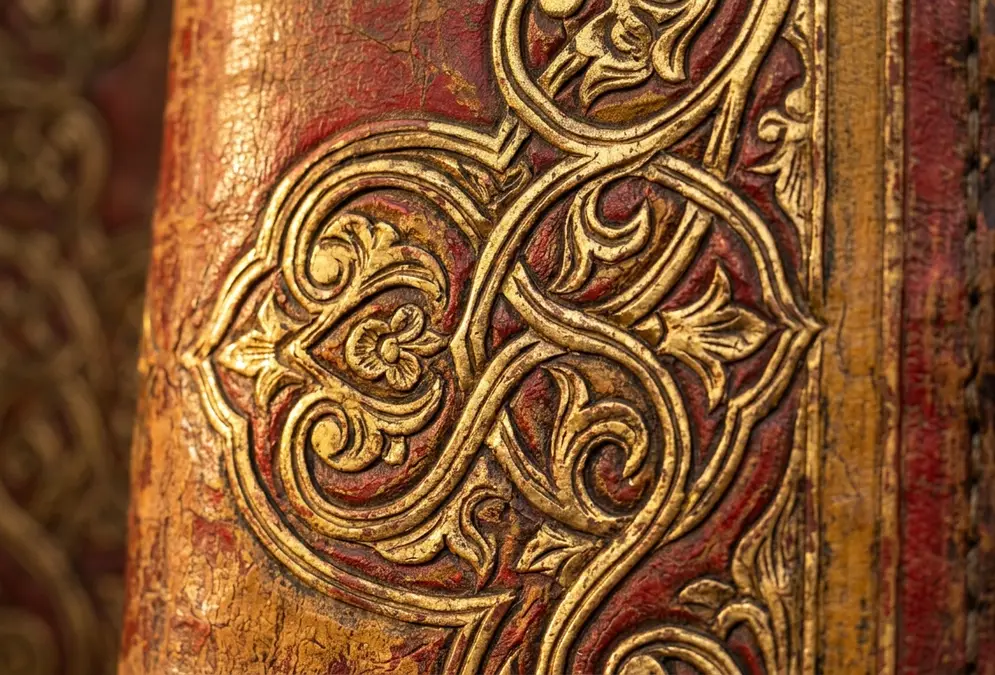
A contemporary guadamecí panel from the Casa Museo Guadamecí showing the layered process: vegetable-tanned sheepskin, silver ground, iron-stamped ataurique relief, and polychrome painting beneath gold leaf.
The golden age: palaces, diplomacy, and European courts
The 16th century was when guadamecí's reach became spectacular. Cordobanes (Córdoba's plain embossed leather, the simpler sibling of guadamecí) had already established Andalusian leather as the European standard for bookbindings, saddles, and upholstery. Guadamecí, as the gilded, painted variant, moved into the luxury tier of that trade.
French palaces of the period featured dancehalls lined with brightly shining polychrome gilt-leather panels imported from Andalucía[4]. The appeal was partly practical: leather panels were warmer than stone walls, easier to hang than tapestries, and more durable than painted plaster in rooms that had fires and people. They were also legible as luxury: the gilding caught torchlight in ways that communicated expense without ambiguity.
But the most historically specific use was diplomatic. Guadamecí served as lavish royal gifts that astonished ambassadors from East and West[4]. The Spanish crown, working from Córdoba and later from other Andalusian production centres, used guadamecí panels as presentation pieces for foreign embassies. An ambassador arriving in Madrid or Seville who received a gilded leather panel depicting the royal arms was receiving an object that announced both the quality of Spanish craftsmanship and the wealth of the court that could produce it.

Explore nearby · Museum
Casa-Museo del Guadamecí Omeya
The world's only museum dedicated to guadamecí — Umayyad gilt-embossed leather from 10th-century Córdoba. Free entry, five rooms, steps from the Mezquita.
The trade routes ran:
- Córdoba workshops to Seville and the port of Cádiz
- From Cádiz to Antwerp, which was then the commercial centre of northern Europe
- From Antwerp to the French, Dutch, and English courts
- Simultaneously, overland to the Italian peninsula and north through the Pyrenees
Flanders became particularly associated with the craft, to the point that the French word for gilded leather, cuir de Flandres, reflected the intermediary role Belgian merchants played. English documentation from the 16th and 17th centuries uses the term gilt leather but the panels themselves, when surviving examples are traced, typically originate in Spain or are copies of Spanish originals.
For the history of Córdoba, the guadamecí trade sits alongside silk, oil, and ceramics as evidence of the city's continued economic importance even after the Caliphal peak. The craft was a 16th-century export industry grounded in a 10th-century innovation.
Industrial collapse and near-extinction
The 19th century ended the guadamecí trade methodically. The cause was not a single event but a convergence of economic pressures that made artisanal production uncompetitive at every point in the chain.
Synthetic gilding arrived first. The chemical and metallurgical advances of the early industrial period produced cheaper substitutes for gold leaf and tin silver at a fraction of the cost. Machine-made metallic foils could be applied mechanically to embossed leather without the mordant preparation that hand-gilding required. The resulting product looked similar at a distance and cost a fraction of the original.
Chemical tanning eliminated the months that vegetable tanning required. Chromium sulphate tanning, developed in the 1850s, could convert a hide to finished leather in a day or two. The resulting leather was softer, more uniform, and far cheaper. It was also unsuitable for the deep embossing that guadamecí required — too supple, with none of the rigidity that oak-bark tanning built into the fibre structure. But it captured the bulk of the market that had previously depended on vegetable-tanned goods.
Machine embossing replaced hand-stamping for decorative leather goods by the mid-19th century. Roller presses could apply repeating patterns to continuous sheets of leather at speeds that rendered individual brocador work economically absurd. The quality was lower; the consistency was perfect; and for manufacturers selling to middle-class buyers rather than royal courts, consistency won.
The craft nearly disappeared for centuries as factory-produced alternatives displaced artisanal work[5]. What remained in Córdoba by the early 20th century was a handful of leather workshops producing cordobanes (the simpler embossed variant) and occasional decorative pieces for the tourist trade. The knowledge of how to apply the silver ground, layer the mordantes, stamp the ataurique reliefs, and gild correctly was not documented. It was held by individual craftsmen who died without formal apprentices, and when they died, it went with them.
By the mid-20th century, guadamecí in its authentic form did not exist as a living craft. What museums held were 16th and 17th-century examples, studied but not reproducible.
Two men who rebuilt the craft
Ramón García Romero was a travelling artist and scholar who spent decades in archival research trying to reconstruct what had been lost[6]. His approach was methodical: he worked through historical documentation, correspondence, trade records, and the material evidence of surviving panels in museum collections. The chemistry of vegetable tanning, the composition of historic mordants, the sequence of operations that produced the layered effect — none of this was written down in a single source. He assembled it from fragments.
The reconstruction was not an attempt to produce something that resembled old guadamecí. It was an attempt to reproduce the Caliphal techniques precisely: the same materials, the same sequence, the same visual vocabulary. García Romero treated the historical record as a specification rather than an inspiration. This is a significant distinction. Many craft revivals produce objects that evoke their source; García Romero wanted objects that were their source, produced by the same process, from the same materials.
His work succeeded to the degree that his revived technique was documented and transmissible, which earlier guadamecí knowledge had not been. His student José Carlos Villarejo García inherited the full process[7].
Villarejo founded the Casa Museo Guadamecí in 2006 as both a working studio and a museum[7]. The combination matters: a museum without a studio would be an archive; a studio without a museum would be a craft shop. Together, they make the process visible in a way that neither can alone. Visitors can see completed works from García Romero's period, early works from Villarejo's, and in the studio section, the process at various stages of completion.
Famous works in the collection include 'The Tree of Life', directly inspired by the carved plasterwork at Medina Azahara, and 'Poem to Córdoba'[8]. Both demonstrate the full visual vocabulary: botanical ataurique, geometric interlace, gilded relief against polychrome ground. They are the kind of objects that make the golden age European demand easy to understand. Looking at a finished panel in good light, the question is not why French courts wanted them. The question is how anyone decided to stop.
Seeing guadamecí today
The Casa Museo Guadamecí is the primary destination, located in the old city near the Judería[10]. The combination of studio and gallery means any visit includes both finished works and works in progress. Check opening times before visiting, as hours can vary for a specialist museum run by a working artisan. Villarejo accepts commissions for contemporary guadamecí work; prices for original pieces reflect the labour involved.
The Judería itself is the historical centre of Córdoba's craft workshops, and several shops in the quarter sell leather goods. Quality varies. The neighbourhood's streets between the mosque and the synagogue have always mixed serious craft production with tourist goods, and the contemporary version is no different. Looking for the authentic article requires knowing what to check.
How to identify real guadamecí:
- The embossed relief should be sharp and irregular — machine-embossed leather has perfectly consistent depth and spacing; hand-stamped work has slight variations that come from individual strikes of the brocador
- The gold should be gold leaf, not metallic paint; genuine gilding has a different surface quality under raking light, with slight irregularities at the edges of each application
- Vegetable-tanned leather has a characteristic amber warmth and rigidity that chromed leather lacks; flex the panel slightly and chromed leather will bend easily, vegetable-tanned will resist
- The back of the piece tells its own story: hand-worked guadamecí shows the pressure marks of stamping on the reverse; machine-pressed pieces are flat on both sides
- Ask about the tanning process — any serious maker of traditional guadamecí will know and be willing to discuss the vegetable tanning in detail
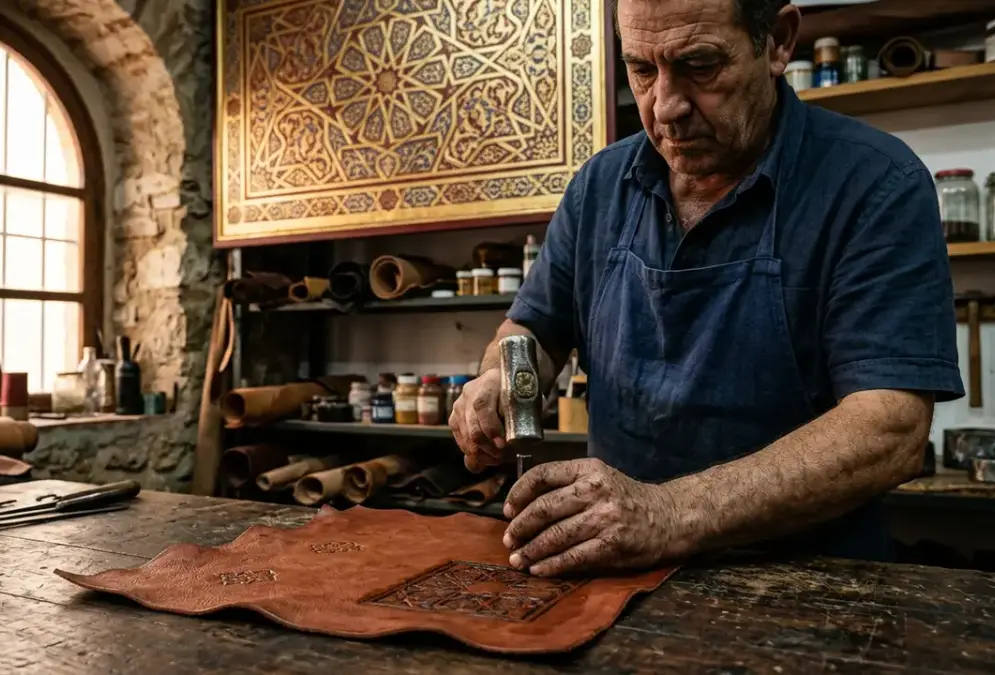
Deep dive · Article
Cordobán Leather: The Craft That Named the English Cordwainer
Córdoba gave English its word for shoemaker. How medieval goatskin tanned with sumac became Europe's finest leather and named a London guild still active today.
The Zoco Municipal de Artesanía on Calle Judíos, in the heart of the Judería, is the city's main artisan collective. Several leather workers sell there, though guadamecí in the strict sense (silver ground, iron-stamped, polychrome-painted, gilded) is rare even here. For the real article, the Casa Museo is the reliable source.
The shopping and crafts guide covers the full craft landscape of the city, from esparto work to silversmithing. For travellers specifically interested in Córdoba's artistic heritage, the art lovers guide places guadamecí within the broader context of what the city produces and keeps.