
The Umayyad origin: Judería workshops and Caliphal patronage
Filigrana califal, the Córdoban term for the craft, took shape during the reign of the Umayyad Caliphate of Córdoba (929–1031), when Abd al-Rahman III declared himself Caliph and set about building a capital to match the claim. Medina Azahara[1], the palace city begun in 936 west of Córdoba, needed metalwork of a quality that would impress Byzantine and Abbasid ambassadors. The city's artisan workshops, concentrated in and around the Judería, supplied it.
The term filigree comes from the Latin filum (thread) and granum (grain), referring to the beaded wire technique that distinguishes the craft from plain silversmithing. In Córdoba, that technique was shaped by three overlapping craft traditions: Arab geometric precision, Jewish ornamental metalwork with roots in North African and Middle Eastern silversmithing, and Christian Visigothic goldsmithing that had never entirely disappeared from Andalusian workshops. The result was not a blended average but something specific to this place and this moment.
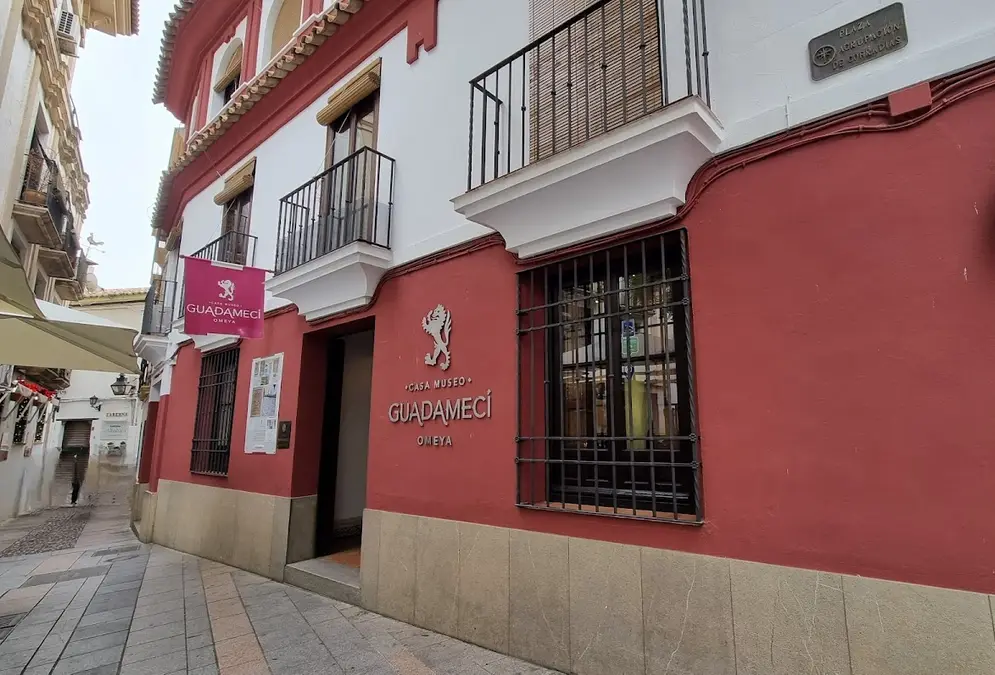
Explore nearby · Museum
Casa-Museo del Guadamecí Omeya
The world's only museum dedicated to guadamecí — Umayyad gilt-embossed leather from 10th-century Córdoba. Free entry, five rooms, steps from the Mezquita.
The 10th century was the golden age of Córdoban orfebrería. At its Caliphal peak, the city held around half a million inhabitants and supported hundreds of workshops producing luxury goods for export. Filigree jewellery, along with silk, leather, and ivory carvings, travelled north to the courts of León and Navarra, east to the Byzantine Empire, and south across the Sahara. The Caliph's treasury commissioned pieces in gold; a wider market in silver made the craft accessible to merchant families and senior officials.
The technique: wire, beeswax, and borax
A finished filigree pendant does not look laborious. The openwork spirals and arabesques suggest something light and spontaneous. The process behind them is neither.
The sequence begins with annealing: a silver rod is heated until soft, then drawn through progressively smaller holes in a steel plate to produce a fine wire. The wire is twisted on itself (two strands wound together), then rolled flat between steel plates to create the characteristic hilos de plata (silver threads) with their rope-like texture. This twisted-wire approach is the physical signature that separates genuine filigree from stamped or pressed imitation: run a fingernail along the surface and you feel the individual twists.
Once the wire is prepared, the artisan arranges it into the design motif on a beeswax-backed board. The wax holds the elements in position before soldering. Geometric patterns (lozenges, eight-pointed stars, arabesques derived from the same calado openwork vocabulary that runs through the stucco of the Mezquita) are assembled wire by wire. Some pieces require twenty or thirty separately formed elements before a single soldering step.
Soldering uses borax as flux, with fine silver powder mixed in to flow through the joints at temperature. The work must be done fast enough to fuse the joints but cool enough not to collapse the wire structure. Experienced silversmiths at Platería Califal describe this as the point where ten hours of preparation can be ruined in thirty seconds[2].
Enamel accents, where they appear, go on last: coloured glass powders applied to enclosed cells in the metalwork, then fired. The result, in a finished piece, is the combination of plata de ley (sterling silver at 925 parts per thousand) with small points of blue, green, or red that give Córdoban filigree its particular depth. A complex brooch or pendant takes twenty hours or more to complete from wire drawing to final polish.
20+ hours
The Atlantic crossing: Mompox, Colombia
The most unexpected chapter in the history of silver filigree Córdoba is what happened to the technique after 1492.
Spanish colonisation of the Americas operated partly through craft transmission. Master silversmiths trained in Andalusian workshops accompanied or followed the early expeditions, carrying their tools and their methods. The technique did not arrive in the Americas as a museum artefact but as a living practice, reproduced in the master-apprentice chain that was the only way craft knowledge moved in the pre-industrial world[3].
The town of Mompox (officially Santa Cruz de Mompox), founded in 1537 on an island in the Magdalena River in what is now Colombia, became the primary inheritor of the tradition[4]. The location was not accidental. Mompox sat on the main route from the Colombian interior to the Caribbean coast, and every shipment of gold heading for Spain passed through the town, which also housed a Royal Mint and served as the collection point for the gold tax. Spanish metalsmiths settled in Mompox precisely because the materials were there. The proximity to raw gold and silver, combined with the resident craftsmen's Andalusian training, produced a filigree tradition that was recognisably Cordovan in technique but increasingly distinct in motif.
Filigrana momposina developed its own design vocabulary over the following centuries: larger, more theatrical pieces than the compact Cordovan style, with sweeping curved forms suited to the tropical light and the social rituals of colonial society. The Momposino artisans working today[3] use wire-drawing, beeswax boards, and borax soldering in sequences that a 10th-century Córdoban silversmith would recognise without difficulty. Both towns still practice methods traceable to the Umayyad workshops.
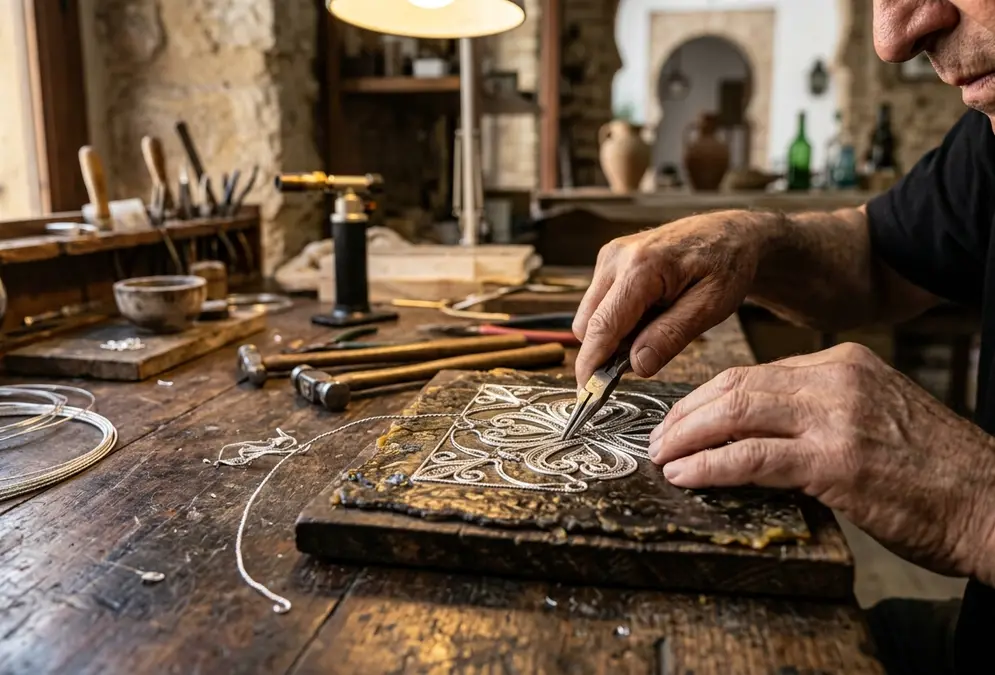
Wire elements arranged on a beeswax board at Platería Califal before soldering. The twisted double-strand wire is the physical marker of genuine filigree; stamped imitations have a smooth, uniform surface.
Mompox was declared a UNESCO World Heritage City in 1995[4], in part because its colonial architecture and craft traditions had survived the 19th and 20th centuries with less disruption than most comparable towns. The filigree connection to Córdoba is one reason the nomination made sense: Mompox preserves something the Spanish city very nearly lost.
Near-extinction: industrialisation and the family workshops
By the late 18th century, Córdoba's filigree production had already contracted from a major export industry to a craft serving local demand and a small tourist market. The 19th century made things worse in ways the craft never fully recovered from.
Factory-produced jewellery arrived from Catalonia and France using machine-stamped silver components that could be assembled at a fraction of the cost of hand-worked filigree. The visual result was different (no twisted wire, no handmade variation) but in ways that required either expertise or close inspection to detect. For buyers who lacked both, cheaper was more compelling.
Chemical tanning and synthetic gilding, which industrialised the leather trade at the same period, had an analogous effect on metalwork. The craft history is parallel to that of guadamecí leather, which collapsed for the same reasons at the same time. Factory goods undercut handmade at every price point, and the handful of family workshops in the Judería that continued the tradition did so because they had no alternative skill and a residual local clientele, not because the economics were favourable[1].
What the 19th century consumed was not just production volume but procedural knowledge. Filigree is a craft transmitted hand to hand through the master-apprentice relationship, not preserved in any written specification[1]. When a master died without an apprentice who had worked through the complete sequence of operations, that particular version of the knowledge was gone. By the early 20th century, only a few Judería families had maintained an unbroken transmission of the full technique.
The sociological map of survival is worth noting. The Jewish silversmiths who had been central to the original Caliphal synthesis were expelled from Spain in 1492, four centuries before industrialisation finished what the expulsion had started. The workshops that lasted into the 20th century were concentrated in streets adjacent to the old Jewish quarter, maintaining the geographic pattern of the original craft community while carrying a Spanish-Christian version of a three-culture tradition.
Revival and where to find it today
The late 20th century brought renewed institutional interest in Córdoba's craft heritage, driven partly by tourism and partly by Andalusian cultural politics that placed artisan production at the centre of regional identity.
In 2014, the Andalusian Regional Government designated Córdoba's old town as an Area of Craft Interest, a classification that carries access to regional funding, promotional infrastructure, and quality requirements for participating workshops. The designation did not create new craftsmen, but it gave the existing ones economic breathing room[5].
The primary destination for visitors is Platería Califal, a fourth-generation workshop with Tourist Artisan Point status, in the Judería streets near the Synagogue. At Platería Califal, visitors can watch the complete filigree process[2]:
- wire drawing
- design assembly on beeswax
- soldering
- finishing
The workshop produces pieces in the Caliphal style, geometric and compact, using the eight-pointed star and interlaced arabesque motifs that connect directly to the 10th-century tradition. Prices reflect the labour involved: a modest pendant starts around €40–60[5]; complex brooches and necklaces run considerably higher.
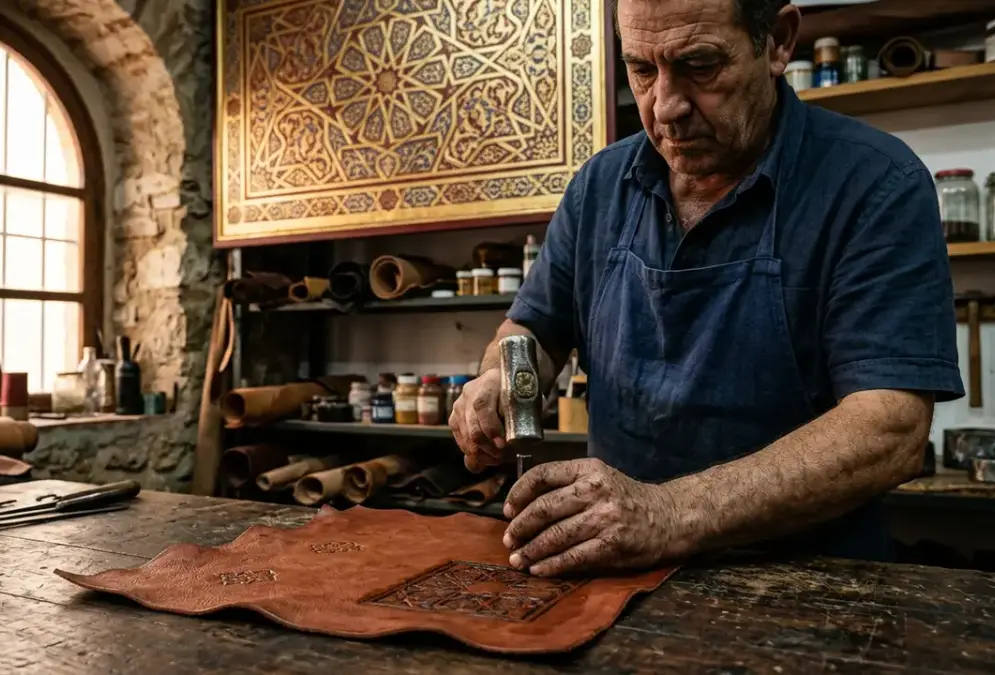
Deep dive · Article
Cordobán Leather: The Craft That Named the English Cordwainer
Córdoba gave English its word for shoemaker. How medieval goatskin tanned with sumac became Europe's finest leather and named a London guild still active today.
Plata con Alma, run by Ana Martina in the Judería, takes a different approach. The materials are 925 Sterling Silver and the forms are contemporary, with filigree wire used in abstract compositions that demonstrate what the technique can do in a modern visual language[6]. For buyers interested in the craft rather than historical reproduction, this is the more interesting option.
The El Zoco Municipal de Artesanía on Calle Judíos, Córdoba's main artisan collective, has silverwork stalls alongside leather, ceramics, and textile workers. Quality varies. A genuine filigree piece has a twisted-wire surface texture you can feel; a stamped piece is smooth. Weight also differs: hand-assembled filigree is lighter than cast or stamped silver of the same apparent size, because the structure is mostly air.
For the broader craft landscape, the Córdoba shopping and crafts guide covers the full Judería circuit, including esparto work, ceramics, and guadamecí leather. For historical context, the history of Córdoba guide places both crafts within the longer arc of the city's economic and cultural life.