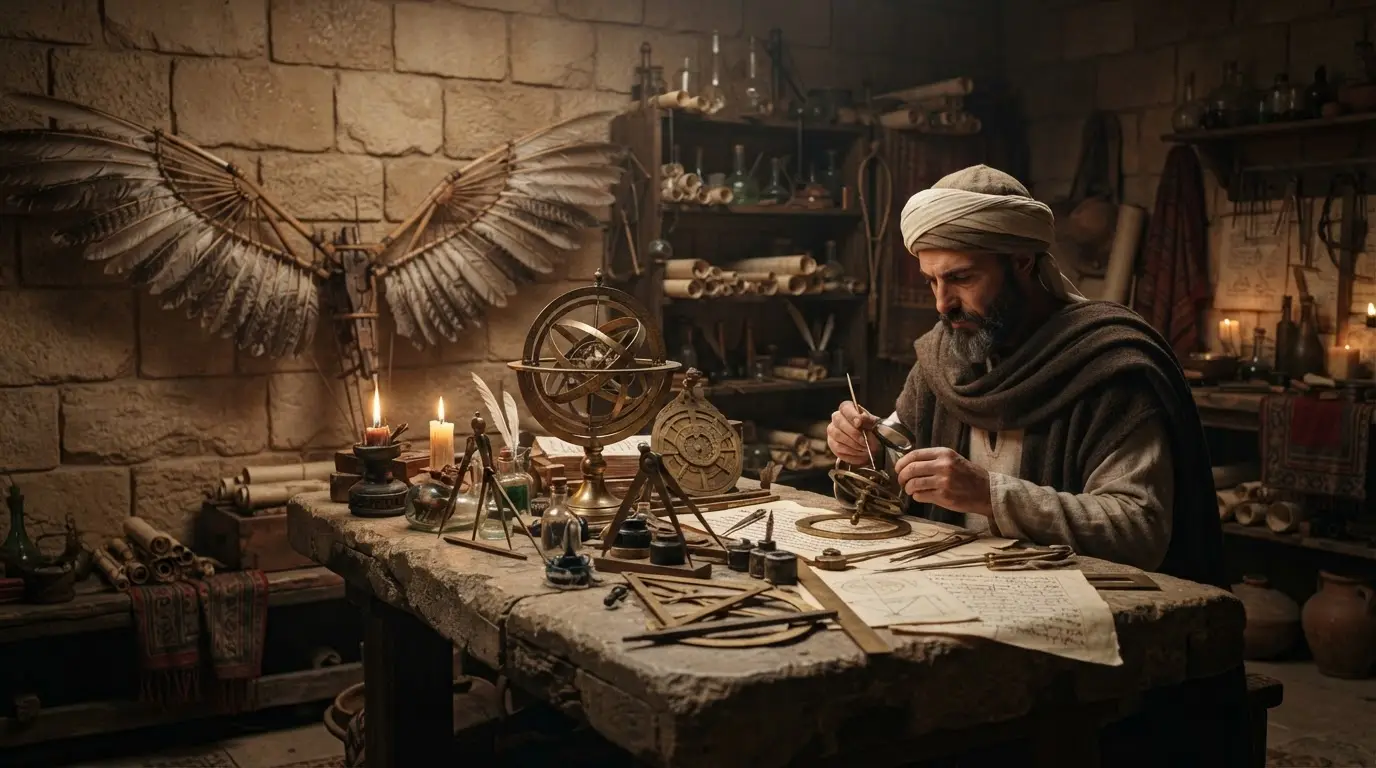

Who was Abbas Ibn Firnás?
Abbas Ibn Firnás was born around 809 or 810 CE near Ronda, in the Takurunna district of Al-Andalus, and died in Córdoba in 887 CE.[1] The scholarly consensus, drawn from the Encyclopaedia of Islam, records him as a mawlā, a client of the Umayyad dynasty rather than a blood relative, working within the court culture that Abd al-Rahman I had established a half-century earlier. That court, by the 9th century, had grown into something unusual for the period: a place where a Berber-descended polymath could move between astronomy, medicine, chemistry, engineering, music, and poetry, and be paid for all of it.
Ibn Firnás worked mainly under Emir Abd al-Rahman II and, later, Muhammad I, the same generation of Córdoban rulers who were expanding the city's mosque and turning the Umayyad Emirate into a serious rival to Abbasid Baghdad for scientific patronage. He is one of a cluster of 9th-century Córdoban figures (court poets, physicians, astronomers) whose names survive mostly in later biographical dictionaries rather than their own surviving manuscripts. That gap between the work and the record is the single most important thing to understand about him, because it shapes everything that follows, including the story that made him famous a thousand years later. The broader cast of scholars and inventors this same court produced fills out our guide to Córdoba's Islamic Golden Age.
The instruments of a Córdoba court scientist
What historians can state with confidence about Ibn Firnás is a list of concrete, technical achievements, and it is a longer list than most people expect from a name they only half-recognise:
Explore nearby · Monument
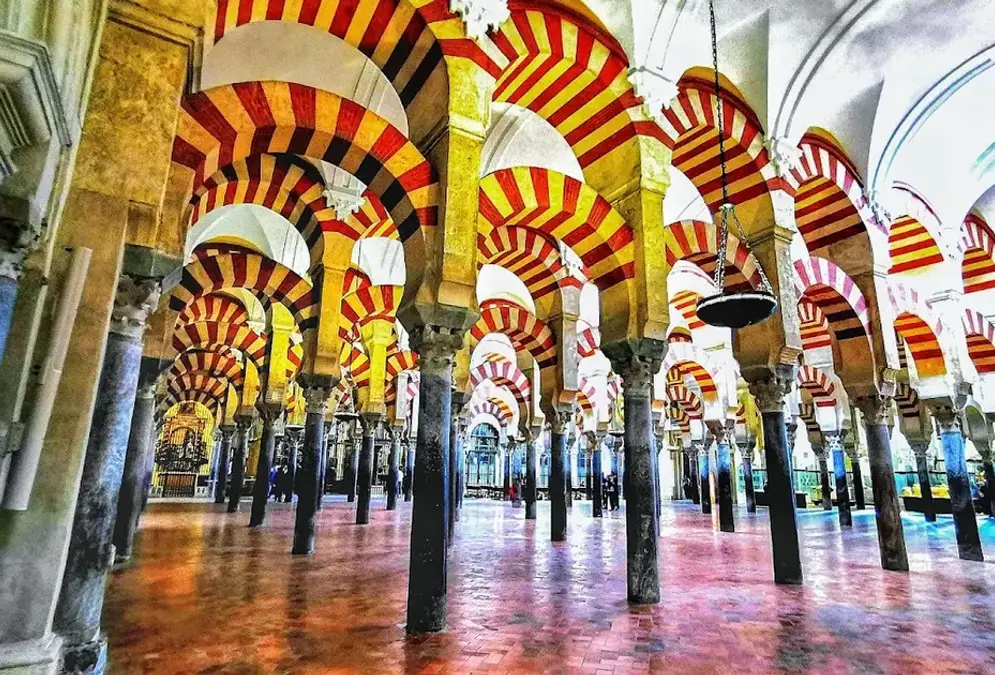
Mezquita-Catedral de Córdoba
856 columns, 1,300 years of Islamic and Christian history. UNESCO monument in Córdoba, Andalusia. Red-and-white arches, Byzantine mosaics, a Renaissance nave.
- Colourless glass, manufactured from sand and stone, a process that ended Al-Andalus's dependence on importing quartz from Egypt for glass-cutting[2]
- Corrective and magnifying lenses, known as "reading stones," among the earliest optical aids on record in Europe
- Glass planispheres, flat astronomical charts used to model the sky
- A mechanically articulated device simulating the motion of the planets and stars, reportedly including staged effects of thunder and lightning, installed at his own residence[2]
- Al-maqata, a water clock, and a reported prototype for a metronome-like device
He also introduced the Zīj al-Sindhind, a set of astronomical tables of Indian origin transmitted through Baghdad, into Al-Andalus: a transfer of technical knowledge that later fed into European astronomy through the same Iberian channels that carried Aristotle and Arabic medicine north.[3] A century later, Maslama al-Majriti took those same Baghdad-derived tables and reworked them for Córdoba's own calendar and meridian. None of this happened in isolation. Córdoba in the 9th century was assembling the intellectual infrastructure (instrument-makers, translators, astronomers) that a century later let al-Hakam II's library grow to its legendary size, and that let a physician like Al-Zahrawi, working a generation after Ibn Firnás at Medina Azahara, write the surgical encyclopedia that European medicine relied on for five centuries.
Measured against that record, Ibn Firnás reads less like a folk hero and more like what he almost certainly was: a working court scientist whose instruments solved practical problems (timekeeping, magnification, astronomical calculation) for a ruling class that valued them.
The legend of flight: what al-Maqqari actually wrote
The story that made Ibn Firnás internationally famous does not come from his own century. It comes from Ahmad al-Maqqari, an Algerian historian who died in 1632 — roughly 750 years after Ibn Firnás himself died.[4] According to al-Maqqari's account, Ibn Firnás covered his body in feathers, fitted himself with a set of wings, and launched from a high point, described only as "an eminence." Per "trustworthy writers who witnessed the performance," as al-Maqqari puts it, he flew a considerable distance, like a bird, before injuring his back on landing; the story adds that he had not thought to fit a tail.
Al-Maqqari does not name those witnesses, and he does not cite where his account of the flight actually came from.[5] What he does offer, as supporting evidence, is a verse by Mu'min ibn Said, a 9th-century Córdoban court poet who wrote under Emir Muhammad I and who was, by most accounts, no friend of Ibn Firnás. Al-Maqqari reads the verse as an allusion to the flight, though the poem never names him directly.
“He flew faster than the phoenix in his flight when he dressed his body in the feathers of a vulture.”
As later chroniclers passed the story down, that single, unattributed verse became the closest thing to a contemporary witness the legend has.
Why historians treat the flight story with caution
The problem is not that a medieval flight attempt is implausible; plenty of cultures record early glider experiments. The problem is the evidentiary chain. Writing in 1961, the historian Lynn Townsend White Jr. put it plainly: no modern historian, he argued, can be satisfied with a source written 750 years after the event, and it would be remarkable if several eyewitnesses had genuinely recorded the flight while no trace of that record survived independently of al-Maqqari.[6] White's own conclusion is a careful hedge rather than a dismissal: "the evidence is slender," he wrote, but he still credited Ibn Firnás with priority over England's Eilmer of Malmesbury, a monk who attempted a similar glide generations later and whose own story rests on comparably thin sourcing.
The legend has also picked up company it may not deserve. A separate, popular story credits an "Armen Firman" with a tower jump and proto-parachute cloak in Córdoba, told as happening some years before Ibn Firnás's own reported attempt. That figure appears only in secondary, popular retellings, never in al-Maqqari's primary account, and several scholars have suggested "Armen Firman" may simply be a corrupted, Latinised rendering of Ibn Firnás's own name. If that reading is right, two supposed aviators collapse into one legend told twice.
None of this proves the flight did not happen. It means the story survives as legend, carried by a single 17th-century chronicler working from unnamed sources many generations after the fact, not as an event historians can independently verify.
Ibn Firnás in modern Córdoba
Modern Córdoba has folded Ibn Firnás into its civic memory twice over. In 1976, the International Astronomical Union named a crater on the Moon after him.[7] In 2011, one of the bridges crossing the Guadalquivir in Córdoba was named the Abbas ibn Firnás Bridge — a modern structure, distinct from the much older Roman Bridge closer to the Mezquita, but crossing the same river that has defined the city's geography since antiquity.[8]
The legend has also drawn serious academic attention. Glaire Anderson, an art historian at the University of North Carolina, has researched Ibn Firnás specifically in connection with the Umayyad court, and worked with a costume designer and fluid-dynamics scientists to physically test a reconstruction of the glider wings the legend describes.[9] Anderson has described drawing on what she calls the earliest surviving account of the flight, contained in an 11th-century manuscript rediscovered in the 1990s after decades lost[10] — a claim, if fully substantiated in her published scholarship, that would predate al-Maqqari by roughly five centuries and meaningfully change the single source picture. That manuscript and its provenance were not independently verified for this article, and the claim should be read as a promising research lead rather than settled fact until her scholarship is checked directly.
Deep dive · Article
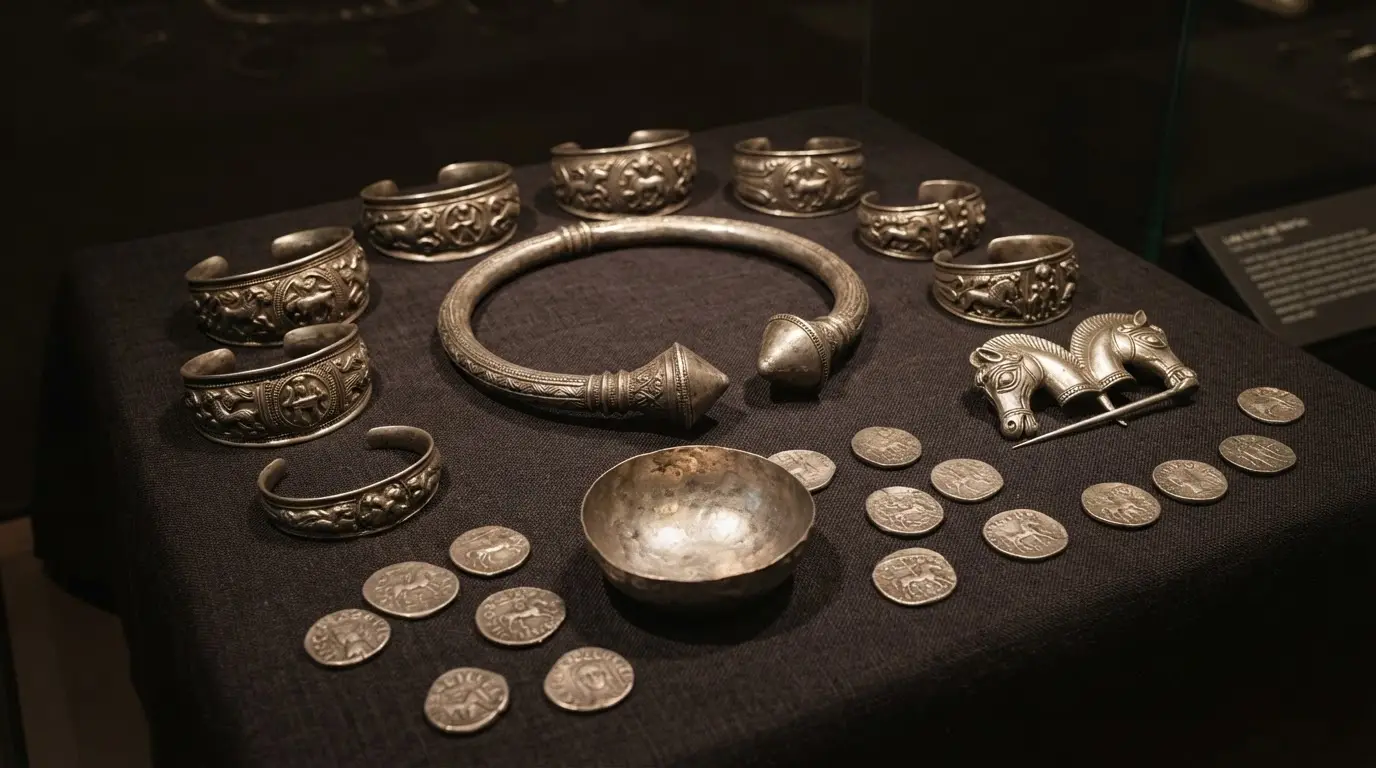
An Andalusian Treasure Has Sat in the British Museum Since 1932
A silver hoard dug up in Córdoba in 1915 left Spain against the law and has been in the British Museum since 1932. Here is how, and what a 2026 study found.
Recommended tours
Tours are selected for quality, not commission. We earn a small fee if you book — at no extra cost to you.

For a visitor standing in the Judería today, thinking about Averroes two-and-a-half centuries after Ibn Firnás, or about the optical instruments a Córdoba court scientist once built, the honest version of the story is the more interesting one: a real court scientist who built real instruments, attached centuries later to a flight that historians can neither prove nor fully dismiss.