

Maslama al-Majriti: a Madrid nisba, a Córdoba career
Abu'l-Qasim Maslama ibn Ahmad al-Faradi al-Hasib al-Majriti al-Qurtubi al-Andalusi carried five place-names and professions in his own name before anyone shortened it. The nisba that stuck, al-Majriti, means simply "of Madrid"; he was born there in the first half of the tenth century, commonly dated to around 950[1]. Madrid at the time was a minor frontier settlement on the Umayyad Caliphate's northern edge, nothing like the scholarly centre Córdoba had already become under Abd al-Rahman III.
He moved to Córdoba as a young man and effectively never left: he studied and worked there until his death in 1007[2][3], during the active decades of the reign of al-Hakam II, the caliph whose enormous library the city still argues about, as the story of its 400,000 vanished volumes shows. Córdoba in those years was assembling exactly the apparatus a mathematician of al-Majriti's ambition needed: a vast library, translation networks, and a caliph personally invested in the sciences.
By his death, Andalusian contemporaries were not shy about ranking him. Josep Casulleras's entry in the Biographical Encyclopedia of Astronomers states it plainly: al-Majriti "was considered by his Andalusian contemporaries as the foremost authority of his time in the field of astronomy"[5]. That reputation rests on three separate, separately documented achievements: a revised set of astronomical tables, a treatise on projection geometry, and one star observation nobody in al-Andalus had thought to make before him.
Córdoba already had one semi-legendary scientific figure from a century earlier, Ibn Firnás, remembered chiefly for a flight attempt wrapped in later myth. Al-Majriti's career runs the opposite way: a well-documented working life whose myths attached themselves only afterward, to books he almost certainly never wrote.
“Maslama al-Majriti was considered by his Andalusian contemporaries as the foremost authority of his time in the field of astronomy.”
The Zij al-Sindhind: resetting the sky's clock to Córdoba
A zīj is an astronomical handbook of tables (planetary positions, star coordinates, calendar conversions) that a working astronomer or astrologer consulted the way a navigator consults tide tables. A century before al-Majriti, al-Khwarizmi had compiled one of the most influential examples in Baghdad, the Zīj al-Sindhind, built on methods borrowed from Indian (Sanskrit siddhānta) astronomy and calculated from an arbitrary reference meridian at Arin, near Ujjain in India.
Al-Majriti's major work in astronomy, undertaken with his disciple Ibn al-Saffar, was adapting that zīj for al-Andalus[6]. The revision changed two structural things at once:
That second change was not cosmetic. Recalculating from Córdoba forced a fresh look at the geographic data underlying the tables, and one outcome survived long after the astronomy around it was superseded: al-Majriti's team produced the earliest known correction toward the real size of the Mediterranean Sea, a figure that subsequent Andalusian geographical tables kept using[8].
Earliest fix
The tables fed directly into the same caliphal apparatus that stocked al-Hakam II's library with translated science. Astronomy, mathematics, and geography were not separate departments in tenth-century Córdoba so much as one continuous project of importing, checking, and correcting inherited Greek and Indian knowledge against Andalusian ground truth.
Ptolemy's Planisphaerium — and the astrolabe he never claimed as his own
The commissioned version of this story says al-Majriti "rewrote Ptolemy." He did not. What the record actually supports is narrower and more precise: a commentary and revision of Ptolemy's Planisphaerium, the treatise on stereographic projection that underlies how an astrolabe's flat face can represent a curved sky. Modern scholarship (Kunitzsch and Lorch, 1994) has corrected an older assumption that he learned Greek and translated the text himself; he most likely revised an existing eastern Arabic translation instead[9].
His contribution to that revision was concrete rather than theoretical. He added material that improved the working procedures for tracing the astrolabe's fundamental lines and for locating fixed stars on its rete, the rotating star-map plate set into the instrument's face[10]. An astrolabe maker in Córdoba working from al-Majriti's revised text could lay out a more accurate rete than one working from the unrevised translation: a small, technical improvement, but the kind that compounds across every instrument built afterward.
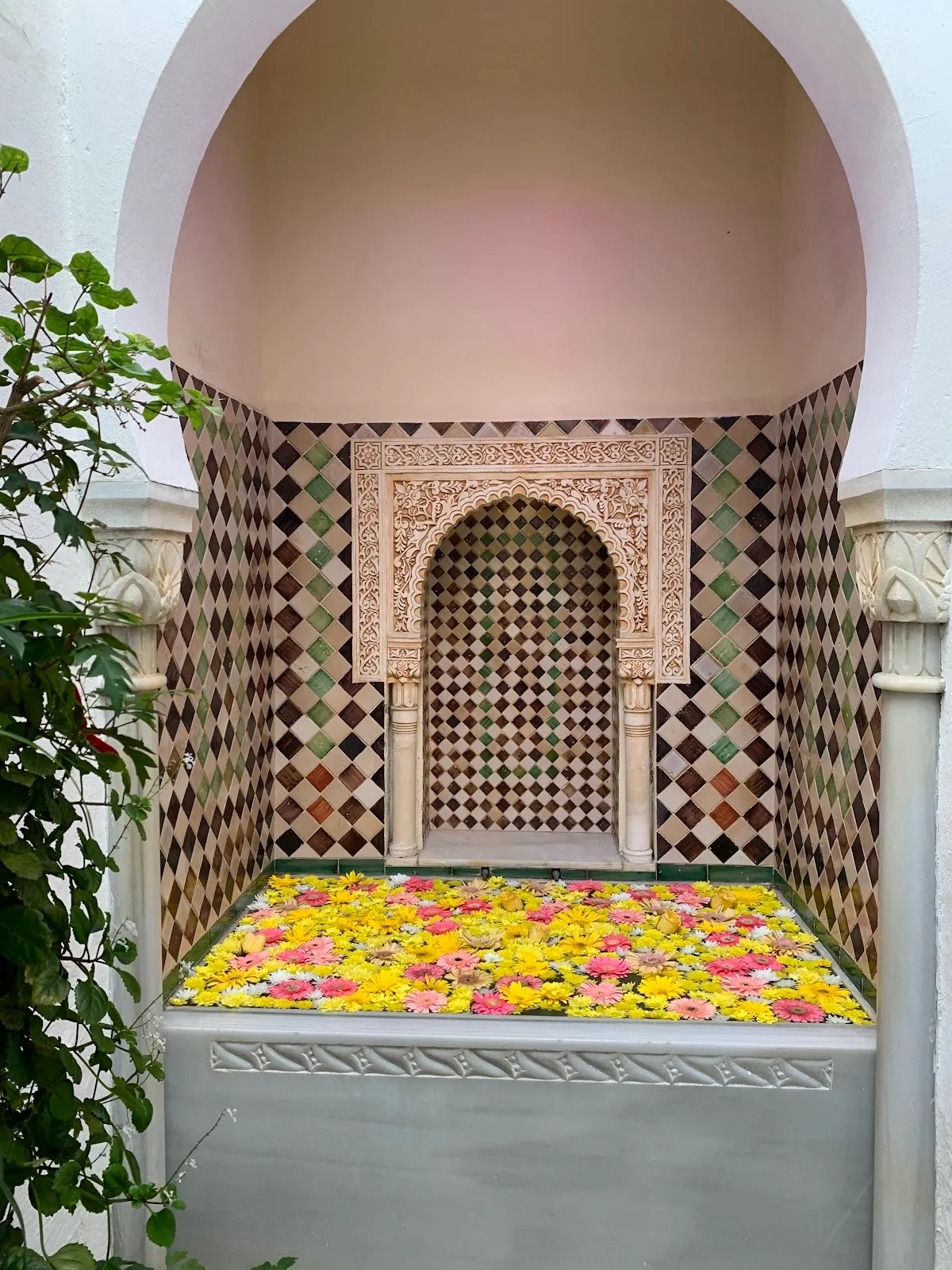
Explore nearby · Museum
Casa Andalusí & Al-Iksir Alchemy Museum
A 12th-century Andalusian house and Spain's only alchemy museum, side by side on Calle Judíos. Combined ticket €7.50 covers both sites in the Judería.
This is worth being exact about because the Planisphaerium is not the Almagest. Ptolemy's star catalogue and planetary theory — the Almagest proper — is a separate, much larger work, and al-Majriti's documented engagement with it is narrower still: a comparison of his own star measurement against its catalogue epoch, covered in the next section, not a translation or rewrite of the text. Precision about scope is the whole point of reading a tenth-century Córdoba scholar on his own terms rather than through a later, flattering exaggeration.
979 CE: the first star observation credited to an Andalusian astronomer
Everything so far describes al-Majriti revising other people's work. The Regulus observation is different: it is his own data. In 979 CE he observed the star Regulus and determined its ecliptical longitude at 135°40' — the first known original astronomical observation made by an Andalusian astronomer, rather than one copied or adapted from an earlier authority[11].
From that single measurement he derived a precession of the equinoxes of 13°10' relative to the epoch of Ptolemy's Almagest star catalogue[12]. Precession is the slow drift of the equinox points against the fixed stars, caused by Earth's axial wobble; measuring it accurately requires comparing a fresh observation against a much older one, separated by centuries, and doing the trigonometry correctly in between. That al-Majriti could run this calculation from Córdoba, using his own instrument and his own star sighting rather than borrowed figures, is the clearest evidence that Andalusian astronomy had stopped being purely a translation exercise by the late tenth century.
Córdoba's skies are considerably more compromised by artificial light now than they were in 979, but the region still has genuinely dark pockets within a short drive; where to actually go for that today is a separate, practical question from the one this article is answering.
A school of credited disciples — and a name attached to books he never wrote
Al-Majriti is described as the founder of "an original school of Andalusian astronomers in which the disciplines of arithmetic and geometry were also cultivated"[13]. Treat that as credited tradition rather than a fully settled institutional fact: what is documented is three named disciples across three generations — Ibn al-Samh, Ibn al-Saffar, and Ibn Barghuth (d. 1052) — who "greatly influenced the development and expansion of the exact sciences throughout al-Andalus"[14], not a chartered academy with a curriculum.
That same reputation is exactly what made him an attractive name to attach to other people's books. Historians note that writers have "at times misattributed to Majriti works on magic and alchemy"[15]. The clearest case is the Ghayat al-Hakim, known in Latin as the Picatrix, and its companion the Rutbat al-Hakim: both are traditionally attributed to him, but "many have called this attribution into question," and the author is now often labelled pseudo-Majriti[16].
The chronology alone makes the traditional attribution hard to sustain. The Arabic original states it was completed in 348 AH, roughly 959 CE (more than five decades before al-Majriti's death), which would make him about five years old when the book was supposedly begun, if his estimated birth year of c. 950 is right[17]. Maribel Fierro's 1996 study in Studia Islamica proposes a more plausible author entirely: a different, contemporaneous scholar named Maslama b. Qasim al-Qurtubi, who died in 964[18], a reminder that a shared given name and a similar era is exactly how a reputation gets borrowed.

Deep dive · Article
47 Metres Tall and Almost Unknown: Spain's Tallest Keep
Belalcázar Castle's 47 m keep is listed by the Junta de Andalucía as Spain's tallest. How it grew, what to see inside and how to book the free guided visit.
Recommended tours
Tours are selected for quality, not commission. We earn a small fee if you book — at no extra cost to you.
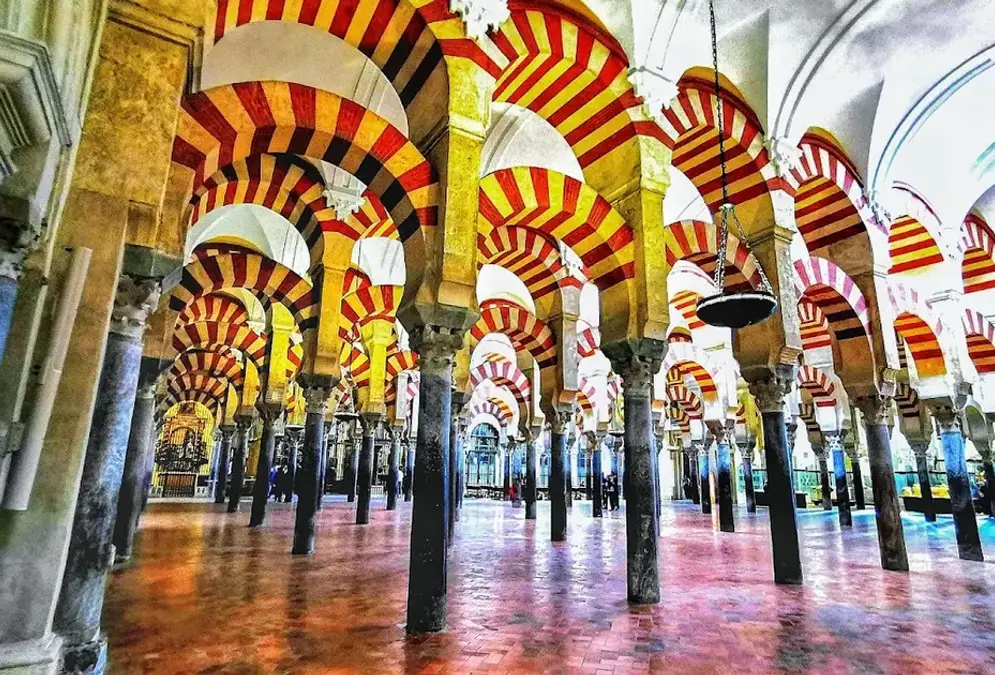


The milieu al-Majriti worked in is still visible on the ground. The Torre de la Calahorra, at the south end of the Roman Bridge, now houses the Museo Vivo de al-Andalus, dedicated to the coexistence of Córdoba's Jewish, Christian, and Muslim cultures[19] — the same tenth-century world that produced a mathematician precise enough to correct the Mediterranean's shape and careless enough, in the eyes of later copyists, to have his name stuck on a grimoire he never touched. For a broader route through that history, the three cultures walk and the guide for history-minded visitors both build on the same ground al-Majriti worked in.