

Who was Al-Qurtubi, and what did Córdoba give him?
Abu Abdullah Muhammad ibn Ahmad ibn Abi Bakr al-Ansari al-Qurtubi was born in Qurtubah, present-day Córdoba, in 1214[1]. By then the Umayyad Caliphate had been broken apart for nearly two centuries, and Almohad governors ruled a smaller, poorer city than the one that had produced Averroes a century earlier. Still, Córdoba kept its schools, its mosques, and its reputation as a place where a boy without money could study law and scripture if he found the right teachers.
Al-Qurtubi's father was a farmer who died during a Spanish military raid in 1230, when Muhammad was around sixteen[2]. To help feed the family, he spent part of his youth carrying clay for the city's potteries — manual labour, not scholarship, filling the hours between lessons. He studied under two local teachers, Ibn Abu Hujja and Abdurrahman ibn Ahmed al-Ashari, working through the standard curriculum for a jurist in training:
- Maliki fiqh, the school of Islamic law dominant across Al-Andalus
- hadith transmission, the chains of testimony behind the Prophet's recorded sayings
- Arabic grammar and qira'at, the canonical readings of the Quran text
That combination, law plus scripture plus grammar, is exactly what a Maliki jurisconsult and future mufassir needed. Al-Qurtubi had it by his early twenties. What he did not have, for much longer, was a city to practise it in.
1236: the conquest that ended Córdoba's Muslim community
Córdoba fell to Ferdinand III of Castile in the summer of 1236, after a siege that finally broke the city's last Almohad garrison — the campaign itself is covered in the siege of Córdoba in 1236. For the Muslim population, the terms afterward were harsh: convert, leave, or risk what conquest usually meant for a city taken by force. Al-Qurtubi, in his early twenties and already trained as a jurist, chose to leave.
He went first to Alexandria, where he studied hadith and tafsir with Egyptian scholars[3], joining a wave of Andalusian refugees who carried Córdoba's legal and scriptural training east rather than abandoning it. It was not a solitary path; whole networks of Córdoba-trained jurists and physicians rebuilt their careers in Cairo, Damascus, and Alexandria through the 1230s and 1240s, each one taking a piece of the city's scholarship with them.
Nothing in the record suggests al-Qurtubi ever tried to return. Alexandria was a stop on the way east, not a destination in itself.
An ascetic life in rural Egypt
From Alexandria, al-Qurtubi moved to Cairo, then further south, settling permanently in Munya Abi'l-Khusayb, a small town in Upper Egypt, where he spent the rest of his life[4]. He never held a court post, never sought a judgeship, and never returned to the kind of public role that many exiled Andalusian scholars took up in their new cities.
What survives about his daily habits comes from later biographers, and it is consistent. He walked about in a simple caftan with a plain cap, disdaining the airs that a scholar of his reputation could easily have claimed[5].
He walked about in a simple caftan with a plain cap, disdaining the airs that a scholar of his reputation could easily have claimed.
A second, independent account describes him more directly still — an ascetic who divided his days between worship and writing[6], with no interest in the politics of Mamluk Egypt swirling around him. In that respect he resembles the philosopher Maimonides, who also spent his own exile in Egypt keeping deliberately clear of court life, absorbed instead in the books that would carry his name.
Recommended tours
Tours are selected for quality, not commission. We earn a small fee if you book — at no extra cost to you.

Al-Qurtubi died in Munya Abi'l-Khusayb on 29 April 1273[7], not quite forty years after leaving Córdoba, having spent almost his entire adult life on a single project: a Quran commentary that would outlast every dynasty that had exiled him, converted his mosque, or ruled the Egypt he settled in.
Tafsir al-Qurtubi: a commentary built for jurists
The book that made his exile worthwhile is formally titled Al-Jami' li-Ahkam al-Qur'an ("The General Judgments of the Qur'an"), universally known simply as Tafsir al-Qurtubi[8]. It is not a narrative commentary in the style that dominated earlier Quran exegesis. Al-Qurtubi mostly skipped the stories and legendary histories that filled other tafsirs, concentrating instead on:
- ahkam, the legal rulings a judge or jurist could actually apply
- qira'at, the canonical variant readings of the Quran text
- Arabic grammar and abrogation, which verses supersede or qualify others[11]
That focus is what made it a working tool rather than a devotional read. A muhaddith citing hadith to support a ruling, or a Maliki judge weighing a property dispute, could open Tafsir al-Qurtubi and find the relevant verses treated as case law, not as story. That's the same insurance policy that kept Averroes' philosophy alive after Al-Andalus stopped producing new copies of it: distance from a collapsing homeland is often what lets a text survive at all.
The scale of the project is part of the story too. The original printed Cairo edition, produced between 1933 and 1950, ran to 20 volumes[9]; a Beirut edition from 2006 expanded the text further, to 24. English-language readers have two main routes in: a one-volume abridgement published by Dar al-Taqwa in London, and the first six volumes translated by Aisha Bewley for Diwan Press[10] — a fraction of the whole, but enough to see why scholars have used it continuously since the 13th century.
20 volumes
None of that would have happened if al-Qurtubi had stayed in Córdoba. The tafsir is an Egyptian book, written by a Córdoba-trained mind that the 1236 conquest had already relocated.
Where Al-Qurtubi fits in Córdoba's scholarly memory
Later biographers rank him plainly: a Maliki scholar and hadith specialist, one of the greatest Imams of Quranic exegesis[12]. Theologically, he held Ash'ari views, practising ta'wil, a reasoned reinterpretation of the Quran's more literal descriptions of God, rather than reading them at face value[13]. Among fiqh-based commentaries, his is still described as the most famous of the genre[14].
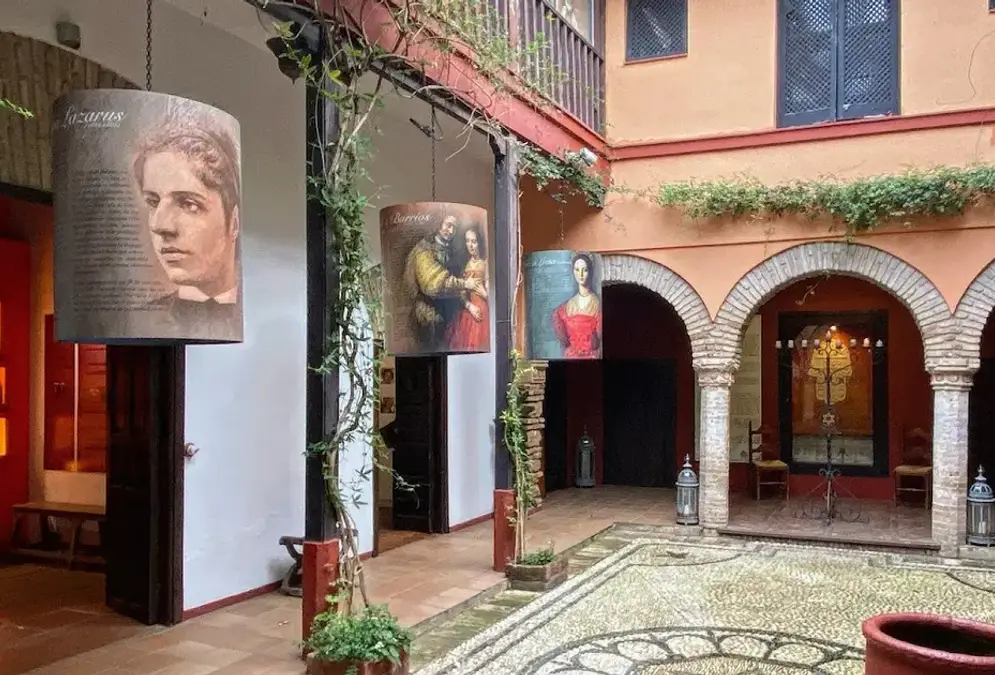
Explore nearby · Museum
Casa de Sefarad
14th-century house in Córdoba's Judería with five themed rooms on Sephardic Jewish life, from medieval Al-Andalus to the 1492 expulsion. Live concerts included.
That places him in a different lineage from the Córdoba scholars the city usually celebrates. Averroes and Ibn Hazm worked and died inside Córdoba, arguing philosophy and law from a position of local authority under Caliphal or Almohad rule. Al-Qurtubi belongs to the generation that came after both of them: pushed out not by a rival dynasty within Islam but by a Christian conquest that ended Muslim Córdoba outright. He carried the city's scholarly training to Mamluk Egypt rather than continuing it at home, and the book he produced there is still assigned in Islamic seminaries eight centuries later — a Córdoba education that outlived the city's Muslim community by a very long way.
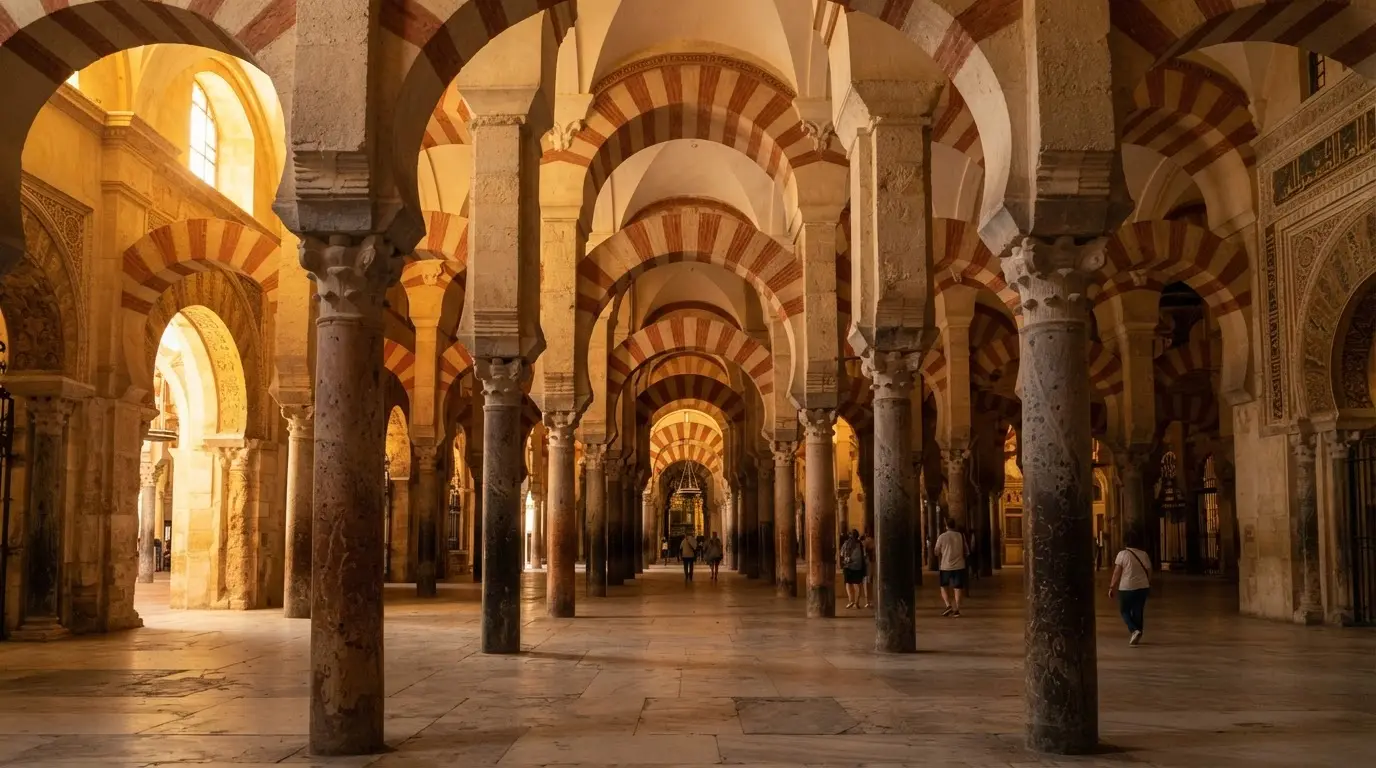
Deep dive · Article
Abd al-Rahman III: The Morning Córdoba Became a Caliphate
Abd al-Rahman III was the first Caliph of Córdoba, declared on January 16, 929, ruling a city of up to 500,000 people and building Medina Azahara in 936.