Córdoba's forgotten astronomer: Abbas ibn Firnas
Abbas ibn Firnas was born around 810 in the mountain town of Ronda, but it was Córdoba that shaped his working life and where he died, in 887. He was active at the court of Abd al-Rahman II, the Umayyad emir who ruled Córdoba from 822 to 852, and it was there, around 840 CE, that he built the invention historians actually credit him with: a mechanical device using a chain of rings that modeled the motion of the planets and stars[1]. Firnas was, by every account that survives, a polymath: a poet at court, a physician, and an engineer credited with early experiments in glassmaking alongside his astronomical work. Córdoba in the ninth century wasn't Baghdad, but it was building toward the same ambition, a court that funded science and medicine alongside poetry and music, and treated a device for tracking the stars as worth paying for in the first place.
Popular retellings go further than that. Some tourism writing describes a private chamber in Firnas's house where he conjured clouds, artificial thunder, and lightning, a vivid planetarium room that would predate anything Europe built by centuries. It's a good story, and it may even contain a kernel of truth, but it doesn't appear in the historical sources checked for this article. What's verifiable is more modest, and in its own way more impressive: a working mechanical model of the sky, built in ninth-century Córdoba, at a time when the rest of Europe had little comparable science.
Firnas is better known today for something else entirely: an early attempt at human flight. The story, as it survives, has him covering himself in feathers, strapping a pair of wings to his arms, and jumping from a height near Córdoba — he covered himself with feathers for the purpose, attached a couple of wings to his body, and, getting on an eminence, flung himself down into the air[2], in the words of the account that preserves it. That account was written by the historian al-Maqqari, roughly 750 years after Firnas's death, with no earlier source to corroborate it. Treat the flight as legend with a plausible historical core, not settled fact; the sky-charting device is the part of his career that historians can actually stand behind, and it's arguably the more remarkable achievement anyway.
Maslama al-Majriti and the mathematics of the sky
A century later, Córdoba produced a second astronomer whose reputation rests entirely on mathematics rather than legend. Maslama al-Majriti is traditionally placed as a native of Madrid, born around 950, but he built his career in Córdoba and died there in 1007, at the height of the Caliphate his work quietly served. He's remembered for one specific, well-documented achievement: he introduced and improved the astronomical tables of Muhammad ibn Musa al-Khwarizmi[3], adapting calculations first developed in Baghdad for astronomers working under a different sky. Those tables mattered in practice, not just in theory: they let scholars calculate prayer times, the direction of Mecca, and the position of the sun and moon for the Islamic calendar, all specific, testable problems rather than abstract speculation.
Several later sources credit al-Majriti with running a formal school of astronomy in Córdoba that trained named disciples who carried his methods forward after his death. That claim is widely repeated, and it fits what's known about Córdoba's intellectual culture under al-Hakam II: this was, after all, the same city that a generation earlier had opened its doors to Ziryab, the Baghdad musician who remade its court's tastes in food, dress, and music. But the school-and-disciples story rests on thinner sourcing than the tables themselves, so it's fairer to call it credited tradition than settled fact. His corrected tables reached well beyond Córdoba's own borders, and later astronomers across al-Andalus kept building on them for generations, which makes al-Majriti one of the more durable influences of Caliphal-era science, even if his own biography stays thin compared to his output.
From astrolabes to dark skies: a city built to read the sky
None of this stargazing legacy is visible from Córdoba's own rooftops anymore. Streetlight and the general glow of a modern city have pushed the naked-eye sky most residents see down toward the faint end of what astronomers grade on the Bortle scale, the standard measure of how much a sky is washed out by artificial light. At the darkest end of that scale, the Milky Way isn't a faint smudge you have to squint for; it's bright enough to cast a weak shadow, and the sky is crowded with stars invisible from any city rooftop. What Firnas and al-Majriti worked out with rings, tables, and an astrolabe is still true; you just can't see the proof of it from the historic centre anymore.
The nearest place where you genuinely can is Los Pedroches, a comarca of 17 villages spread across roughly 3,500 square kilometres in the far north of Córdoba province[4]. It's a strange kind of symmetry: the same province that once illuminated its Caliphal palace with mercury and reflected light after dark, as Medina Azahara's night visits still demonstrate today, now protects some of the darkest, least-lit skies in mainland Spain, on purpose.
Explore nearby · Monument
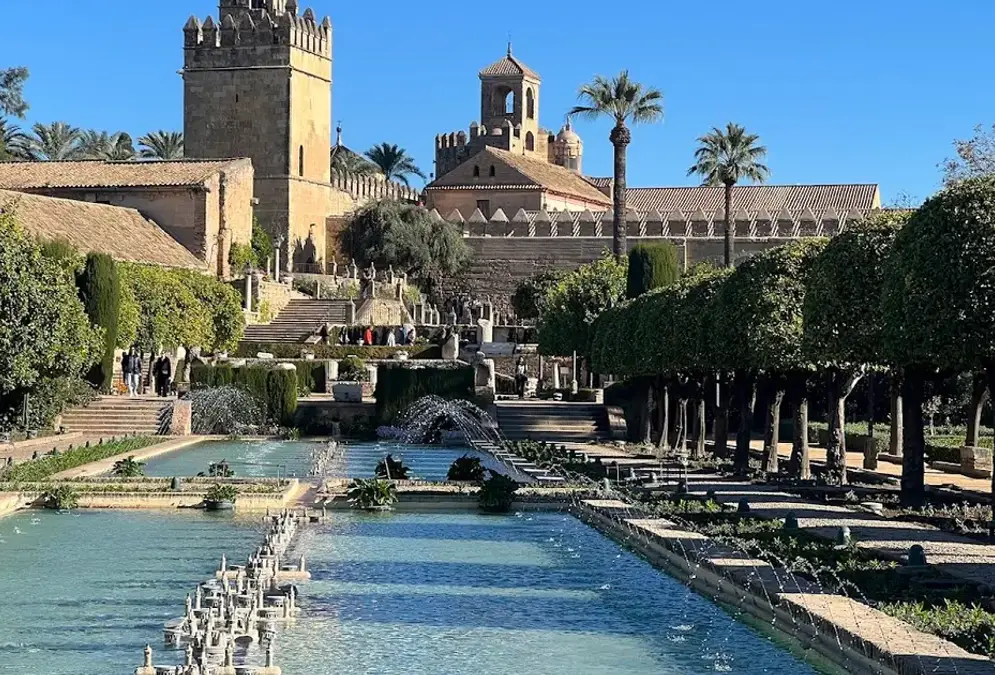
Alcázar de los Reyes Cristianos
Alcázar de los Reyes Cristianos, Córdoba: 14th-century fortress where Columbus met the Catholic Monarchs. UNESCO gardens, Roman mosaics. €5, free Tuesdays.
Los Pedroches: Andalusia's certified Starlight Reserve
Los Pedroches earned its official Starlight Reserve certification in December 2016[5], awarded by the Fundación Starlight, the Spanish body that verifies night-sky quality against a strict technical protocol rather than popular opinion. The certification made it the tenth zone catalogued under that system anywhere in the world[6], an order of certification worth noting, not a ranking of whose sky is darkest. Los Pedroches wasn't judged against nine other reserves and found to be the tenth-best; it was simply the tenth to complete the process. Starlight certification isn't just a marketing badge: it requires participating municipalities to commit to specific outdoor-lighting standards, monitored sky-quality readings, and ongoing protection of the night environment, not just a good sky on the night the inspectors happened to visit.
For a Córdoba-based traveller, the appeal is how close this all is. Los Pedroches sits roughly 75km north of the city, a little over an hour's drive through the rolling farmland and holm-oak dehesa of the Sierra Morena foothills. There's no need to fly to the Canary Islands or plan a multi-day trip to see a genuinely dark sky; it's a half-day excursion from the Mezquita. Public transport doesn't reach the observatory directly, so a rental car, or a private transfer arranged in advance, is the realistic way to get there for an evening session and back.
10th
Villanueva del Duque Observatory: where to actually see the sky
The practical way to experience those skies is the Villanueva del Duque Astronomical Observatory, a public facility built specifically for astro-tourism rather than research. Its dome measures 5 metres in diameter[7], holds groups of up to 12 people, and houses a 20-inch (500mm) Skywatcher Dobson GoTo Stargate telescope, a serious amateur instrument well beyond what most travellers will have used before. Sessions are run exclusively for public stargazing, not shared with a research programme, so a booked evening is genuinely about what you can see, not what a scientist happens to be measuring that week. Sessions can be booked directly through the observatory in advance; because Los Pedroches doesn't yet have the density of stargazing tour operators you'd find around a more established astro-tourism hub, the observatory itself is the most reliable starting point for a first visit, rather than a patchwork of private guides.
Bring warm layers even in summer; Sierra Morena nights cool fast once the sun drops, and standing mostly still outdoors after dark gets cold quickly. A red-light torch helps keep your night vision intact between naked-eye views and time at the eyepiece. Ask the observatory staff what's worth prioritizing that night — options typically include:
Deep dive · Article
Why Is Córdoba So Hot? The Science Behind Europe's Hottest City
Córdoba records 46.9°C and averages 16 days above 40°C every year. Geography, climate science, and how locals in Europe's hottest city actually survive it.
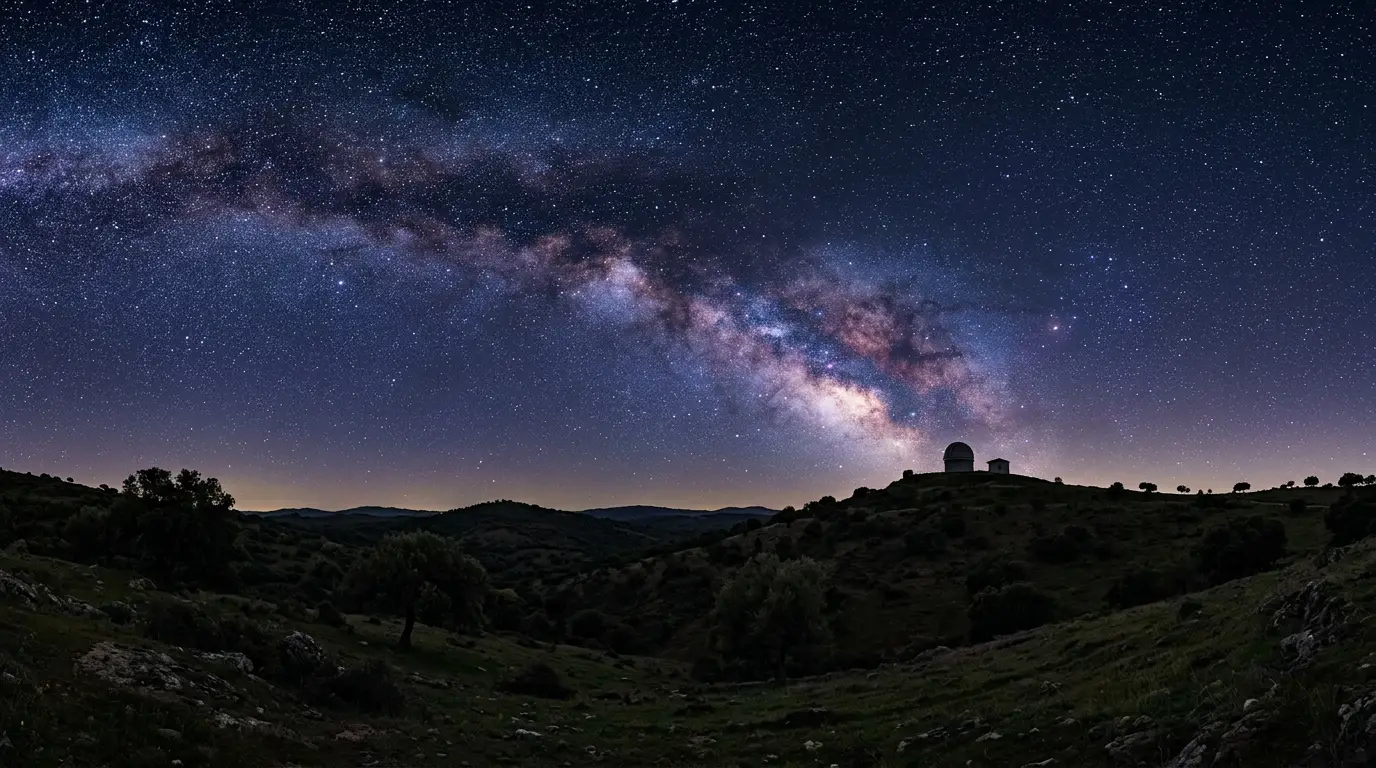
The Villanueva del Duque Observatory's 5-metre dome sits beneath skies dark enough to justify the reserve's Starlight certification, no city glow, just the Sierra Morena horizon.
- Naked-eye and telescope views of visible planets
- Deep-sky objects such as star clusters and nebulae
- Meteor activity, when the calendar lines up with a shower
When to go: meteor showers, new moons, and beyond Los Pedroches
There's no single best month for Los Pedroches confirmed by the reserve itself, but general astronomy holds here as anywhere: autumn and winter nights are longer and typically clearer, while summer puts the bright core of the Milky Way higher in the sky, even if the nights themselves are shorter. If you want a single date to build a trip around, make it August 13, 2026: the Perseid meteor shower peaks that night, predicted for 14:53 UTC[8], and the timing lines up with a new moon, meaning no moonlight to wash out the fainter meteors right when the rate is highest.
Los Pedroches is a genuinely dark sky, certified as such, and close enough to reach on a Córdoba weekend without giving up a full day of driving. If it leaves you wanting darker skies still, La Palma, Spain's first-ever Starlight Reserve and a step up again in sky darkness, is worth the extra flight. darkskiesatlas.com's La Palma guides are the most thorough planning resource we've come across for it, with practical detail on where to stay and when to go.
New moon