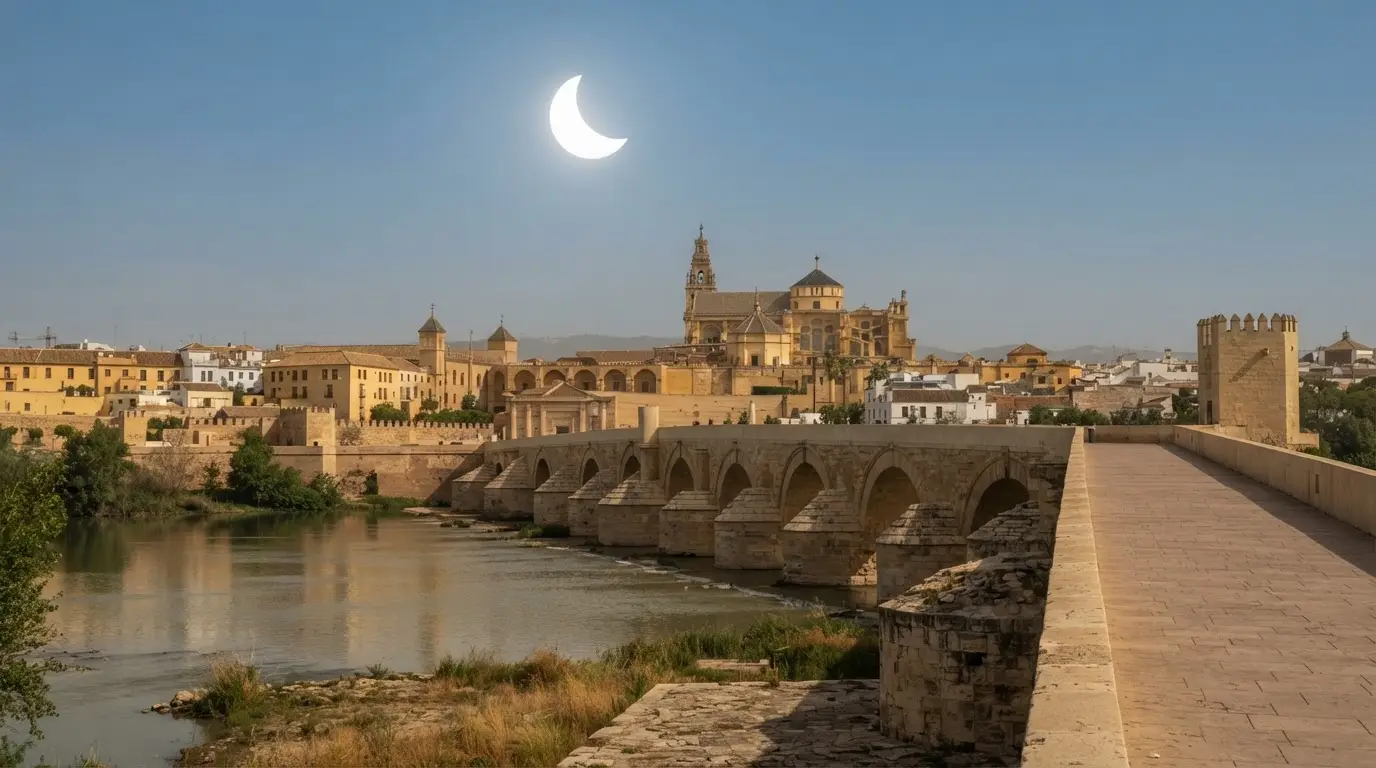

Why Córdoba isn't in the path: what it sees instead
On 2 August 2027, a Monday, the Iberian Peninsula gets the second of three consecutive eclipses inside three years[4]. Córdoba will not go dark. The city sees a deep partial eclipse with a magnitude of 0.964[1], the fraction of the Sun's diameter the Moon covers, while the Moon fully covers the Sun only along a narrow band far to the south. An independent calculation confirms the total phase is not visible in Córdoba at all[5]; it can only be observed there as a partial eclipse, however spectacular the near-total crescent looks.
The distinction between magnitude and obscuration matters here, because eclipse coverage routinely conflates the two. Spain's official astronomical institute, the IGN, spells out the difference for Madrid: a magnitude of 0.88 there works out to 85% obscuration[6], a noticeably lower figure than the magnitude alone suggests. No equivalent obscuration percentage has been published for Córdoba, so the honest number to quote is the magnitude, 0.964, not a rounded "96% of the Sun covered" claim nobody has actually calculated.
What Córdoba does get is still worth setting an alarm for: a thin, blazing crescent of Sun at maximum eclipse, safe to view only through certified eclipse glasses or a solar filter. It is a genuine spectacle. It is not totality, and no amount of hopeful phrasing changes that.
The city missing totality in 2027 is a modern accident of geometry, not a historical one: Córdoba's own medieval astronomers had the zij tables that made eclipse timing possible centuries before this one was ever predicted by modern orbital mechanics.
What totality actually looks like on the coast
The path of totality enters Spain from the Atlantic, crossing the Strait of Gibraltar and covering Ceuta and Melilla, almost the whole of Cádiz province, part of Málaga province, and the southern edges of Granada and Almería[7]. Córdoba sits well north of all of it, outside the band by a wide margin.
On the coast, the sky genuinely goes dark. The IGN puts totality in Málaga city at 1 minute, 48 seconds, starting 10:48 local time, and in Cádiz at 2 minutes, 54 seconds, starting 10:45[2], over a minute more darkness than Málaga. That extra minute comes at a cost: Córdoba sits on the same high-speed AVE, Avlo and Avant network that reaches Málaga in 49 minutes[17], but Cádiz is served only by slower Media Distancia regional trains[18], meaning a change onto a slower service rather than a direct hop. timeanddate's own independent calculation for Málaga comes out a touch longer, at 1 minute 57 seconds[8]; the two respected sources differ by nine seconds, most likely down to exactly which point in the city each one measured from.
Either way, totality itself is short. The whole event in Málaga, from first bite to last, spans about two hours twenty minutes[8], the part visitors chasing a nine-second difference between two sources tend to forget, and the part that actually fills most of the morning. For the astronomy itself, rather than where to sleep, darkskiesatlas.com's event page for the 2 August eclipse carries the path and timing detail in full. If ordinary dark skies rather than an eclipse are the goal, Los Pedroches to the north is the region's own Starlight reserve, a different destination for a different night, well outside this eclipse's path.
The basecamp case: real beds, and a fast train south
None of this works without somewhere to sleep, and Córdoba's case rests on two things: real hotel inventory, and a fast way to the totality band on the day. Córdoba connects to Málaga by AVE in as little as 49 minutes[3], on a high-speed line built for 350 km/h that runs 155 km from its Almodóvar del Río junction[9]. Even allowing for a change or a slower off-peak service, a same-day return to the coast is realistic, not an expedition: leave before dawn, watch the eclipse mid-morning, be back in Córdoba for dinner. For the full route picture, see how to get to Córdoba.
Early August in Córdoba is also, bluntly, hot: an average daily high of 36.5°C, a dry 43% relative humidity, and around 19 clear days with 336 sunshine hours across the month[10]. That is a real trade-off against a coastal sea breeze, but it carries a genuine upside on eclipse morning specifically: dry inland heat means a lower chance of the low coastal cloud that can spoil a totality view. See our guide to Córdoba in summer for the wider seasonal picture.
Córdoba is also simply a bigger city than most of the totality corridor. Tarifa, Barbate, Vejer de la Frontera, the towns actually inside the band, are small coastal resorts built for a summer crowd nowhere near the scale an eclipse-chaser influx would bring. Córdoba already handles crowds at a comparable scale every year, for Semana Santa and the Patio Festival, and its hotel stock is built for that volume.
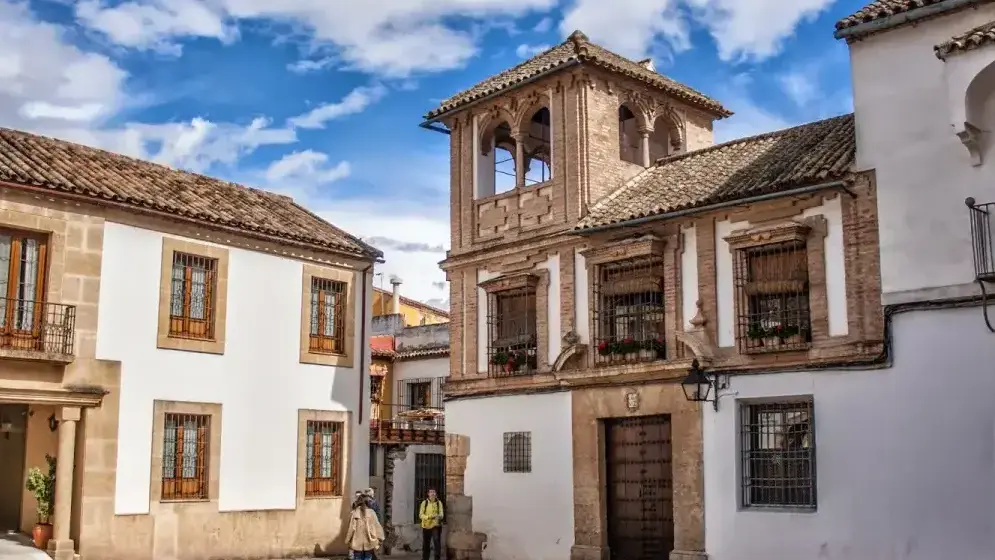
Explore · Neighbourhood
Historic Centre
Córdoba's working heart packs Roman columns, baroque palaces, century-old tapas bars and boutique shops into one walkable district near the Mezquita-Catedral.
For the neighbourhoods worth booking first, see our guide to the best area to stay in Córdoba. Book now: the corridor's price curve, described below, suggests the whole region's accommodation will tighten as 2027 approaches.
Booking now: what the coastal corridor's prices already show
The market has already made its own prediction, eleven months out. As of mid-August 2026, hotels along the Cádiz totality corridor were fielding next-year bookings specifically for eclipse dates, an unprecedented lead time, according to the head of the province's hotel association, who said some properties had been taking 2027 reservations for three months already, something he called unusual and never seen before[11]. At the Hotel Dos Mares in Tarifa, over 70% of August 2027 capacity was already reserved by that point, some booking requests arriving with the subject line "Eclipse Tarifa 2027"[12].
Short-term rentals show the same pattern, sharper. Listings in parts of Cádiz province that ran around €200 a night in August 2026 were, at the same point, quoted at over €12,000 for the single night of the eclipse[13]. By late August 2026, specific listings bore that out: a rural house in Zahora was quoted at €41,026 for eclipse night, against about €652 a night the following week[19], and an apartment in Vejer de la Frontera reached €28,020 for the night of 1–2 August, against roughly €325 a night in late July[20]. Those are snapshot figures from a fast-moving market, not fixed prices, but they are the clearest signal available that the corridor's small hotel and rental stock will not comfortably absorb the demand an eclipse this well publicised is going to bring.
Recommended tours
Tours are selected for quality, not commission. We earn a small fee if you book — at no extra cost to you.

Every one of those surge reports is about towns inside the totality band; nothing in the reporting points to Córdoba's own prices moving yet. For budgeting the trip overall, including a same-day coastal excursion, see our guide to Córdoba travel costs.
Eclipse-day logistics: timing, safety, and what isn't confirmed yet
Córdoba's partial eclipse on 2 August 2027 runs from first contact at 09:42 to fourth contact at 12:01, with maximum around 10:49 local time[14]. Budget the whole late morning, not just a ten-minute window, and don't take eclipse glasses off until conditions are genuinely safe again, wherever you're watching, coast or city.
What isn't yet locked down is anything eclipse-specific from the official channels. A check of Turismo de Córdoba's public events agenda in late August 2026 turned up nothing eclipse-related[15]; any municipal programming for the day, if it happens, will surface there closer to 2027, which is the page worth bookmarking rather than guessing at now. Renfe's own site showed no sign of special eclipse-day AVE services or extra frequencies as of the same date[16], only routine summer offers, worth checking again as the date approaches but not worth building a rigid plan around yet.
Deep dive · Article
Andalusia Maps a New Route Through Eight Córdoba Landscapes
Andalusia's heritage institute has published a GPX and KML route linking eight Córdoba landscapes, from Medina Azahara to Santa Eufemia. Here is each stop.
Book the Córdoba stay and a flexible AVE slot for 2 August 2027 now. Treat the exact eclipse-day train schedule, and any city programming, as details to confirm later rather than reasons to wait.