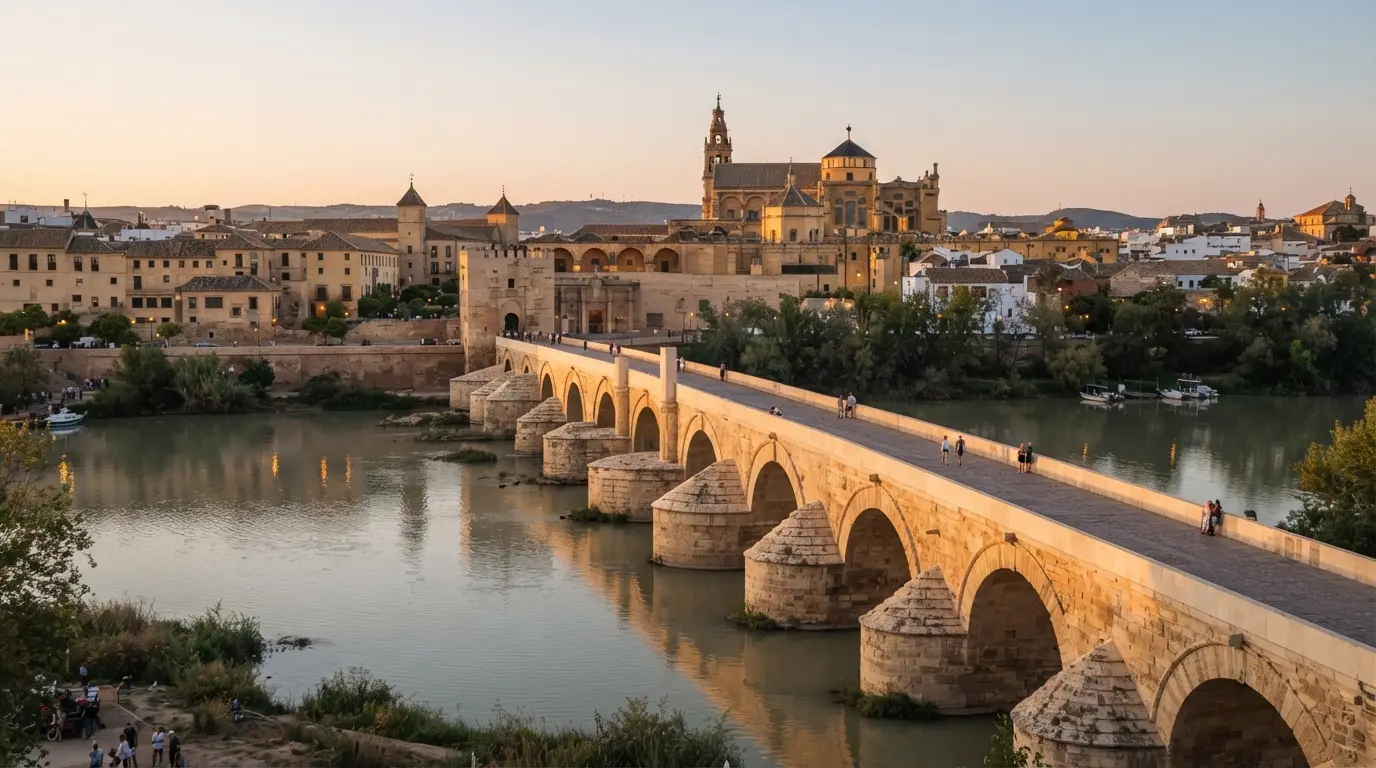

Córdoba Is the Hinge of the Andalusia Circuit, Not a Layover
Every Andalusia road trip funnels through Córdoba at some point, whether the driver plans it or not. It's the only stop in the region where the routes to Seville, Málaga, Madrid and Granada physically cross, on both the motorway network and the high-speed rail line. Most itineraries treat that convergence as a reason to pass through fast: a couple of hours between two cities that feel more finished, more photographed, more essential to see.
Look at the timetable before you look at the road atlas. The AVE covers Seville to Córdoba in 40 minutes[1], and every Madrid- or Barcelona-bound service running to Granada calls at Córdoba on the way, whether the traveller planned a stop there or not. That isn't a scheduling accident. Córdoba sits on the spine that links the region's other big draws together, which is exactly why it gets flattened into a stopover instead of treated as one.
The case for stopping properly here is structural, not sentimental. The same geometry that makes Córdoba convenient to drive or ride through, sitting almost exactly between Seville and Granada, with Málaga and Madrid both reachable inside a couple of hours, is what makes it worth building a real stop around, rather than treating it as the gap between two other cities.
The Legs That Make or Break the Circuit
For rail-based circuits, the numbers are generous enough to be misleading: Seville to Córdoba in 40 minutes[1], Córdoba to Granada in about 1 hour 30 minutes[2]. Neither leg asks for a full travel day, and that's precisely the trap. A trip that budgets those minutes for transit and nothing else has quietly decided Córdoba is a platform change, not a place.
| Leg | By AVE | By car |
|---|---|---|
| Seville → Córdoba | 40 minutes[1] | About 1h20 via the A-4 |
| Córdoba → Granada | 1h30[2] | About 2h via the A-92/A-45 |
Demand is already moving the other way. Overnight stays in the city's tourist apartments jumped 30.4% in 2023, to just over 1 million[3], a growth rate that suggests more travellers are already figuring out what a rushed stopover misses, even before the road-trip crowd catches up.
Driving changes the arithmetic without changing the argument. The A-4 autovía puts Seville within easy reach, and the A-92/A-45 corridor opens onto Granada and Málaga, but a one-way rental picked up in Seville and dropped off in Granada carries its own fee, a cost that's much easier to justify against a stop worth two or three nights than against a lunch break. Whatever you're driving, sort out the practicalities before the dates are fixed: do you need a car in Córdoba, driving in Córdoba and parking in Córdoba cover the decisions that matter.
The structural point holds regardless of how you arrive: every train running Madrid–Granada or Barcelona–Granada calls at Córdoba along the way[4], which makes it a hub by design, not by accident. A road-trip itinerary that treats it as a place to drive straight past is arguing with the region's own transport geography, not just its own schedule.
What the One-Day Stop Structurally Can't Reach
Medina Azahara is the clearest case for a longer stop. The ruined caliphal city sits roughly 8 km outside Córdoba[5], at the foot of the Sierra Morena, too far to fold into a walk from the Judería, and not served by the ordinary city bus network. A driver who allots Córdoba an afternoon between Seville and Granada will see the Mezquita-Catedral's courtyard and little else; Medina Azahara needs its own half-day, its own transport plan, and ideally its own slot in the itinerary rather than a rushed add-on squeezed between two other cities.
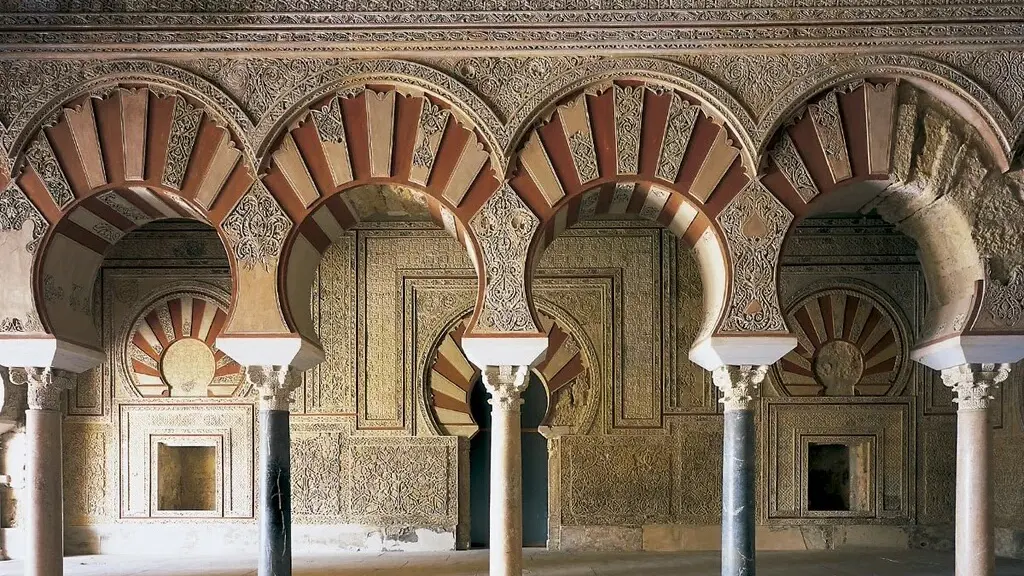
Explore nearby · Monument
Medina Azahara
Medina Azahara is Córdoba's UNESCO listed Caliphate City: a 10th century palace 8 km from town, with the Salón Rico and award-winning museum. Plan your visit.
It also isn't a footnote to Córdoba's old town, whatever the guidebook map suggests. The site earned its own UNESCO World Heritage inscription in 2018[6], separate from the listing that covers the historic centre, recognition that it stands as a heritage site in its own right, not a minor annex a few kilometres out.
What's visible today is only a fraction of what's there. Only around 10% of the site has been excavated[7] so far, which cuts both ways: it's a genuine argument for going before more of it is understood and interpreted for visitors, and a reason to budget real time rather than a quick photo stop on the way out of town.
Build the transfer into the itinerary rather than treating it as optional. Medina Azahara tickets covers the shuttle and timing logistics, the Medina Azahara guide covers what you'll actually find on site, and day trips from Córdoba lists the wider set of excursions that only make sense once you've committed to more than a few hours in the city.
Four UNESCO Lines on One Map
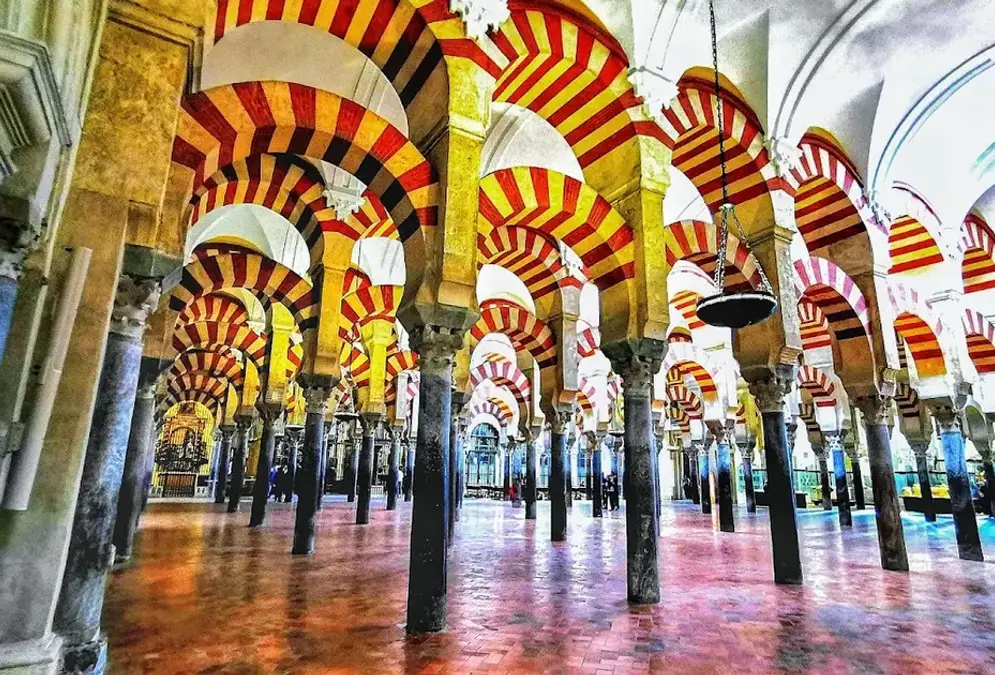
Córdoba's Mezquita-Catedral was inscribed on the UNESCO World Heritage List in 1984, then extended in 1994 to cover the historic centre and the Alcázar[8]. That's one inscription stretching across several separate monuments that most road-trip stops compress into a single photo outside the Puerta del Perdón.
Add Medina Azahara's own 2018 listing[6] and the Patios Festival's 2012 inscription on UNESCO's Intangible Cultural Heritage list, a twelve-day event held each May[9], and Córdoba carries four distinct UNESCO designations inside a city most itineraries allow half a day. The full UNESCO heritage rundown, the Mezquita-Catedral itself, and the Patios Festival guide are worth reading before you decide how much time that deserves.
The density runs deeper than the caliphate, too. Jewish heritage in Córdoba and Roman Córdoba both sit inside the same walkable core, layered under the same UNESCO-listed streets, reasons that stack on top of the transport logic in the previous section, not instead of it.
Building the Stop Into the Circuit, Not Around It
Where Córdoba falls in the running order matters less than whether it gets a fixed overnight at all. Coming from Seville, arriving mid-afternoon and leaving the next morning turns a transit stop into an actual visit; coming from Granada, the same pattern works in reverse. Best area to stay in Córdoba covers where to base that overnight, and getting to Córdoba covers the arrival logistics whichever direction you're coming from.
How many nights, specifically, is its own decision with its own trade-offs, how many days in Córdoba works through that in detail, and isn't worth re-litigating here. What matters for a road trip is that the decision gets made deliberately, weighed against Medina Azahara's transport needs and the Patios calendar, rather than defaulted to whatever's left once Seville and Granada have taken their share of the week.
The comparisons worth reading before you fix the route are Córdoba, Granada and Seville together for the three-city trade-off, and slow travel in Córdoba for what changes once the day-trippers clear out in the evening. Both assume you've already decided to stop here; this piece is only about why that decision is worth making in the first place.

Deep dive · Article
Córdoba Off-Season: Why the Quiet Months Are the Smart Visit
Córdoba's Mezquita drew a record 2,186,774 visitors in 2024, yet January stayed nearly empty. Here's the data behind why Nov–Mar is the smartest time to visit.
Recommended tours
Tours are selected for quality, not commission. We earn a small fee if you book — at no extra cost to you.


None of this requires abandoning the rest of the circuit. It just means treating Córdoba as a hinge with its own weight, not a joint you pass through on the way to somewhere else.