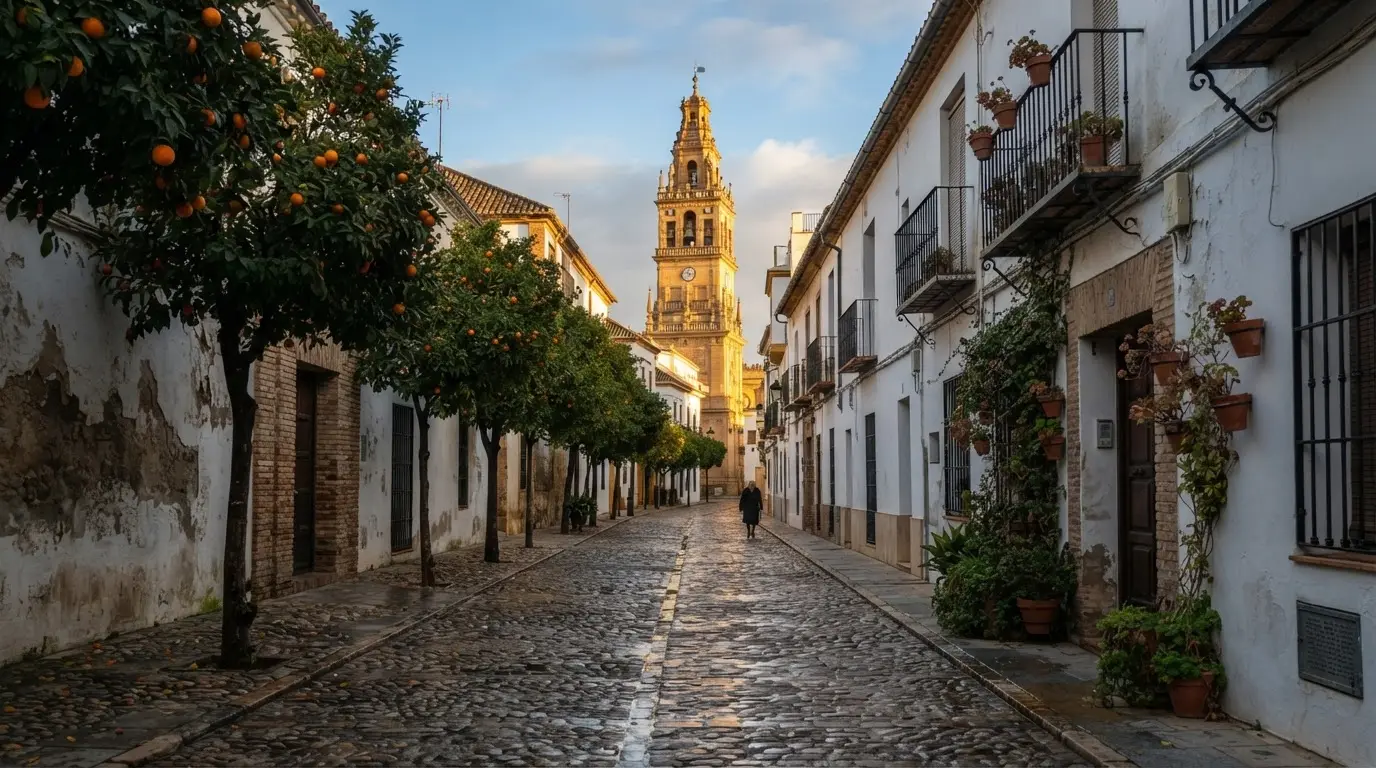

Córdoba's record year, and the quiet month underneath it
The Mezquita-Catedral, Córdoba's UNESCO-listed Mosque-Cathedral, closed 2024 with 2,186,774 visitors — its highest total since the Cabildo began keeping records[1]. That's more people passing through its forest of striped arches in twelve months than live in the entire city. A companion piece on how Córdoba handles two million Mezquita visitors a year breaks down the daily caps, the entrance queues and the ticketing system that came with a number that size. This piece asks a different question: what does the other side of that record look like, in the months when the same monument is nowhere near capacity?
That record didn't happen in isolation, and it isn't only a Córdoba story. Spain's inland and rural regions — the interior towns and provincial cities officials now group under the informal label "green Spain" — saw visitor numbers climb by roughly 60% between 2019 and 2025, outpacing the roughly 45% growth logged by the country's traditional coastal and urban hotspots over the same period[2]. Córdoba, landlocked and two hours from the nearest beach, sits squarely inside that shift. The city isn't just busy; it's busy in a way that increasingly resembles where Spanish tourism is choosing to grow next, rather than where it has always concentrated.
None of this makes the summer crowds a myth, or the record year an accident. What it does is separate two questions that get collapsed into one all the time: is Córdoba worth visiting, and when should you visit it. The first answer has been settled for centuries; the second is where a genuinely different trip is available, at the same admission price, to anyone willing to travel outside the five months everyone else already picked.
What the calendar actually looks like
Start with the underlying visitor-flow pattern, because "busy" and "quiet" both hide a lot of variation underneath them. March, April, May, September and October are Córdoba's five certified busy months at the Mezquita-Catedral, each one clearing 200,000 monthly visitors and cresting at 273,000 in May[3]. January isn't one of them. Neither is June, July or August, the stretch most first-time visitors assume is the only season worth booking a flight around.
Explore nearby · Monument
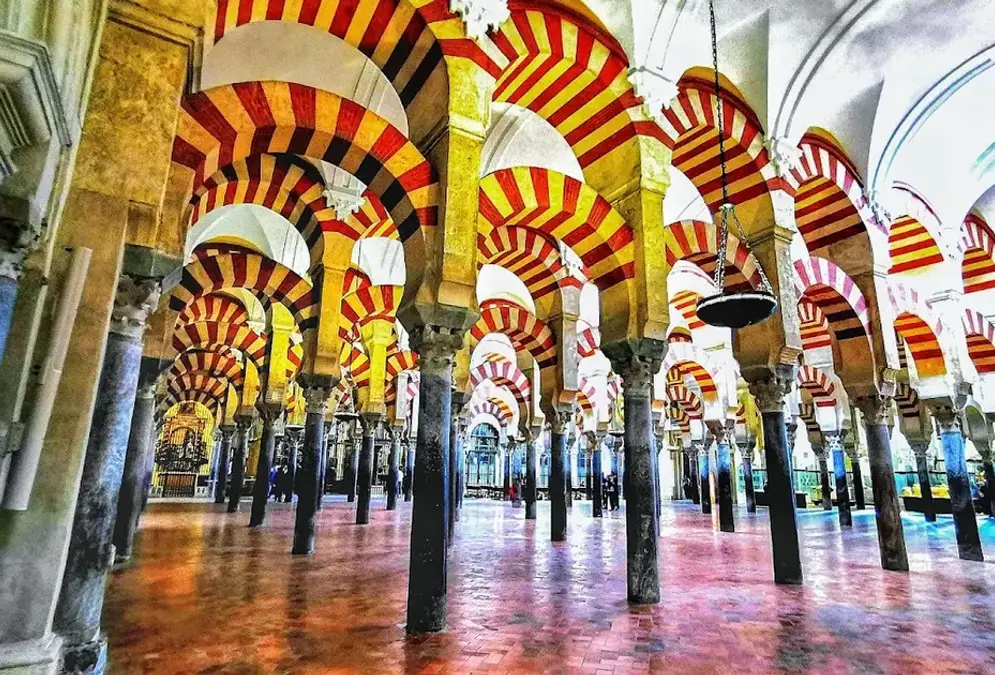
Mezquita-Catedral de Córdoba
856 columns, 1,300 years of Islamic and Christian history. UNESCO monument in Córdoba, Andalusia. Red-and-white arches, Byzantine mosaics, a Renaissance nave.
The first half of 2026 confirms that pattern is holding, not fading with time. The Mezquita-Catedral passed 1,099,223 visitors in H1 2026, the third consecutive year it has cleared the million-visitor mark before July even arrives[4]. That total was actually down 7.35% on the same period in 2025, but the Cabildo attributes the dip to a specific, one-off disruption: a high-speed rail accident and weather-related line closures near Adamuz, plus broader travel headwinds, not to any drop in appetite for visiting the city. Read the underlying demand rather than one bad half-year of rail service, and the shoulder months are still doing the heavy lifting they did in 2024.
Spain's official policy: deseasonalisation is the plan, not a side effect
Spain closed 2025 with 97 million international visitors, an all-time record and a 3.5% rise on 2024[5], a trend covered in more depth in Spain travel statistics 2026. Read as a headline, that's a straightforward tourism-boom story: more people, more money, another record year. It isn't being told that way in Madrid, and that distinction matters more than it sounds.
At a Council of Ministers press briefing in March 2026, Spain's Minister for Industry and Tourism named the trend behind the record explicitly, in front of cameras rather than in a strategy document nobody reads: deseasonalisation, decentralisation and diversification. "What we want to happen is happening," he said[6]. That's not incidental praise for a good year. It's a government describing its own policy working as designed: spreading demand across more months and more regions, rather than simply cheering another record August. A country doesn't put a minister in front of a podium to celebrate an accident.
Recommended tours
Tours are selected for quality, not commission. We earn a small fee if you book — at no extra cost to you.
This isn't Spain's first attempt at spreading tourism more evenly, but it's the first with this much money and this much explicit political framing behind it. The Sustainable Tourism Strategy 2030, covered in more depth below, treats the gap between May and January not as an inconvenience to be smoothed over, but as the resource the whole plan is built to use.
The economics behind the policy
The demand shift shows up first in who is coming. In H1 2026, 53.52% of Mezquita-Catedral visitors were Spanish, against 46.48% international, with France, the United States and Italy the leading foreign markets[7]. A tourism model built entirely around peak-season foreign arrivals doesn't produce that kind of domestic majority; a model that works across more of the calendar does, because Spaniards traveling inside Spain are far likelier to go in October or February than in the middle of August.
The spending numbers make the case more bluntly than the visitor counts do. Between 2019 and 2025, tourist spending in Spain grew by 20.4%, nearly double the 10.9% growth in arrivals over the same period[8]; fewer new visitors are producing proportionally more revenue, and the government's own account credits shoulder-month and off-peak travel with a growing share of that gap.
| Metric | Growth, 2019-2025 | What it shows |
|---|---|---|
| Tourist arrivals, nationwide | +10.9% | The baseline everyone expects |
| Tourist spending, nationwide | +20.4% | Growing almost twice as fast[8] |
| Coastal & urban hotspots | ~+45% | Still growing, no longer leading[2] |
| Inland "green Spain" regions | ~+60% | Outpacing the coast[2] |
The money behind that shift is real, not aspirational. Spain is in the middle of investing €3.4 billion in EU funds against what officials call the Sustainable Tourism Strategy 2030, a roadmap built explicitly around diversification, decentralisation and deseasonalisation, aiming at what the ministry terms "triple sustainability": social, environmental and economic[9]. Visiting in November instead of May isn't a workaround the industry merely tolerates. It's closer to the outcome the funding was designed to produce.
Why November–March is the smart window to actually be there
None of the policy language changes what a visit actually feels like on the ground, so start there instead. On the single busiest day of January 2024, the Mezquita-Catedral recorded 3,500 visitors, with hourly peaks that never topped 500 people, comfortably under the site's saturation threshold[10]. Compare that to the year's single busiest day overall, which hit 8,000[10]. January isn't a compromise season, and it isn't the monument operating at reduced hours or limited access: it's the same building, the same opening times, the same eleven centuries of columns, at roughly half its own comfortable ceiling.
The climate does the rest of the arguing, and it does it in plain numbers. Córdoba's average January high is 15.2°C, against 37.1°C in July[11]. That's not a marginal difference between two pleasant options — it's the gap between walking the old quarter in a light jacket at any hour you like, and not walking it at all between roughly 2pm and 6pm in August, when the stone itself is too hot to lean against. If you've already read the guide to visiting Córdoba in winter, you know what that means for how a day gets structured here; if you haven't, the short version is that November through March is the only stretch of the year when the city's outdoor hours and its comfortable hours are the same hours.
Deep dive · Article
Why Córdoba Deserves More Than a Day on an Andalusia Road Trip
Córdoba sits where the Seville, Granada and Madrid routes cross by road and rail, making it Andalusia's hinge city and worth more than a one-day drive-by stop.
How to plan the visit
The ticket price doesn't change with the season. The Mezquita-Catedral's general adult entry was 13€ in 2024, the ticket 60% of all visitors bought[12]. Paying the same price for a room with a fraction of the footsteps in it isn't a discount on paper, but it's the closest thing to a shoulder-season discount this particular monument offers.
The heat calendar is the other half of the planning decision. Córdoba averages 16 days a year above 40°C and 68 days above 35°C, almost all of them concentrated in the exact months everyone assumes are the only time to go[13]. Skip those months and you skip the days the city itself effectively half-closes between early afternoon and early evening: shutters down, streets empty, patios the only place worth sitting.
The travelers already making this trade are a specific, identifiable group, not an eccentric minority. This pattern is often labelled silver tourism: tourists over 65 show far steadier year-round spending than younger age groups, with over 85% of their total 2025 spending occurring in every single month, without the sharp August and Christmas spikes that define younger travelers' habits[14]. If you're planning a Córdoba trip as a couple or solo, outside a school calendar, you're not experimenting with an unusual idea. You're doing what a large, steady share of visitors already do.
Bloom season and the Patio Festival are still worth the crowds they bring, and the overtourism pressures the city is already managing are real and worth understanding before you book either way. The case here is for treating November through March as a first choice, not a fallback booked only when the calendar didn't cooperate. For the month-by-month logistics — what's open, what to pack, which festivals fall when — the best time to visit Córdoba guide covers the practical ground this piece has deliberately left alone.