
Who Hosius was, and how little is certain
Hosius is the English form of a name that appears as Ossius in Latin and Greek sources and as Osio in Spain. The birth year usually given, about 256, is only a computation from the great age at which he died.[4] Nothing survives about where he was born, how he was trained or how he became bishop of Córdoba.[5]
What can be said with some confidence is how long he held the see. His episcopate is thought to have begun around 295 and to have lasted more than sixty years,[6] long enough to span the last great persecution, the conversion of the empire's ruler and the first doctrinal war the Church fought in public. It is a wide arc for one man.
The city he served was still Roman Corduba, a name whose road to modern Córdoba is traced in the origin of Córdoba's name. Be suspicious of any biography that hands him a confident Córdoba childhood. The sober version starts in middle age, at a council.
From Elvira to Constantine's court
His first documented act is attending the council held at Elvira, early in the fourth century, where he was the leading bishop present.[7] Córdoba at the time was a Roman provincial city, and the Roman temple uncovered there is the grandest reminder of the civic religion a Christian bishop lived beside.
By 312 he appears in Constantine's entourage, and how the connection began is unknown.[8] What is clear is the use the emperor made of him. In 324, with the quarrel between Bishop Alexander of Alexandria and the priest Arius spreading, Constantine sent Hosius to Alexandria with a conciliatory letter.[9] The mission failed, and the following year the dispute went to a council at Nicaea.
Explore nearby · Monument
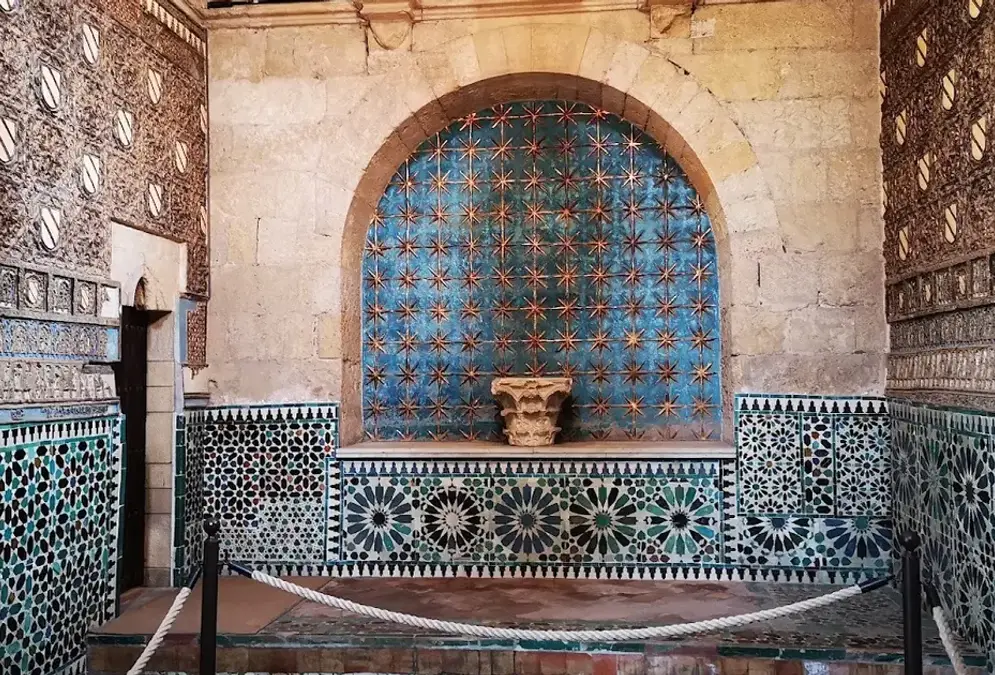
Capilla de San Bartolomé
A late 14th-century Gothic-Mudéjar chapel in Córdoba with exquisite plasterwork, blending Christian and Islamic artistic traditions over 600 years old.
A provincial bishop turned imperial envoy is the root of everything later claimed for him. When an emperor needs a trusted churchman to carry a letter, and later to take a leading place in an assembly, the man he sends gets remembered as the emperor's voice.
Did Hosius preside at the Council of Nicaea?
Nicaea met in 325 with few Western bishops: Hosius came from Spain, Nicasius from Dijon, Caecilian from Carthage and Eustorgius from Milan, among the handful.[10] That thin Western delegation makes the Spanish bishop's prominence easier to understand and harder to measure. Historians give three answers to who held the chair, and the honest summary is that the evidence does not force a choice.
- He presided. Older Catholic reference works say he presided together with the two Roman priests Vitus and Vincent, while admitting that the capacity in which he did so is much discussed.[11]
- Not formally. A Protestant encyclopedia of the same era answers that no ancient authority says he presided formally, and that his name appearing first beside the Roman legates proves nothing.[12]
- Unclear. Recent scholarship allows that perhaps he presided, without settling whether he did so in the pope's name or as Constantine's nominee.[13]
What nobody disputes is that he was there and carried weight. One recent study credits him with an active part in drawing up the canons and the Nicene Creed,[14] which is a more defensible claim than the popular shorthand that he wrote the Creed.
So when a plaque, a talk or a guide says Hosius led Nicaea, read it as a position in this debate, not as settled fact. The Córdoba commemoration honours the man at the council, whichever chair he sat in.
Serdica to Sirmium: the last councils, the signature and the death
His better-attested chair came later. The Council of Serdica is usually dated to 343, though 342 and 347 are also argued, and Hosius is believed to have presided there, proposed the canons and been the first to sign the Acts.[16] That puts the Nicaea question in sharper relief.
By the mid-350s the emperor was Constantius II, and Hosius, if the traditional birth year is right, was close to a hundred. In a letter to Constantius sent shortly after 355 he recalled that he had suffered under Maximian in the Diocletianic persecution,[17] and that letter, preserved by Athanasius, is the only writing of his that survives.[18]
Constantius then summoned him to Sirmium and kept him there for a year, starting in July 357 at the earliest.[19] The man who had stood beside Constantine ended as a detained guest at the court of Constantine's son.
Under pressure Hosius signed the second Sirmian formula, a compromise creed of Arian tendency, and the facts about the end of his life are far from clear.[20] Whether to read that signature as the lapse of a man of about a hundred under duress or as a flaw in the man himself is a judgement; the record supports only that he signed.
Osio's Córdoba afterlife: a palace theory and a cause
Archaeologists have tried to give him a Córdoba address. The excavated Roman complex at Cercadilla is the candidate: its original function may have been that of a palatium Maximiani, or episcopium, a bishop's residence.[23] It remains a hypothesis, not a finding.
The Diocese of Córdoba held a congress called "El siglo de Osio de Córdoba" in 2013,[24] and in 2025 it described a cause to extend the cult he already receives in the East to the whole Church as moving forward.[25] Ask the diocese for the cause's current stage before repeating any claim about it.
Recommended tours
Tours are selected for quality, not commission. We earn a small fee if you book — at no extra cost to you.
Seeing Hosius's traces in Córdoba
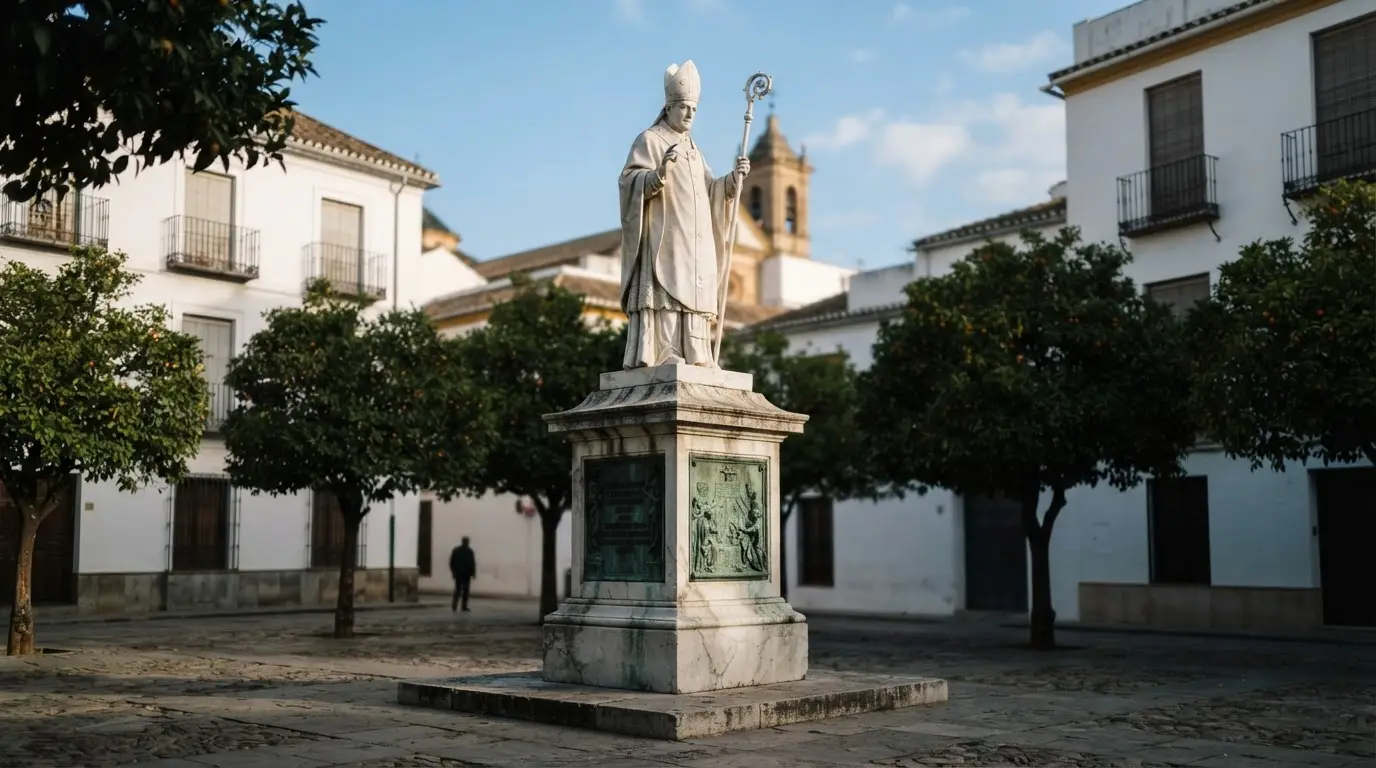
The Osio monument stands in the Plaza de las Capuchinas, a work of the sculptor Lorenzo Coullaut Valera.[2] It was made in 1925 and installed in April 1926 for the Nicaea centenary,[26] and its pedestal carries three bronze reliefs: Osio in conversation with Constantine on the front, his part in the Council of Nicaea on the right and his martyrdom on the left.[27]
The dedication on the back names him bishop, confessor and counsellor of Constantine the Great, and records that he presided at Nicaea.[28] That takes the "presided" side of the debate outright, which is worth knowing before you read it.
Cercadilla, the Roman complex floated as his possible residence, is listed by the Junta de Andalucía as currently closed to the public,[29] so there is nothing to enter and no hours to plan around. It lies in the city beside the RENFE station.[30]
Deep dive · Article
Abd al-Rahman III: The Morning Córdoba Became a Caliphate
Abd al-Rahman III was the first Caliph of Córdoba, declared on January 16, 929, ruling Córdoba for 49 years and starting work on Medina Azahara in 936 CE.
The visitable Hosius is therefore thin: one monument in one square and a closed Roman site that may once have been his residence. That thinness is faithful to the sources.