Córdoba's Duque de Rivas Went From Exile to Don Álvaro
Ángel de Saavedra, Duke of Rivas: Córdoba-born soldier, exile and author of Don Álvaro. His life, the 1929 Benlliure monument and where to find it today.
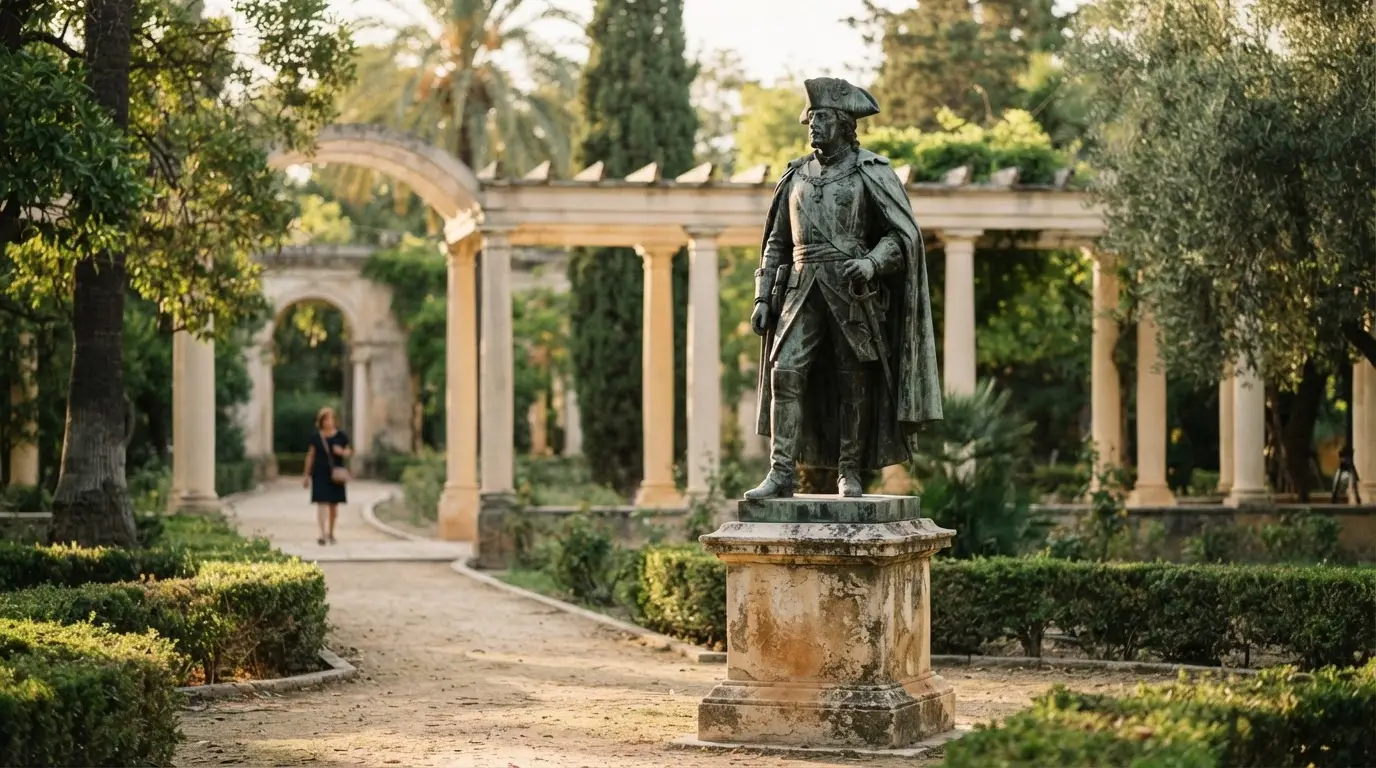
On 18 November 1809 a French attack at Ontígola left an eighteen-year-old cavalry officer from Córdoba gravely wounded and given up for dead[1]. He lived to become the Duque de Rivas and, after years of exile, the author of Don Álvaro o la fuerza del sino, the play on which Verdi's La forza del destino was built[2]. Córdoba keeps a Mariano Benlliure statue of him[3] in the northern part of the Jardines de la Victoria, the stretch named after him on the Paseo de la Victoria[24], and it is a short stop rather than a destination, best found once you know the man.
Primo de Rivera came to Córdoba for the ceremony[6]
In this article
Jump to a section
⌄
Born in Córdoba in 1791: A Childhood of Early Honours
Ángel Saavedra y Ramírez de Baquedano was born in Córdoba on 10 March 1791[7], a segundón, or younger son, which in a noble Spanish house meant the title was going to someone else and the honours were handed out early as compensation. He became a Knight of Justice of the Order of Malta at six months, a cavalry captain in the Infante's regiment at seven and a holder of the Santiago habit at nine[8]. None of it had anything to do with what he had done.
Where exactly he was born is partly a matter of civic tradition. Córdoba's tourism board names Casa Carbonell, beside the convent church of Santa Ana, as his birthplace[9]. The building there now is late-19th-century in style and houses the municipal company VIMCORSA, with temporary exhibitions in its large halls[10], so it is unlikely to be the house he knew. Access depends on what is on show, so check the current programme before detouring.
By 1800 the family had moved to Madrid, so his Córdoba childhood was short. The city would claim him anyway, and he would come back to it as a young man.
Left for dead, then a liberal deputy
At Ontígola the boy with the cavalry commission met the real thing. The French clash of 18 November 1809 was a disaster for the Spanish side, and Saavedra, then eighteen, was gravely wounded and given up for dead[1]. Córdoba had already lived through the French sack of 1808, so for a Cordoban officer the Peninsular War was never a distant affair.
In Córdoba he befriended the liberal Antonio Alcalá Galiano, whose ideas shaped his politics, and in December 1821 the province sent him to the Cortes as a deputy[11]. The boy who had collected royal and religious honours before he could shave was now a constitutional liberal. Fourteen years separate the wound at Ontígola from his flight abroad, and the deputy's seat lasted barely two of them: within two years of his election the liberal cause in Spain had collapsed, and Saavedra was on the run.
Eleven years abroad: Gibraltar, Malta, France
He fled in 1823 and reached Gibraltar three days later in a Valencian boat, at the start of an exile that would last eleven years[5]. Malta kept him for five years, and in the spring of 1830 he moved on to the conservative France of Charles X[12]. Malta was the island of the order that had knighted him as a baby, and its harbour light gave him one of his best-known poems: El faro de Malta sets a storm at sea against the steady lamp of the lighthouse, which stands for reason amid the fury of the passions[13].
In Orléans the former cavalry captain gave painting lessons to survive[14], and in Tours he finished El moro expósito, a first prose version of Don Álvaro and a number of Romances históricos[15]. Alcalá Galiano, his friend from Córdoba, later said the plot of Don Álvaro grew out of the conversations the two of them had there[16].
Don Álvaro therefore has a Córdoba root and a foreign workshop. Its author drafted it in a French provincial town after teaching painting to eat, and he would see it staged as a grandee.
Don Álvaro, 1835: a premiere with precedents
Back in Spain, he had been home only a few months when his elder brother Juan Remigio died, apparently of apoplexy, and the younger son became Duke of Rivas, Grandee of Spain and a member of the Estamento de Próceres in the Cortes[17]. The title he had never expected arrived before the play that would carry it.
On 22 March 1835 Don Álvaro o la fuerza del sino, or Don Álvaro, or the Force of Fate, opened at the Teatro del Príncipe in Madrid[4]. It was not the first Spanish Romantic drama staged in Spain[18], and the earlier ones had been tolerated because they did not break with the past. The play belongs in any history of Spanish Romanticism, but not at its starting line.
Francesco Maria Piave based the libretto of Verdi's La forza del destino on the play[2], so anyone who has sat through that opera has met Rivas's plot without knowing it.
Ambassador, minister for two days, academy director
As ambassador in Naples from 1844 he fell for the climate and the people, and stayed six years that were among the happiest and calmest of his life[19]. His 1854 turn as president of the ministry lasted two days, after which he took refuge in the French embassy[20].
He finished as director of the Real Academia Española, elected on 20 February 1862 and in post until he died on 22 June 1865 in a Madrid palace now known as the Palacio de Viana[21][22]. Córdoba has a Palacio de Viana of its own, a different building, so keep the two apart when planning a day.
Timeline
10 March 1791
Born in Córdoba
Ángel Saavedra y Ramírez de Baquedano, a younger son of a noble family[7].
18 November 1809
Left for dead at Ontígola
Gravely wounded in a disastrous encounter with the French[1].
The monument to Ángel de Saavedra stands in the Jardines del Duque de Rivas, next to the Paseo de la Victoria[23]. Mariano Benlliure's statue[3] was inaugurated on 5 May 1929, when Miguel Primo de Rivera, who then headed the directorate governing Spain, came to Córdoba for the ceremony[6].
Benlliure chose the statue's site himself[25]. A pergola behind it, by the architect Carlos Sáenz de Santamaría[26], traces its origins to the same commission[3], so the statue and the structure behind it belong to one scheme rather than the statue being dropped into an existing garden. Stand a few steps back and read the two together.
Recommended tours
Tours are selected for quality, not commission. We earn a small fee if you book — at no extra cost to you.
If the Duke makes you want the rest of the line, Córdoba's older literary names are the Roman poet Lucan and the Baroque poet Góngora.
Frequently asked questions
Who was the Duque de Rivas, and what is his Córdoba link to Don Álvaro?
Ángel de Saavedra, 3rd Duke of Rivas, was born in Córdoba on 10 March 1791 and died in Madrid on 22 June 1865. A soldier, liberal deputy and exile, he wrote the drama Don Álvaro o la fuerza del sino, which premiered at the Teatro del Príncipe in Madrid on 22 March 1835. His Córdoba links are his birth, his early liberal politics in the city and the Benlliure monument unveiled there in 1929.
Was the Duke of Rivas born in Córdoba?
Yes. Ángel Saavedra y Ramírez de Baquedano was born in Córdoba on 10 March 1791. The city's tourism board names Casa Carbonell, beside the convent church of Santa Ana, as his birthplace, though the building there today is late-19th-century in style, so the address is best read as local tradition.
Where is the statue of the Duke of Rivas in Córdoba?
The monument stands in the Jardines del Duque de Rivas, next to the Paseo de la Victoria. It is a statue by Mariano Benlliure, inaugurated on 5 May 1929 in the presence of Miguel Primo de Rivera.
Was the Duke of Rivas ever prime minister of Spain?
Briefly. In 1854 he served as president of the ministry, but the spell lasted only two days, after which he took refuge in the French embassy.
How does Don Álvaro relate to Verdi's La forza del destino?
Francesco Maria Piave wrote the libretto of Verdi's La forza del destino based on the Duke of Rivas's drama Don Álvaro o la fuerza del sino, first staged in Madrid in 1835.
Why did the Duke of Rivas go into exile?
He was a liberal who had been elected deputy for Córdoba province in December 1821. When the liberal cause collapsed in 1823 he fled to Gibraltar by boat, then lived five years on Malta and, from 1830, in France, in an exile that lasted eleven years.
Can you visit the Duke of Rivas's birthplace in Córdoba?
Casa Carbonell, the house locally identified as his birthplace, stands beside the convent church of Santa Ana. It now houses the municipal company VIMCORSA, and many of its large halls are used for temporary exhibitions, so what you can see depends on the current programme.
“The libretto was written by Francesco Maria Piave based on a Spanish drama, Don Álvaro o la fuerza del sino (1835), by Ángel de Saavedra, 3rd Duke of Rivas”
“El 5 de mayo de 1929, Miguel Primo de Rivera, presidente del directorio que gobernaba España llegó a Córdoba para asistir a la inauguración del monumento”
“el joven segundón pronto comenzó a recibir distinciones como el nombramiento de Caballero de Justicia de la Orden de Malta a los seis meses de edad, el de capitán de caballería en el regimiento del Infante a los siete años, y el hábito de Santiago a los nueve.”
“The magnificent Carbonell House stands in the centre of Cordoba, next to the Convent Church of Santa Ana, and was the birthplace of Ángel de Saavedra, Duke of Rivas, the 19th century Romantic writer.”
“contrapone la imagen hostil de una tempestad en el mar con la imagen tranquilizadora de la luz del faro de Malta, símbolo de la razón en medio del furor de las pasiones.”
“Unos meses después de su llegada falleció su hermano mayor Juan Remigio, al parecer, de una apoplejía, con lo que Ángel Saavedra se encontró así Duque de Rivas, Grande de España y miembro del Estamento de Próceres en las Cortes.”