Julio Romero de Torres: The Painter Who Made Córdoba Sensual
Julio Romero de Torres (1874–1930) turned Córdoba's women, light, and flamenco into Andalusian symbolism. His last painting remains in his Córdoba museum.
Art history background with eight years writing interpretive content on Córdoba's Caliphal heritage.
Updated Published
Julio Romero de Torres was born in 1874 inside the building his father ran, which now houses the Museo de Bellas Artes de Córdoba. He spent 55 years turning the city's women, light, and flamenco into a style that Spanish critics called Andalusian symbolism. By the time he died in 1930, the whole city came out to watch him pass.
In this article
Born inside the museum
On November 9, 1874, Julio Romero de Torres was born in an apartment inside the Museo de Bellas Artes de Córdoba. His father, Rafael Romero Barros, was both its director and a painter of some reputation. The family did not just live near the museum; they lived inside it, among the canvases.
By age ten, Julio was apprenticed to his father[1]. He was drawing systematically by the time other children were learning arithmetic. At seventeen he was illustrating the local newspaper Diario de Córdoba, producing weekly vignettes that required him to observe and condense what he saw. Two brothers, Rafael and Enrique, were also painters. In that household, it was less a choice than a condition.
10
Age when Julio began his artistic apprenticeship under his father Rafael Romero Barros, director of the Museum of Fine Arts of Córdoba. By seventeen, he was illustrating the Diario de Córdoba.
His formal training ran through the Escuela de Bellas Artes de Córdoba. The school, modest by Madrid standards, gave him rigorous academic grounding without pulling him out of the city he was already reading so carefully. Córdoba in the 1880s was a provincial capital living on the memory of a far larger past: Caliphal ruins, Roman foundations, three-cultures churches and synagogues pressed close together in the old medina. That compression, that sense of depth underfoot, never left his work.
The Olive Press noted in May 2026, on the 96th anniversary of his death, that he was «precocious and sexy», which is one way of putting it[2]. Another is that he found his subject early and spent the rest of his life going deeper into it.
What Andalusian symbolism actually means
Before 1908, Romero de Torres worked in a post-Romantic realism that won him prizes at the National Exhibition of Fine Arts: a third-class medal in 1899, respectable enough, but nothing that distinguished him from dozens of competent contemporaries. The work was accomplished. It was not yet his.
That changed after a trip to Italy in 1908[3]. Spending time with Raphael and Leonardo in Rome and Florence was not unusual for Spanish painters of his generation, but what he took from that encounter was specific: a method of using figures as vehicles for ideas that exceeded their literal presence on the canvas. In Raphael's allegories he saw not decoration but a philosophical architecture, symbol as structure.
The style he built on his return has a name: Andalusian symbolism. Romero de Torres himself rarely theorized it in writing. The approach was to treat the visible world of Córdoba (a woman at a window, a guitarist in shadow, a coal girl warming her hands) as a surface through which something else was visible. The symbol was not ornamental. It opened dimensions the literal image could not access on its own: spiritual interiority, erotic charge, the presence of death at the edge of the everyday.
His palette did the same work. Deep blacks, cold blues, the honey-coloured Córdoba stone, the greenish shadows of whitewashed interiors. These were not choices made for beauty. They were emotional temperatures, specific to southern light in a city built for shade.
The Two Paths (1915) is his clearest diagram of the system: on one side, a nun; on the other, a woman choosing sensual pleasure. Not one against the other but one inside the other, each requiring the other's existence to make sense. The painting fetched a six-figure sum at auction in 2020[1]. The bidders understood what they were bidding for.
The women who posed for him
Women reportedly queued for portrait sittings with Romero de Torres. This was partly because he was handsome, partly because his affairs were the kind Córdoba talked about, and partly because being painted by him was understood as a form of preservation. Your face would outlast you.
He painted the women of Córdoba with little attempt to disguise their identities. The Carmens of Córdoba society appear under symbolic names (Cante Hondo, La Saeta, La Fuensanta), but the faces were recognised. These were not studio inventions. They were local women, coal-sellers' daughters, flamenco singers, figures from the barrios around Plaza del Potro, painted with the same careful attention he gave to Caliphal stonework.
The painting later known as Nurseries of Love caused the most trouble. It depicted young women working in conditions Córdoba preferred not to look at directly. The National Exhibition rejected it. Córdoba loved it. The distinction matters: the city recognized itself in the image, even if the institutions refused it.
His most lasting act of cultural recognition may be La Fuensanta, a portrait that ended up on Spain's 100 Peseta banknote in 1953, more than two decades after his death[1]. The face of a Cordoban woman in every wallet in Spain. Popular culture validated what the academies had occasionally resisted.
What makes the female portraits more than flattery or provocation is the symbolist depth behind each one. These women are not passive objects. They look back. They hold fruit, musical instruments, light, all with the specific gravity of figures in Renaissance allegory, grounded in Andalusian everyday life. The sensuality is inseparable from the seriousness. That combination was, and remains, unusual.
La Chiquita Piconera: his last painting
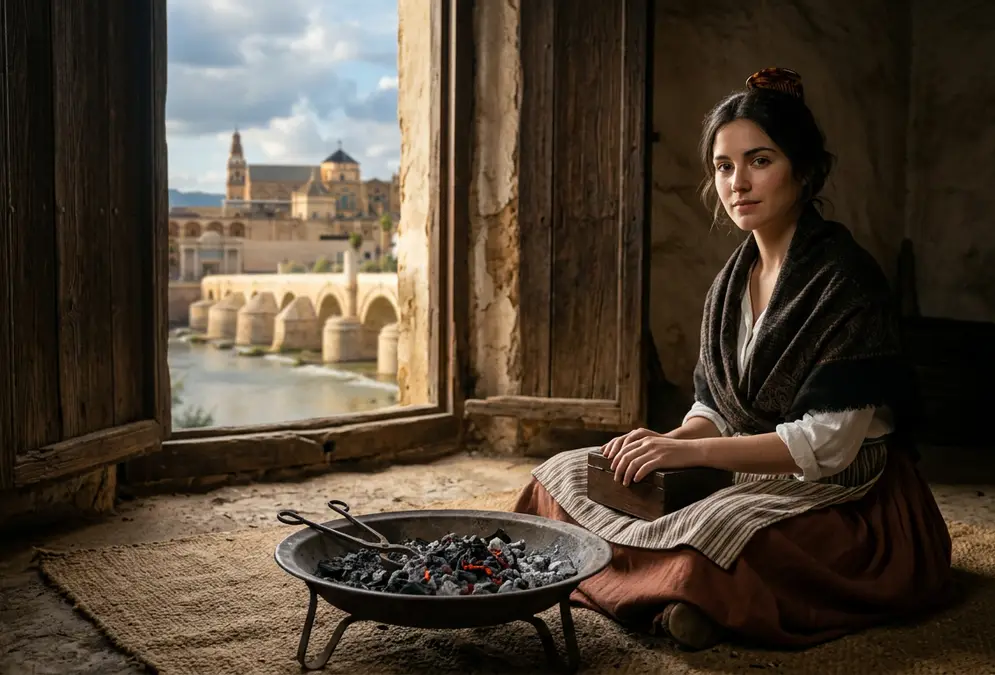
In February 1930, Romero de Torres finished what would be his last complete painting[1]. A teenage girl sits behind a copper brazier, her hands folded, her gaze direct. Behind her, a half-open door frames a specific Córdoba landscape: the Guadalquivir river, the Roman Bridge, the Paseo de la Ribera, the Torre de la Calahorra, and an evening sky. The girl does not look at the view. The view is for us.
La Chiquita Piconera (The Little Coal Girl) encapsulates everything Romero de Torres had been working toward. The brazier she warms herself beside is a domestic object from the barrios where coal girls worked: poverty close to comfort, warmth close to fire. Her gaze refuses innocence and refuses knowingness in equal measure. She is simply there, looking back, with Córdoba laid out behind her like a statement.
Today the painting is the centerpiece of the Museo Julio Romero de Torres in Córdoba — the same building complex where he was born. It is where it belongs. In 2024, it briefly traveled to Madrid as a celebrated guest work in a Thyssen-Bornemisza exhibition (6 May to 28 July), then came home.
“
“the painter of Andalusian essences”
Antonio Machado, poet
For any account of what Andalusian symbolism actually looks like when fully realized, La Chiquita Piconera is the answer. Not a sermon, not an allegory, not a provocation. A girl. A brazier. A door. And through the door, the city.
Romero de Torres finished *La Chiquita Piconera* in February 1930, three months before his death. The landscape behind the girl is identifiably specific: Roman Bridge, Torre de la Calahorra, Paseo de la Ribera. The painting hangs in the Museo Julio Romero de Torres in Córdoba.
Buenos Aires, 1922: the triumph
In 1922, Romero de Torres sailed to Argentina with his brother Enrique and twenty-six paintings. The venue was the Witcomb Gallery in Buenos Aires, then the most prestigious commercial gallery in South America. The catalogue was written by Ramón del Valle-Inclán, one of the defining literary voices of the Generation of '98. That choice tells you how seriously the Spanish cultural establishment had come to take him[1].
The show was a success of a kind Córdoba rarely exports. Buenos Aires in the 1920s was a city consuming European art at speed, with a large Spanish immigrant community that saw in Romero de Torres's Andalusian figures something between homeland memory and mythic image. The Hispanic-American consciousness movement of the period gave the work an additional frame: this was not simply Spanish painting but a claim about what Spanish culture could be in the Americas.
He came back to Spain with a reputation that the National Exhibitions in Madrid could no longer ignore. His formal standing at the Real Academia de Bellas Artes de San Fernando had been accumulating for years: he had been a corresponding member since 1904[4] and held a professorship there from 1916.
Timeline
1874
Born inside the Museum
Born November 9 in the apartment of his father Rafael Romero Barros, director of the Museum of Fine Arts of Córdoba.
1895
First National Exhibition
Honorable mention at the National Exhibition of Fine Arts in Madrid. Career enters national visibility.
1908
Gold Medal: Musa Gitana
First Prize Medal at the National Exhibition for Musa Gitana. International critics begin to take notice.
1915
The Two Paths
Paints The Two Paths, his clearest illustration of the duality between spiritual and sensual. Later sells at auction for over €400,000.
1922
Buenos Aires triumph
26 works shown at Witcomb Gallery. Catalogue by Valle-Inclán. Resounding international success.
1930
Death in Córdoba
Finishes La Chiquita Piconera in February. Dies May 10 of liver disease, aged 55. Two canvases left unfinished.
In 2022, the Museum of Fine Arts of Córdoba, the building where he was born, held a centennial retrospective: Julio Romero de Torres in Argentina: One Hundred Years of a Historical Exhibition (1922–2022). The Provincial Historical Archive of Córdoba contributed documentation from the original show. One hundred years later, the city was still going through the papers.
A city in mourning
By 1928, Romero de Torres was visibly unwell. Doctors advised a long rest. He kept painting.
He returned to Córdoba in early 1930 to recuperate, moved back into the house near Plaza del Potro where he had been born, and finished La Chiquita Piconera in February. Two more canvases were on the easel when he died on May 10, 1930, of liver disease and exhaustion[2]. He was 55.
The whole city came out. This is not a figure of speech. Córdoba in 1930 had just over 103,000 inhabitants according to the census, and accounts describe the streets from his house to the cemetery filled for the length of the procession[2]. The Olive Press, writing on the 96th anniversary of his death, put it plainly: no one represents the soul of Córdoba as well as he does, ranking him alongside or above the bullfighter Manolete and the philosopher Maimonides.
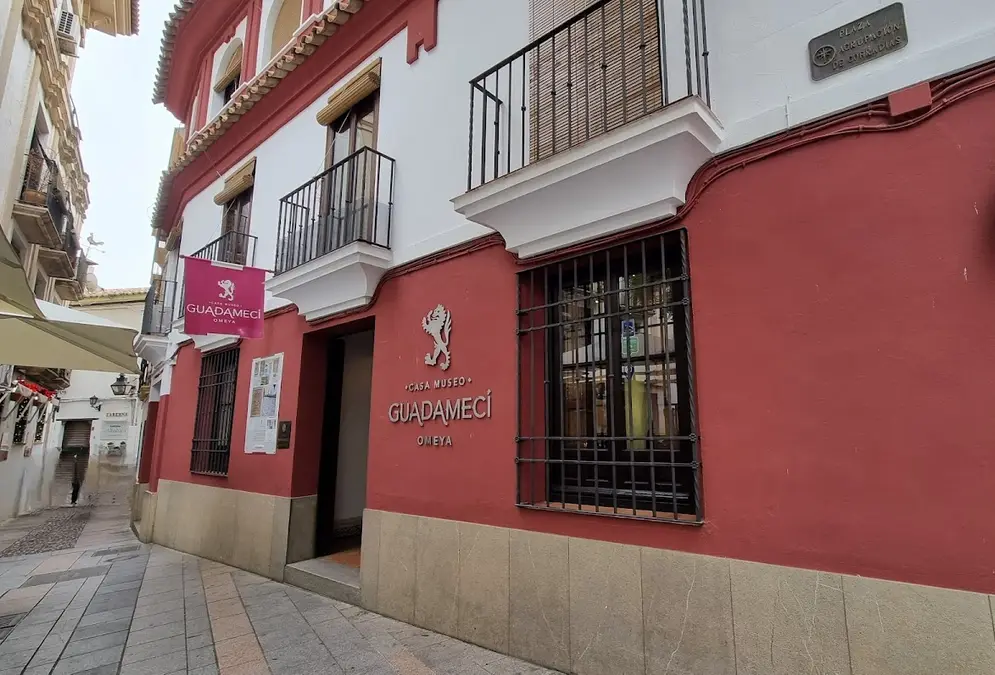
In November 1931, his widow Francisca Pellicer and their children gave his studio to the city. The Museo Julio Romero de Torres opened at Plaza del Potro on November 23, 1931, inside the same honey-coloured building complex where he had been born. Next door, separated by a wall and sharing the same courtyard, the Museo de Bellas Artes de Córdoba occupies the other wing of the former Charity Hospital. He came into the world in one half of the building; his work now lives in the other.
Visitors coming to Córdoba for the art-lovers experience or following the longer thread of Córdoba's cultural history will find both museums open to the same courtyard. You enter through the same gate. The museum hours, the admission price, the guided tour: the practical details are on each museum's page. What the pages cannot tell you is what it feels like to walk across that courtyard knowing that on one side is the room where he was born, and on the other is the room where his paintings now hang: the same light, the same stone, fifty-five years compressed into forty paces.
FAQ about Julio Romero de Torres Córdoba
Who was Julio Romero de Torres?
Julio Romero de Torres (1874–1930) was a Spanish painter from Córdoba, the leading figure of what critics call Andalusian symbolism. He was born inside the Museum of Fine Arts of Córdoba, where his father served as director, and spent his career painting Cordoban women, flamenco culture, and the city's light as vehicles for symbolic and spiritual ideas. He died in Córdoba on May 10, 1930, aged 55, with two paintings unfinished on the easel.
What is Andalusian symbolism and how did Romero de Torres use it?
Andalusian symbolism treats the visible world (a woman's face, a brazier, a guitar) as a surface through which invisible or spiritual dimensions become accessible. Romero de Torres developed this approach after a trip to Italy in 1908, where he studied Raphael and Leonardo. His symbols are not decorative; they carry philosophical weight. The sensual and the sacred coexist in the same image. His palette of deep blacks, honey-toned ochres, and cool blues functions as emotional temperature rather than naturalistic colour.
What is La Chiquita Piconera and why is it his most important work?
La Chiquita Piconera (The Little Coal Girl), finished in February 1930, was Romero de Torres's last complete painting. It shows a teenage coal girl seated beside a copper brazier, gazing directly at the viewer. Behind her, through a half-open door, Córdoba's Roman Bridge, the Guadalquivir, and the Torre de la Calahorra are visible in evening light. The painting brings together sensuality, the everyday life of marginalized women, and Córdoba as setting and soul in a single composition. It hangs permanently in the Museo Julio Romero de Torres in Córdoba, the building where he was born.
Why did he paint so many female portraits?
Female figures were the primary vehicle for his symbolist language. He painted local Cordoban women (coal girls, flamenco singers, women from the barrios around Plaza del Potro) with little attempt to hide their identities, giving them the formal weight of Renaissance allegory. The sensuality in the portraits is inseparable from their philosophical structure. Women reportedly queued for sittings, attracted by both his reputation and the understanding that being painted by him was a form of permanence. His portrait La Fuensanta appeared on Spain's 100 Peseta banknote in 1953, twenty-three years after his death.
What happened at the 1922 Buenos Aires exhibition?
In 1922, Romero de Torres exhibited 26 works at the Witcomb Gallery in Buenos Aires, the most prestigious commercial gallery in South America at the time. His brother Enrique traveled with him. The catalogue was written by Ramón del Valle-Inclán. The show was a major success, confirming his international standing and his significance within the Hispanic-American cultural movement of the period. In 2022, the Museum of Fine Arts of Córdoba held a centennial retrospective marking the exhibition's 100th anniversary.
Where can I see his works in Córdoba today?
The Museo Julio Romero de Torres at Plaza del Potro holds the world's largest collection of his paintings, housed in the former studio where he worked, part of the same building complex where he was born. Admission and hours are on the museum page. The Museo de Bellas Artes de Córdoba occupies the adjacent wing of the same courtyard. La Chiquita Piconera, his most famous work, is the centerpiece of the Museo Julio Romero de Torres collection — you will see it there.
Why does Córdoba claim him as one of its defining figures?
Romero de Torres was born in Córdoba, trained in Córdoba, painted Córdoba's women and light and streets his entire career, and died in Córdoba. The city turned out in the streets for his funeral in 1930. His portrait La Fuensanta appeared on the national currency. The Olive Press, writing in 2026, argued that no one represents the soul of Córdoba as well as he does, placing him alongside or above Manolete the bullfighter and Maimonides the philosopher — a measure of how thoroughly he is identified with the place that made him.
How did he die, and what happened to his studio?
Romero de Torres died on May 10, 1930, of liver disease and exhaustion, aged 55, with two paintings unfinished. He had returned to Córdoba from a period of ill-health to recuperate and continued painting until he could not. In November 1931, his widow Francisca Pellicer and their children gave his studio to the city of Córdoba. The Museo Julio Romero de Torres opened in that space on November 23, 1931, at Plaza del Potro, the same building where he had been born.