
A museum in the right building
The Museo de Bellas Artes de Córdoba occupies the former Hospital de la Caridad, on Plaza del Potro, one of the city's oldest squares. The hospital itself dates to the last quarter of the 15th century, but its most significant surviving parts — the stairway, the patio, and the chapel — belong to the early 16th century. The museum's collection was founded in 1844, in the wake of the ecclesiastical desamortización that emptied Spain's convents and monasteries and filled its new provincial museums with the art. Under its first director, Diego Monroy Aguilera, the collection was initially installed in the provincial deputation building; the space proved inadequate, and in 1862 it moved into the Hospital de la Caridad, where it has stayed ever since.
That move mattered for another reason. The man who opened the doors of the new museum in 1862, its first director, was Rafael Romero Barros — father of the painter Julio Romero de Torres, whose own museum now stands in the same building. The courtyard he oversaw, planted with orange trees, and the Baroque staircase with its octagonal wood-coffered ceiling, are still what visitors walk through today before reaching the first gallery.
The Baroque galleries
The collection's real weight sits in Spanish Baroque and 19th-century painting. Its principal holdings include works by Bartolomé Bermejo, Luis de Morales, Juan de Valdés Leal, José de Ribera, Francisco de Zurbarán, Bartolomé Esteban Murillo, and Antonio del Castillo, alongside sculpture by the Córdoba-born Mateo Inurria. The Zurbarán canvases are the ones worth slowing down for — monumental friars and martyrs rendered with the stark, close-observed realism that made him the preferred painter of the Counter-Reformation. Valdés Leal, more famous in Seville for his memento mori paintings, shows a different, more measured side of his technique here.
Spend time in these rooms before moving on. The paintings reward sustained looking that a well-lit, uncrowded gallery makes possible — and this museum, off the main tourist circuit, rarely gets crowded.
19th and 20th century rooms
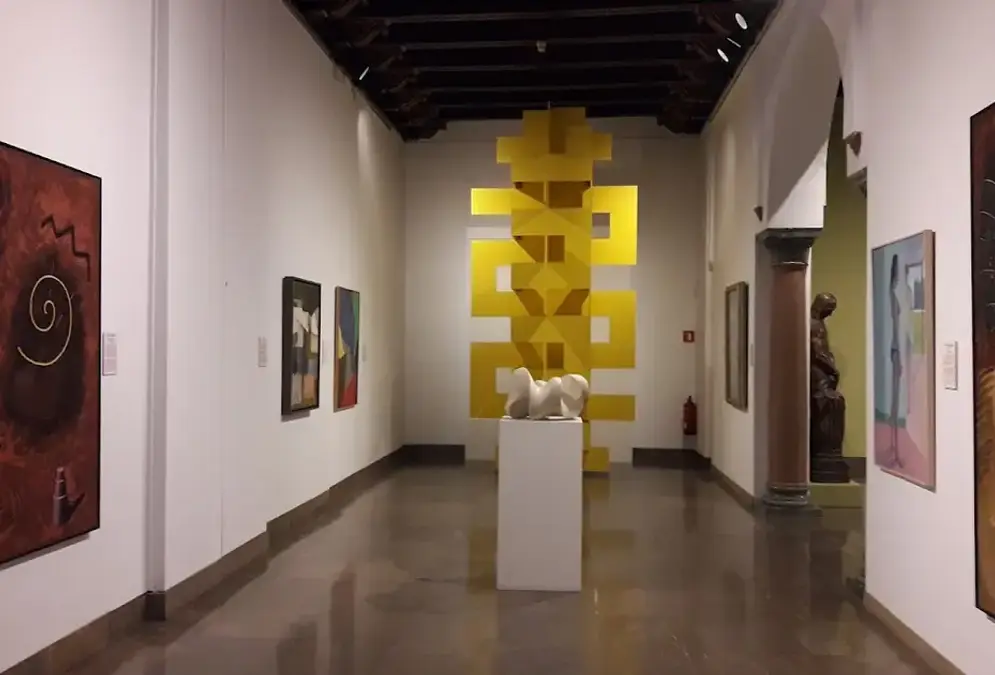
The collection continues into the 19th and 20th centuries with later Spanish painting and sculpture, tracing a line from the Baroque masters through to more modern work. The range gives the museum a real sense of Spanish art's trajectory rather than a single frozen moment — useful context before crossing the courtyard into the museum next door.
Visiting with the Julio Romero de Torres Museum
The museum shares its building and Plaza del Potro address with the Julio Romero de Torres Museum, dedicated to the Córdoba-born symbolist painter whose father directed the Fine Arts Museum a generation earlier. Visiting both in one trip is straightforward — they share the same complex. The Centro Flamenco Fosforito is also on the square. Combining all three takes half a day and covers genuinely distinct ground: religious Baroque painting, early 20th-century symbolism, and flamenco history.
Practical notes
Admission is free for EU citizens. The museum is closed on Mondays, and its opening hours shrink in summer: from 16 June to 15 September it opens Tuesday to Sunday, 9am to 3pm only, reverting to the longer Tuesday–Saturday 9am–9pm (Sunday 9am–3pm) schedule the rest of the year. The Roman Bridge and the Mezquita-Cathedral are both within fifteen minutes on foot.
For a complete overview of Córdoba's museum offer — from Roman archaeology to Andalusian palace collections — see the Museums of Córdoba guide.