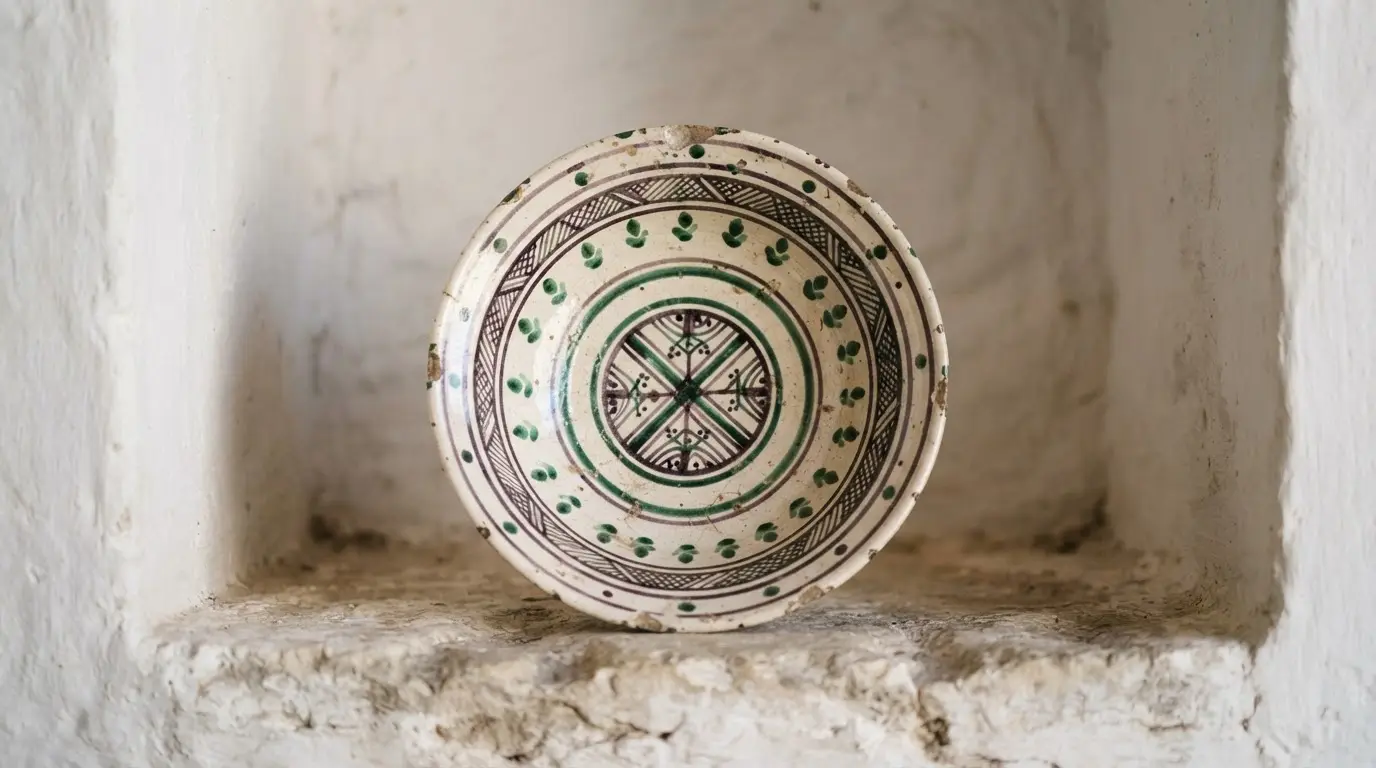

How a verde y manganeso plate was made
A verde y manganeso dish is defined by its surface, and the surface is built in layers that each do a different job. Reading them from the ground up explains why the ware looks the way it does, and why a potter in 10th-century Córdoba could not have shortcut any of the steps without losing the effect.
The white ground
The base layer is an opaque white glaze covering at least one face of the vessel, and on it the decoration is painted with copper oxide for green and manganese oxide for black-purple.[8] The whiteness comes from tin. Potters mixed a tin-and-lead calx with plant ashes, a mixture used in the late-Emirate workshops and the caliphal ones alike,[9] and the formula is described as an Abbasid-style recipe of tin oxide, lead oxide and soda ashes, though a clear link to Abbasid practice is hard to establish.[10]
Tin is what turns a clear lead glaze opaque. It gives the painter a surface to draw on instead of a transparent film over bare clay. The pigments do the rest: they sit on that pale ground and read as crisp lines, which is the whole visual trick of the ware.
Painting, then two firings
Glazed wares from Córdoba and Pechina were fired twice, a slower and more expensive route than a single firing, which already says something about who the dishes were made for.[11]
The painter's palette was deliberately small: green from copper, black-purple from manganese, both laid on white. Everything on the ware, from Kufic lettering to the stag on the Jerez bowl, is built from those two strokes.
Older than the caliphate, bigger than the court
The old story gave the ware to the caliphate. The better evidence gives a first, small-scale production to the late Emirate, growth under the caliphate and a peak around the middle of the 10th century.[12] Some scholars push the beginnings back further, to the mid-9th century and the glassware fashions associated with Ziryab, though that link is a proposal, not a settled fact.
Scale is what the caliphate supplied. Once Abd al-Rahman III had proclaimed it, output multiplied, and the workshops seem to have trimmed costs by putting more lead into the glaze and less tin, since lead is cheaper and tin had to be brought in from other parts of the peninsula.[13] A glaze that was once a luxury recipe became a production recipe, and the compromise is visible in the chemistry itself.
Prestige then did the rest. Closer or looser imitations of the official pieces were being made in other Andalusi cities as early as the 10th century.[14] The pattern is familiar from any luxury style: the court sets the look, and provincial potters copy what they can reproduce. A cheaper, lead-heavy glaze plausibly made that copying affordable, and it is one reason the ware stopped being a palace monopoly.
Córdoba or Madinat al-Zahra?
For a long time the open question was where this court-style ware was fired: at Madinat al-Zahra, where so much of it turns up, or in the workshops of Córdoba itself. Kiln debris is the evidence that settles such arguments, and the first workshop evidence for the caliphal polychrome ware has come from the Córdoba workshop area, which manufactured it during the Caliphate.[16]
The palace-city is not out of the picture. A stag bowl in the Archaeological Museum of Jerez is ascribed to the palatine workshops of Madinat al-Zahra on technique and style.[17] The designs there are more elegant and careful, in simple and floriate Kufic, than the plain Kufic of Córdoba's western suburbs.[18] The safest reading is a quality gradient inside one trade, a finer palace line and a plainer city line, with Córdoba's kilns the best-documented source and the question of a separate palatine workshop still open.
Explore nearby · Monument
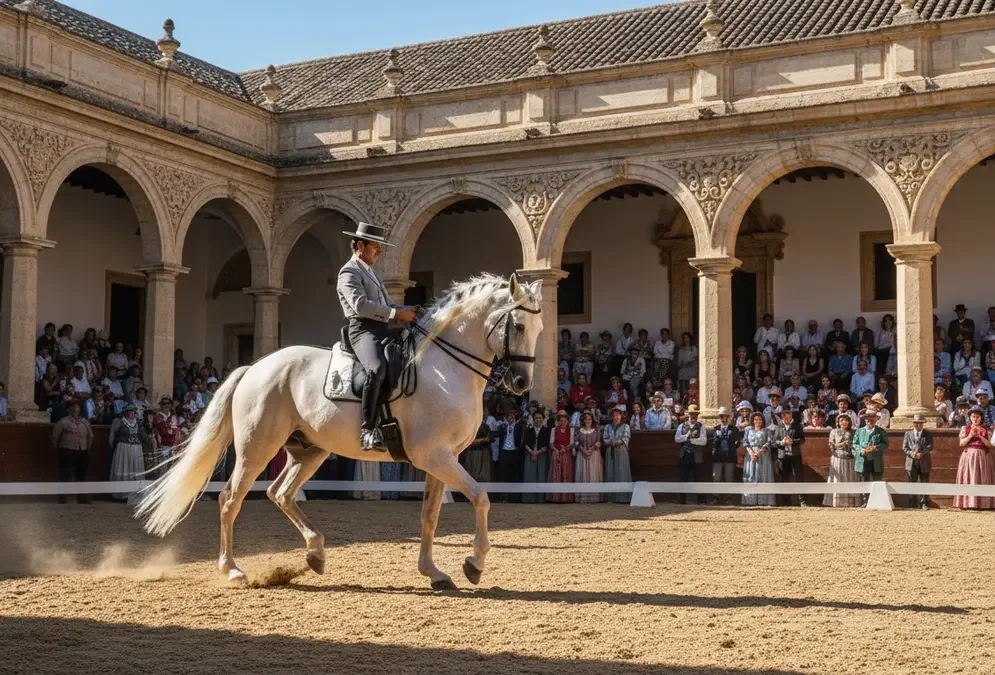
Caballerizas Reales de Córdoba
Philip II's 1568 Royal Stables, birthplace of the Andalusian horse. Evening show combining classical dressage, vaquera riding and flamenco. UNESCO heritage.
For a visitor the practical consequence is modest but real. A dish found in a city house and a dish found in the palace-city may come from the same kilns and the same recipe, and still differ in how carefully the lettering was drawn. The Jerez stag bowl is the palace-line piece to hold that comparison against. Judging a piece by the hand that painted it, and not only by where it was dug up, is how the argument is being worked out.
What it was for, and what it said
Reading the vessels tells you who used them, and the decoration tells you what the state wanted said at its table. The two questions pull in different directions: the shapes are everyday, while the lettering and colour are not.
Plates for sharing
Most of the ware is ataifores, large plates for communal eating, and the rest of the repertoire is small by comparison:[19]
- cups
- jugs
- pharmacy jars
- inkwells
- zoomorphic vessels
The same workshops could have supplied both high-quality wares for the palaces and cheaper products for domestic households,[20] a split that would explain how a court style ended up in ordinary homes. Among Córdoba's other caliphal crafts, this is the one that may have reached ordinary tables.
Power, white, green and black
Some pieces carry the word al-Mulk, "Power", an inscription with a clear legitimising purpose.[21] A dish with that script on it was a small piece of the state's self-presentation, the same project that the Alcázar of the caliphs expressed in stone.
The palette may carry the same message. One scholarly reading takes white as the colour of the Umayyad dynasty, green as the Prophet's, and black as the austerity of the Qur'an and the dignity of the caliphal throne.[22] Treat it as an interpretation rather than a documented intention.
Seeing the ware today
Madinat al-Zahra is the obvious place to meet it: the ware may make up about a tenth of the palace-city's whole ceramic record, and it became the most characteristic of the caliphate.[23] The site museum's permanent exhibition is laid out in four blocks, and verde y manganeso pieces appear among its illustrated objects.[24] The setting and the surviving halls are laid out in the Medina Azahara guide. Away from Córdoba, the clearest single piece is the stag bowl in the archaeological museum of Jerez, which the museum itself ascribes to the palace workshops.[25] The museum's school-visit guide also gives the ware a showcase of its own.[26] Seen next to a plain domestic dish, the stag bowl shows how much of the ware's character lies in a confident, economical line.
Excavation has uncovered potters' kilns in Córdoba itself: a workshop of three rectangular kilns at Ronda Oeste, and the older emiral potters' quarter at Zumbacón, which held more than 100 kilns.[27][28]
Deep dive · Article
An Andalusian Treasure Has Sat in the British Museum Since 1932
A silver hoard dug up in Córdoba in 1915 left Spain against the law and has been in the British Museum since 1932. Here is how, and what a 2026 study found.
Recommended tours
Tours are selected for quality, not commission. We earn a small fee if you book — at no extra cost to you.
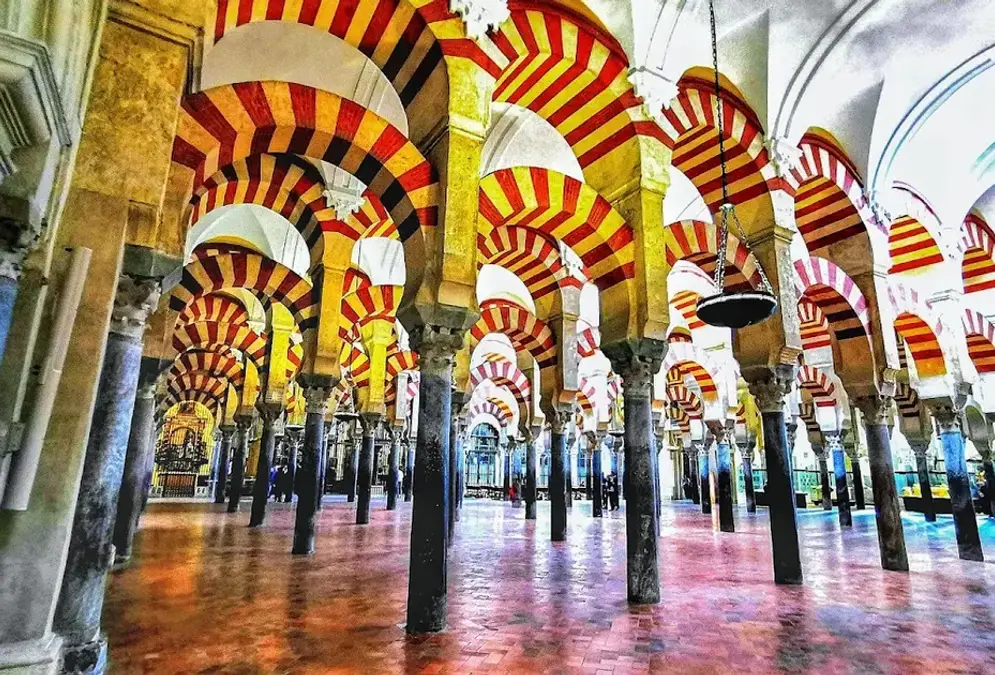
On any fragment, look at the white, the paint and the back. The white should be opaque and the paint green or black-purple, while the back, in the pieces studied, is a transparent honey or greenish lead glaze, since only the decorated face carries the tin.[29] A fragment that matches is a small, handleable piece of how the caliphate dressed its tables.