
Where the Alcázar of the Caliphs stood
Córdoba became the capital of al-Andalus in 717, when the governor al-Hurr moved it into what had been the Visigothic capital.[2] The building programme came later.
In 784, after a failed plot against him, Abd al-Rahman I moved his residence for good to the palace site in the city and rebuilt it as the new Alcázar.[3] A year later he began the Great Mosque next door.[4] The man behind both projects is the subject of our profile of Abd al-Rahman I, the fugitive who founded Córdoba.
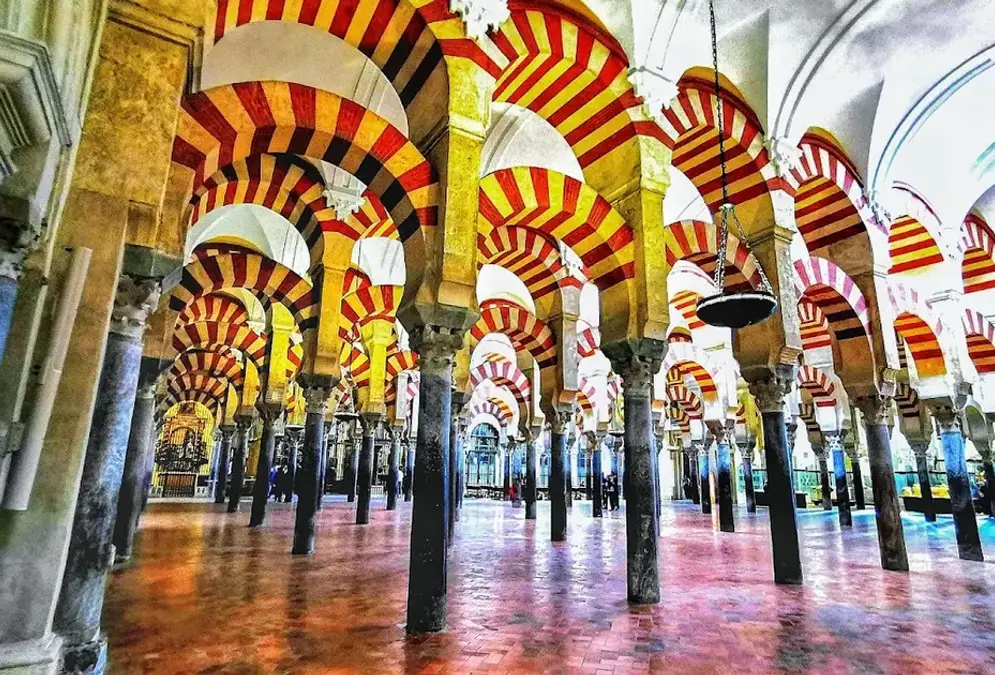
So the palace and the Mezquita-Catedral were conceived as neighbours, a ruler's house and a prayer hall built side by side within a year of each other. Everything the cathedral nave now dominates, the Alcázar once faced.
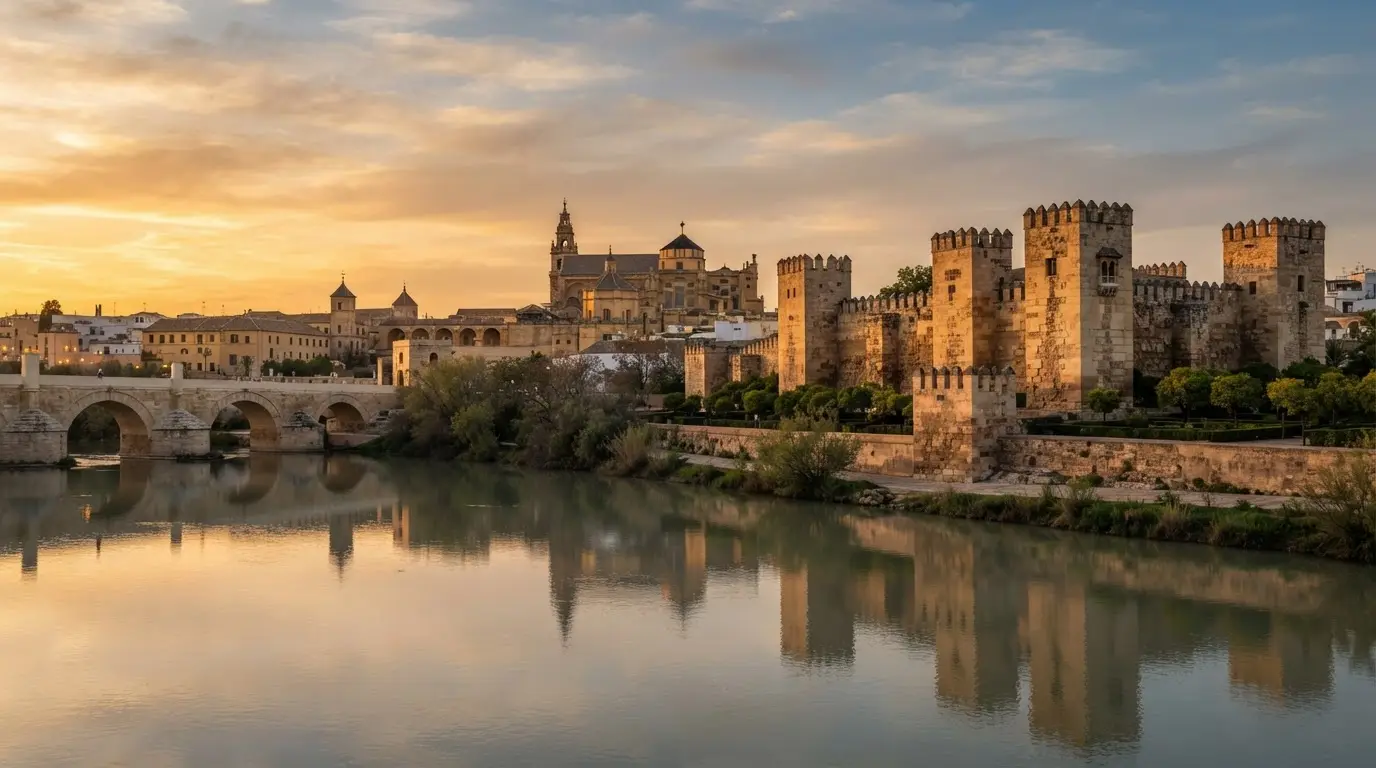
Look for the compound on a modern map and you will not find it labelled. Its ground lies under the Alcázar de los Reyes Cristianos, the Episcopal Palace, the Seminary of San Pelagio and the Campo Santo de los Mártires square, which covers the Caliphal Baths.[1] One walk touches all of them.
What happened inside the Alcázar
Calling it a palace undersells it. The site mixed the private residences of rulers and their households with government offices and administrative areas.[5] Think compound rather than castle: a court, a ministry district and a family home sharing walls.
The Dar al-Wuzara, the House of the Viziers, stood near a gate called Bab al-Sudda.[6] The gate fronted a public square where executions and military parades took place.[7] Ministers worked behind it; the state's punishments and its pageantry happened in front.
Bab al-Adil, the Gate of Justice, showed the other face of rule. Citizens presented petitions to the emir there, and he dispensed justice in return.[8] The name was literal, which is rarer in palace architecture than it sounds.
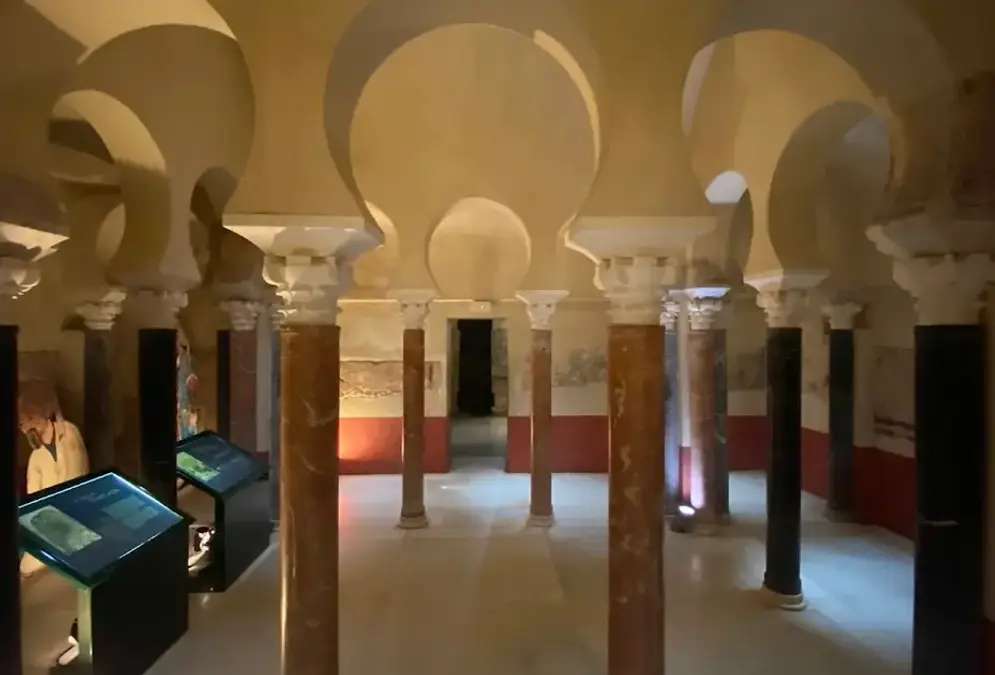
Explore nearby · Monument
Caliphal Baths (Baños del Alcázar Califal)
Underground 10th-century Islamic hammam beneath Córdoba's Campo Santo square, with star skylights, marble pillars and intact cold, warm and hot rooms.
The dynasty also stayed after death. The Rawda, the royal cemetery inside the compound, received emirs and caliphs from Abd al-Rahman I (d. 788) and Hisham I (d. 796) onward.[9] Residence, ministry, courtroom and tomb sat inside one enclosure.
Two palaces, one capital: Medina Azahara and the Alcázar
In 929 Abd al-Rahman III made Córdoba the headquarters of an independent caliphate.[10] A new palace-city rose a few kilometres to the west soon after, a story told in full in Medina Azahara and its thousand-year burial. The narrower question here is what happened to the old Alcázar.
ICOMOS, the body that evaluated Medina Azahara for UNESCO, is clear that the move was real: personnel and all organs and services of the caliphal administration were transferred there.[11] The tidy version, in which the caliphs kept governing from the Alcázar and used the new city as a stage set, does not survive that document.
The same evaluation rejects the opposite myth. Córdoba was not abandoned; Medina Azahara complemented it.[12] The old Alcázar kept its importance even after the seat of government moved.[13]
The sources behind this article draw no clean line between what each palace was for. Treat any guide that gives you a confident list with suspicion.
The two stories separate in 1009-1010, when Medina Azahara was laid waste in the civil war that ended the caliphate.[14] After that, only one of the two palaces was still standing, and it was the one beside the Mezquita.
How the Alcázar disappeared
Córdoba fell to Christian forces in 1236 and the Alcázar was divided like an estate. One part was donated to the bishop, and that part is today's Episcopal Palace.[15] Other parts went as spoils to nobles and to the Order of Calatrava.[16]
A compound split between a bishop, noble houses and a military order has no single owner, and so no single building to protect. Each new owner built for its own use.
In 1328 Alfonso XI of Castile began the present Alcázar de los Reyes Cristianos on part of the old fortress site.[17] His builders kept only part of the Moorish ruins.
Yet the fortress looks Islamic, because Alfonso used the Mudéjar style.[18] That is why visitors walk in and assume they are standing in the caliphs' house. They are standing in a Castilian royal fortress that borrowed the older vocabulary.
The ticketed Alcázar is not the caliphs' palace
A search for the caliphs' palace leads most visitors to the Alcázar de los Reyes Cristianos. That building is a 1328 Castilian fortress that kept only part of the Moorish ruins.[18] The caliphal traces are elsewhere, on the street and at the baths.
How to trace the Umayyad Alcázar on foot today
The caliphs did not cross the street like everyone else. A covered passage, the sabat, was raised over the street between palace and mosque and gave the ruler direct access to the maqsura.[21] Emir Abdallah built the first one for security, and al-Hakam II replaced it when he enlarged the mosque.[22]
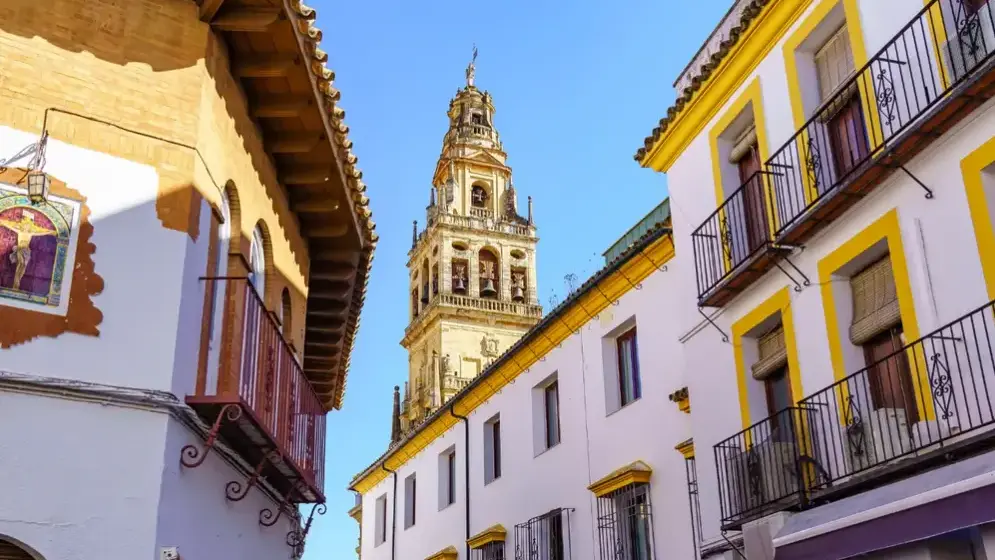
Start where it ended. On the Mezquita's west façade, almost at the corner with the north façade, a small door is still visible that gave access to the corridor behind the qibla wall.[23] Find it, then look back at the street the passage once spanned.
The footprint, in walking order
- Mezquita west façade, near the north corner: the small door tied to the sabat
- Episcopal Palace: the part of the Alcázar given to the bishop after 1236
- Seminary of San Pelagio: also on the old footprint
- Alcázar de los Reyes Cristianos: Alfonso XI's 1328 rebuild, not the caliphal palace
- Campo Santo de los Mártires: the square over the Caliphal Baths
From there the ground runs through the Episcopal Palace and the Seminary of San Pelagio to the Reyes Cristianos, then on to the Campo Santo de los Mártires, where the square covers the Caliphal Baths.[1] Those baths date from al-Hakam II's reign and were expanded under the Almohads.[24] They are the clearest room-scale survivor of the compound.
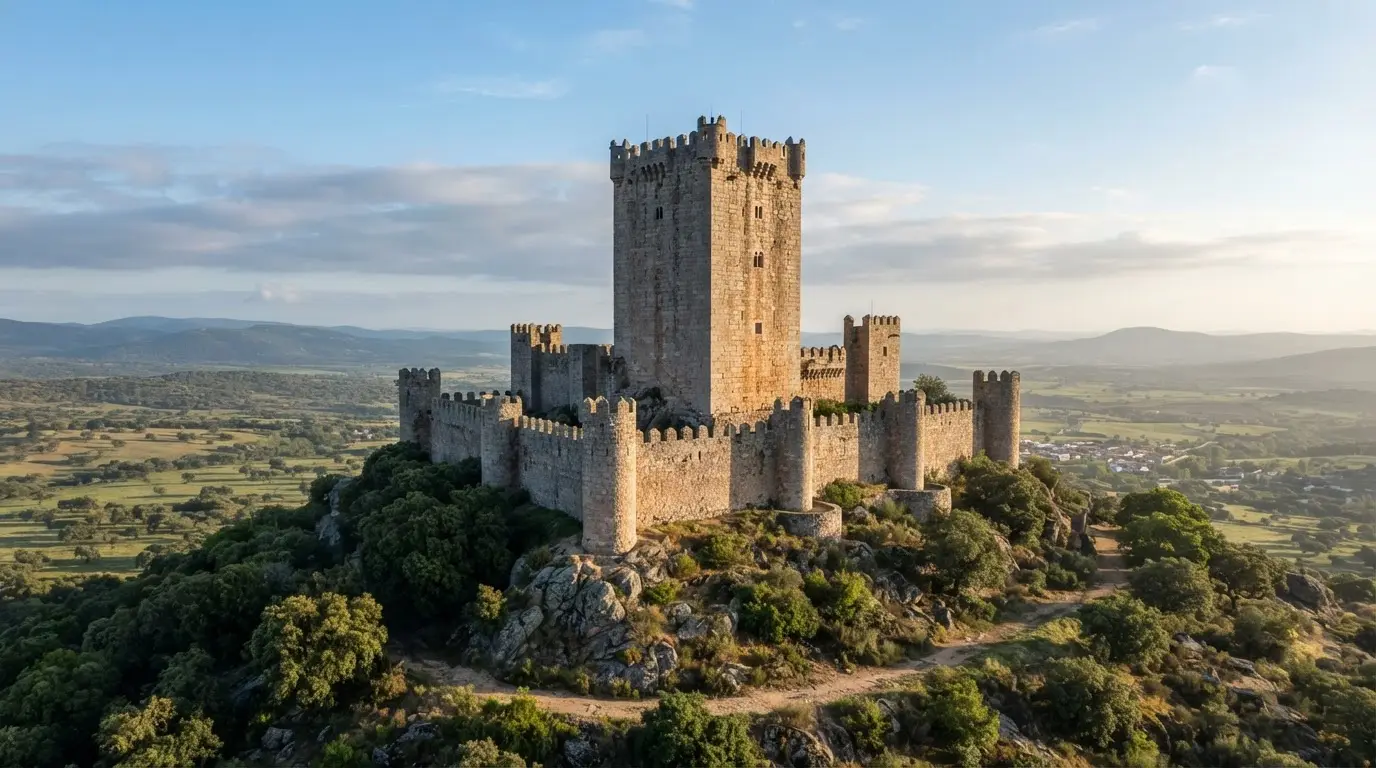
Deep dive · Article
47 Metres Tall and Almost Unknown: Spain's Tallest Keep
Belalcázar Castle's 47 m keep is listed by the Junta de Andalucía as Spain's tallest. How it grew, what to see inside and how to book the free guided visit.
Walk it in that order and you follow, in reverse, the way the ground changed hands: caliph, then bishop, then king. Check opening hours for the baths and the fortress on their own pages before you go.
Recommended tours
Tours are selected for quality, not commission. We earn a small fee if you book — at no extra cost to you.