
What is Cercadilla, and why is it called a palace
Cercadilla sits on the north-western edge of Córdoba's historic centre, in railway land that has been in industrial use since the nineteenth century. The first hint of what lay underneath surfaced in 1922, during routine work to expand the railway yard, when workers uncovered part of a vaulted underground gallery.[6] Nobody grasped what they had found at the time; the fragments went back into the ground, and the site stayed forgotten for decades.
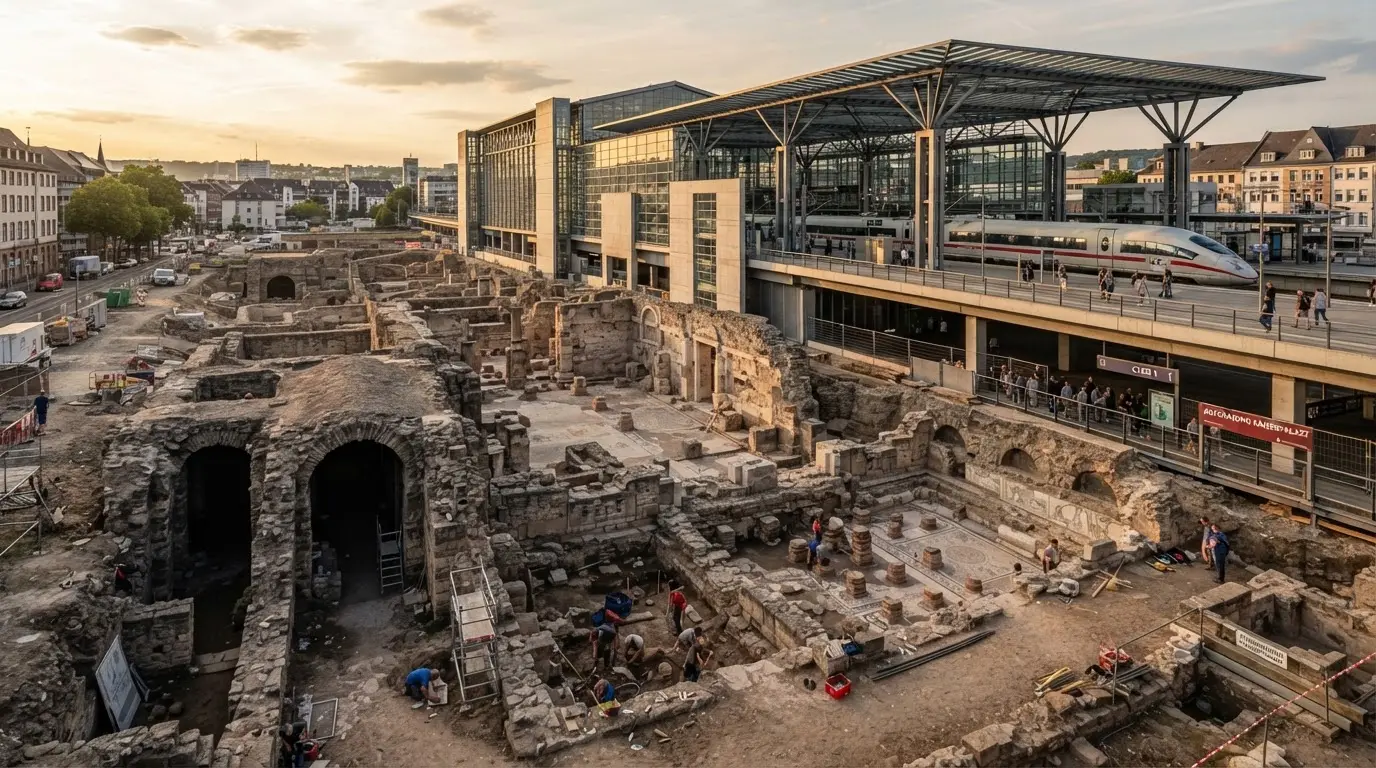
What emerged from the 1991 dig was a palatial complex of unique design, covering more than 80,000 square metres and ranking as Hispania's most significant building linked to imperial power in its day[2]. It was organised around a cryptoporticus, a semicircular underground vaulted gallery 150 metres long, with a barrel vault four metres high and four and a half metres wide.[7] A design that requires an entire palace complex to be organised around a single underground gallery is not something a builder improvises; it argues for resources and ambition well beyond a routine provincial commission.
Arranged around an artificial terrace built above that gallery, the complex included:[8]
- A great basilical hall
- A small thermal (bath) complex
- Two triclinia, or banquet halls
- Two smaller basilical halls
- Two polyabsidal halls
- A probable nymphaeum
- The imperial apartments
The Junta de Andalucía's own listing calls the building the only structure of its kind preserved anywhere in the territory once occupied by the Roman Empire, attributing it to the tetrarch emperor Maximian, said to have used it as his seat during a stay in Hispania in 296–297 AD.[9]
That framing matters, because so little Roman-era architecture in Córdoba survives above ground at all. Where the Roman Temple still stands as a fragment fused into the modern city centre, Cercadilla's galleries were never meant to be seen again once the tracks went in.
Was it really Maximian's palace
The date rests on solid epigraphic evidence. Baths within the complex yielded an inscription naming Constantius Chlorus and Galerius, the two junior Caesars appointed under the First Tetrarchy, which fixes construction to between 293 and 305 AD.[3] The Tetrarchy split imperial rule among four men, two senior emperors and two juniors, each answering for a different frontier; a residence of this scale at Córdoba, then a provincial capital rather than an imperial seat, says something about how much weight the western Mediterranean still carried at the end of the third century.
Whose residence it actually was is the harder question. Professor Ramón Corzo Sánchez and archaeologist Pedro Marfil argue the complex was never linked to Maximian at all, and was in fact commissioned by Bishop Ossius of Córdoba in honour of Saint Acisclus, the city's patron. Part of their case rests on construction technique: the building was laid out using an 80 cm measuring unit, one associated with Christian architecture of the period rather than imperial building projects.[4] Reading the stone rather than the guidebook is what leads to the disagreement in the first place — measurements, not myths, are what separate the two camps.
Explore nearby · Monument
Palacio de la Merced
18th-century baroque palace in Córdoba: former convent with gilded altarpieces, elegant patios and Zurbarán paintings. Free entry on weekday mornings.
The two readings may not be as far apart as they look. Whatever the complex was originally built as, it changed function fast: within a few years of Maximian's fall, the site appears to have passed into Christian religious use, a transition the archaeology traces in some detail. For a visitor today, the honest answer to "who built Cercadilla" is that no single answer has consensus; the tourist information may say Maximian, but the case for a bishop's monument to a martyred saint is taken seriously by working archaeologists, not dismissed as a fringe theory.
Three days that erased a palace
Archaeologists had barely begun when construction caught up with them. Two campaigns of rescue excavation ran between May and August 1991, and then again from December 1991 to May 1992, racing to document a floor plan and an occupation history reaching back to the first century BCE before the machines arrived.[10]
The first race was lost quickly. Once crews moved onto the site to build Córdoba's new high-speed rail station on 20 May 1991, it took just three days for machinery to destroy almost everything that had been preserved in the area known as the playa de vías, the trackbed zone.[1] What actually stopped the bulldozers was a criminal complaint filed with the police, not any change in official policy.
The archaeologists on site did not wait for permission to act. Camino Fuertes, who would later become the site's director, and her colleagues took turns standing watch over the remains at night, afraid the machines would move back in once nobody was looking.[11] Whatever they salvaged in those eight months of fieldwork turned out to be most of what any future visitor would ever get to see.
A year of negotiation, then the machines came back
For about a year after the police complaint, the site sat in limbo while the Ministry of Public Works, the Junta de Andalucía's culture department, Córdoba's city council and the state rail operator RENFE argued over what to do with it. The urgency was not really about archaeology: Spain's first high-speed line was being built against the clock, ahead of Seville's Expo '92, and Cercadilla's ruins sat in exactly the wrong place to slow it down. Every technical report on record recommended against continuing to build over the site regardless. The decision that ended the argument was political rather than technical: construction resumed on 20 May 1992, in a zone that, according to one detailed academic account of the site, affected around 60% of the Roman palace's surface area.[12]
The second demolition was as fast as the first. Between 20 and 22 May 1992, crews cleared a strip 500 metres long and 200 metres wide, cutting through more than three metres of archaeological stratigraphy — layers running from the Roman period up through the Islamic city.[5]
Part of what made the resumed works possible was a fog of false claims. Camino Fuertes later counted at least five pieces of misinformation that circulated at the time:[13]
- The high-speed line would skip Córdoba altogether because of the ruins
- The site amounted to nothing more than "four stones"
- The archaeologists were personally profiting from the dig
- The remains would be built around rather than destroyed
- The rail alignment itself would have to change
The story travelled well beyond Spain. The Times reported that Spain was about to demolish something on the scale of Buckingham Palace, a comparison Córdoba-based archaeologist Ana Zamorano would later recall with some bitterness.[14] The same rail line that ended the argument over Cercadilla would, within a few years, reshape how budget high-speed rail changed who visits Córdoba — a transformation nobody arguing over the ruins in 1992 could have anticipated.
“The destruction of the Roman building was "a brutal attack on the historical heritage and an oversimplified looting."[15]”
From imperial hall to church and cemetery
Maximian's own claim on the building did not last long. He was forced to abdicate in 305 AD, and the complex appears to have passed into Christian religious use with unusual speed.[16] Archaeological evidence points to the northern triconch hall functioning as the Church of San Acisclo, dedicated to Córdoba's most important local martyr cult of late antiquity.[17]
A Christian necropolis grew up around the basilica and stayed in continuous use for centuries. Among the burials recovered is the tombstone of Bishop Lampadius, who served the diocese for seventeen years and five months before his death on 19 September 549.[18] None of that continuity is visible to a casual visitor today, but it is the reason archaeologists describe Cercadilla as a palimpsest as much as a palace.
Deep dive · Article
Averroes: Córdoba's Philosopher Who Saved Aristotle
Born in Córdoba in 1126, Averroes wrote the commentaries that returned Aristotle to Christian Europe. Thomas Aquinas read him. Paris called him the Commentator.
A 2007 study by the site's own excavation director added further layers to that picture: late-antique burials, an Emirate-era bathhouse, an aqueduct and Caliphal-period fountains, all sharing the same patch of ground the Romans had first built on.[19]
What's left, and can you visit it today
Not everything at Cercadilla was destroyed outright. Before the 1992 works resumed, conservators extracted a large water cistern (33 metres long and 3.6 metres wide) from the palace's service quarters and relocated it to the gardens of the Paseo de Córdoba, where it still stands today.[20]
2 of 8 ha
The excavated section of the site, a little over two hectares of the original eight, opened to the public between 2004 and 2015. It has been closed ever since, with no announced plan to reopen it.[21]
Before you go
Cercadilla is currently closed to visitors, with no confirmed reopening date. Check the Junta de Andalucía's cultural agenda before planning a stop here — the excavated remains are not accessible without notice.[22]
The Junta de Andalucía's own cultural agenda still lists Cercadilla as currently closed to the public, with admission free whenever it does reopen.[22] Whatever formal heritage protection covers the site today, it has not translated into a euro of maintenance budget or a fixed reopening date. For now, the Roman Bridge and the city's other Roman-era monuments remain the more reliable way to see what survives of Roman Córdoba above ground.
Recommended tours
Tours are selected for quality, not commission. We earn a small fee if you book — at no extra cost to you.