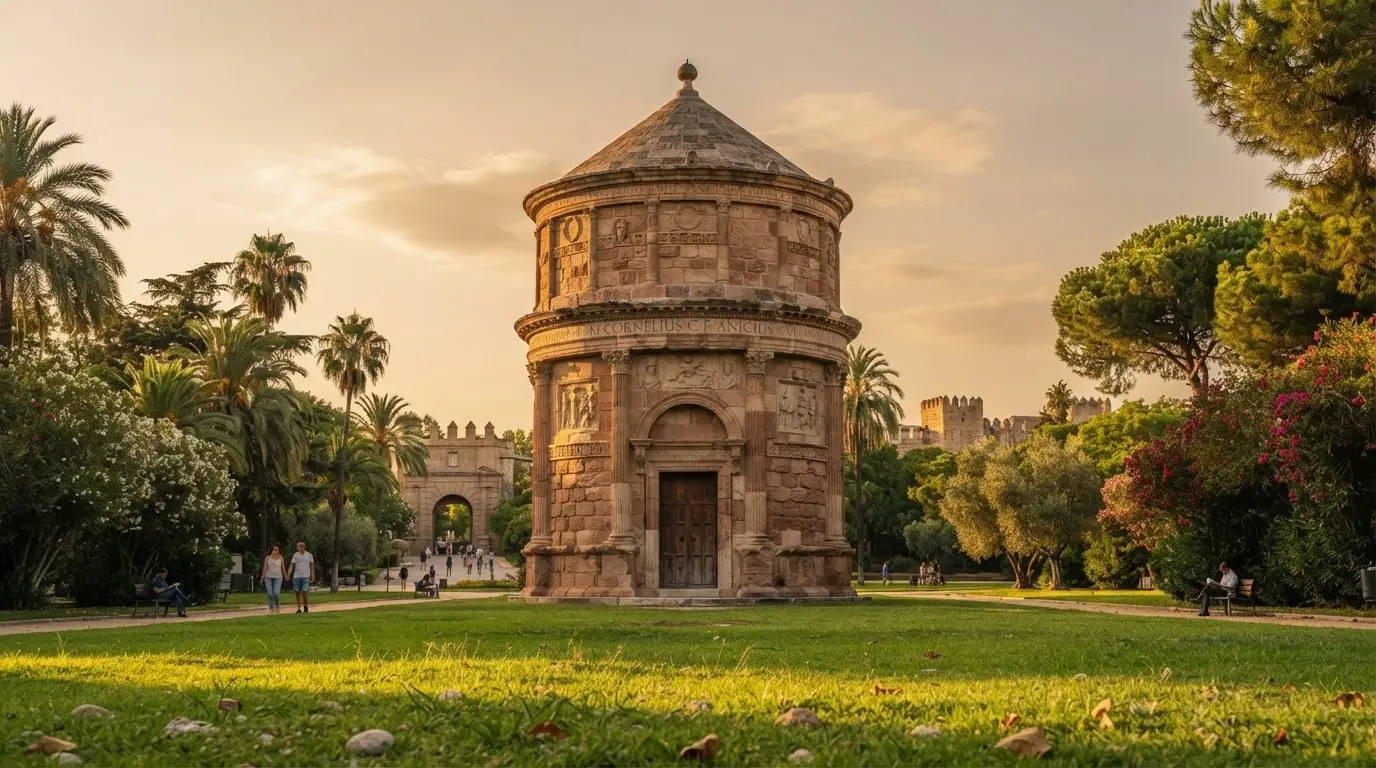

Two Tombs in a City Park
The Jardines de la Victoria run along the western edge of Córdoba's old town, a public park most visitors cross on the walk between the train station and the historic centre. Two low, drum-shaped structures sit near its southern end, easy to mistake for landscaping or an oversized flower bed.
They are, in fact, two Roman mausoleums, built in the 1st century AD on opposite sides of the road that once carried travellers out of the city toward Hispalis, modern Seville — the Via Augusta, one of the great arteries of Roman Hispania.[1] Each tomb is a cylindrical monument 13 metres in diameter, a scale and shape more commonly associated with imperial mausoleums in Rome and Italy than with a tomb on the edge of a provincial capital in Baetica.[3]
The site sits at what was once the Puerta Gallegos, the western gate through which the Via Augusta left Colonia Patricia Corduba, the Roman city that predates modern Córdoba.[7] Whatever stood at street level here in the 1st century has long since gone, but the ground itself never moved: the mausoleums survive in situ, on the same patch of the Jardines de la Victoria where a Roman family first built them.[9]
That continuity is unusual. Most of Roman Córdoba survives only as fragments in museum cases or foundations glimpsed during construction work. Here, for once, the monument still occupies its original footprint, a rare instance of Roman Córdoba standing exactly where it was built rather than reassembled from pieces or reconstructed from a description.
Rome's Law of the Dead: Why the Tombs Stand Outside the Walls
Building tombs beside a road just outside a city gate was not a matter of available land. It followed a rule that governed almost every Roman settlement across the empire: the dead were kept outside the city, and their monuments lined the roads leading away from it, where the living would pass them on the way in and out.[6]
Colonia Patricia Corduba, the Roman colony that grew into modern Córdoba, followed the same pattern as Rome itself. Funerary monuments belonged to the roadside necropolis belt ringing the walled city, never inside it. The Puerta Gallegos mausoleums mark one edge of that belt, built at the point where the Via Augusta crossed from the walled city into open country toward Hispalis.[7]
Explore nearby · Monument
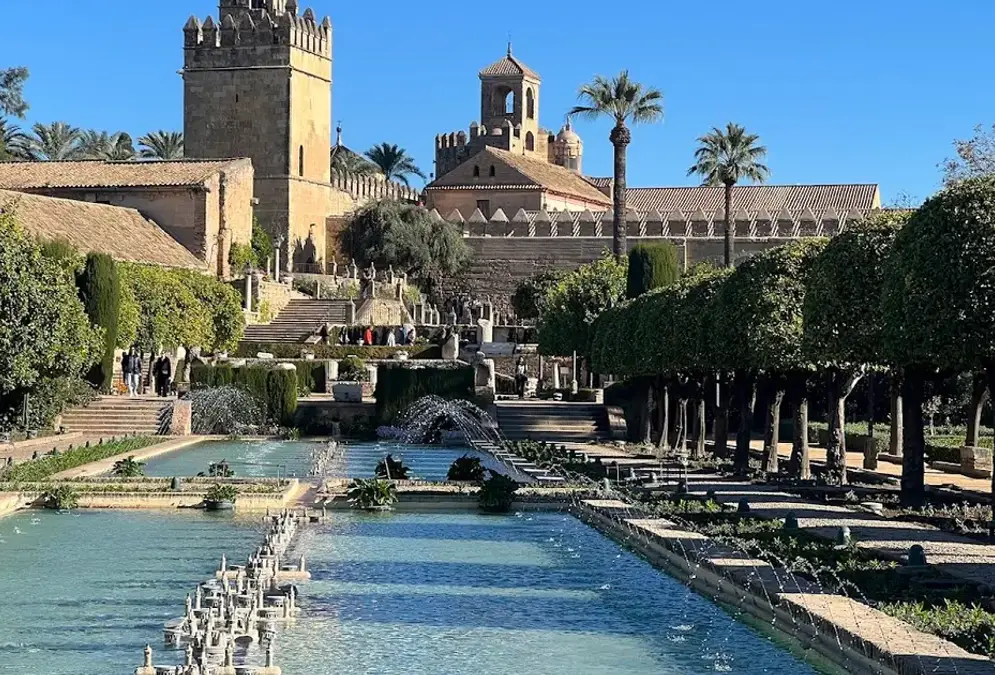
Alcázar de los Reyes Cristianos
Alcázar de los Reyes Cristianos, Córdoba: free entry on Tuesdays. A 14th-century fortress-palace with terraced Moorish-inspired gardens and Roman mosaics.
What makes the Puerta Gallegos tombs unusual is not their location but their design. A cylindrical mausoleum on this scale has no close parallel elsewhere on the Iberian Peninsula; the closest comparisons come from the mausoleums of the imperial family and Rome's own elite, built in the capital and across Italy.[5] That gap between a provincial tomb and an imperial-capital design has led some archaeologists to suggest an Italic architect designed the monument: someone trained on the mausoleum forms circulating in Rome, brought in for a single commission in Baetica.[5] Whether that architect travelled from Italy or worked from pattern books, the design choice tells you the family behind it wanted their tomb to look like Rome, not like Corduba.
The Roman Bridge that once carried the Via Augusta across the Guadalquivir on the opposite side of the city shows the same road system at work: public infrastructure and private monuments both organised around the routes that connected Corduba to the rest of Hispania.
A Patrician's Tomb and His Family's Columbarium
Dating the mausoleums comes from their construction rather than from any inscription naming who lies inside. Both tombs were raised during the reign of the emperor Tiberius (14–37 AD), within the first decades of the Roman Empire's shift from Republic to dynastic rule.[2]
The two structures did not share a function. The North Mausoleum held the tomb of a single, unidentified patrician — someone wealthy enough to commission an imperial-scale monument, but whose name has not survived in any record tied to the site. The South Mausoleum, by contrast, functioned as a columbarium: a shared tomb built to hold the ashes of that patrician's ancestors and extended family, generation after generation, rather than a single burial.[2]
Nothing about the design was accidental. A cylindrical drum 13 metres across, in a paired arrangement flanking the city's main approach road, was the kind of monument only an established, land-owning family could commission, built by a family that wanted every traveller entering or leaving Corduba on the Via Augusta to see it.[8] Colonia Patricia's wealthiest households built the same message into their private houses: the Roman houses of Colonia Patricia that once stood inside the walls used the same materials and the same impulse toward architectural display that shaped this pair of tombs outside them.
Who exactly the family was remains unknown. No inscription naming them has been recovered, and the fuller excavation reports that might identify them more precisely are not available online. What survives is the tomb itself, the clearest evidence Córdoba has of how one Roman family chose to be remembered for the rest of imperial history.
Buried by Time, Found by Accident: The 1993 Discovery
For most of the twentieth century, nobody knew the mausoleums were there. Whatever remained above ground had long since been buried under the modern park, and nothing about the Jardines de la Victoria signalled that a Roman necropolis lay beneath the grass.
That changed in 1993, when archaeological test excavations — the kind of routine survey work that precedes construction and landscaping projects across Córdoba's historic core, uncovered the remains of both structures.[4] What came out of the ground was not a single wall or foundation trench but two substantial cylindrical bases, enough surviving fabric to reconstruct the North Mausoleum's original form with confidence, and roughly half of the South Mausoleum's circular plan.[12]
Once the excavation confirmed what had been found, the mausoleums were rebuilt following their original patterns: a reconstruction that restored the North Mausoleum to its complete circular drum and rebuilt half of the South Mausoleum's circular plan, the remainder marked by a viewing platform, rather than leaving either as a low, illegible foundation.[12] That decision is why a visitor today can read the shape of a Roman mausoleum at a glance, rather than squinting at a low masonry outline the way you have to at many Roman sites in Spain.
Deep dive · Article
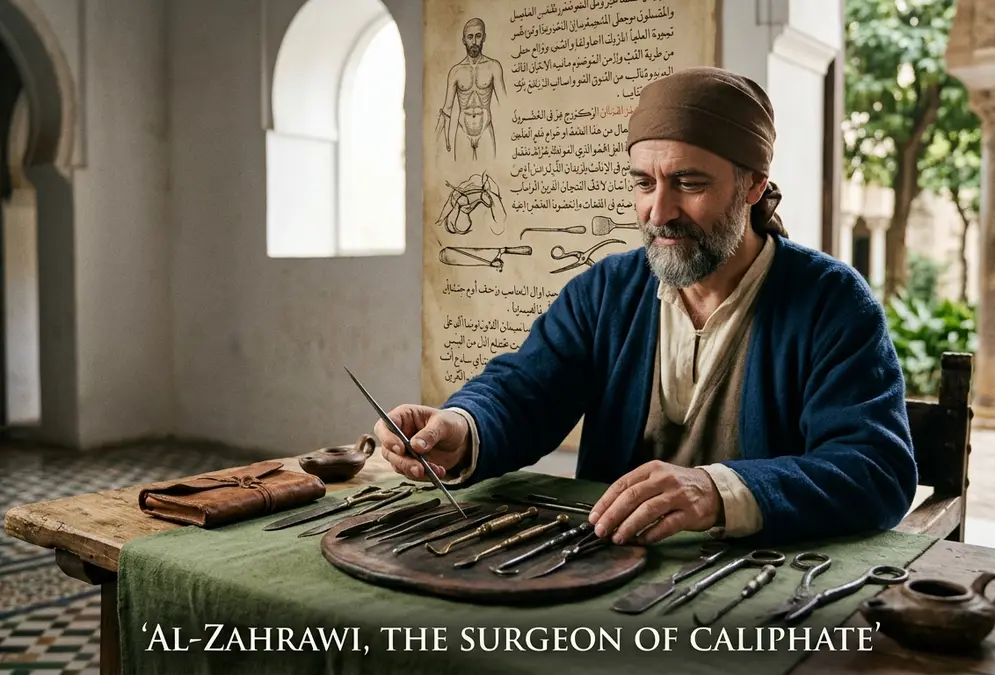
Al-Zahrawi Córdoba: the surgeon who invented the scalpel
Al-Zahrawi, the father of modern surgery, was born near Córdoba in 936 CE. He invented the scalpel and catgut sutures, and shaped surgery for 500 years.
The 1993 find sits alongside a handful of other accidental Roman discoveries that have reshaped how Córdoba understands its own Roman core. The Roman Temple found under City Hall in 1951 is the best-known example, a discovery that likewise turned a construction project into an archaeological one overnight. Córdoba's Roman layer keeps surfacing this way: not through a planned excavation campaign, but through routine digging that happens to hit something nobody expected to still be there.
Visiting the Mausoleums Today: Guided Tours and the Interpretation Center
Access changed recently, and not by much. For most of their post-1993 history the mausoleums sat in the Jardines de la Victoria as visible but unexplained park furniture: no signage worth stopping for, no way to get closer than the path. That ended on 1 September 2024, when guided visits began under a contract between Córdoba's tourism delegation and the private operator Eventour Andalucía Incoming.[10]
The guided route runs through a purpose-built Interpretation Center of the Funerary World, installed inside the mausoleum structures themselves. The visit covers:[11]
- A general introduction to Córdoba's importance as a Roman city
- The role of the city's most prominent Roman-era residents
- The main Roman remains still visible across the capital
- The funerary rites and customs of the period
Recommended tours
Tours are selected for quality, not commission. We earn a small fee if you book — at no extra cost to you.
That last point is the one that makes the visit worth the detour if you have already seen Córdoba's better-known Roman sites. The Roman Temple and the Archaeological Museum cover public and civic Roman life in detail; the Puerta Gallegos mausoleums are the one place in the city built specifically to explain how Corduba's Roman residents thought about death, burial, and being remembered.
Check the current schedule and reservation process before planning a visit, since tour operators and time slots for a site this recently opened are the details most likely to change year to year. The mausoleums sit inside the Jardines de la Victoria itself, an easy stop if you are already walking between the train station and the old town.